Agentic Marketing vs. Marketing Automation: A Decision Framework, Not a Rivalry
Every vendor page selling "agentic marketing" tells you to move everything toward agents. Almost none tell you what should stay exactly where it is. That's the gap this post fills. It's a practitioner-sourced framework for deciding, workflow by workflow, which one you actually need.
The framework below comes from a working practitioner thread, not vendor copy. The people quoted are running real automation and agent stacks. None of them are selling either one. We build both layers ourselves inside SketricGen's own template library, so the framework below reflects what actually held up in production, not just what a comparison chart implies.
Who this is for
- You're a marketing or ops lead at a 5-50 person B2B company already running some automation (email sequences, lead routing, ad rules). A vendor is pitching you "agentic marketing" without explaining what actually changes operationally.
- This isn't a beginner primer. It assumes you already know what your automation stack does. You want a clear-eyed way to decide what to hand to an agent versus what to leave as a trigger-based rule.
Key Points
- Agentic marketing and marketing automation aren't rivals. Most teams run both at once, layered, not swapped.
- The real dividing line is judgment versus determinism, not "AI" versus "no AI." If you can write the logic as an if/then without hedging, it doesn't need an agent.
- Three questions decide which one a workflow needs: does it require judgment on ambiguous input, is the action irreversible or spend-bearing, and is it high-volume/low-variance or exception-heavy.
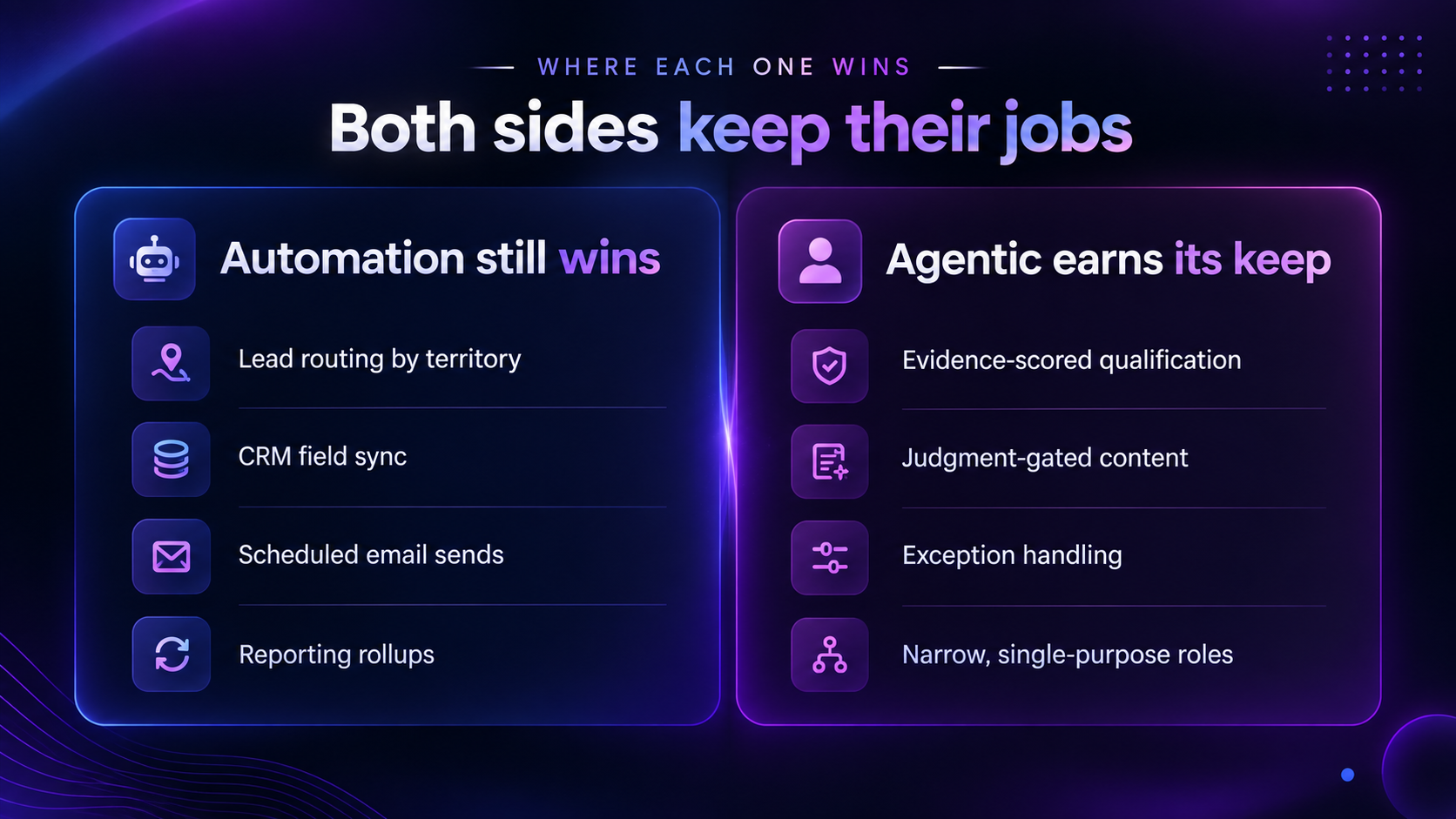
- Classic automation still wins for most current marketing workflows: lead routing, field updates, scheduled sends, CRM sync. Bolting an agent onto a deterministic trigger adds inaccuracy for no benefit.
- Agentic marketing earns its place in narrow, single-purpose roles: evidence-scored lead qualification, judgment-gated content decisions, exception handling. Not "one AI runs marketing."
- The most common mistake practitioners report: calling a rebranded trigger "agentic" without adding any judgment step, which erodes trust fast.
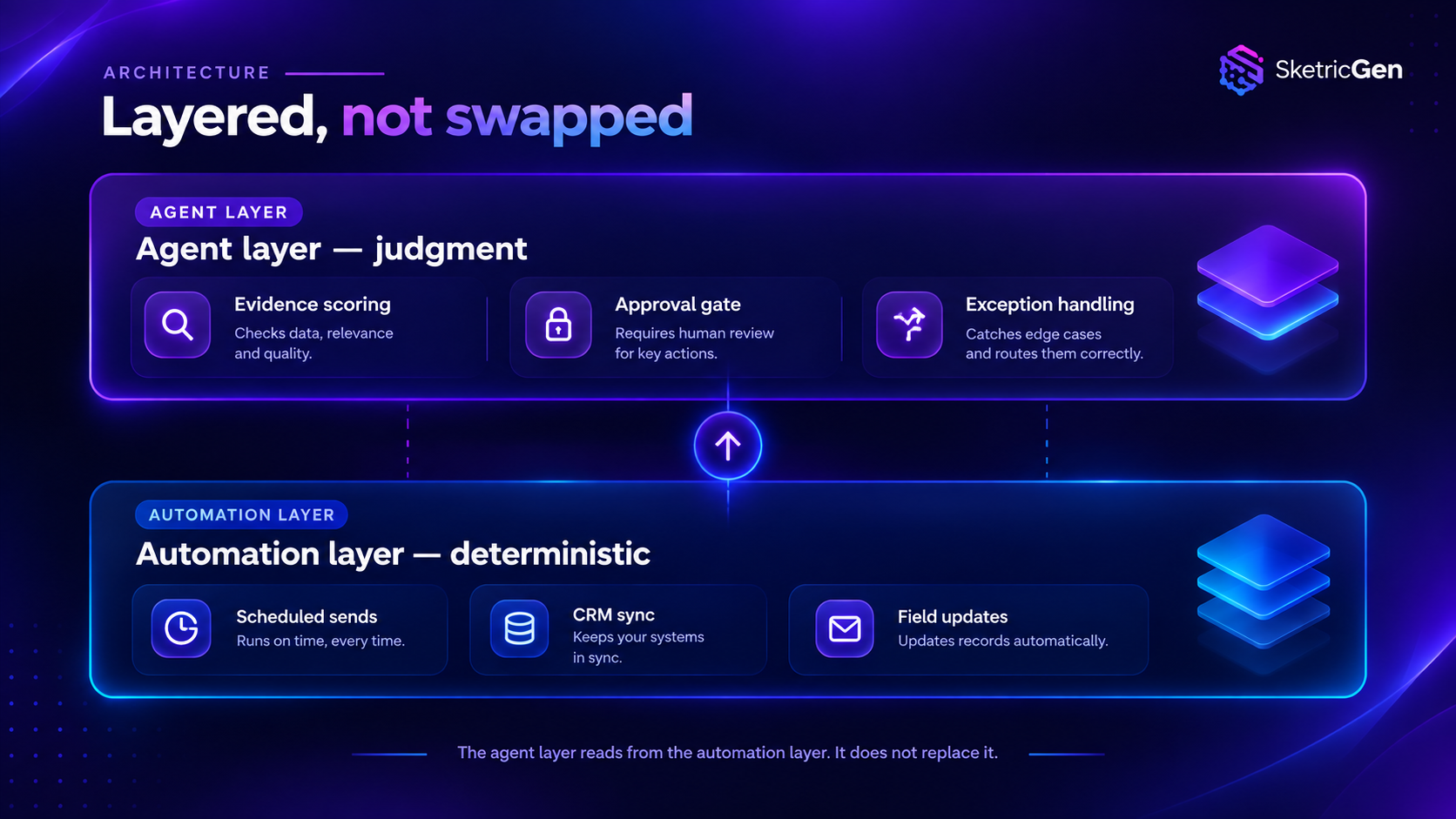
- SketricGen runs this exact model across its own template library: automation for the deterministic layer, agents for the judgment layer. More on that in Next steps below.
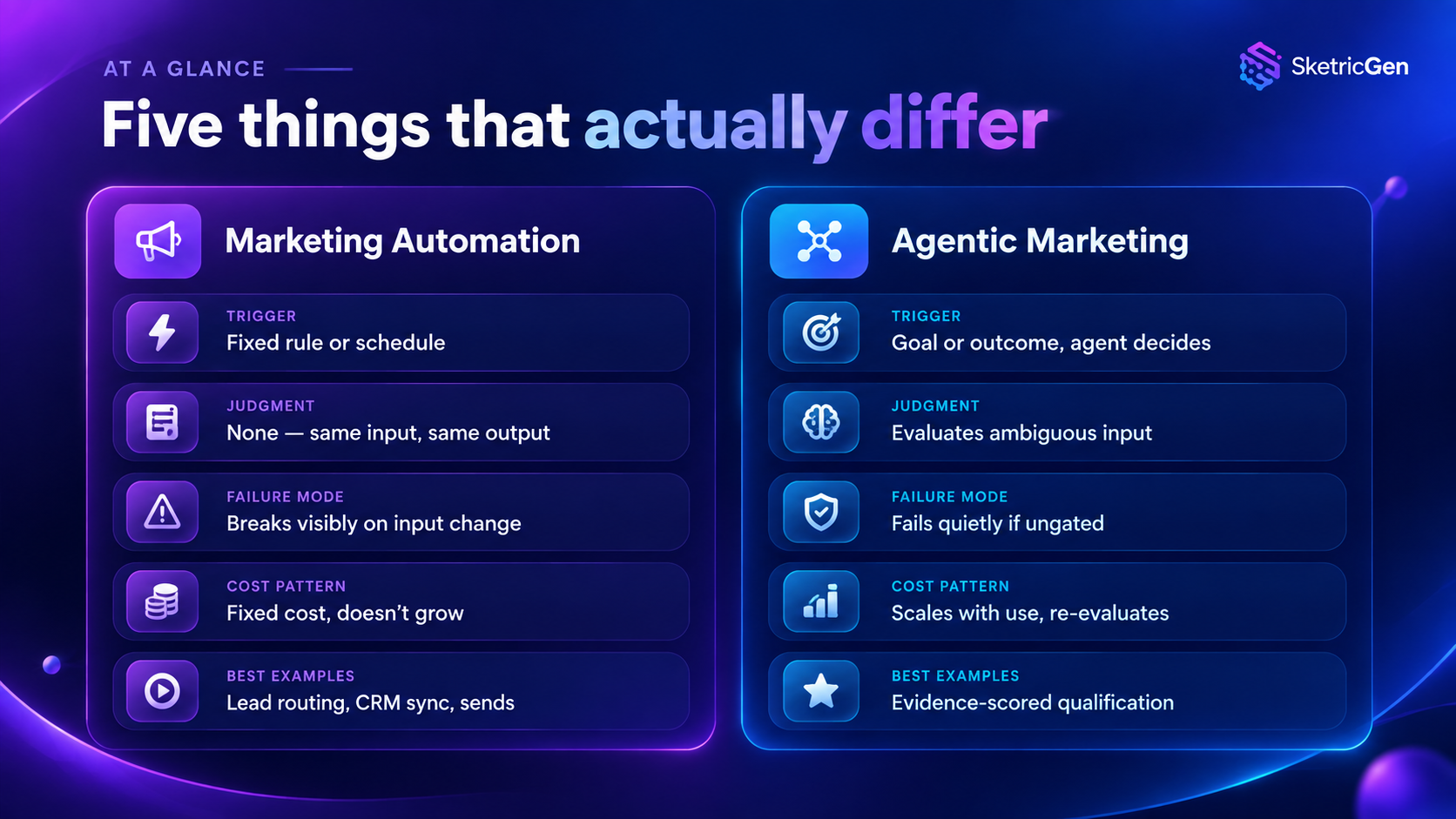
At-a-glance: automation vs. agentic marketing
| Dimension | Marketing Automation | Agentic Marketing |
|---|---|---|
| Trigger | Fixed rule or schedule (if-this-then-that) | Goal or outcome, agent decides the path |
| Judgment involved | None. Same input always produces the same output | Evaluates ambiguous input and chooses among options |
| Failure mode | Breaks visibly when an input changes shape (a field moves, a value is missing) | Fails quietly by making a plausible but wrong call, unless gated |
| Cost pattern | Cheap once built; a fixed cost that doesn't grow with volume | Re-evaluates on every run; token cost and review overhead scale with use |
| Best examples | Lead routing, field sync, scheduled sends, CRM updates | Evidence-scored lead qualification, exception handling, narrow content agents |
What "agentic marketing" actually changes
Agentic marketing isn't automation with a smarter label. Automation runs a fixed path: same input, same output, every time. That's exactly what makes it reliable for structured work. An agent instead works toward a goal. It gathers context and chooses among options when the path isn't already known.
The clearest way to see the difference: automation is a fixed rule executing on a trigger. An agent evaluates ambiguous input and decides what to do next, inside guardrails you set. That's the whole shift, not "AI-powered" versus "not AI-powered." Plenty of automation already uses AI for classification or scoring without becoming agentic. And plenty of "agentic" tools are just triggers with an AI label bolted on. For a deeper look at how these platforms are built under the hood, see our breakdown of what an AI workflow builder actually does.
The three questions that decide which one you need
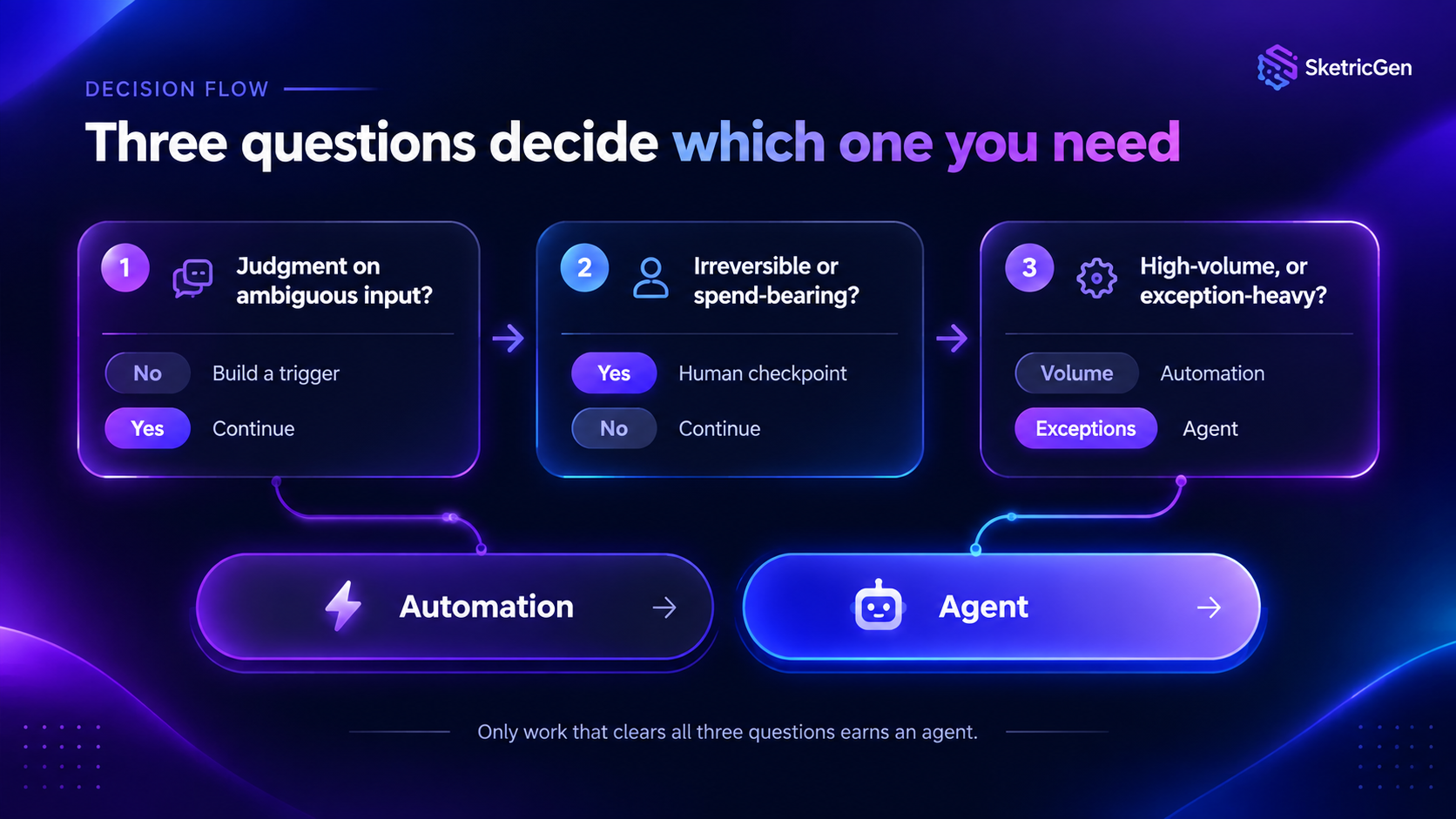
Skip the vendor framing. Ask these three questions about the specific workflow in front of you, not your stack as a whole.
Does this step require judgment on ambiguous input, or is the path already known?
If you can write the logic as a clean if/then without hedging, it's a workflow, not a job for an agent. SeriousHat4465 put it directly in a long r/automation thread comparing agents to automation: "If you can write the logic as an if/then without hedging, use a workflow. If the step requires judgment about ambiguous inputs, use an agent." That single line does more work than most vendor comparison pages combined.
Is the action irreversible, or does it spend money or reach a customer?
This is where the honest gating happens. OpsPacket frames agents and automation as two different failure modes, not a better-and-worse pair. Automation handles structured, auditable work. Agents handle fuzzy decisions that are cheap to recover from if wrong. In the same thread, Basit-Mirza offers a simple "reads vs writes" heuristic: let the agent act freely on reads, and route anything that writes through the normal, reviewed workflow. South_Hat6094 draws the line specifically at irreversible decisions: money, customer-facing messaging, and permission changes. Those should stay behind a human checkpoint, he argues, regardless of how good the agent's proposal looks.
Is this high-volume and low-variance, or exception-heavy?
High-volume, low-variance work (lead routing by territory, scheduled email sends, CRM field updates) is exactly what automation was built for. It's cheap once built and doesn't drift. Exception-heavy work, where every fifth case needs a different call, is where an agent's judgment starts paying for itself instead of just adding overhead.
Decision rule: If the step is a clean if/then and nothing gets spent or sent irreversibly, keep it on a trigger. If it needs judgment on ambiguous input and stays inside a reviewed guardrail before anything irreversible happens, give it to an agent. When in doubt, keep it a trigger and revisit once you can name the specific judgment call it's missing.
Where classic automation still wins
This is the section most vendor pages skip, because it doesn't sell more agent seats. Most of what a marketing team runs day to day is still correctly automated, and it should stay that way.
Lead routing by territory or score, CRM field sync, scheduled email sends, and campaign reporting rollups are deterministic end to end. There's no ambiguous input to judge and nothing that benefits from an agent re-deciding the path each time. Korvacs summed it up bluntly: "If the automation is deterministic end to end, then you don't really want to offload that to a non-deterministic tool. You would simply be introducing inaccuracies for no benefit." That's not a knock on agents, it's a matter of matching the tool to the workflow's actual shape.
There's also a cost argument most comparisons leave out. joshuahasideas points out that agents re-decide on every run. That means ongoing token cost and, in practice, someone babysitting the output to make sure it hasn't quietly drifted off course. Fixed workflows are cheap once built and don't drift over time. Keep the steps that are already known fixed. Reserve the agent budget, both money and attention, for the steps that actually leave the system or touch a customer.
If your team already runs Zapier, Make, or n8n for this layer, that's not a legacy problem to solve. It's the correct architecture for deterministic work. For teams evaluating where that platform layer is headed next, see our comparisons of Make alternatives for AI workflow automation and Zapier alternatives built for AI-era automation, and our broader look at why businesses are moving to AI workflow platforms in the first place.
Mistake I made: Early on, I pushed a lead-routing rule, a straight if-territory-then-owner assignment, onto an agent because "agentic" sounded like the upgrade path. It added latency, occasionally misrouted a lead when it "interpreted" an edge case a plain rule would have handled the same way every time, and cost more per run than the trigger it replaced. I moved it back to a rule inside a day. The lesson: agentic isn't an upgrade to a workflow that was never ambiguous in the first place.
Where agentic marketing earns its keep
Agentic marketing earns its place in narrow, single-purpose roles, not as a replacement for the whole function. Evidence-scored lead qualification, judgment-gated content decisions, and exception handling are where the judgment actually pays off.
GildedGazePart describes splitting agents by task instead of building one general marketing agent: a narrow Quora-monitoring agent, a YouTube-comments agent, and a content-repurposing agent, each scoped to a single judgment call, rather than one system trying to "do marketing." That scoping is what keeps failure modes contained. Most-Presence9232 draws a hard line at paid ads specifically, refusing to let an agent take autonomous action there because the downside is asymmetric. A bad spend decision costs real money immediately, while organic and community work runs fine with just a human approval step before anything ships.
SketricGen's own Lead Generator template is a concrete version of this pattern: it scores leads on evidence rather than a static rule, caps total spend, checks a contacted ledger to avoid duplicate outreach, and gates anything that writes or spends behind approval. That's the shape agentic marketing should take: narrow, evidence-based, and reviewed before it acts irreversibly, not a black box running the whole funnel.
The common mistake: bolting "AI" onto a trigger and calling it agentic
The most common failure isn't a bad agent. It's calling a trigger "agentic" without adding a judgment step, then losing the team's trust when it behaves exactly like the trigger it always was, just slower and less predictable.
vellosothiago, who tried building marketing agents, put it plainly: "I don't really trust it without double-checking everything," especially on ad optimization decisions. That's precisely the trust gap that opens up when a workflow gets an "AI" label without an actual judgment layer or a review gate behind it. It echoes OpsPacket's framing above: agents aren't automatically better, they're a different failure mode, and introducing that failure mode without a reason makes the workflow worse, not smarter.
The platform shift underneath this matters too. As automation tooling itself gets AI features bolted on, it's worth understanding what's actually changing versus what's just repackaged. Our take on why n8n has been eating into Zapier's mid-market share digs into that shift in more detail.
What practitioners are saying
On the ad-spend line: Most-Presence9232, running production marketing agents, describes refusing to let an agent take autonomous action on paid ads because the downside is asymmetric, while organic and community work runs fine with a human approval step. That's the irreversibility question from the decision framework, applied in practice.
On narrow, single-purpose agents: GildedGazePart reports doubling web traffic in 23 weeks by running several small, scoped agents, a Quora-question agent, a YouTube-comments agent, a content-repurposing agent, instead of one system trying to run all of marketing. Scope, not scale, is what made it work.
Author's Take
One thread that stuck with me during this research: Worth_Influence_7324 wrote that "one person with strong taste, a clear point of view, and ten agents may outperform a traditional team of fifteen. But only if that person is actually good." I don't read that as an argument for headcount cuts. I read it as an argument about where judgment lives once agents take over the production layer.
When automation runs the deterministic steps and agents run the narrow, judgment-heavy ones, the human role shifts. It moves toward setting the guardrails, reviewing what the agents propose, and deciding what's worth automating in the first place. That's a real skill, and it's not the same skill as writing the copy or building the trigger by hand.
My stance: don't evaluate agentic marketing by whether it replaces your team. Evaluate it by whether it gives more leverage to your strongest judgment call, the one person on your team who reliably makes the right close call on ambiguous input. If it doesn't, you've bought a slower trigger.
Next steps
Start with the Lead Generator template if you want to see the agentic pattern in a working example: evidence-scored, spend-capped, approval-gated. It's a concrete way to test the three-question framework on a real workflow before you touch anything else in your stack.
This is also how SketricGen approaches marketing automation across the board: automation stays on the deterministic layer, and an agent only takes the judgment-heavy step, reviewed before anything irreversible happens. That's not a positioning line. It's how the template library itself is built, one narrow agent per job instead of one system trying to run all of marketing.
The same pattern shows up across the parts of a marketing stack this post has been talking about:
- SEO research: the AI SEO Content Brief Generator handles the judgment-heavy research step, pulling real keyword and SERP data instead of letting a model invent volume numbers, then pausing for your approval before the brief ships.
- Outreach: the Web Lead Extractor turns a plain description of your ideal customer into a scored, deduplicated lead list, with spend capped per run before a single business gets scraped.
- Social: the LinkedIn Post Generator applies the same shape to content: research, copy, and a branded image card move through three approval checkpoints before anything publishes, so the judgment call stays with a person even though the production work doesn't.
None of these run unsupervised. Each one is scoped to a single job and gated the same way the framework above argues it should be. That's the actual reason to treat them as a starting point instead of stitching together a general-purpose agent from scratch.
When you're ready to layer judgment-based agents on top of the automation you already run, without ripping out what already works, SketricGen AI Workforce is built for exactly that: automation for the deterministic layer, agents for the judgment layer, one system.
FAQs
Marketing automation follows a fixed rule: the same input always produces the same output, on a schedule or trigger. Agentic marketing works toward a goal and makes a judgment call when the path isn't already known, inside guardrails you set. The dividing line is judgment versus determinism, not whether AI is involved somewhere in the process.
Sometimes, yes. A workflow that adds an AI label without adding an actual judgment step or a review gate is a trigger wearing a new name, and practitioners report exactly this trust problem when they double-check output that never needed a judgment call in the first place. Genuine agentic marketing adds evaluation and a decision, not just a label.
No. Most teams run both layers at once. Keep deterministic, high-volume work like lead routing and CRM sync on your existing automation platform, and add an agent only where a workflow genuinely needs judgment on ambiguous input or has to handle exceptions your current rules can't cover.
Anything deterministic end to end: lead routing by territory or score, CRM field updates, scheduled email sends, and reporting rollups. If you can write the logic as an if/then without hedging, an agent adds cost and inaccuracy without adding value.
Evidence-scored lead qualification is a clear one. SketricGen's Lead Generator template scores leads on evidence rather than a static rule, caps spend, and gates outreach behind approval, which is the narrow, reviewed shape agentic marketing should take.
Ask three questions: does the step require judgment on ambiguous input, is the action irreversible or does it spend money or reach a customer, and is it high-volume/low-variance or exception-heavy. A clean if/then with no irreversible action stays a trigger. Judgment on ambiguous input, gated before anything irreversible happens, goes to an agent.
Only behind a review gate. Practitioners running production marketing agents draw a hard line at paid ad spend specifically, because a bad autonomous decision there costs money immediately and can't be undone. Organic work and community engagement tend to run fine with a lighter approval step, since the downside of a bad call is smaller and easier to reverse.
The mechanics are genuinely different. Traditional automation behaves like a fixed motion on an assembly line: the same action runs regardless of what's actually in front of it, which is why a small unexpected input can break it outright. An agentic system is built to notice the input changed and adapt its next step instead of failing, which is the practical difference practitioners point to when they push back on "just a buzzword" framing.
Related blogs
View more
AI Executive Assistant vs. AI Chief of Staff: The Difference That Actually Matters
comparisons
AI Email Assistant: Why Drafting Isn't the Problem (and What Actually Fixes Inbox Overload)
comparisons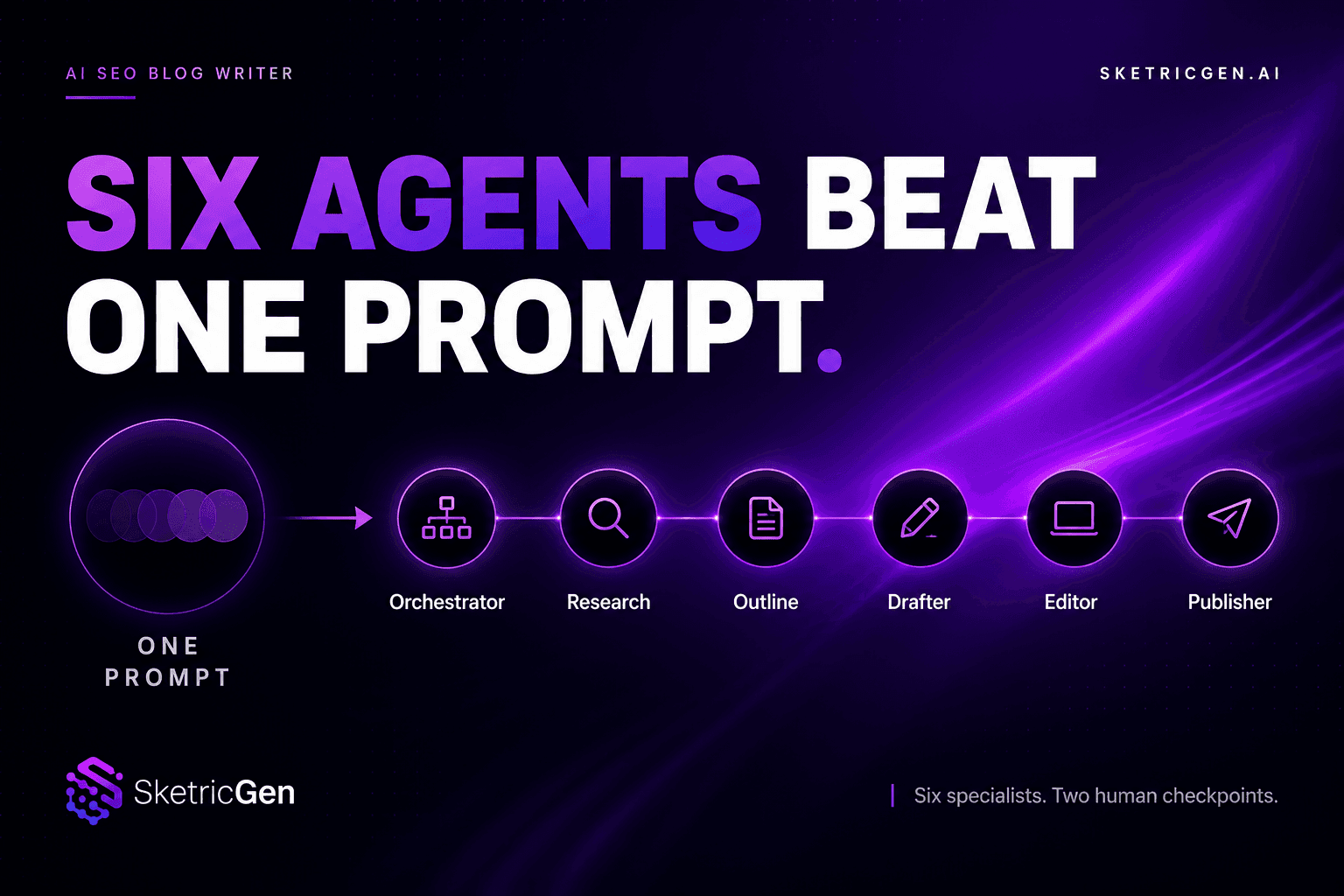
AI SEO Blog Writer: Six Agents Beat One Prompt
comparisons
OpenAI Agent Builder vs. Google Vertex AI Agent Builder vs. No-Code Alternatives (2026)
comparisons