AI Executive Assistant vs. AI Chief of Staff: The Difference That Actually Matters
By Sam | SketricGen
Search "AI executive assistant" and most of what comes back is a ranking: 8 tools tested, 12 tools tested, a feature table comparing email drafting and calendar optimization. None of it asks the question that actually decides whether the tool helps you: are you looking for something that executes tasks you hand it, or something that holds context across your day and acts without being asked every time?
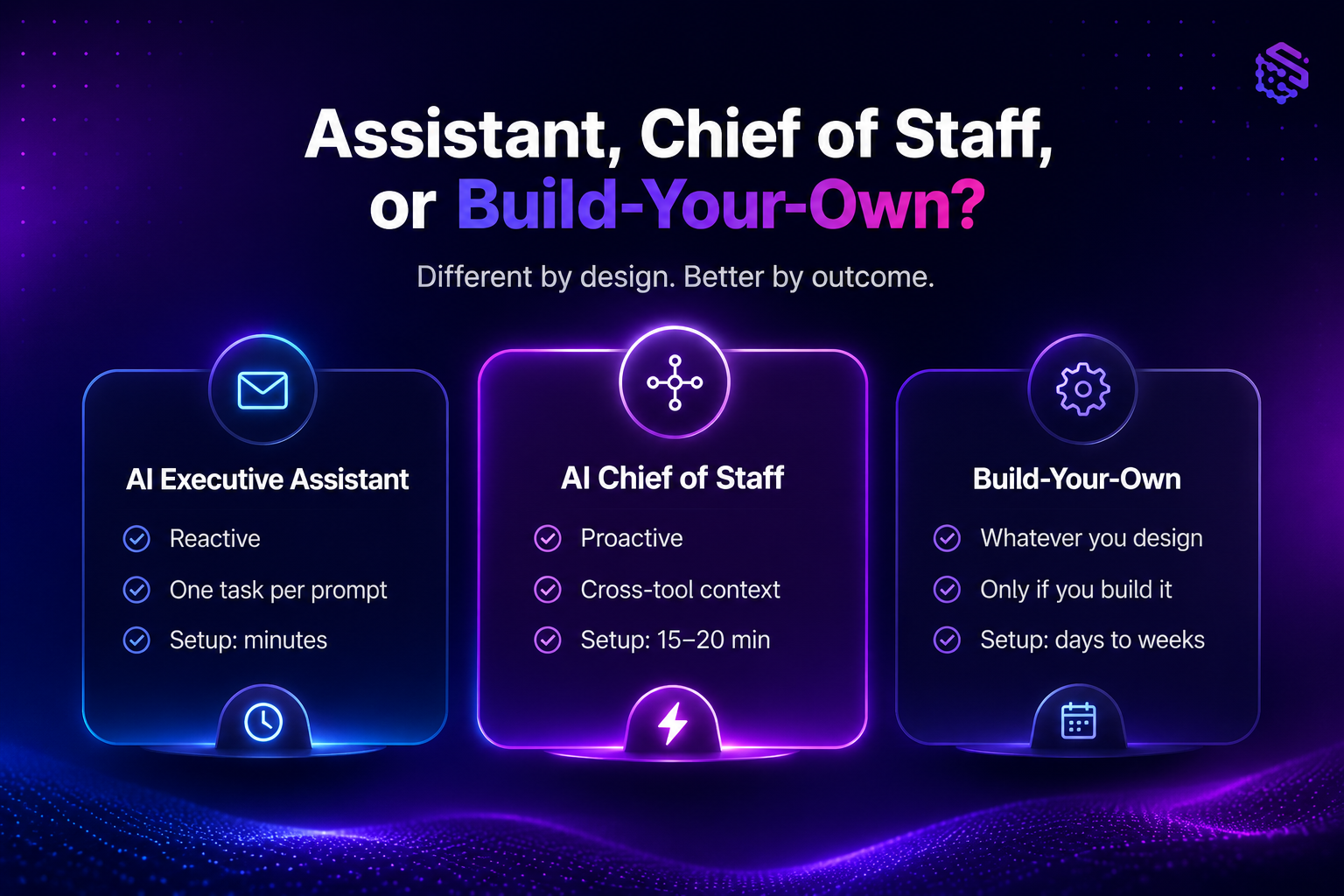
That's the real split. An AI executive assistant is reactive. It waits for a prompt and does one thing well: draft this email, move this meeting, summarize this doc. An AI chief of staff is proactive. It holds context across your calendar, inbox, notes, and people, and initiates action, flagging a conflict before you notice it, drafting a follow-up before you ask for one.
Picking the wrong one is why a lot of founders end up with "another dashboard" instead of less admin work. This post breaks down the actual difference, walks through the real decision (buy a tool, build your own system, or run a pre-wired template), and stays honest about where a human still needs to stay in the loop.
Who this is for
- Solo founders and startup operators juggling a calendar, an inbox, Notion notes, and meeting prep across four separate apps, with no admin hire to hand it to.
- Small ops or consulting leads doing the coordination work of a chief of staff without the title, the headcount, or a system that remembers what they've already told it.
- Anyone comparing "buy a tool" vs. "hire an EA" vs. "build something custom" who wants the real tradeoffs before committing budget or engineering time to either path.
- Teams weighing partial adoption who only need one or two pieces (scheduling, or meeting prep) today but want room to add the rest later without starting over.
- Founders who keep asking "can it also check my calendar for that" after trying a single-purpose AI assistant, and suspect the tool they actually need is a different shape entirely.
Key Points
- An AI executive assistant executes single tasks reactively; an AI chief of staff holds cross-tool context and initiates action.
- The real decision isn't "which tool has the most features," it's buy a single-purpose tool, build a custom system, or run a pre-wired router-plus-specialist template.
- Real builders are explicit that a working chief-of-staff system still needs human guardrails: don't let it auto-send in the first two weeks, keep a stakeholder-context doc.
- SketricGen's Personal Ops Assistant template runs the router-plus-specialist pattern out of the box, with setup in about 15-20 minutes.
- AI speeds up triage, scheduling, and research. It doesn't replace judgment, discretion, or relationship management, and the practitioners closest to this problem say so directly.
AI executive assistant vs. AI chief of staff: the difference that actually matters
An AI executive assistant is built around one job: you give it a task, and it does that task. Draft this email. Reschedule this meeting. Summarize this document. It's useful, and it's reactive by design. It doesn't know what you need until you tell it.
An AI chief of staff is a different shape of tool. It holds context across your calendar, your inbox, your notes, and the people you deal with, and it acts on that context without waiting for a fresh prompt every time. It notices a scheduling conflict before you do. It drafts the follow-up after a meeting because it already knows the meeting happened and who needs to hear from you.
A detailed Quora discussion on whether "AI chief of staff" is a real category or just marketing lands on roughly this same split: the assistant executes, the chief of staff coordinates. The category isn't invented, but it also isn't just a bigger version of the assistant. It's a different job description running on the same underlying model.
Decision rule: if you keep asking "can it also check my calendar for that" after using a tool, you don't have a chief of staff. You have an assistant that's almost, but not quite, doing the job you actually need.
At-a-glance: AI executive assistant vs. AI chief of staff vs. build-your-own
| Dimension | AI executive assistant (single tool) | AI chief of staff (router + specialists) | Build-your-own |
|---|---|---|---|
| Primary behavior | Reactive, one task per prompt | Proactive, cross-tool context | Whatever you design |
| Cross-tool context | Usually no, single app | Yes, by design | Only if you build it |
| Initiates action | No, waits for a prompt | Yes, within guardrails you set | Only if you build it |
| Typical setup time | Minutes | 15-20 minutes (pre-wired template) | Days to weeks |
| Ongoing maintenance | Minimal | Low, vendor-managed | You own it, API changes and all |
| Best for | One well-defined recurring task | Founders juggling multiple tools and people | Teams with a very specific, non-standard workflow |
What an AI chief of staff actually needs to do
A chief of staff that's just a chat window with calendar access isn't really a chief of staff. Practitioners building these systems on Reddit describe a specific set of "operating artifacts" that separate a working chief-of-staff system from a chatbot: a stakeholder map of who matters and how to talk to each of them, a decision log of what's been agreed and why, and a running weekly-priorities doc it can check itself against.
Without those artifacts, an AI system can still schedule and draft, but it can't do the harder part, because that requires remembering who's involved and what's already been decided, not just what's on today's calendar.
In practice, that breaks down into four capability areas: scheduling (reading and adjusting your calendar), docs and notes (retrieving and updating context in a tool like Notion), communications (drafting messages across email and chat), and briefing or research (pulling together what you need to know before a meeting or decision). A single-purpose assistant usually covers one of these. A chief of staff needs all four working from the same shared context.
Buy vs. build vs. router-plus-specialist template
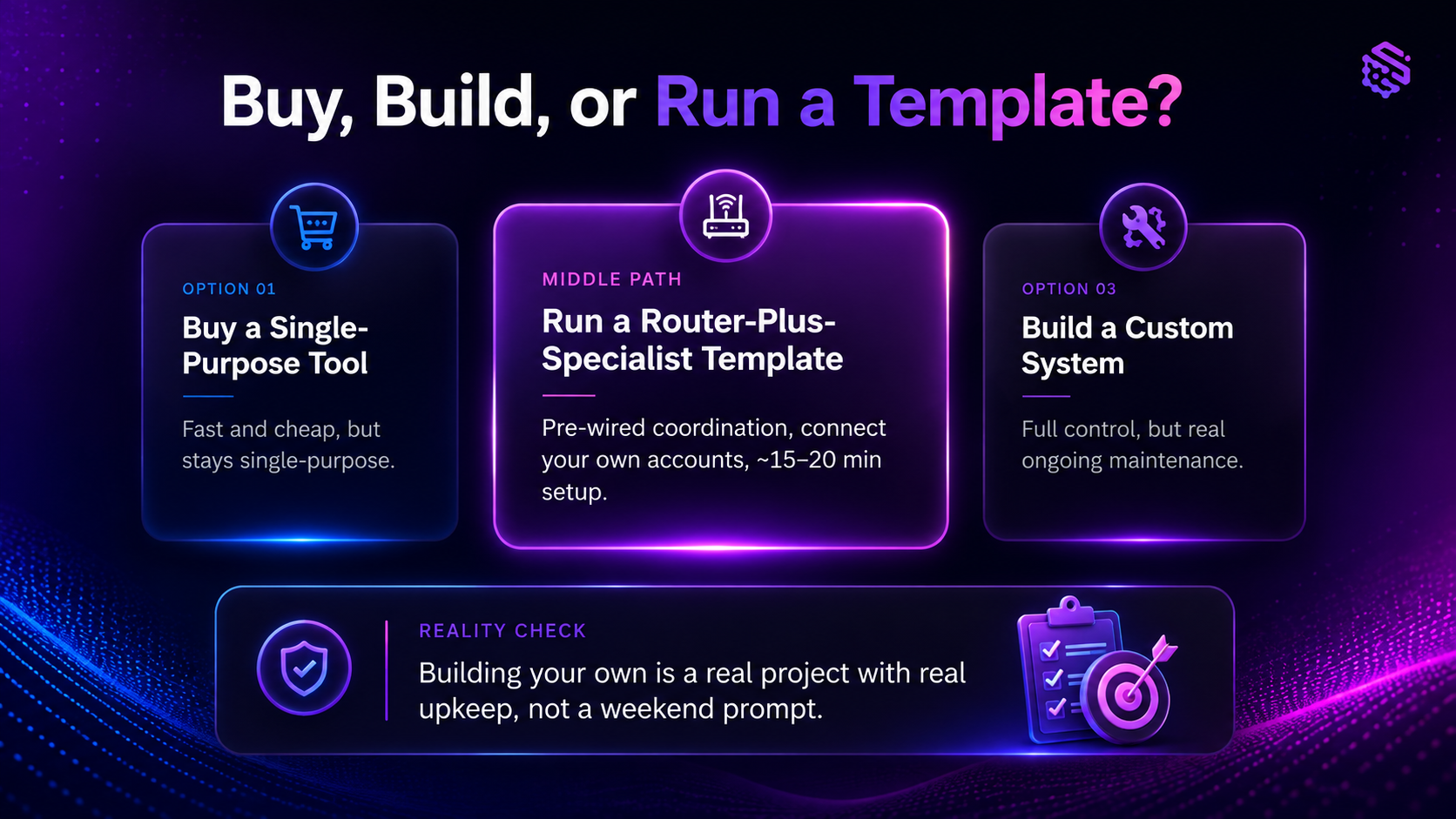
Once you know which job you actually need, there are three real paths, not two.
Buy a single-purpose tool. Fast to start, cheap, and fine if your actual need is narrow, like inbox triage or calendar optimization. The tradeoff is that it stays single-purpose. It won't start reading across your other tools no matter how long you use it.
Build a custom system. One founder's Reddit build log describes putting together an 8-agent personal chief-of-staff system as a non-developer. It works, and it's a real project, not a weekend prompt. He also built in an explicit guardrail: don't let the system auto-send anything for the first two weeks, while trust in its judgment is still being established.
Run a pre-wired router-plus-specialist template. This is the middle path: a router agent plus a set of specialists, already built and tested, that you connect to your own accounts instead of designing from scratch.
The cost math isn't abstract either. On r/smallbusiness, one founder described replacing a $25/hr virtual assistant with an AI setup and feeling genuinely conflicted about it, not because the AI failed, but because a flat hourly human cost and an upfront agent setup cost aren't as easy to compare as either side makes it sound. That honesty is worth sitting with before you commit to either path.
Reality check: building your own chief of staff is a real project with real upkeep, not a weekend prompt. Budget for maintenance (API changes, broken integrations, drift in what "good" output looks like), not just the initial build.
How SketricGen's Personal Ops Assistant fits
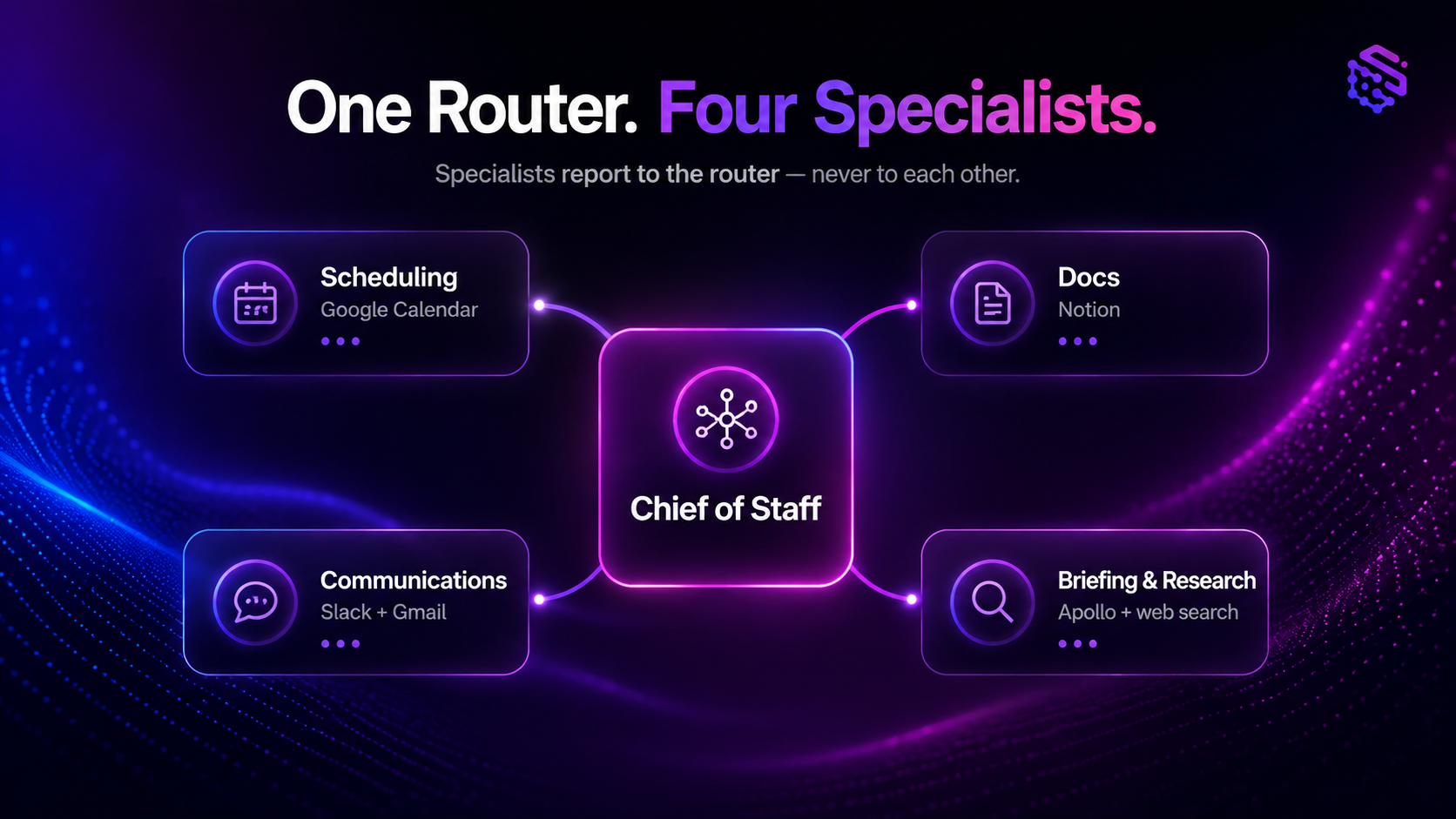
SketricGen's Personal Ops Assistant template is a working, clone-and-configure example of the router-plus-specialist path, not a concept. It's built as one Chief of Staff router agent plus four named specialists, and it's designed to replace the specific mix of calendar, inbox, notes, and meeting-prep work a founder used to hand to a human EA.
Before: calendar, inbox, Notion notes, and meeting prep live in four different tools, and switching between them eats the time they're supposed to save. After: one conversation with the Chief of Staff routes the request to whichever specialist owns it, and every meeting-prep request comes back in the same fixed brief format instead of an ad hoc search before each call.
| Agent | Owns | What it actually does |
|---|---|---|
| Chief of Staff | Routing only | Reads every request, hands it to exactly one specialist, and relays that specialist's answer back verbatim. It never does the work itself and never splits a request across two agents. |
| Scheduling | Google Calendar | Anchors on the current date/time, checks free/busy against your working hours, proposes 2-3 open slots, then creates the event with a Google Meet link and invites once you pick one. |
| Docs | Notion | Finds or creates the right page, writes meeting notes in a standard Attendees / Decisions / Action items / Notes format, and queries or updates databases. |
| Communications | Slack and Gmail | Drafts Gmail replies for approval by default, sending only when you explicitly say so; posts, DMs, or replies in Slack once it's resolved the right channel or person. |
| Briefing & Research | Apollo plus web search | Finds the meeting, enriches external attendees and their company, skips that step entirely for internal-only meetings, and returns a sourced brief (quick summary, objectives, attendees, company context, talking points), saving a copy before it replies. |
The architecture is one level deep by design: the router hands work to the right specialist, but specialists never hand work to each other. That keeps the system predictable and easy to reason about when something goes wrong, and it's the same shared-context idea from the "what a chief of staff actually needs to do" section above, applied to a real, running system instead of a wishlist.
For the ICP this post is written for, that translates into concrete value, not just architecture:
- Skips the EA hiring decision, at least for now. The four specialists cover the bulk of what a founder or ops lead hands a human executive assistant day to day, without a headcount conversation.
- Preferences persist across every specialist. Say "default my meetings to 45 minutes" or "my signature is Best, Sam" once, and it's saved to a shared preferences file every agent reads, instead of re-explaining defaults to a new tool each time.
- Meeting prep stops being inconsistent. The Briefing agent returns the same structured brief every time, and it has a hard privacy rule against surfacing salary, HR, legal, or medical content, so a generated brief is safe to screen-share as-is.
- You can adopt it in pieces. Slack is optional and the system degrades gracefully without it, so a team that only needs Scheduling and Docs today can connect just those two and add Communications or Briefing later.
- It grows past ops. SketricGen's library of 2,000+ apps means a specialist can pick up a CRM or ticketing tool later without rebuilding the router.
Required connections are Google Calendar, Gmail, Notion, and Apollo (for attendee/company enrichment); Slack is optional. Setup, meaning connecting the four required apps and filling in each specialist's defaults (time zone, working hours, Notion parent page, Slack channel, signature), runs about 15-20 minutes, not a build cycle.
What it looks like in practice:
Booked: Call with Jane Ortiz, Thursday 2:00-2:30 PM (your local time), Google Meet link included. Invite sent to jane.ortiz@example.com.
That's the Scheduling agent's typical output: no extra prompting, no manual back-and-forth over time zones, and a real calendar link in the reply. A "prep me for my 6pm" request comes back the same way every time, as a sourced brief instead of whatever a quick search happens to turn up.
If you're weighing this against a single-purpose tool, it's worth seeing how AI scheduling assistants handle a similar buy-vs-build decision for the narrower calendar-only case, or how AI handles meeting-prep research on its own if briefing and research is your main pain point rather than full coordination.
If the four-specialist structure above sounds like what you're actually missing, you can clone the Personal Ops Assistant template and connect your own accounts instead of building the router-plus-specialist pattern from a blank canvas.
Where AI still needs a human in the loop
This is the part vendor round-ups tend to skip, and it's worth saying plainly: none of this replaces judgment.
On a Reddit thread asking whether AI has replaced the personal executive assistant, one commenter put it bluntly: "No executive is going to engage in back-and-forth dialogue with a chatbot for unpredictable, out-of-the-box admin requests." Another, describing what actually matters in the role, wrote: "AI can organise my calendar. It cannot tell that I should cancel a meeting because I sound exhausted. It cannot smooth over an awkward conversation before it becomes a conflict. It cannot build trust over years. Those are the parts that matter most."
Boldly's breakdown of AI skills for executive assistants lands on a similar point from the other side of the desk: AI speeds up email triage, transcription, and repackaging information, but the piece frames human judgment and relationship skills as what keeps a human EA indispensable, not something a checklist can absorb.
The builders who've actually shipped these systems agree, and they build guardrails accordingly. One founder who automated his business bank account with an AI agent kept a simple rule: "Transfers still need my approval so nothing moves without me confirming," alongside a spend-limited card for small purchases the agent handles alone. The chief-of-staff builder mentioned earlier used the same instinct: no auto-sending for the first two weeks, while trust in the system's judgment is still being established.
Guardrail worth copying: keep a short doc of who matters and how to talk to each of them, and don't let anything external-facing (emails, messages, payments) auto-send until you've watched the system make that judgment call correctly a few times first.
Common mistakes when picking (or building) an AI executive assistant
- Treating it as just another dashboard. If it doesn't hold context across tools, it's an assistant, not a chief of staff, no matter what it's called.
- Skipping the stakeholder or context doc. Without it, even a well-built system can execute tasks but can't actually coordinate.
- Letting it auto-send too soon. Every builder who's been honest about this recommends a trust-building period before anything goes out unsupervised.
- Choosing by integration count instead of the actual job. More integrations doesn't mean more coordination if the tool still waits for a prompt every time.
- Underestimating build maintenance. A custom system is a real project with real upkeep, not a one-time setup cost.
What practitioners are saying
A Reddit thread asking whether anyone has actually built a real AI chief of staff pulled 64 upvotes and 44 comments, mostly from people either sharing partial builds or asking the same question from a different angle. That volume of engagement says the gap between "AI assistant" marketing and what people actually want is wider than the vendor content suggests.
The r/smallbusiness cost-comparison thread reads differently from the usual "AI replaced my VA" success post. It's someone thinking out loud about a tradeoff that doesn't have a clean answer, which is a more useful starting point than most vendor content offers.
Author Take - Sam
The distinction that matters here isn't marketing, it's job description. Most people searching "AI executive assistant" actually want a chief of staff and don't have the vocabulary for it yet, which is exactly why the vendor round-ups keep missing the point. My take: don't pick a tool by feature count. Pick by whether it holds context across the parts of your day that actually connect, and be honest with yourself about the trust-building period before you let anything run unsupervised.
Next steps
If the router-plus-specialist pattern above sounds like the gap in your own setup, clone the Personal Ops Assistant template and connect your own calendar, inbox, and notes. If you want to see what else is possible beyond ops coordination, SketricGen's AI Workforce agents cover a wider range of workflows, including using agents to automate follow-up work beyond ops and no-code AI agent builders worth trying if you'd rather build than start from a template.
FAQs
An AI executive assistant executes single tasks when you prompt it (draft this, schedule that). An AI chief of staff holds context across your calendar, inbox, notes, and people, and acts on that context without a fresh prompt every time, coordinating rather than just executing.
Not quite. "AI agent" describes the underlying technology, a system that can take multi-step action toward a goal. "AI chief of staff" describes a specific job that agent is doing: cross-tool coordination for one person's work, usually built as a router agent plus specialists rather than one general-purpose agent.
Look past the feature checklist to the actual job-to-be-done: does it hold context across the tools you already use, or does it just execute isolated tasks well? For a small team, a router-plus-specialist template that connects your existing calendar, inbox, and docs tool usually beats a single-purpose tool with more features in one narrow lane.
Most single-purpose executive assistant tools integrate with one or two of these, not all three. Router-plus-specialist templates, like SketricGen's Personal Ops Assistant, are built specifically to connect Google Calendar, Gmail, and Notion together under one coordinating agent, rather than requiring separate tools for each.
Build if your workflow is genuinely non-standard and you're prepared to maintain it long-term. Use a template if your workflow looks like most founders' (calendar, inbox, notes, meeting prep), since a pre-wired router-plus-specialist template gets you the same coordination without the build time or ongoing maintenance burden.
No, and practitioners on both sides of the desk say so directly. AI speeds up scheduling, drafting, and research. It doesn't replace judgment calls, discretion in sensitive situations, or relationship management built over time, which is where experienced EAs say their real value sits.
Not from day one. Builders who've shipped these systems recommend a trust-building period, commonly citing a rule of no auto-sending for the first two weeks, plus keeping a stakeholder-context doc so the system knows who matters and how to talk to each of them before anything goes out unsupervised.
About 15-20 minutes, connecting Google Calendar, Gmail, Notion, and Apollo (Slack is optional). That covers initial setup; expect to spend more time in the first couple of weeks reviewing its output before you loosen the guardrail on auto-sending and let it run with less oversight.
Related blogs
View more
AI Email Assistant: Why Drafting Isn't the Problem (and What Actually Fixes Inbox Overload)
comparisons
AI SEO Blog Writer: Six Agents Beat One Prompt
comparisons
OpenAI Agent Builder vs. Google Vertex AI Agent Builder vs. No-Code Alternatives (2026)
comparisons
Best AI Agent Builder for Small Business Teams (2026 Buyer's Guide)
comparisons