AI Email Assistant: Why Drafting Isn't the Problem (and What Actually Fixes Inbox Overload)
If you're evaluating an AI email assistant because you're buried in 80 to 100+ emails a day, here's the short version: most tools are built to write your replies faster, but that's rarely the part that's actually costing you time. The hard part is triage. Knowing what matters, what can wait, and what to trust an assistant to handle without you double-checking it.
This guide is sourced from real Reddit and Quora threads from people managing that volume today, not from vendor feature lists. It covers what an AI email assistant actually needs to do, the real choice between buying a closed tool, building your own, or running an editable agent, and an honest look at where SketricGen's own Smart Email Manager template fits into that choice.
The average knowledge worker receives roughly 121 emails a day and sends about 40, a volume where manual habits like batching and folders stop being enough on their own.
Who This Is For
- Solo founders and consultants who are past labels and folders and want triage plus drafted replies, without losing final approval on what gets sent.
- Small ops and support teams who need more than one person to see what's urgent, not just whoever happens to be watching the inbox.
- Anyone comparing AI email tools broadly who wants to understand what the category actually solves before picking a vendor.
Key Points
- Drafting isn't the bottleneck. Triage and context are, according to the people actually using these tools.
- 80 to 100+ emails a day is roughly the threshold where manual habits (batching, labels, canned responses) stop holding.
- There are three real paths: buy a closed tool, build your own against the Gmail API, or run an editable agent.
- DIY against the Gmail API is workable, but it's ongoing maintenance, not a weekend project.
- Trust matters more than writing quality. Draft-first, visible rules beat auto-send-by-default for most people.
- SketricGen's Smart Email Manager is one editable-agent example, not the only answer, and it's Gmail-only and chat-triggered today.
The Real Problem: Triage and Context, Not Drafting
Most "best AI email assistant" articles rank tools by how well they write. That's not what the people actually using these tools say is hard.
On r/aiToolForBusiness, one commenter put it plainly: "drafting is the easy part, the hard part is context." They run a daily 7am triage digest and flag anything left unanswered after 48 hours, because the drafting step was never where their time was going. (source)
Another practitioner in the same thread said summarizing and drafting mostly "just shifts the work around." What actually saved them time was having the real asks and deadlines pulled out of their messages into a task list, not an AI-written reply. (source)
That's the reframe this guide uses: an AI email assistant is worth adopting when it fixes triage and context extraction. Drafting is a nice add-on, not the reason to buy.
Manual Habits vs. AI Email Assistant vs. Build-Your-Own
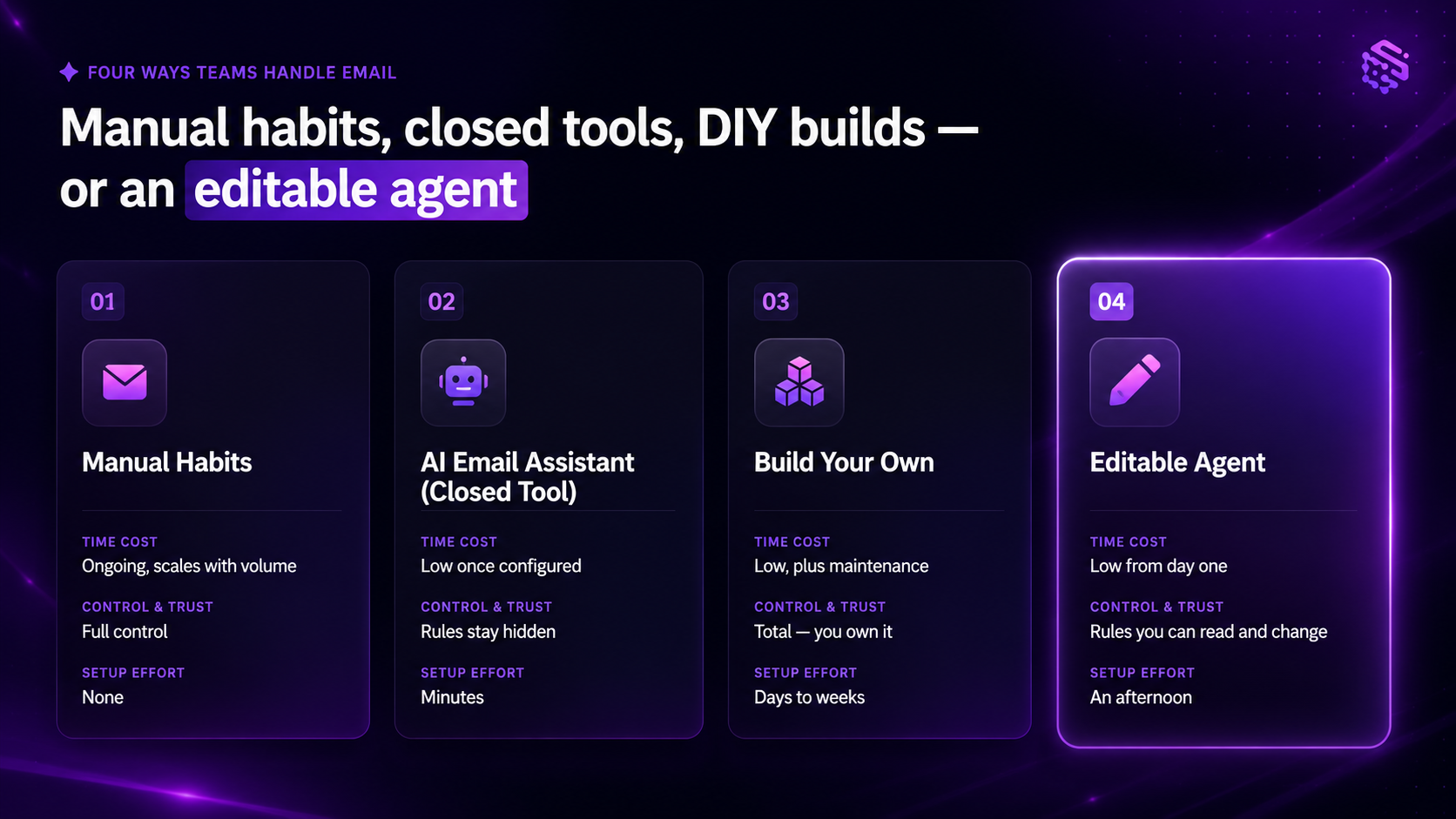
| Approach | Time cost | Control / trust | Setup effort | Best for |
|---|---|---|---|---|
| Manual habits (batching, labels, the "4 D's": do, delegate, defer, delete) | Ongoing, scales with volume | Full control | None | Under ~80 emails/day |
| AI email assistant (closed tool) | Low once configured | Depends on the vendor; often a black box | Minutes to hours | People who want a ready-made product |
| Build-your-own (Gmail API + custom script) | High upfront, ongoing maintenance | Full control | Days to weeks | Builders who want to own every piece |
| Editable agent (rules-based, inspectable) | Low once configured | Visible rules, draft-first by default | Minutes | People who want automation they can still read and edit |
A Reddit thread in r/smallbusiness lists the manual toolkit people try first: batch email 2 to 3 times a day, apply the "4 D's," unsubscribe aggressively, use canned responses, and eventually hand triage to a VA once volume justifies it. (source)
What an AI Email Assistant Actually Needs to Do
An AI email assistant is software that reads incoming email, classifies it by urgency or type, and takes action (drafting, labeling, logging, or alerting) based on rules it either learns or is given. Triage and classification are the core job; drafting is one possible action among several.
At minimum, a useful assistant needs four working pieces:
- A trigger. A chat command, a button, or a schedule that starts a run.
- An inbox connector. Something that can read unread mail, open a thread for context, label, archive, draft, or send.
- A classification layer. Rules plus judgment that decide urgent versus FYI versus spam.
- Optional logging or alerting. A database for a searchable record, a chat channel for urgent pings.
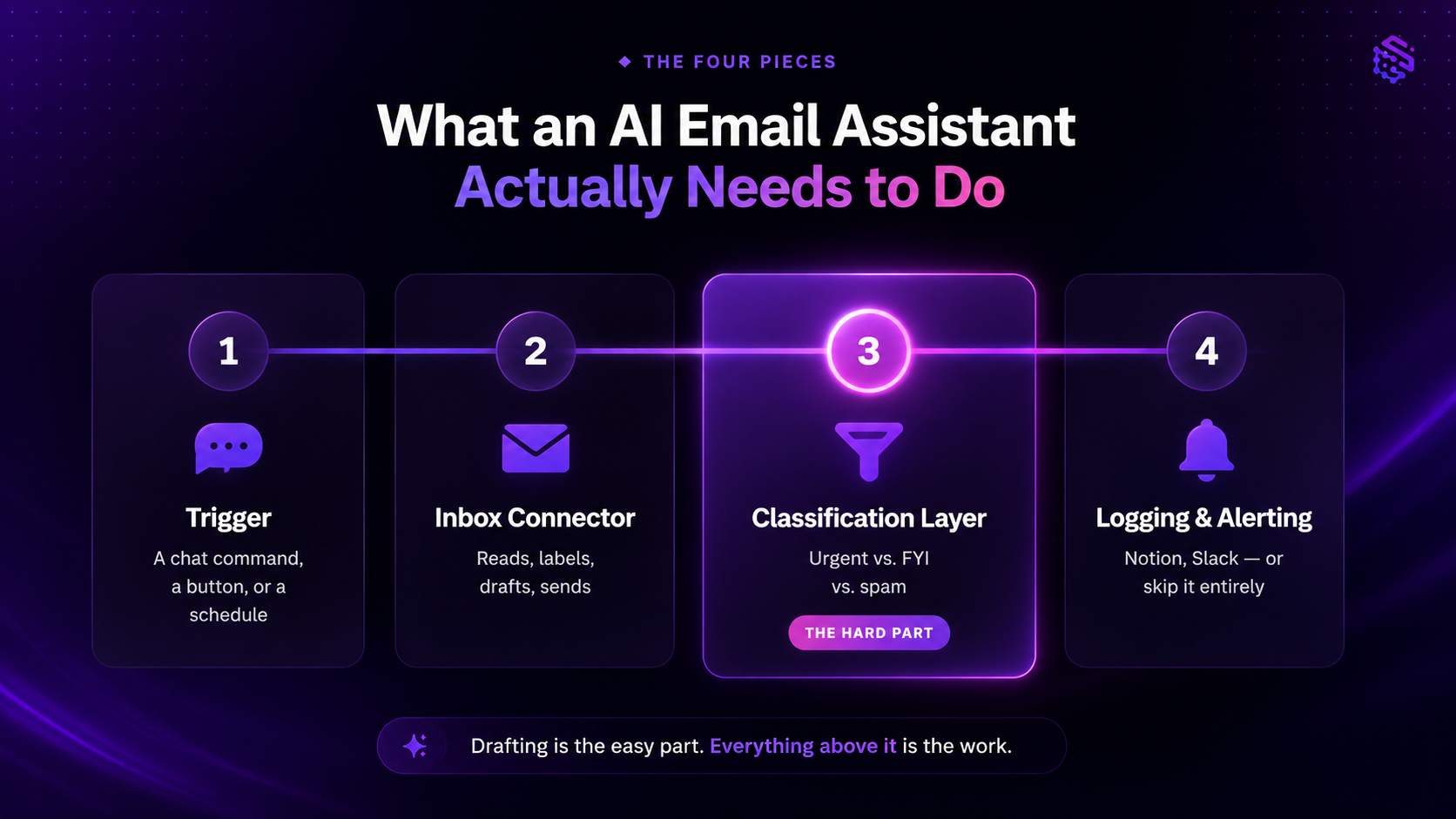
If a tool can't do the classification layer well, drafting quality doesn't matter much. It'll write a great reply to the wrong email first.
Buy vs. Build vs. Editable Agent
This is the actual decision, and most vendor round-ups only show you one side of it because they're selling the "buy" option.
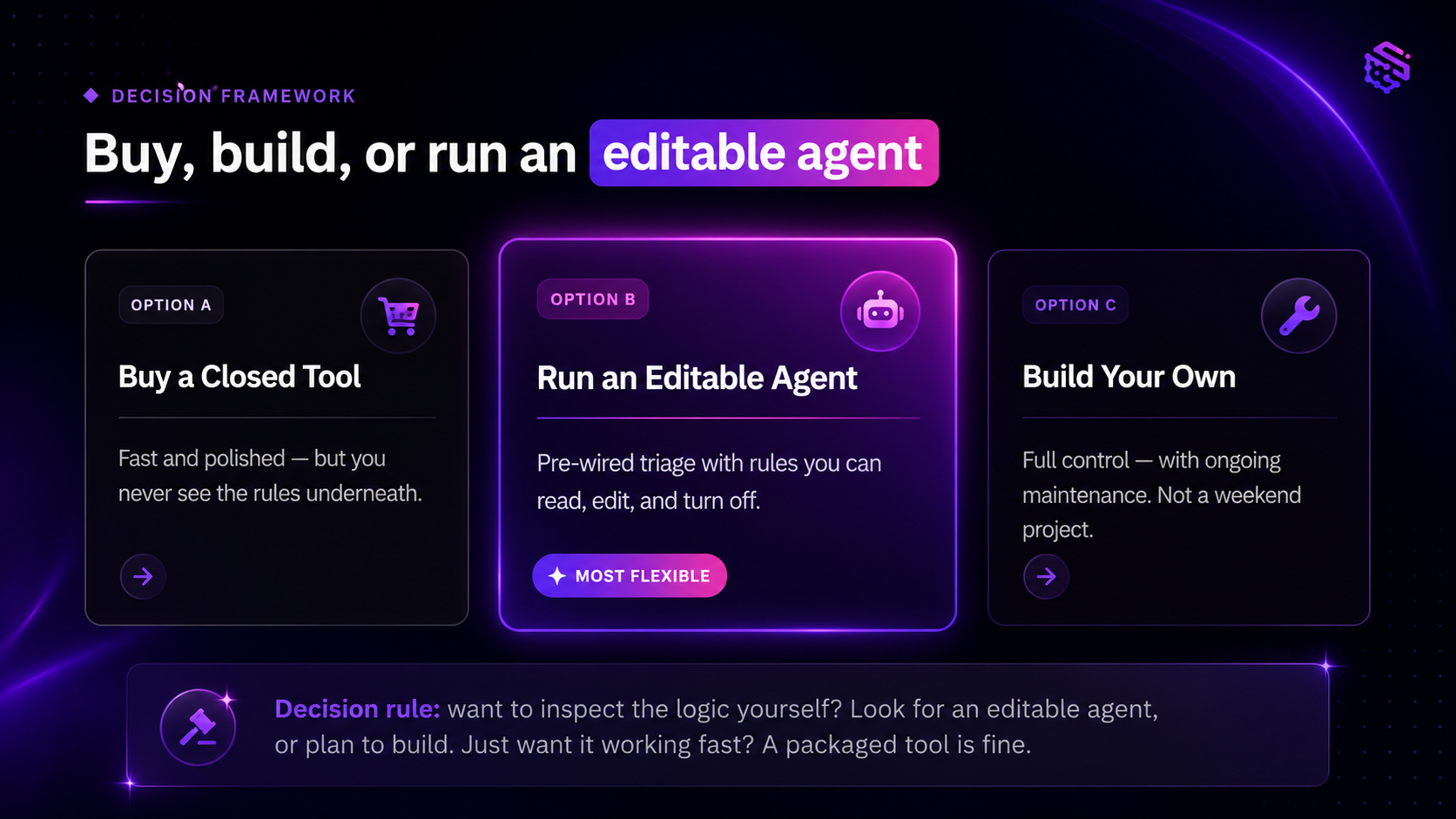
Buying a closed tool (Superhuman, Shortwave, and similar) gets you a polished product fast, but you're trusting someone else's classification logic and often can't see or adjust the rules underneath.
Building your own against the Gmail API is a real, workable path. One founder on r/SideProject described being "drowning in 200 emails a day" and building an open-source AI assistant rather than buying one. (source) But you own the classification prompt, Gmail's label-creation logic (Gmail doesn't ship an "Urgent" label by default), matching your database's exact column names, and hosting something reliable. That's ongoing maintenance, not a one-time build.
Running an editable agent sits between the two: pre-wired triage, drafting, and logging, but with rules you can read and change in plain language instead of a closed prompt.
Decision rule: if you want to inspect and adjust the classification logic yourself, look for an editable agent or plan to build. If you just want a working inbox faster and don't mind a closed system, a packaged tool is fine.
How SketricGen's Smart Email Manager Fits
SketricGen's Smart Email Manager template is one example of the editable-agent path, worth naming plainly rather than dressing up.
It's built for Gmail specifically, not Outlook or other providers today. It reads unread mail, classifies each message as urgent, needs-reply, FYI, or spam/promo, drafts context-aware replies for the ones that need a response, and labels and archives the rest. Logging to Notion and alerts to Slack are optional; if you don't connect them, triage still runs and simply skips those two steps.
Two things worth knowing before you clone it: it's draft-first by default (nothing sends until you approve it, and auto-send is an opt-in setting per category), and it's chat-triggered, not scheduled. There's no built-in cron job in this version, so you send the triage prompt yourself rather than expecting it to run automatically every morning. Its rules live in a plain, editable file, backed by an installable ops__email_triage_rubric skill, so you can inspect and change the classification logic instead of guessing at a hidden prompt.
If you're comparing this against other no-code AI agent builders worth trying, the relevant question isn't which one drafts the nicest email. It's which one lets you see and adjust the triage logic without starting from a blank canvas.
Common Mistakes When Picking (or Building) an AI Email Assistant
Mistake: judging tools by writing quality alone. A tool that drafts beautifully but classifies urgency badly will bury the emails that actually matter under polished replies to the wrong ones.
Mistake: turning on auto-send everywhere on day one. Start draft-first, confirm the classification logic matches your judgment for a week or two, then opt specific categories into auto-send once you trust it.
Manual habits aren't a mistake by themselves. The r/smallbusiness thread above shows batching and the "4 D's" work fine under roughly 80 emails a day. The mistake is sticking with pure manual habits well past the point they stop scaling, then judging every AI option by how well it drafts instead of how well it triages.
What Practitioners Are Saying
On r/CustomerSuccess, a common workflow for high-volume support-style inboxes is forward to AI, get a draft, review it, then send, handling 20 to 30 demanding customer emails a day this way. (source)
On r/ProductivityApps, one person noted that AI email tools "are great until you realize they're reading your entire life," and went looking for a middle ground with more scoped access instead of full-inbox AI. (source)
That second point matters when you're evaluating any tool: ask what it actually reads, not just what it drafts.
Author Take - Sam
The community view here (drafting is easy, context is hard) matches what we saw building the Smart Email Manager template. Our practical rule: don't evaluate an AI email assistant by asking it to write you a sample reply. Give it a messy real inbox and see what it decides is urgent. If the triage call is wrong, no amount of writing polish fixes that. And if a tool wants full inbox access before you've seen how it classifies anything, that's a reasonable place to slow down and ask more questions first.
Next Steps
If triage and context are your actual problem, start there before comparing writing quality across five tools. Try the Smart Email Manager template if you want an editable, Gmail-based starting point, or look at the broader AI Workforce agents if email is one part of a bigger workflow you want to automate.
Related reads
- AI Scheduling Assistant: Types, How It Works & How to Pick One
- 6 Best No-Code AI Agent Builders (Tried and Tested)
- AI Agent for Lead Generation: The 2026 Playbook
FAQs
Gmail's native AI features (like Gemini-assisted replies) work inside Gmail's interface and don't typically log to a separate database or alert other channels. A dedicated AI email assistant, whether closed or editable, usually adds cross-app actions: logging important emails to Notion, alerting Slack, or applying your own custom rules across categories that Gmail's built-in features don't cover.
Not quite. Email triage is one function: classifying messages by urgency or type and acting on that classification. Email management software is the broader category, which can include triage plus scheduling, templates, shared inboxes, and reporting. Most people searching for email management software are actually trying to solve triage first.
It depends what it's doing. Practitioner reports suggest drafting-only tools mostly shift the work around, since you still have to review every draft. Assistants that extract real asks and deadlines into a separate task list, or that reliably triage without needing review on every message, are the ones that report actual time saved.
Prioritize the classification layer over the writing quality. Look for visible, editable rules rather than a hidden prompt, a draft-first default so you keep approval, and optional logging so a team can see what's urgent without needing your inbox.
That's a fair concern, and it's worth checking what a tool actually reads versus what it drafts or acts on. Some assistants scope access to specific labels or a limited batch size rather than the whole mailbox; ask specifically before connecting a full OAuth grant.
Building your own gives you full control, but it means owning the classification prompt, Gmail's label logic, and hosting: ongoing maintenance rather than a one-time project. Buying a closed tool is faster but often means trusting someone else's rules. An editable agent is a middle path if you want pre-wired triage with rules you can still inspect and change.
Not automatically. Many Gmail-specific assistants, including SketricGen's Smart Email Manager, are built around the Gmail API and don't cover Outlook or other providers out of the box. Check a tool's requirements before assuming cross-provider support.
Time savings tend to come from triage and context extraction, not from drafting alone. People who reported real time savings were the ones who stopped re-reading every sender to figure out urgency, not the ones who just got faster-written replies.
Related blogs
View more
AI Executive Assistant vs. AI Chief of Staff: The Difference That Actually Matters
comparisons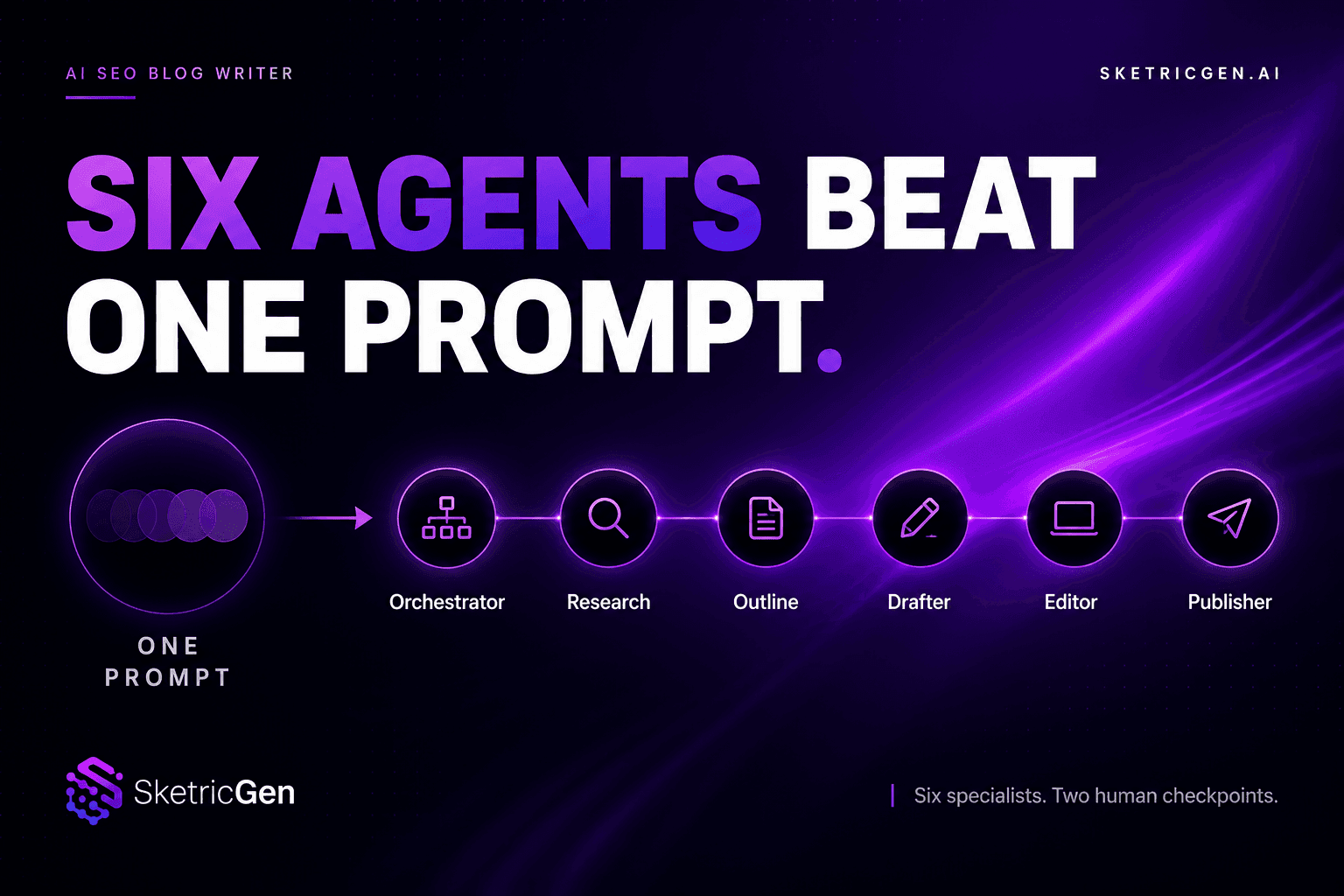
AI SEO Blog Writer: Six Agents Beat One Prompt
comparisons
OpenAI Agent Builder vs. Google Vertex AI Agent Builder vs. No-Code Alternatives (2026)
comparisons
Best AI Agent Builder for Small Business Teams (2026 Buyer's Guide)
comparisons