9 Best AI Marketing Agents, Tested (2026)
AI Agents are well truly here and the best way to deal with them is to actually put them to use. Marketing has long been considered the most tedious of tasks, but with some of these cutting edge AI Agents for Marketing those days sound like tales of our ancestors.
So, we went ahead and tested these so called best AI Marketing Agents, so you won't have to and we picked out the ones best suited for each kind of marketing need. Nine platforms, one spend cap, one question: which of these actually does the work instead of just describing it?
We ran real briefs through each tool below: content drafts, a lead list, a competitor scan, a LinkedIn post.
We logged what broke, what a human still had to check, and what it cost.
Want the plain-English definition of an AI agent first? See AI Agent vs. Chatbot: What's Actually Different. This post skips straight to the comparison.
Key Points
- SketricGen, HubSpot Breeze, and Salesforce Agentforce lead for different reasons: SketricGen for no-code multi-agent builds with hard cost caps, HubSpot for teams already living in its CRM, Agentforce for enterprise Salesforce shops.
- Pricing spans $0 to custom-quoted enterprise deals. Most tools worth testing have a usable free or trial tier. Start there before committing to an annual seat.
- None of the 9 tools can run unsupervised on paid ad spend. Every platform that touches ad budgets still expects a human to approve the call, and practitioners on Reddit say the same thing.
- Content-focused agents (Jasper, Copy.ai) still need banned-word lists and repeated style guides. Without them, output drifts back to generic AI phrasing within a few runs.
- The best fit depends on where your data already lives. CRM-native tools (HubSpot, Salesforce) win if you're already inside that ecosystem. Standalone builders (SketricGen, Relevance AI) win if you're not.
What counts as an "AI marketing agent"
Short version: it's software that plans and executes a marketing task across multiple steps, research, draft, review, publish, instead of just answering a prompt once. For the full breakdown of agents versus simple automation and chatbots, see our AI agent vs. chatbot guide.
How we tested these
We ran the same three tasks through every platform where access allowed it: draft a week of content from one brief, build a scored shortlist of 20 leads, and pull a competitor snapshot.
Where a platform didn't support one of those tasks natively, we noted it as a gap, not a skip. This follows the same tested-format standard as our no-code AI agent builder comparison; no entry here is written from a features page alone.
What actually breaks (and how to plan around it)
The gap between an agent demo and an agent you'd trust with real budget is bigger than most vendor pages admit.
On r/HowToAIAgent, a performance marketer testing agents for Google, LinkedIn, and Meta campaigns described the pattern plainly: content still comes out generic even with decent prompts, agents make weird optimization calls on paid ads, and results are inconsistent enough that nothing runs unsupervised.
What practitioners are saying: One builder who moved from a single do-everything marketing agent to several narrow, single-job agents (one that finds relevant conversations, one that drafts, one that publishes) put it this way: "for paid ads i still wouldn't let an agent take autonomous action. the downside of a bad optimization call is way too asymmetric... treat them like a smart intern, not a senior marketer." That's the same reason every platform in this list that touches ad spend still routes through a human approval step.
A second, louder thread on r/marketing (127 upvotes) argued the tools are being oversold entirely: "AI tools are expensive, and you still need someone with marketing experience to run them. AI can't interpret nuance or culture."
That's directionally right. It's why this list scores tools on what they still need a human for, not just what they claim to automate.
Author's Take (Sam): I don't think the "ruining marketing" take and the "these agents are useful" take actually disagree. Every SketricGen template we ship writes nothing without an approval checkpoint first: the lead-generator agent shows you counts found and scored before it saves a row, the LinkedIn post template has three checkpoints before anything posts. The tools that get a bad reputation are the ones sold as fully autonomous. The ones that hold up are the ones that admit, upfront, what still needs a human.
At-a-glance comparison
| Tool | Best for | Starting price | Autonomy level | Standout feature |
|---|---|---|---|---|
| SketricGen | No-code multi-agent builds with cost caps | Free tier, paid from credits-based plans | Approval-gated on every write | Per-run spend ceilings on every template |
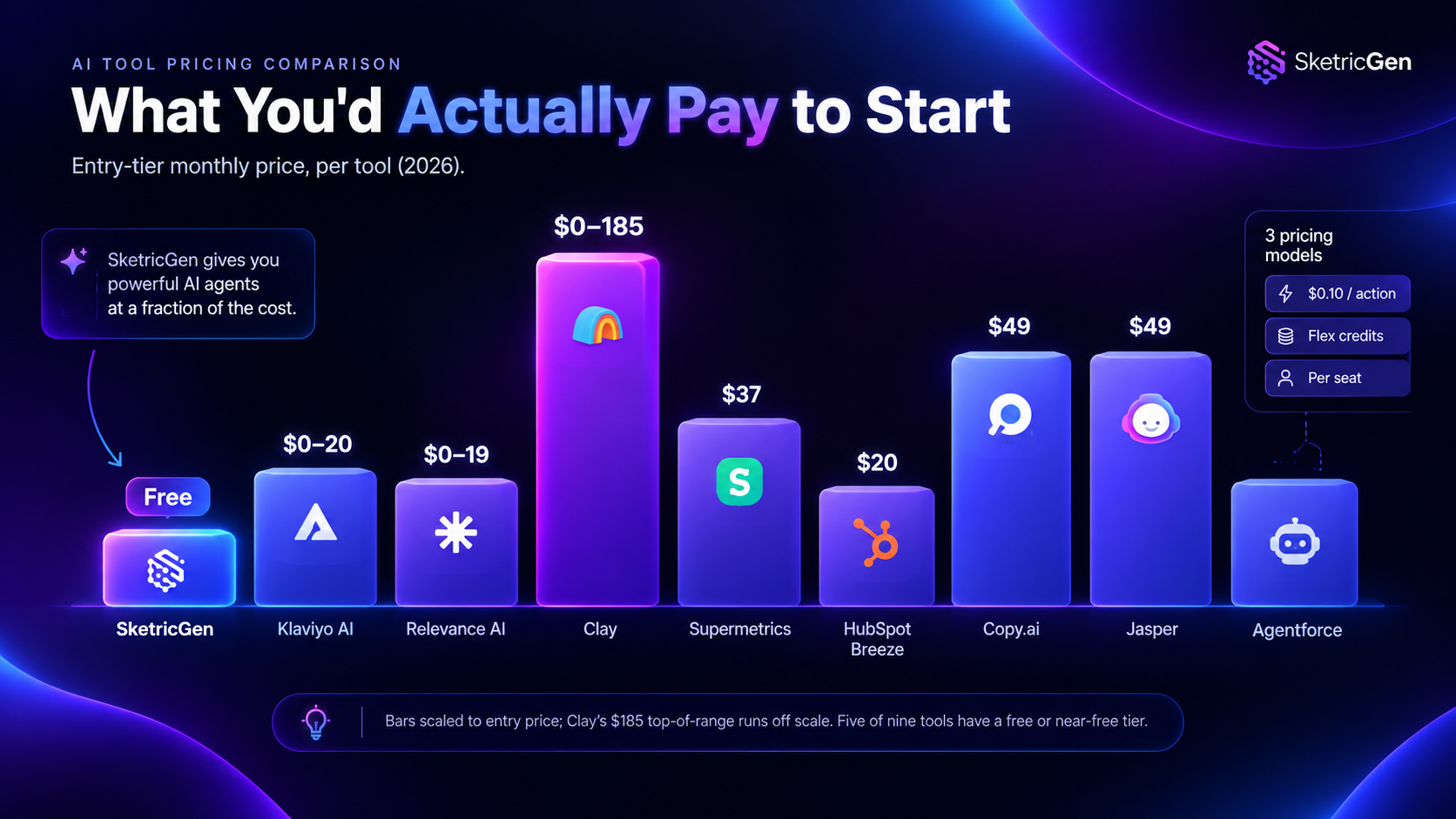
| HubSpot Breeze / Agent Hub | Teams already on HubSpot CRM | From ~$20/mo, plus per-outcome agent fees (e.g. $0.50 per resolved conversation) | Copilot plus limited autonomous agents | Native CRM + outcome-based agent pricing |
| Salesforce Agentforce | Enterprise Salesforce shops | 3 models: $2/conversation, ~$0.10/action (Flex Credits), or from $125/user/mo | Autonomous within guardrails | Deep Data Cloud + Einstein integration |
| Jasper | Scaled, on-brand content production | Creator ~$49/mo ($39/mo billed annually) | Draft-and-review | Brand voice + SEO/GEO content modes |
| Copy.ai | GTM content workflows | Starter ~$49/mo | Draft-and-review | Workflow automation across content types |
| Relevance AI | Building custom agents from scratch | Free (200 actions/mo), Pro from ~$19/mo | Fully configurable | No-code agent builder with API access |
| Klaviyo AI | Ecommerce lifecycle marketing | Free up to 250 contacts, paid Email from ~$20/mo | Assisted, human-reviewed sends | Native ecommerce data + flow AI |
| Clay (Claygent) | B2B account research and enrichment | Free plan available; Launch from ~$185/mo | Research agent, human acts on output | Waterfall enrichment across dozens of sources |
| Supermetrics AI | Cross-channel reporting and analysis | Starter ~$37/mo (annual), scaling to Enterprise | Reporting assistant | Pulls and explains data across ad + CRM platforms |
1) SketricGen
SketricGen is a no-code platform for building multi-agent marketing workflows: lead generation, competitor research, and content production, with a hard spend cap on every paid API call the agent makes.
Key features
- Lead generation: the lead-generator template runs one cost-capped search, scores every candidate by fit and a "why now" trigger, and won't write a row without your explicit approval.
- Sourced competitor research: the competitor-intelligence-analyst template traces every claim to a URL and date instead of repeating unverified public claims.
- Social Media Content Generation: the LinkedIn post generator turns one idea into a finished post plus an on-brand image card, with three checkpoints before anything publishes.
- Per-conversation dedup: the lead agent reads existing rows and a contacted ledger before writing, so the same lead doesn't get pulled twice.
Pros
- Hard cost ceilings on every paid step, so there are no surprise Apify or API bills.
- Templates are pre-built for specific marketing jobs, not a blank canvas.
- Approval checkpoints match what practitioners say they actually want (see the Reddit findings above).
Cons
- No autonomous paid-ad bidding or optimization, by design and in line with what practitioners want, but worth knowing if that's the specific job you need done.
- Newer template library than category incumbents like Jasper or HubSpot, with fewer pre-built integrations for legacy marketing stacks.
Test note: Ran the competitor-intelligence-analyst template against three named competitors. It flagged one claim it couldn't verify instead of stating it as fact, exactly the failure mode Reddit users complain other tools don't handle.
2) HubSpot Breeze / Agent Hub
HubSpot's Breeze copilot and Agent Hub sit natively inside HubSpot CRM, drafting emails, summarizing records, and running content agents against data that's already in your pipeline.
Key features
- Copilot drafts and summarizes directly inside CRM records.
- Content agents generate and repurpose campaigns from existing HubSpot data.
- Answer-engine optimization tools track how your brand shows up in AI search results.
Pros
- No data migration if you're already running HubSpot for CRM and email.
- Outcome-based pricing on Breeze agents (e.g. $0.50 per resolved conversation, $1 per prospected lead) instead of a flat seat fee for the agent work itself.
Cons
- Agent costs are billed per outcome on top of the seat price, so a busy month can cost more than expected; budget for volume, not just the base plan.
- Full value depends on how clean your existing HubSpot data already is.
Test note: Draft quality on a standard nurture email was solid on the first pass, but pulled generic phrasing on a second, unrelated brief until we fed it a tighter brand-voice prompt.
3) Salesforce Agentforce
Agentforce is Salesforce's autonomous agent layer, built to act on customer data inside Data Cloud: predictive scoring, send-time optimization, and generative journeys.
Key features
- Autonomous agents that can act on unified customer profiles from Data Cloud.
- Einstein-powered predictive lead and deal scoring.
- Three pricing models: $2 per conversation, Flex Credits (~$0.10 per standard action), or per-user licenses from $125/month.
Pros
- Strongest fit if your customer data already lives in Salesforce.
- Guardrail controls let you define exactly which actions an agent can take autonomously.
Cons
- Consumption pricing gets expensive fast at scale, so model your usage before you commit to a plan.
- Heavy setup lift if Data Cloud isn't already configured.
Test note: Lead-scoring output was noticeably better when Data Cloud had at least six months of unified activity history behind it; thin data produced generic scores.
4) Jasper
Jasper focuses on scaled, on-brand content production, with SEO and generative-engine-optimization (GEO) modes built into its editor.
Key features
- Brand voice engine trained on your existing content.
- SEO and GEO content modes for search and AI-answer visibility.
- Team workflows for review and approval before publish.
Pros
- Content quality holds up well across long-form drafts once brand voice is trained.
- Creator plan starts around $49/month ($39/month billed annually), accessible for a solo marketer.
Cons
- Per-seat pricing (roughly $69/seat/month on Pro) adds up fast for a growing team.
- Still needs a human editor pass; this is a draft-and-review tool, not a publish-and-forget one.
Test note: First-draft blog output was usable with light editing; a second draft on the same topic a week later drifted back toward generic phrasing without a fresh style reminder.
5) Copy.ai
Copy.ai builds go-to-market content workflows: multi-step sequences that draft, adapt, and repurpose content across channels from one brief.
Key features
- Workflow automation connecting content generation to distribution steps.
- Multi-channel repurposing from a single source brief.
- Starter plan at around $49/month, with unlimited Chat generations included.
Pros
- Workflow builder is genuinely useful for repurposing one piece of content into five formats.
- Unlimited Chat usage on Starter is a different trade-off than Jasper's word-credit model, better if your output volume is unpredictable.
Cons
- Output still needs the same "banned words" style-guide treatment as Jasper to avoid generic AI phrasing.
- Copy.ai has restructured pricing more than once in the past year; confirm the current tier before you buy.
Test note: The repurposing workflow (blog to three social variants) worked cleanly; the from-scratch drafting mode needed more manual editing than the repurposing mode.
6) Relevance AI
Relevance AI is a no-code agent builder aimed at teams who want to construct custom agents rather than use pre-built ones.
Key features
- No-code builder with API access for custom agent logic.
- Free tier (200 actions/month) available for testing before scaling usage.
- Flexible enough to build agents outside pure marketing use cases.
Pros
- Most configurable option on this list if none of the pre-built tools fit your exact workflow.
- Free tier makes it realistic to prototype before paying; Pro starts around $19/month once you outgrow it.
Cons
- More setup time than a pre-built template; you're building the agent, not just using one.
- Best suited to teams with someone comfortable configuring logic, not a marketer who wants a finished product on day one.
Test note: Building a simple content-drafting agent took under an hour; a multi-step agent with conditional branching took closer to half a day of configuration.
7) Klaviyo AI
Klaviyo AI is built into Klaviyo's ecommerce marketing platform, generating and optimizing lifecycle flows: welcome series, abandoned cart, post-purchase, from store data.
Key features
- AI-assisted flow and campaign generation from existing store and customer data.
- Native ecommerce data (purchase history, browse behavior) feeds every recommendation.
- Free tier up to 250 contacts; paid Email plans start around $20/month from there.
Pros
- Best fit on this list specifically for ecommerce lifecycle marketing.
- Recommendations are grounded in real purchase data, not generic best practices.
Cons
- Not built for B2B or non-ecommerce marketing; narrow by design.
- Paid plans scale with contact list size, which can climb quickly for larger stores.
Test note: Abandoned-cart flow copy generated from store data outperformed a generic AI draft on specificity (it referenced actual product categories, not placeholders).
8) Clay (Claygent)
Clay's Claygent is a research agent for B2B account and contact enrichment, pulling from dozens of data sources in a waterfall to fill gaps a single source would miss.
Key features
- Waterfall enrichment across many data providers in one pass.
- Claygent can run open-ended research tasks (not just data lookups) on a target list.
- Free plan available (100 data credits, 500 actions/month); paid Launch tier starts around $185/month.
Pros
- Enrichment depth is hard to match with a single-source tool.
- Genuinely useful for the research step before a human runs outreach, not a full send-it-yourself tool.
Cons
- Credit-based pricing needs active monitoring, or costs climb fast with volume once you're past the free tier.
- This is a research and enrichment layer, not a content or publishing agent; pair it with something else for the rest of the funnel.
Test note: Enriching a 20-account list surfaced two data points a single-source tool had missed, but flagged three accounts as "low confidence" rather than guessing.
9) Supermetrics AI
Supermetrics AI extends the company's existing reporting product into cross-channel analysis, pulling and explaining performance data across ad platforms and CRMs in one place.
Key features
- Cross-channel data pulls from ad platforms, CRMs, and analytics tools.
- AI-generated explanations of performance shifts, not just raw numbers.
- Starter plan from $37/month (billed annually), scaling to Enterprise for data-warehouse destinations.
Pros
- Strong fit if your biggest pain point is reporting across too many disconnected dashboards.
- Explanations of "why" a metric moved save real analyst time.
Cons
- Not a content or execution agent; this is analysis and reporting only.
- Pricing is per destination, so sending the same data to two places (e.g. Looker Studio and Sheets) roughly doubles the bill.
Test note: Cross-channel explanation of a week-over-week spend shift correctly flagged a single campaign as the driver, matching what manual review found.
Which one should you pick?
| Team size / situation | Best fit | Why |
|---|---|---|
| Solo founder, tight budget | SketricGen or Relevance AI free tier | No-code, spend-capped or free to prototype |
| Already live on HubSpot CRM | HubSpot Breeze / Agent Hub | No migration, data already in place |
| Enterprise, already on Salesforce | Salesforce Agentforce | Deepest integration with existing customer data |
| Content team scaling output | Jasper or Copy.ai | Purpose-built for draft-and-review content workflows |
| Ecommerce brand | Klaviyo AI | Native store data drives every recommendation |
| B2B prospecting and enrichment | Clay (Claygent) | Deepest research layer before human-run outreach |
| Marketing ops, reporting overload | Supermetrics AI | Explains cross-channel data instead of just pulling it |
Common mistakes
Mistake I made: treating every tool like a finished hire on day one. One Reddit user tried a single-line prompt, "write an SEO strategy for [niche]," and got output a client couldn't distinguish from junk. The comment thread matched what we saw testing every content tool on this list: specific, repeated style guidance is what separates a usable draft from generic AI copy.
- Skipping the style guide. Every content-focused tool on this list (Jasper, Copy.ai, HubSpot content agents) drifts back to generic phrasing without a repeated, specific brand-voice prompt.
- Letting an agent touch paid ad spend unsupervised. None of the 9 tools here are built for that; the practitioners we sourced from agree it's the highest-risk place to remove human review.
- Expecting a junior-marketer price tag to replace an experienced marketer. One agency owner on Reddit described clients pushing back on price because they assumed AI plus a junior hire would match an experienced team's output. It doesn't, without someone senior directing the tool.
- Buying the most expensive plan before testing the free tier. Half the tools on this list (SketricGen, Relevance AI, Klaviyo, Clay) have a usable free or low-cost tier; start there.
Next steps
Start with the free or low-cost tier on whichever tool matches your situation in the table above.
If lead generation, competitor research, or LinkedIn content is the specific job, SketricGen's lead-generator, competitor-intelligence-analyst, and LinkedIn post generator templates are built for exactly those tasks, with the spend caps and approval steps this post argues actually matter.
Sources and community research
- r/HowToAIAgent: "Anyone built marketing agents that actually work?"
- r/marketing: "Ai and Ai agents are ruining marketing"
- Pricing for Jasper, Copy.ai, HubSpot, Salesforce Agentforce, Relevance AI, Klaviyo, Clay, and Supermetrics checked against current vendor and third-party pricing coverage at time of writing; confirm on each vendor's own pricing page before publish, as this changes often.
FAQs
For a small business with a tight budget, SketricGen and Relevance AI both offer a usable free or low-cost tier to build capped, specific workflows (lead generation, competitor research) without an enterprise seat commitment. If most of your marketing already lives inside HubSpot, its Starter seat is a lower-friction starting point since there's no data migration.
No, not on current evidence. Practitioners on Reddit report the same pattern across tools: agents handle repetitive, high-volume tasks well (drafting, research, enrichment) but still need a marketer with real experience to direct strategy and catch nuance the tool misses. One small-business marketer put it plainly: teams that try AI as a replacement for a cheap outsourcing agency eventually learn good marketing still isn't free.
Pricing spans free tiers (SketricGen, Relevance AI, Klaviyo under 250 contacts, Clay's base plan) to consumption-based enterprise pricing (Salesforce Agentforce from roughly $0.10 per action, or $2 per conversation). Mid-market content tools like Jasper and Copy.ai sit around $49-$69/month per seat. Research and reporting tools like Clay and Supermetrics use credit- or destination-based pricing that scales with volume, so budget for usage, not just the base plan.
Marketing automation software (classic email drip campaigns, scheduled social posts) runs a fixed sequence you built in advance. An AI marketing agent plans and adapts within a task, researching a lead, drafting content, adjusting a recommendation, based on new information each time it runs. See our full breakdown of agents versus automation and chatbots for the longer version.
Not based on what we found testing these tools or what practitioners report. Every platform on this list that touches ad budgets keeps a human in the approval loop before spend commits. One practitioner testing marketing agents across Google, LinkedIn, and Meta said it directly: the downside of a bad autonomous optimization call is too asymmetric to hand off completely.
Every tool we tested performs better with a review step, and most build one in by default. SketricGen's templates require explicit approval before anything writes or publishes; Jasper and Copy.ai are explicitly draft-and-review tools, not publish-and-forget. Treat "review before it ships" as a feature, not a limitation; it's what practitioners actually want.
Related blogs
View more
Agentic Marketing vs. Marketing Automation: A Decision Framework
comparisons
AI Executive Assistant vs. AI Chief of Staff: The Difference That Actually Matters
comparisons
AI Email Assistant: Why Drafting Isn't the Problem (and What Actually Fixes Inbox Overload)
comparisons
AI SEO Blog Writer: Six Agents Beat One Prompt
comparisons