AI SEO Blog Writer: Six Agents Beat One Prompt
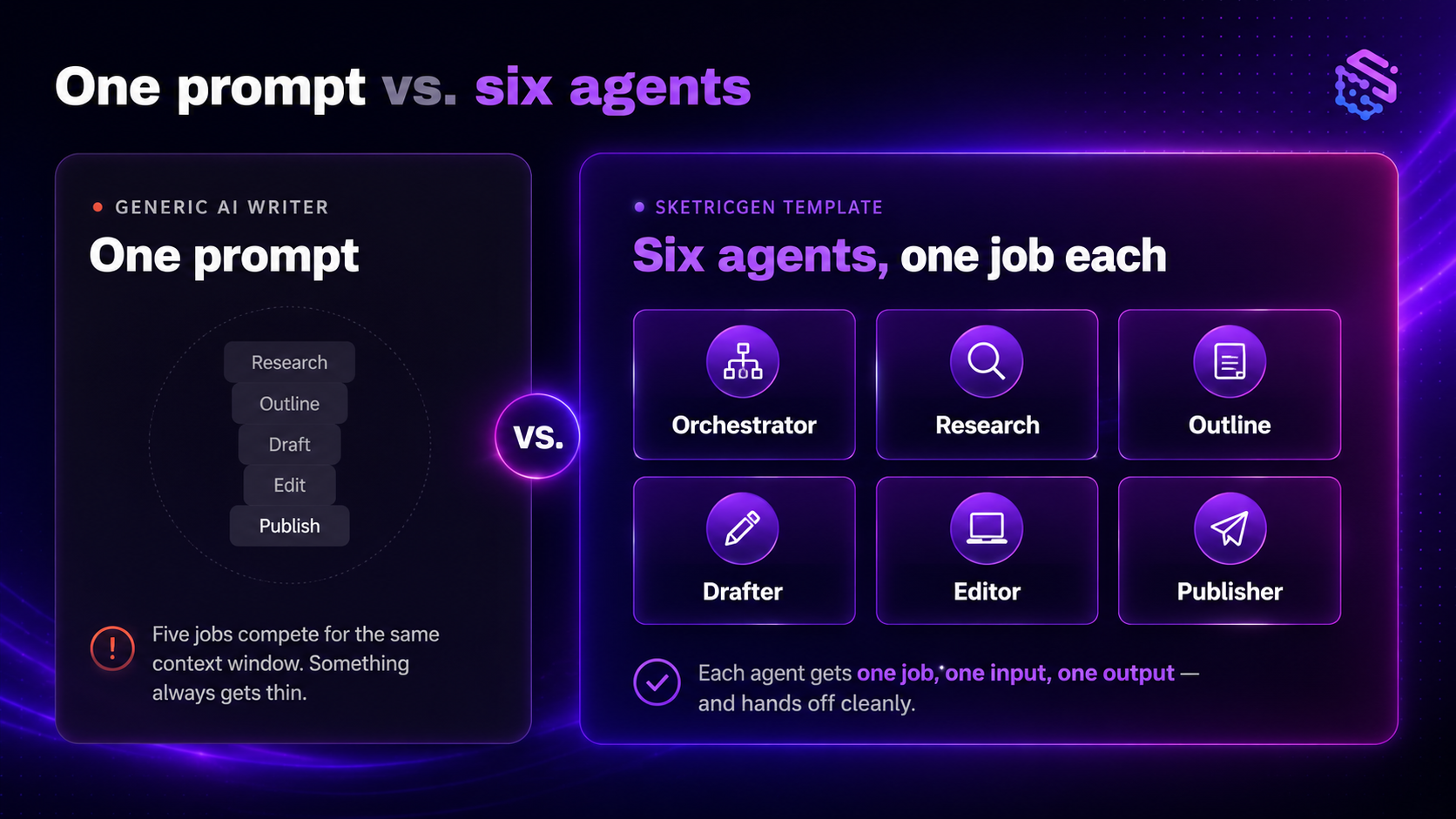
An SEO blog built on a single AI prompt has a ceiling. Ask ChatGPT or Claude directly to write a blog post, and one model has to research, structure, draft, and edit inside one context window, so one of those jobs always gets shortchanged. SketricGen's Optimized SEO Blog Writer template runs that same work as six specialist agents instead of one. This post covers why that split matters, how the template works, and what it scores on real checkers.
This blog is written using SketricGen's own SEO Optimized Blog Writer template.
Who this is for
- You're a marketer, founder, or small content team writing your own blog posts, tired of single-prompt output that reads generic.
- You're weighing a human SEO writer against AI, and want a third option that isn't "hope the model gets it right."
- Not for you if you want a zero-oversight, one-click writer with no review step. Two human checkpoints are part of the design, not a limitation.
Key Points
-
ChatGPT and Claude used directly are one writer doing five jobs at once: research, structure, draft, edit, format. The SEO Optimized Blog Writer runs those as six separate agents, each with one job.
-
This post was written using the SEO Optimized Blog Writer template itself, disclosed here rather than at the bottom.
-
Blog posts from this template consistently score 8.2+ on Semrush's SEO Writing Check and test under 7% AI-detected on ZeroGPT.
-
YOu connect dedicated agents with: DataForSEO for keyword data, Google Docs or Notion for delivery, neither of which a single chat prompt can reach.
-
Setup takes 10 to 20 minutes, most of it a one-time onboarding interview.
The real problem: one monolithic AI writer
The pain point isn't "which AI writes best." It's that a single prompt asks one model to be researcher, editor, and SEO analyst in one pass, with no one checking the work afterward.
A developer who got tired of doing this by hand put it plainly after building an open-source alternative: "Most AI writing tools stop after generating a single article. I wanted something closer to a production workflow," (Reddit). One pass, no workflow, no review, in one sentence.
On Quora, the recurring caveat across several answers to "what's the best AI tool for SEO content" is that a single model pass reads generic and still needs heavy editing before it's publishable (quora). That's not a model problem. It's a straight forward architecture problem.
Decision rule: If you are pasting a bunch of keywords & topic into ChatGPT and expecting a publish-ready post back, the architecture is the bottleneck, not the model. A single pass can draft. It can't reliably research, self-edit, and fact-check itself in the same breath.
What generic AI writers already get you
Single-prompt tools and generic "AI seo content generator" products aren't useless. They're fast, and they'll hand you a reasonable first draft with basic structure.
Where they stop: they rarely pull live keyword or SERP data, they don't run a separate editing pass with different incentives than the drafting pass, and there's no built-in checkpoint where a human reviews the plan before the words get written. You get speed. You don't get a process.
Inside the SEO Optimized Blog Writer: six agents, one job each
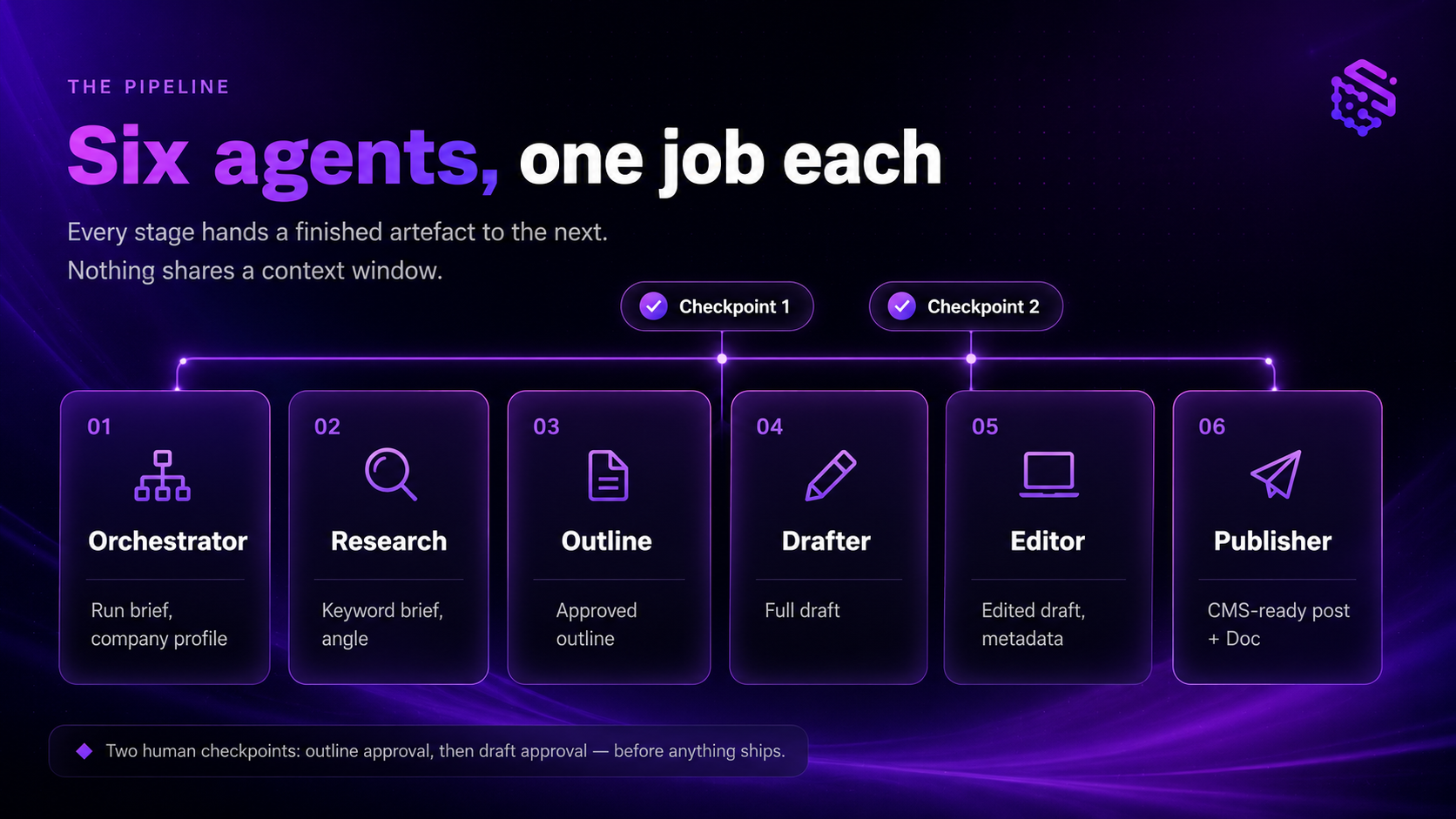
The template runs the same job a single prompt attempts alone, split across six agents, with two points where a human reviews the work before it moves forward.
| Agent | Pipeline role | What it produces |
|---|---|---|
| Orchestrator | Coordinates the run, onboarding, and checkpoints | Run brief, company profile, routing |
| Research | Idea, SERP brief, angle, practitioner sourcing | Keyword brief, angle, sourced texture |
| Outline | Turns research into a blueprint | Approved outline (Checkpoint 1) |
| Drafter | Writes the full draft | Draft following angle and word target (Checkpoint 2) |
| Editor | Edit, E-E-A-T, headline, meta, QA | Edited draft, metadata, QA report |
| Publisher | Assembles and ships the final post | CMS-ready post and Google Doc |
Independent builders on dev.to and Towards Data Science, working with tools like CrewAI and LangGraph, keep landing on the same design by hand: a Research agent, a Writer agent, and an Editor or Reviewer agent kept deliberately out of the writer's context, so the reviewer catches what the writer missed. That's the same separation this template ships by default. For the deeper mechanics of why splitting one job across agents beats one big prompt, see how multi-agent AI systems actually work.
Why tool connections matter
A chat prompt can't log into your keyword tool or your Google Doc. Agents with tool access can.
Our Research agent pulls real keyword volume, difficulty, llm mentions and SERP data from DataForSEO when it's connected, and falls back to just web search when it isn't.
The Publisher agent writes the finished post straight into a Google Doc (or Notion, if you swap the destination), with links, tables, and lists intact, instead of leaving you to rebuild formatting by hand.
For more on how agents reach outside tools like this, see how to build and use MCP servers.
The proof: what practitioners are already hand-building
Nobody in these threads is asking "is AI good at writing." They've already tried the single-prompt version, hit the same wall, and started building staged pipelines by hand to fix it.
What practitioners are saying: A builder on PromptEngineering subreddit started a 5-stage pipeline (research, outline, draft, audit, QA) after a client asked for content to rank "everywhere: Google Search, AI Overviews, ChatGPT, Gemini, Claude, Perplexity" (r/PromptEngineering). The same author later reported one blog from that workflow hitting 80,000+ Google Search impressions (r/SEO_LLM). A solo founder on Agentic_SEO subreddit documented taking one site from near zero to 1.12 million impressions and 6,180 clicks in 12 months after replacing manual writing with an automated pipeline (r/Agentic_SEO).
The client's own request, as relayed on r/PromptEngineering, sums up the modern bar: "I want my content to rank everywhere. Google Search, AI Overviews, ChatGPT, Gemini, Claude, Perplexity... basically anywhere AI can find it," (source). A single prompt was never built to hit that many targets at once. A staged pipeline is.
Setup: getting from zero to your first post
Setup takes 10 to 20 minutes, and most of that is a one-time profile set-up to understand your keywords, your competitors, your tone & preferred structure of blog.
- Clone the template into AgentSpace.
- Connect Google Docs on the Publisher agent (recommended, so the final post lands as a formatted Doc).
- Connect DataForSEO on the Research agent (optional; without it, research falls back to web search).
- Web Search is already enabled, no setup needed.
- Send "setup" and answer the short onboarding interview. Review and approve the company profile it builds.
- Send a topic plus seed keywords to write your first post, for example:
Reducing SaaS churn | keywords: churn rate, retention, B2B onboarding. - Approve the outline and the draft at the two checkpoints, or add "fully unattended" to skip straight to a finished Doc.
Pro tip: Run the onboarding interview before your first real post, not after. Every post afterward reuses that company profile (voice, banned words, approved claims), so skipping it means your first few drafts need more manual correction than they should.
Open the SEO Optimized Blog Writer template to try this setup yourself.
The numbers: Semrush score and AI-detection result
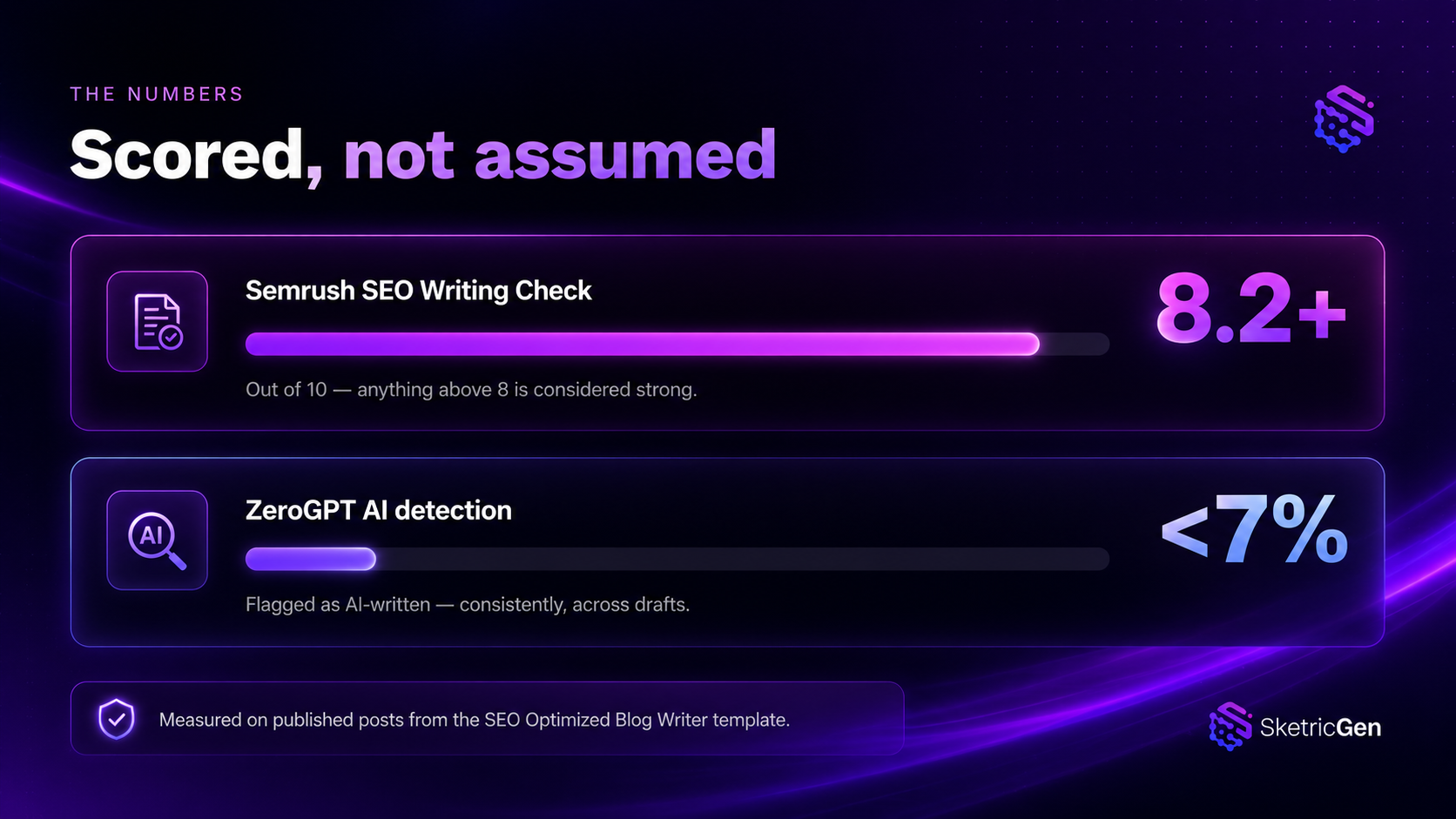
| Check | What it measures | Result |
|---|---|---|
| Semrush SEO Writing Check | Originality, SEO, readability, tone, and structure | 8.2+ consistently, on a scale where 8+ is considered strong |
| ZeroGPT AI detector | Likelihood the text was AI-generated | Under 7% AI-detected, consistently |
Check the methodology yourself at the Semrush SEO Writing Check and ZeroGPT.
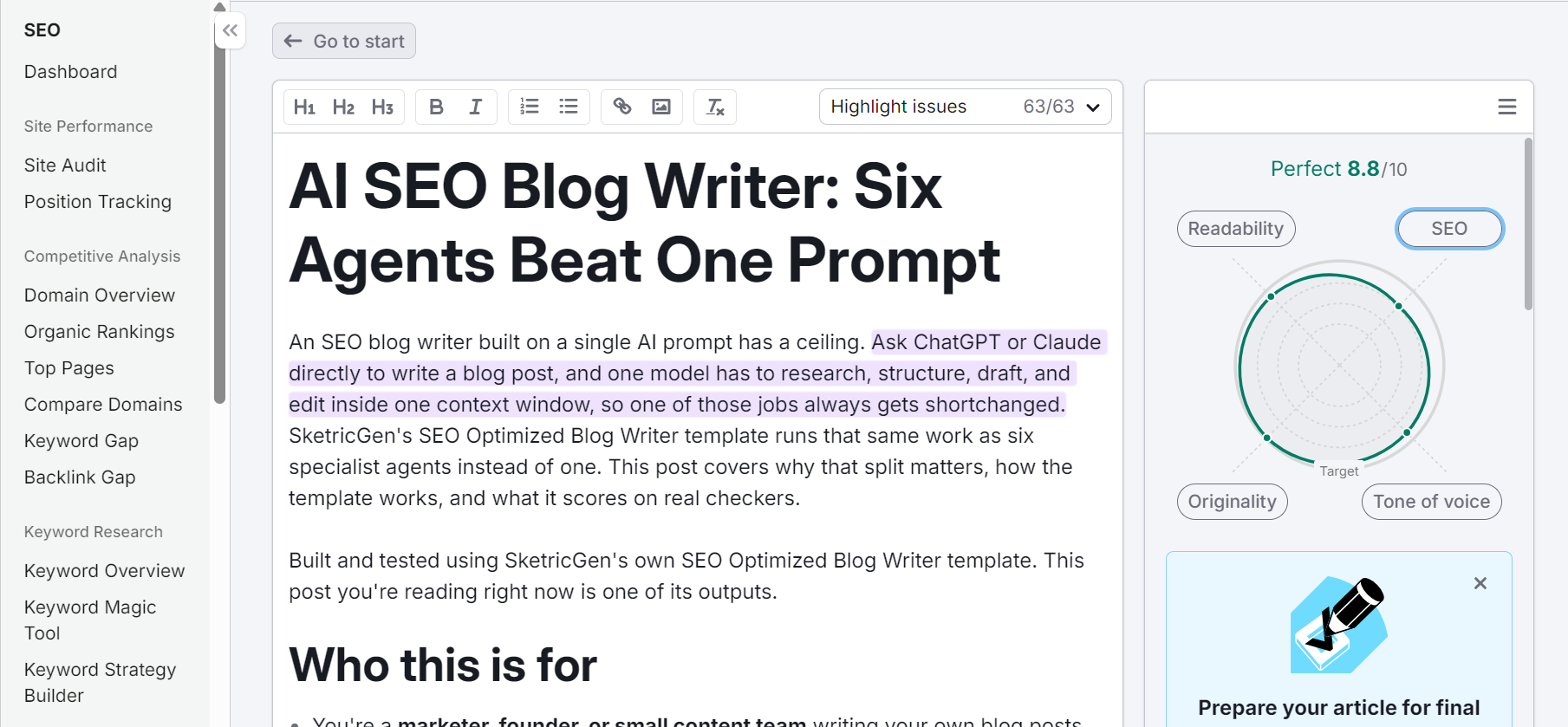
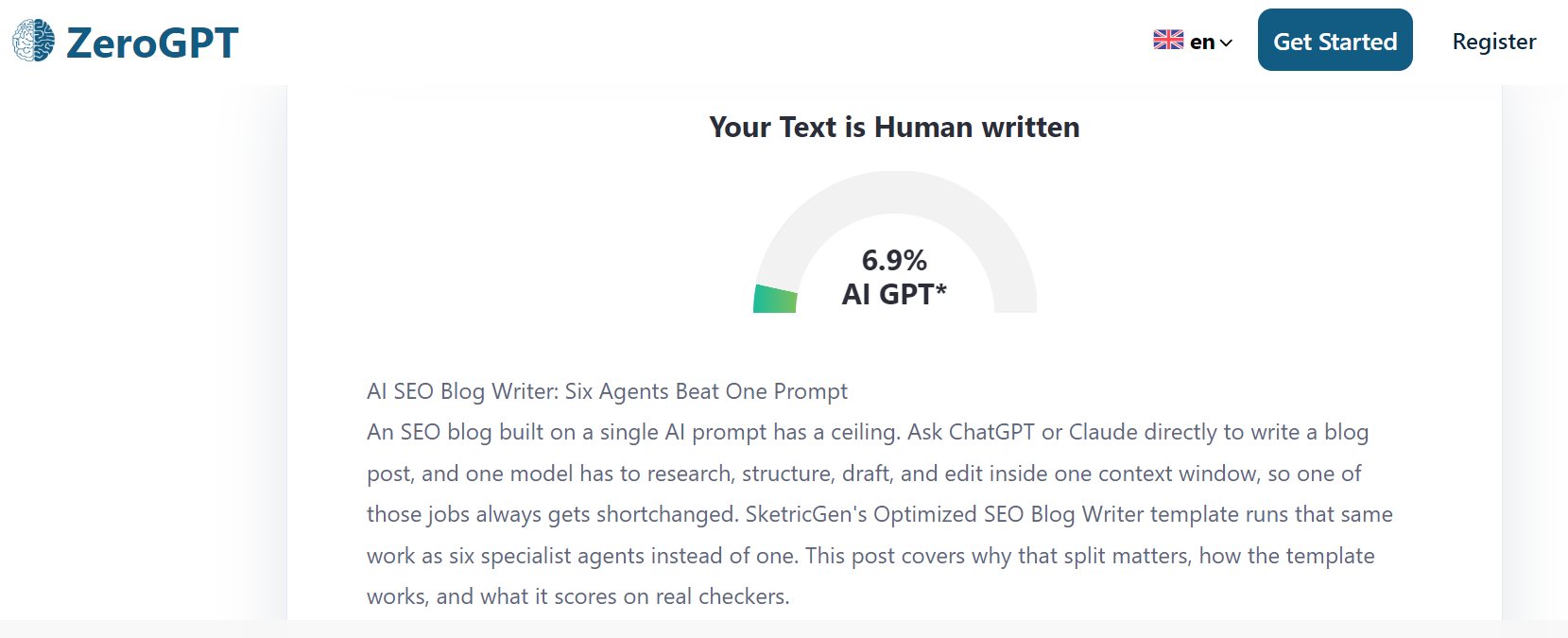
One Reddit user's own test on r/DigitalMarketing shows why the detection number matters: running a lightly-edited AI paragraph through GPTZero flagged it as 100% AI, while a more heavily rewritten version flagged far lower (source). The editing pass moves that number, not the model alone, which is the job the Editor agent does here.
Author's Take
I've watched the same story play out on r/SEO: someone tries AI for a site, it works for a bit, then traffic just dies. One person put it exactly that way: "I made a site using AI and for a while it kinda worked, it got picked up, but then it just died," (r/SEO). By their own admission, the content wasn't that great, it was random prompts with no review step.
My decision rule after building and shipping a lot of AI-assisted content: a single prompt is fine for a quick internal draft you're going to rewrite yourself anyway. The moment you're publishing under your name or your company's, the setup time for a managed pipeline, agents with defined jobs and a real review checkpoint, pays for itself within a post or two. The plateau-and-die pattern above is what happens when nobody owns the review step.
Common mistakes when writing SEO blog posts with AI
- Publishing the first draft. No review pass means no one caught the generic phrasing or the unverified claim.
- Skipping real keyword data. Guessing at intent instead of pulling actual volume and SERP data produces posts that target the wrong query.
- Letting the model invent specifics. Stats and claims need a source, or they need to come out.
Next steps
One prompt, one context window, five jobs it's trying to do at once. That's the ceiling every single-shot AI writer hits eventually. The SEO Optimized Blog Writer template exists because splitting that work across six specialist agents, with real tool access and two human checkpoints, is what clears it. This post is one of its outputs.
Open the SEO Optimized Blog Writer template and send your first topic and seed keywords to see it run.
FAQs
The strongest option separates research, outlining, drafting, and editing into distinct steps rather than one prompt. SketricGen's SEO Optimized Blog Writer template runs exactly that as six agents (Orchestrator, Research, Outline, Drafter, Editor, Publisher), with real keyword data and two human checkpoints.
Yes. The SEO Optimized Blog Writer template runs research, outlining, drafting, editing, and publishing to a Google Doc from a single topic-and-keywords message, with the option to skip checkpoints and run fully unattended.
ChatGPT and Claude used directly do the entire job (research, structure, draft, edit) in one prompt and one context window. An agent-based SEO blog writer splits those jobs across specialists, each with one task, plus, in this template's case, two human review points before anything ships.
A writing assistant helps you draft or polish text you're mostly directing yourself. An AI SEO agent runs the surrounding process too: keyword research, outline planning, and QA, not just the sentence-level writing.
No. DataForSEO is optional and adds real keyword volume and SERP data to the Research agent. Without it, research falls back to web search, which works but with less precise keyword grounding.
Posts from this template test under 7% AI-detected on ZeroGPT. The Editor agent enforces hard bans (no em or en dashes, no AI-filler hype words) and varies sentence length on purpose, the same lever one Reddit tester found mattered most: a heavily-edited AI paragraph scored far lower on detection than a lightly-edited one (source).
For repeatable, on-brand blog production, often yes, and practitioners are already proving the ceiling is high: one solo founder took a site from near zero to 1.12 million impressions in a year running an automated pipeline (source). What it doesn't remove is the review step. Two human checkpoints are built into the template on purpose, because the plateau-and-die pattern reported on r/SEO happens when nobody reviews the output at all (source).
Related blogs
View more
AI Executive Assistant vs. AI Chief of Staff: The Difference That Actually Matters
comparisons
AI Email Assistant: Why Drafting Isn't the Problem (and What Actually Fixes Inbox Overload)
comparisons
OpenAI Agent Builder vs. Google Vertex AI Agent Builder vs. No-Code Alternatives (2026)
comparisons
Best AI Agent Builder for Small Business Teams (2026 Buyer's Guide)
comparisons