3 Best Zapier Alternatives for AI Automation
If you are looking for Zapier alternatives, you are not just trying to replace a tool. You are trying to solve one of the following key problems:
- Rising usage costs as workflows scale
- Need for deeper logic and control
- Need for self-hosted flexibility
- Need for production AI agent workflows, not just classic app-to-app automation
This guide compares the most practical Zapier alternatives in 2026 and helps you pick based on your real use case.
TL;DR
- Choose Zapier if you want broad integrations for mostly deterministic workflows. Can become expensive at high task volume.
- Choose SketricGen if your target is multi-agent AI workflows with orchestration patterns, production deployment, and trace-level run visibility. Strong fit for AI-first workflows.
- Choose Make if you want a visual builder with strong flow control and often better economics for complex automation.
- Choose n8n if you want developer flexibility and self-hosting control. Can be cost-efficient with self-hosting.
Why Teams Are Looking Beyond Zapier
Zapier remains strong for classic automation, but the market has shifted from simple app automation to AI-assisted and agentic workflows. That shift changes what matters when evaluating tools.
Four reasons come up repeatedly when teams evaluate alternatives.
Cost behavior changes with AI-heavy workflows
Zapier usage is straightforward for classic Zaps, but AI-heavy flows can make more tool calls per request.
On Zapier MCP, one MCP tool call is documented as two tasks.
This can materially increase spend for workflows that call multiple tools per run. In short, Zapier can get expensive at scale.
Agent reliability is still a live concern
In Zapier's subreddit, users report practical friction when using Zapier Agents for production-like scenarios.
Example discussion:
A common pattern appears in user reports: workflows work in simple cases, but edge cases expose limits in control or reliability.
Internal automation and product-embedded AI are different jobs
Many teams now need to ship customer-facing agent experiences via API or widget, not only internal back-office automation.
Zapier has limited support for these deployment patterns, which pushes some teams to look elsewhere.
Teams need stronger run explainability
As AI agents take meaningful actions, teams increasingly ask for deeper observability:
- What happened during a run
- Which tool executed
- Where latency occurred
- Where cost was incurred
Traditional Zap-style logs often lack the depth needed for these scenarios.
SketricGen (Best for AI-first workflows)
For teams building production AI workflows where multiple agents collaborate, SketricGen is purpose-built for this agentic automation model.
Why SketricGen stands out
Multi-agent orchestration patterns
SketricGen supports:
- agent handoffs
- forced handoffs
- agent-as-tool patterns
These patterns are essential for complex workflows where specialized agents collaborate.
Production-ready deployment
Agents can be deployed as:
- Widgets
- APIs
- Messaging integrations (Slack, WhatsApp)
This makes it a strong fit for customer-facing AI experiences, not just internal automation.
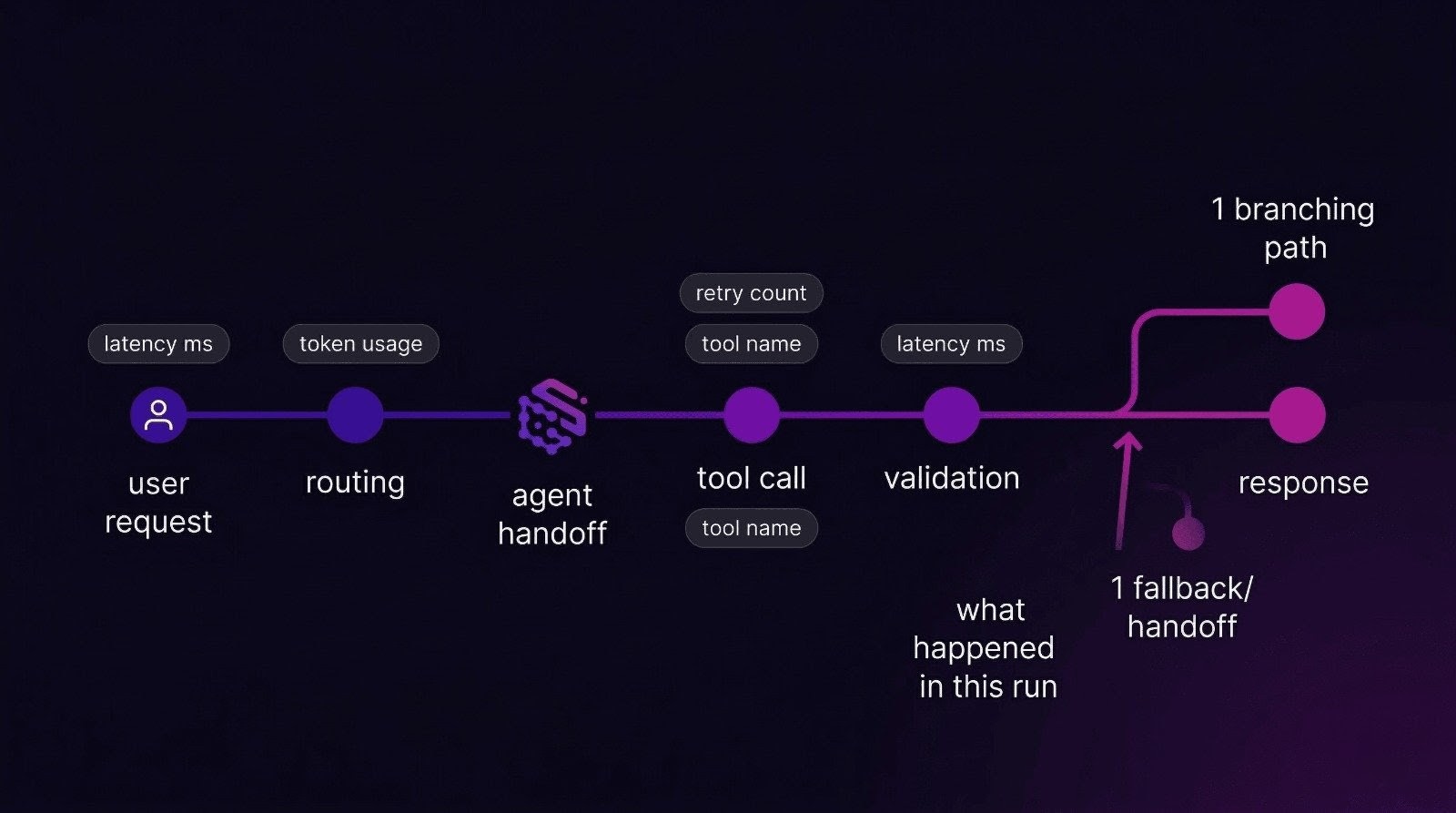
Trace-level visibility
Every run shows:
- tool usage
- latency sources
- model cost
- agent collaboration steps
This level of observability is critical for debugging and optimization in production.
Built for AI-first workflows
While platforms like Zapier and Make focus on deterministic automation with optional AI, SketricGen is designed for workflows where AI agents are the primary actors.
Tradeoffs
- Different mental model than traditional automation tools
- Strongest value appears when agent orchestration is actually required
Best fit when
- Multiple agents must collaborate
- You are building customer-facing AI experiences
- You need detailed execution traces
- Workflows are AI-first rather than deterministic
Other Top AI Alternatives for Automation
Make
Best for: Teams that want a visual automation builder with strong flow control.
Strengths
- Visual flow builder with routers and branching
- Good for complex deterministic workflows
- Large integration catalog
Tradeoffs
- Scenarios can become complex to maintain
- Still primarily an automation platform rather than a true AI agent runtime
Good fit when
- You need advanced branching and data mapping
- Workflows remain mostly deterministic with occasional AI steps
n8n
Best for: Technical teams wanting flexibility and infrastructure control.
Strengths
- Open-source model
- Self-hosting support
- Strong extensibility for developers
Tradeoffs
- More operational responsibility
- Governance and orchestration patterns must be implemented manually
Good fit when
- You want low vendor lock-in
- Engineering resources are available for maintenance
Platform Comparison
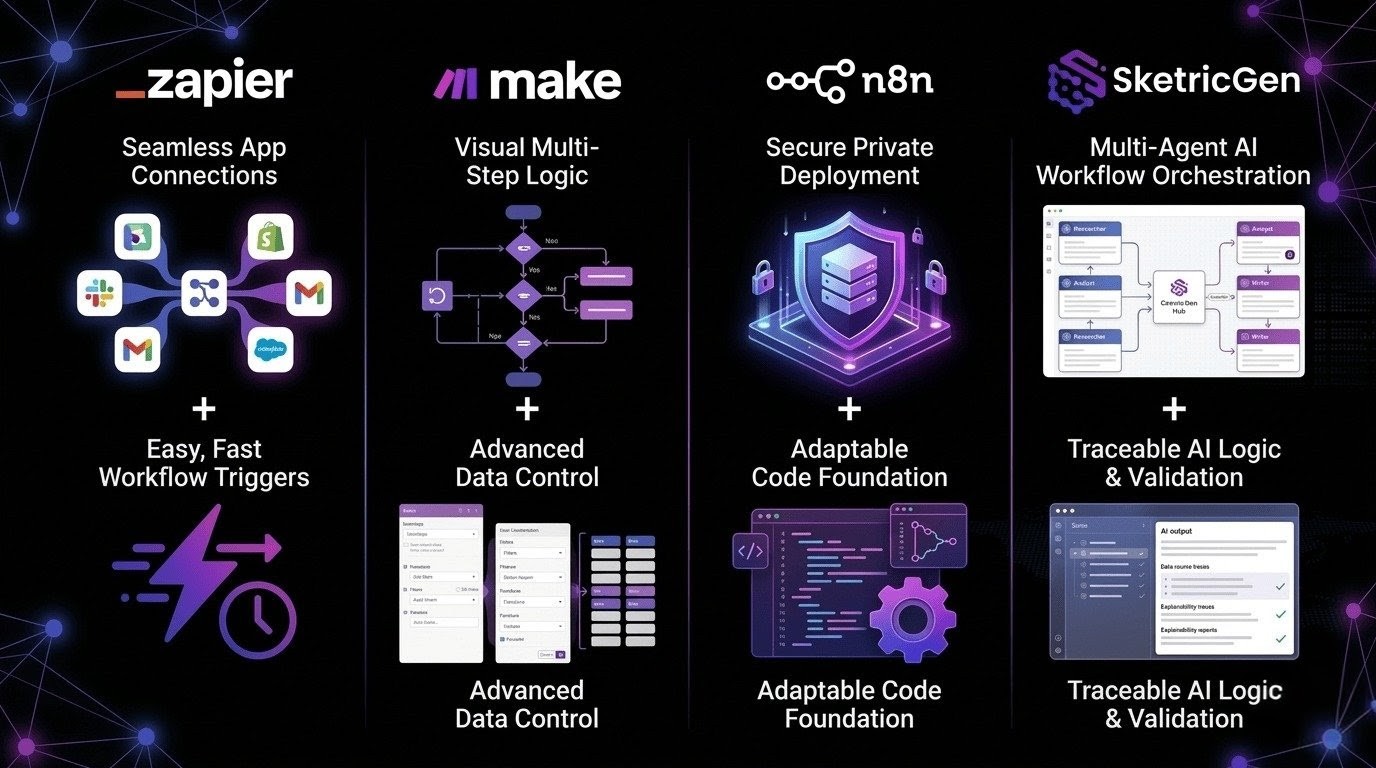
| Dimension | Zapier | Make | n8n | SketricGen |
|---|---|---|---|---|
| Core orientation | Classic automation + agent features | Visual automation | Developer-first automation | Multi-agent AI workflow runtime |
| Integration breadth | Very high | High | Moderate-to-high | High + MCP/custom tools |
| Self-hosting | No | No | Yes | No |
| Multi-agent orchestration | Limited | Limited | Custom/manual | First-class |
| Deployment focus | Internal automation | Internal automation | Developer-heavy | Product + channel deployment |
| Run visibility | Logs/history | Logs/history | Logs/history | Trace-style inspection |
What communities are saying
Community threads provide useful directional signals. And this is what relevant communities have to say;
Common themes include:
r/zapier– Agent reliability issues in complex scenariosr/nocode– Concerns about tool longevity and ecosystem volatility- Founder communities – Growing separation between internal automation and product-embedded AI
If your goal is customer-facing AI, prioritize orchestration and observability over raw integration counts.
Cost considerations
Pricing pages change frequently, so avoid hardcoding exact monthly estimates.
Instead, model workflows using:
- Average tool calls per run
- Monthly run volume
- Model usage per run
- Retry or failure rate
- Human review rate
Test one representative workflow on each platform for 7–14 days before you commit.
How to choose the right platform
Start with one core question:
Are you automating deterministic processes, or building agentic behavior?
When to choose Zapier
- You need speed and integrations
- Workflows are deterministic
- Budget is not the main concern
When to choose SketricGen
- Multiple agents collaborate
- Deployment via widget/API is required
- You need run traces for debugging
- Workflows are AI-first
When to choose Make
- Visual flow control is important
- Logic is complex but still deterministic
When to choose n8n
- You want self-hosting
- Your team can manage infrastructure
- Extensibility matters more than ease of use
Migration strategy
Migration does not need to happen all at once.
Use a split strategy:
- Keep stable deterministic automations where they are
- Move AI-native workflows that require orchestration
- Track reliability, latency, and cost for 30 days
- Expand only if results justify migration
This reduces disruption while giving you objective performance data.
Recommended next step
Run a controlled workflow comparison:
- Same input volume
- Same success criteria
- Same two-week testing window
Measure:
- Completion quality
- Latency
- Operator effort
- And very importantly unit cost
One real workflow test will tell you more than any feature checklist.
FAQs
Yes. For many deterministic automations, it remains one of the fastest ways to build workflows.
Sometimes. It depends heavily on operation counts and workflow structure.
For many technical teams, yes—but it requires operational ownership.
Not exactly. It is better viewed as a platform for AI-first, multi-agent workflows.
Comparing integration counts first instead of workflow behavior under production conditions.
Related Reads
Sources
How is Usage measured in Zapier
Related blogs
View more
AI Executive Assistant vs. AI Chief of Staff: The Difference That Actually Matters
comparisons
AI Email Assistant: Why Drafting Isn't the Problem (and What Actually Fixes Inbox Overload)
comparisons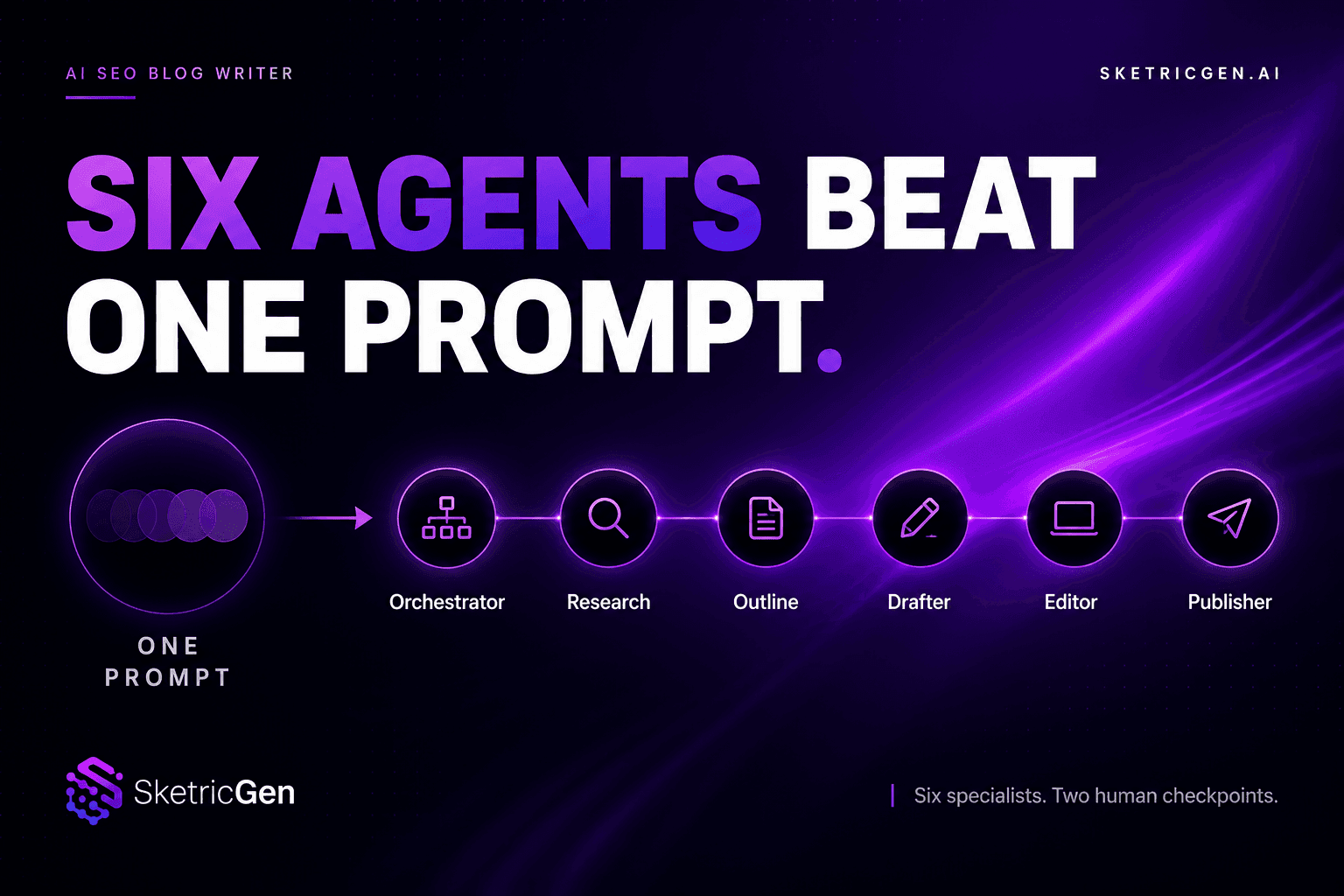
AI SEO Blog Writer: Six Agents Beat One Prompt
comparisons
OpenAI Agent Builder vs. Google Vertex AI Agent Builder vs. No-Code Alternatives (2026)
comparisons
Best AI Agent Builder for Small Business Teams (2026 Buyer's Guide)
comparisons