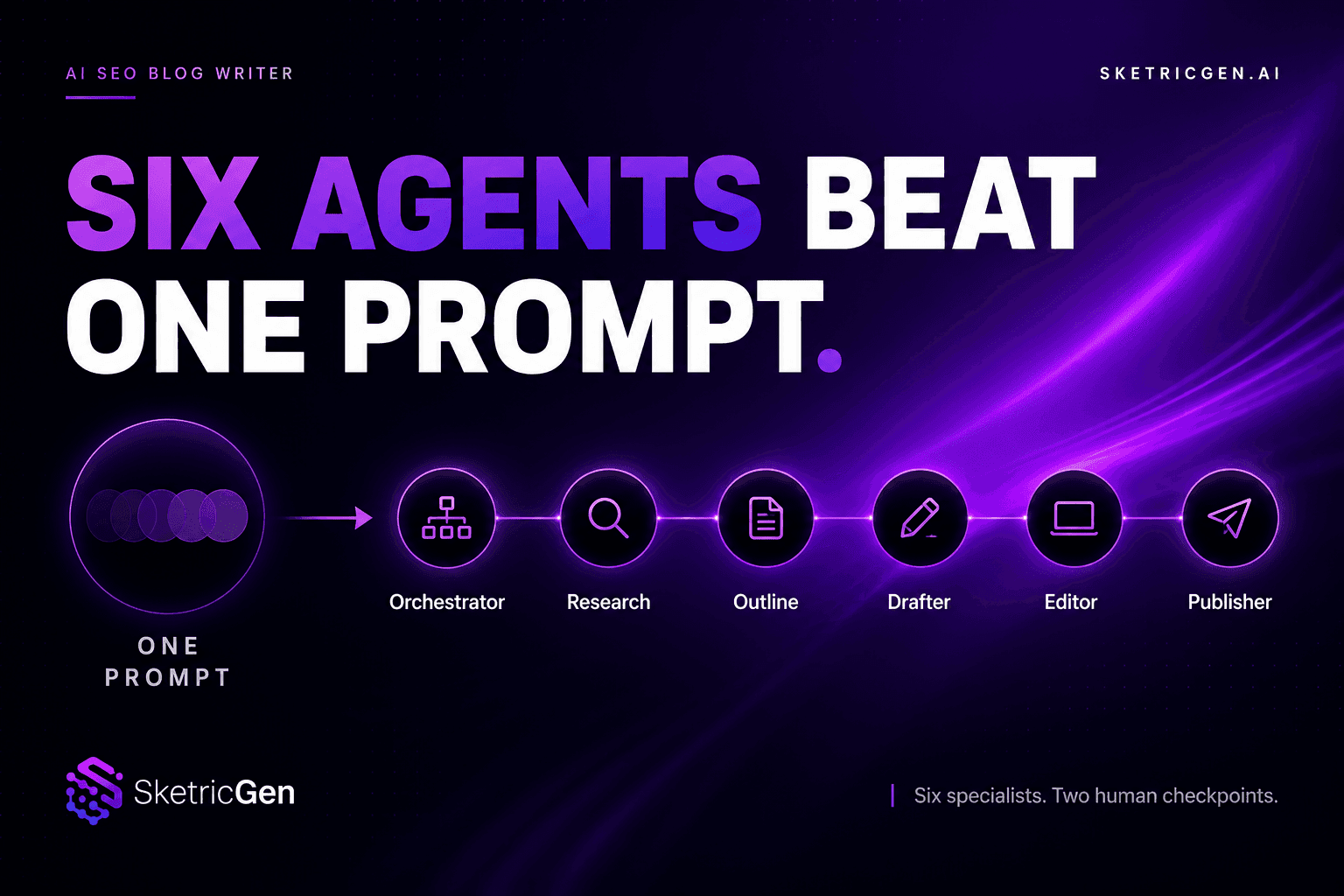
Best Make Alternatives for AI Workflow Automation in 2026
Most Make.com users do not leave because they hate Make. They leave because the scenario that worked at 500 runs a month quietly costs double at 5,000. Their new AI scenario eats a week of credits in an afternoon, and the "AI Agent" feature they were promised still cannot step outside the scenario it lives in.
That is the wall. It is why "make alternatives" is becoming one of the higher volume automation searches of 2026.
This guide is not a 13-tool listicle. It is 5 honest picks, routed by what your team actually looks like, with real pricing math and community signal from teams that already switched. One operator writing on aimaker.substack described moving to n8n after roughly a month because "the pricing is predictable and you know what bill you'll get." That is the call most of you are about to make.
Who This Is For
- Startup founders who built v1 automations on Make and now need AI agents, not scenario maps
- RevOps and operations leads watching per-operation costs balloon as workflows add AI calls
- SMB executives and non-technical leads evaluating tools their own team can actually own
Summary
- SketricGen is the closest one-for-one swap for Make users who want AI-native multi-agent workflows with a visual builder and trace-level debugging
- Gumloop is the best pick for small teams that want AI as the starting point, not a bolted-on module
- n8n remains the top choice for technical teams that want self-hosting and execution-based pricing
- Zapier still has the widest integration library and lowest learning curve for simple SaaS-to-SaaS flows
- Relevance AI is built for sales and GTM teams running multi-agent revenue workflows
- Make still wins for deterministic, integration-heavy ops with minimal AI and teams already fluent in scenarios
At-a-Glance Comparison
| Feature | Make.com | SketricGen | Gumloop | n8n | Zapier | Relevance AI |
|---|---|---|---|---|---|---|
| Pricing model | Credit/operation (from $10.59/mo) | Subscription tiers | Usage-based | Free self-hosted / Cloud from EUR 20/mo | Task-based (from $20/mo) | Actions + Vendor Credits (Free 200/mo, up to $349+) |
| Learning curve | Low for simple, steep for complex scenarios | Low (no-code) | Low (conversational) | Steep (technical) | Very low | Medium |
| AI-native agents | Agents only inside scenarios, no RAG | Built-in (Max + multi-agent orchestration) | AI-first from day one | LangChain nodes, manual wiring | Zapier Agents (maturing) | Multi-agent collaboration built-in |
| Visual builder | Scenario canvas | Drag-and-drop AgentSpace | AI-assisted canvas | Node-based canvas | Linear Zap builder | Logic builder |
| Text-to-workflow | Maia (very limited) | Max Agent Builder (full workflow) | Conversational | No | Copilot (limited) | No |
| Multi-agent orchestration | Not native | AI-routed + forced handoffs + agent-as-tool | Yes | Manual wiring | Limited | Built-in |
| Trace/debug visibility | Execution history | Full traces (handoffs, tools, latency, cost) | Run logs | Execution logs | Task history | Run logs |
| Integrations | 2,000+ apps | 2,000+ apps + MCP | Narrower, premium-in-sub | 500+ nodes | 8,000+ apps | 2,000+ apps |
| Self-hosting | No | No | No | Yes (open-source) | No | No |
| Best for | Integration-heavy deterministic ops | AI-native multi-agent, no-code | AI-first small teams | Technical teams w/ DevOps | Simple SaaS-to-SaaS | Sales/GTM agent teams |
Why Teams Are Looking Beyond Make.com
Four reasons keep surfacing across community threads, and they tend to stack.
Operation-based pricing punishes AI workflows
Make counts every module execution as one operation. A 10-step scenario running 1,000 times equals 10,000 operations, which is the entire Core plan ceiling for a month.
Add one AI step per run and operation counts climb faster because AI scenarios fan out: fetch context, reason, tool-call, write result. A Thinkpeak pricing audit documented "simple" Make scenarios burning up to $500 a month in wasted credits, largely because polling triggers are charged for every check even when no new data exists.
Compare that with n8n's execution-based model, which counts one execution per full workflow run regardless of node count, or SketricGen's subscription tiers that do not charge per tool call inside an agent.
Pro tip: Do this math before you pick. Take your busiest scenario, multiply steps by runs per month, then multiply by 3 for any AI step that fans out. That is your real operation count. If it exceeds your Core or Pro plan ceiling, you are paying for headroom on a platform that was not built for AI reasoning.Make's AI Agents still live inside scenarios
Make introduced AI Agents in April 2025, which was a real step forward for non-technical builders.
Here is the catch. Those agents only run as modules inside a scenario. They cannot function as standalone agents embedded elsewhere, they do not support RAG in the current release, and there is no native multi-agent orchestration. A Hatchworks comparison noted the same gap: Make's agents "can't function outside workflows or be embedded elsewhere and don't support RAGs yet."
That gap matters once you need an agent on your website, in WhatsApp, or collaborating with another agent on a different job.
Production monitoring is thin
In a production-readiness thread on the Make Community forum, a builder managing a 25k-person audience put the frustration plainly: "How can you in good faith ask clients to pay for a platform like this, if it has no good, automated systems for monitoring and rapidly solving issues like this?"
The specific friction: no warning indicator when scheduled scenarios stop running, no auto-recovery for incomplete executions, and manual remediation of each failed run. Annoying for internal automations. A liability for customer-facing ones.
The learning curve is real on complex scenarios
Make starts easy. Routers, iterators, aggregators, data stores, and error handlers accumulate as workflows grow. Teams hit a point where maintaining a scenario requires a specialist who thinks in Make primitives. Forum and Quora threads aggregating user sentiment keep surfacing the same pattern: easy first build, slow climb as complexity rises.
None of this makes Make a bad tool. It makes it a bad fit for a specific moment in workflow maturity.
When Make Still Wins
Three cases keep Make in the right column:
- Deterministic integration-heavy workflows with no AI reasoning step. Move a row from Airtable to Google Sheets, ping Slack, log to a CRM. Make handles that cleanly.
- Teams already fluent in Make's scenario model, routers, and data stores. Switching costs are real.
- Budget-only ops workloads under a few thousand operations a month where AI is not in scope. The Core plan at $10.59/mo is hard to undercut.
If your workflow map is mostly deterministic and your team is comfortable, stay. If even one of those is softening, keep reading.
The 5 Best Make Alternatives for AI Workflow Automation
1. SketricGen: Best for AI-Native Multi-Agent Workflows (No-Code)

SketricGen is a no-code AI workflow builder for the exact moment Make users hit: non-technical teams building multi-agent workflows that reason, call tools, and deploy to real channels.
What makes it different from Make:
Make starts with a blank scenario canvas. SketricGen starts with plain English. Max Agent Builder runs a short requirement-gathering conversation, then generates a complete multi-agent workflow in real time. You refine it visually on the AgentSpace canvas, adjusting agent roles, instructions, tools, and routing without code.
Key features:
- Text-to-workflow generation via Max, so you describe the outcome instead of wiring nodes
- Multi-agent orchestration patterns: AI-routed handoffs, designer-routed pipelines, and agent-as-tool reuse
- Trace-level debugging: every agent run, tool call, handoff, latency point, and cost is visible
- Multi-channel deployment: website widget, WhatsApp, Slack, API
- 2,000+ integrations plus native MCP support for tool use
- Structured inputs and outputs with typed schemas so data passes cleanly between agents
Pricing: Subscription-based with transparent tiers. No credit-burn model. See pricing.
Best for: Teams that want production-grade AI agent workflows with full visibility, without writing code or managing servers.
Tradeoffs: Smaller community ecosystem than Make or n8n. No self-hosting option. Strongest value appears when the workflow actually needs AI reasoning; deterministic-only ops teams will not feel the gap.
Pro tip: If you are coming from Make, start with a template for your most common workflow (lead routing, support triage, content ops). Customize it in AgentSpace. You will have a working multi-agent flow in minutes instead of rebuilding a scenario from scratch.Start with SketricGen | Browse templates
2. Gumloop: Best AI-Native Builder for Small Teams
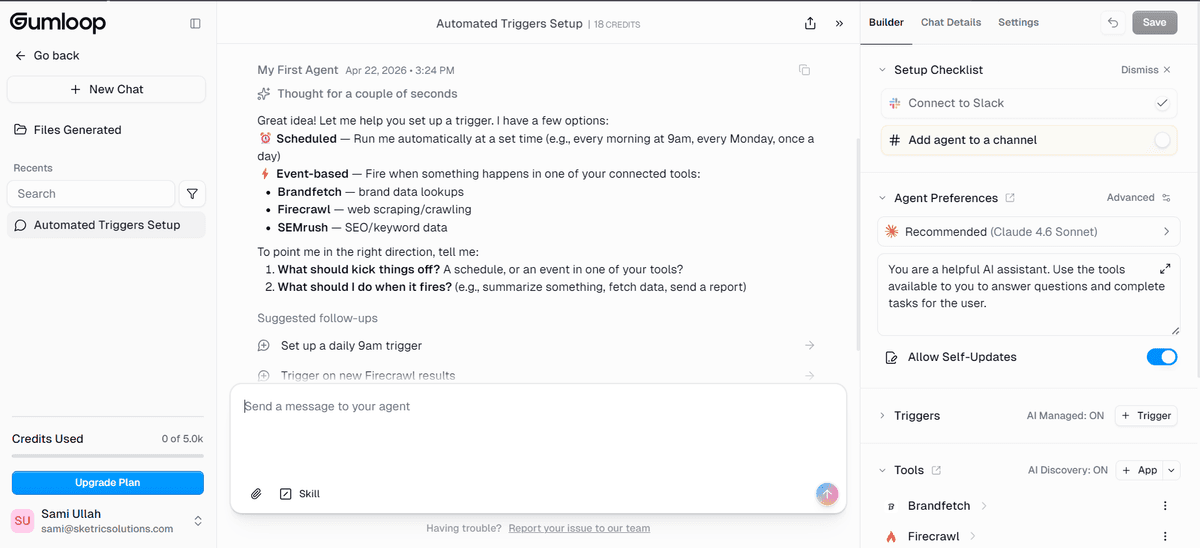
Gumloop is a no-code builder where AI was the starting point, not an add-on module. It fits small teams that want conversational agent building and premium AI integrations inside the subscription.
Key features:
- AI-first canvas designed for unstructured data, scraping, summarization, and enrichment
- Conversational builder that drafts workflows from chat
- Premium AI integrations (Claude, GPT-family) included in plan
- Strong fit for content ops, research, and enrichment flows
Best for: Marketing, research, and ops teams that need AI reasoning inside every workflow and want the simplest builder experience.
Tradeoffs: Narrower integration catalog than Make. Less suited for multi-channel agent deployment. Pricing still scales with usage.
A Gumloop editorial comparison put it plainly: "For Gumloop, integrating AI wasn't an afterthought, it was the main motivation behind building the product." That is the right mental model for Make users whose workflows are now AI-native.
3. n8n: Best for Technical Teams That Want Self-Hosting
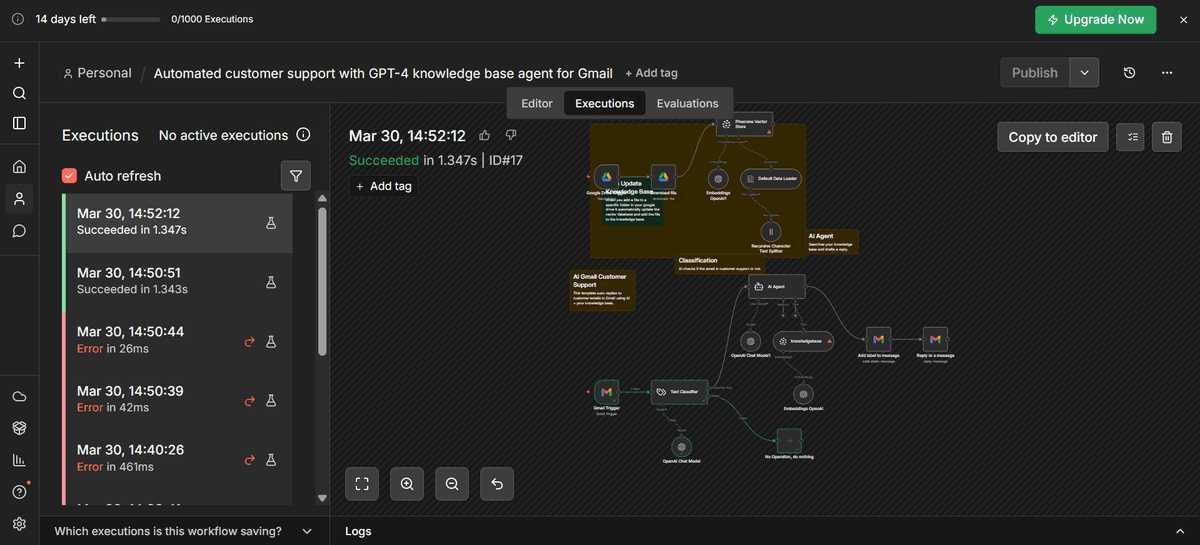
n8n is an open-source workflow automation platform with a node-based canvas, execution-based pricing, and strong AI agent support via LangChain nodes.
Key features:
- Self-hostable (the license is free; infrastructure is not)
- Cloud plans from EUR 20/month
- Execution-based pricing: one full workflow run equals one execution regardless of node count
- 500+ native integrations plus custom HTTP
- AI Agent node with ReAct-style reasoning, tool use, and built-in RAG support
Best for: Technical teams with DevOps capacity that need data-residency control, custom JavaScript injection, or deep API flexibility.
Tradeoffs: Steep learning curve for non-technical users. Agent workflows still require manual wiring of memory, prompts, error handling, and fallback flows. Self-hosted total cost of ownership typically lands between $200 and $500+/month once infrastructure and maintenance hours are included.
Decision rule: If your team has someone who can debug a Docker container at midnight, n8n is a solid pick. If that sentence made anyone flinch, it is not your tool.If you want the long version, see our n8n alternatives breakdown.
4. Zapier: Best for Integration Breadth and Simplicity
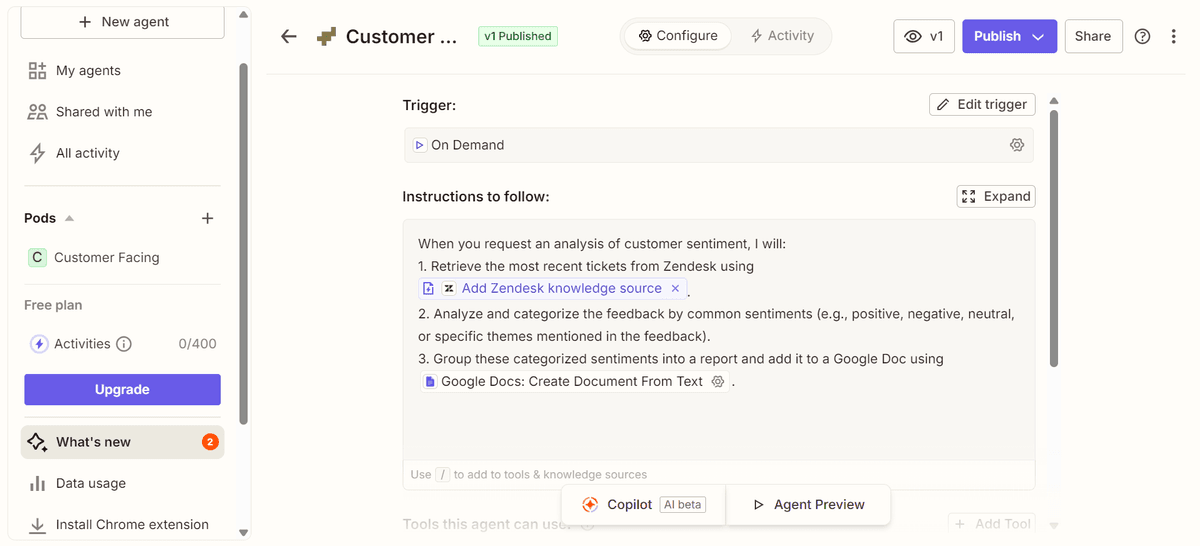
Zapier still carries the widest integration library in the space (8,000+ apps) and the lowest barrier to entry. If your main job is connecting SaaS tools fast, Zapier gets you there.
Key features:
- 8,000+ pre-built app integrations
- Zapier Copilot for natural-language Zap creation
- Zapier Agents for autonomous task execution across integrated apps
- Tables and Interfaces for lightweight internal tools
Best for: Non-technical teams and solopreneurs running simple SaaS-to-SaaS flows with minimal setup.
Tradeoffs: Task-based pricing scales fast on high-volume flows. Multi-agent orchestration is limited. Zapier Agents are maturing but not yet at the depth of purpose-built agent platforms. The linear Zap builder cannot handle the branching complexity of Make or SketricGen.
If Zapier's ceiling is your concern specifically, our Zapier alternatives guide covers that track.
5. Relevance AI: Best for Sales and GTM Agent Teams

Relevance AI is built for revenue teams running multi-agent workflows: one agent researches a prospect, hands off to another for outreach, another handles scheduling.
Key features:
- Multi-agent orchestration with shared context
- Actions + Vendor Credits pricing (BYO API keys to bypass Vendor Credits on paid plans)
- Vector database for knowledge retrieval
- Enterprise-grade security options
Best for: Sales, SDR, and GTM teams that want an AI workforce for prospecting, outreach, and research-heavy workflows.
Tradeoffs: UI is less intuitive than SketricGen or Gumloop. Pricing starts at a free 200-actions-per-month plan and scales to $349/mo Teams plus custom Enterprise. Costs can rise fast if agents run continuously.
Make vs n8n vs SketricGen
This is the head-to-head Make switchers search most. Here is the short version:
| Dimension | Make | n8n | SketricGen |
|---|---|---|---|
| Learning curve | Low-to-medium | Steep | Low |
| AI-native agents | Modules only, no RAG | Via LangChain, manual wiring | Built-in with orchestration |
| Multi-channel deployment | Limited (API/webhooks) | Limited (API/webhooks) | Website, WhatsApp, Slack, API |
| Pricing model | Per-operation | Per-execution | Subscription |
| Best for | Deterministic integration-heavy | Technical teams w/ DevOps | Non-technical, AI-native teams |
Verdict: Make if your workflows are deterministic and mature. n8n if you have a developer. SketricGen if you need AI agents in production without hiring for the stack.
Gumloop vs Relevance AI
Both are AI-native, but they aim at different jobs.
- Gumloop wins for unstructured data pipelines (content ops, scraping, enrichment) and conversational building
- Relevance AI wins for sales workforce patterns where agents collaborate on a single revenue workflow
- Pricing: Gumloop is simpler; Relevance splits Actions from Vendor Credits, which takes a read-through
- Deployment: Relevance leans API/embed; Gumloop wraps workflows into shareable apps
If you are deciding between the two: pick Gumloop for content and research, Relevance for pipeline, outbound, and sales agents.
How to Pick the Right Make Alternative
The right pick depends on the team and workflow shape you actually have.
| Your situation | Best pick | Why |
|---|---|---|
| Need AI-native multi-agent workflows without code | SketricGen | Max builds the orchestration, AgentSpace refines it, traces show what happened |
| Small team, AI reasoning in every workflow | Gumloop | AI-first canvas and premium integrations in-plan |
| Technical team, need self-hosting and data control | n8n | Open-source, execution-based pricing, LangChain integration |
| Need 8,000+ integrations with zero ramp | Zapier | Largest catalog, simplest builder |
| Sales/GTM, multi-agent revenue workflows | Relevance AI | Agent collaboration and shared context built in |
| Workflows are deterministic and your team knows Make | Stay with Make | The switching cost is not worth it |
Migration Strategy (for Make Switchers)

Do not rip and replace. Run a controlled swap.
- Audit one high-volume scenario for operation consumption. Count steps times monthly runs and add a 3x multiplier for any AI step that fans out.
- Rebuild that scenario on your chosen alternative. Most AI-native platforms will let you describe the outcome and skip node wiring.
- Run both in parallel for 14 days. Measure completion quality, latency, operator effort, and unit cost.
- Expand only if results justify. Keep deterministic Make scenarios where they are until you have proof.
One real workflow test tells you more than any feature table.
Mistake to avoid: Do not pick a Make alternative by integration count alone. Integration count does not predict whether the tool can handle the AI reasoning step inside your workflow. A 500-integration platform with real multi-agent orchestration beats an 8,000-integration platform with a linear builder on every AI workflow that matters.Author Take
If your workflow has even one AI reasoning step per run, you are not choosing an automation tool anymore. You are choosing an AI runtime. Pick accordingly.
Most Make users I have seen switch after a single pricing cycle where an AI workflow ate a plan and a half of operations in three weeks. That is the signal. Once you start running agents, the per-module pricing model and the "AI-as-add-on" architecture stop making sense.
Make is still a good automation tool. It was never designed to be an AI runtime. That is the difference to pick on.
Sources
- Make Community: Are you using Make.com in production?
- Thinkpeak: Make.com Pricing and Hidden Costs (2026)
- Lindy: Make.com Pricing breakdown
- Hatchworks: n8n vs Make for AI agents
- n8n blog: Best AI Workflow Automation Tools
- Gumloop vs Make
- aimaker.substack: Make vs n8n review
- Eesel: Make pricing breakdown
FAQs
Yes, if your workflows are deterministic and integration-heavy and your team is fluent with Make's scenario model. It remains one of the cleanest visual automation tools at lower volumes. If your roadmap includes AI agents, multi-channel deployment, or scenarios that reason rather than map, you will outgrow it. Compare with SketricGen or Gumloop for AI-native workflows.
n8n self-hosted has the lowest software cost (free), but production infrastructure and DevOps time often lands the real number at $200 to $500+/month. For managed platforms, SketricGen and Gumloop both offer starter tiers. Zapier is often cheaper at low volumes and scales fast once task counts grow.
Make introduced AI Agents in April 2025. They execute plain-language instructions inside scenarios. The limits: agents cannot run outside a scenario, no native RAG support, and no multi-agent orchestration layer. If your use case needs standalone agents or multi-agent handoffs, SketricGen or Relevance AI are closer to purpose-built.
n8n has stronger AI primitives (LangChain nodes, RAG, ReAct-style agent node) and execution-based pricing that scales better on multi-step AI flows. The tradeoff is technical depth: agents need manual wiring of memory, prompts, and error handling. Make's AI Agents are easier to configure but live inside scenarios. For teams that want AI-native without coding, SketricGen sits between the two.
For non-technical founders and ops leads, SketricGen and Gumloop are the closest fit. SketricGen's Max Agent Builder lets you describe a workflow in plain English and generates it. Gumloop's conversational builder does similar for AI-first ops flows. Both keep you out of the node-wiring that makes Make feel heavy at scale.
For AI-native workflows, yes, and it does so with native multi-agent orchestration, trace-level debugging, and deployment to website, WhatsApp, Slack, and API that Make does not offer natively. For purely deterministic integration-heavy workflows with no AI step, Make is still a clean pick. Most teams run a hybrid: keep stable Make scenarios, move AI-native workflows to SketricGen.
Related Reads
Related blogs
View more
7 SEO Automation Tools Compared (And the Reports They Actually Produce)
comparisons
9 Best AI Marketing Agents, Tested (2026)
comparisons
Agentic Marketing vs. Marketing Automation: Decision Framework
comparisons
AI Executive Assistant vs. AI Chief of Staff: The Difference That Actually Matters
comparisons
AI Email Assistant: Why Drafting Isn't the Problem (and What Actually Fixes Inbox Overload)
comparisons