n8n Just Ate Zapier's Lunch: 80% of Its New Mid-Market Customers Were Already Paying for Zapier
Who this is for: Ops leads, technical founders, and automation builders at mid-market companies who are evaluating their current automation stack. Or whose Zapier bill keeps climbing without a clear explanation.
Key Points
- YipitData's June 2026 analysis shows n8n grew its observed mid-market customer base from 12 to 122 in 12 months. That is 10x year-over-year.
- Nearly 80% of those new n8n customers were already paying for Zapier when they switched.
- n8n 2.0 (launched January 2026) shipped 70+ AI nodes, native LangChain integration, persistent agent memory, and self-hosted LLM support. It is a full AI agent platform now, not just a workflow automation tool.
- Zapier charges per task; n8n charges per workflow execution. A 10-node workflow running 10,000 times costs ~$370/month on Zapier and ~$24/month on n8n Cloud. That is a structural 90% cost gap.
- MCP (Model Context Protocol) is becoming the universal standard for how AI agents connect to tools. It makes Zapier's point-to-point Zap model look architecturally dated.
- SketricGen was already built on n8n and MCP-native infrastructure. This market shift validates that design decision rather than creating it.
At a Glance: n8n vs. Zapier in 2026
| Zapier | n8n | |
|---|---|---|
| Pricing model | Per task (each step billed separately) | Per workflow execution |
| Cost: 10k runs, 10-node flow | ~$370/mo (100k tasks billed) | ~$24/mo |
| AI agent support | Add-on (Zapier Agents, Canvas) | Native (70+ AI nodes, LangChain, memory) |
| Self-hosting | No | Yes |
| Open source | No | Yes (fair-code license) |
| Native integrations | 8,000+ | 400+ (unlimited via HTTP/API) |
| Local/self-hosted LLMs | No | Yes (Ollama, any OpenAI-compatible endpoint) |
| MCP support | Limited | Native MCP hub |
| Best fit | Non-technical teams, fast setup | Technical teams, AI-native workflows, scale |
Sources: HatchWorks 2026 comparison · Zapier pricing · n8n pricing
The Numbers: What Just Happened
The data is from YipitData's mid-market automation study, published June 2026. Worth reading in full, but the core numbers:
- n8n grew from 12 to 122 observed mid-market customers between January 2025 and January 2026.
- That is 10x growth in 12 months.
- 80% of those new n8n customers were already paying Zapier at the time of the switch.
These were not teams brand-new to automation. They were teams that had built on Zapier, hit a ceiling, and moved.
Zapier still holds nearly half the mid-market and continues to grow, just at single-digit rates year-over-year. The migration direction is not ambiguous. n8n is winning replacement decisions 2:1 over reversions, per the same dataset.
The Pricing Problem Zapier Cannot Fix
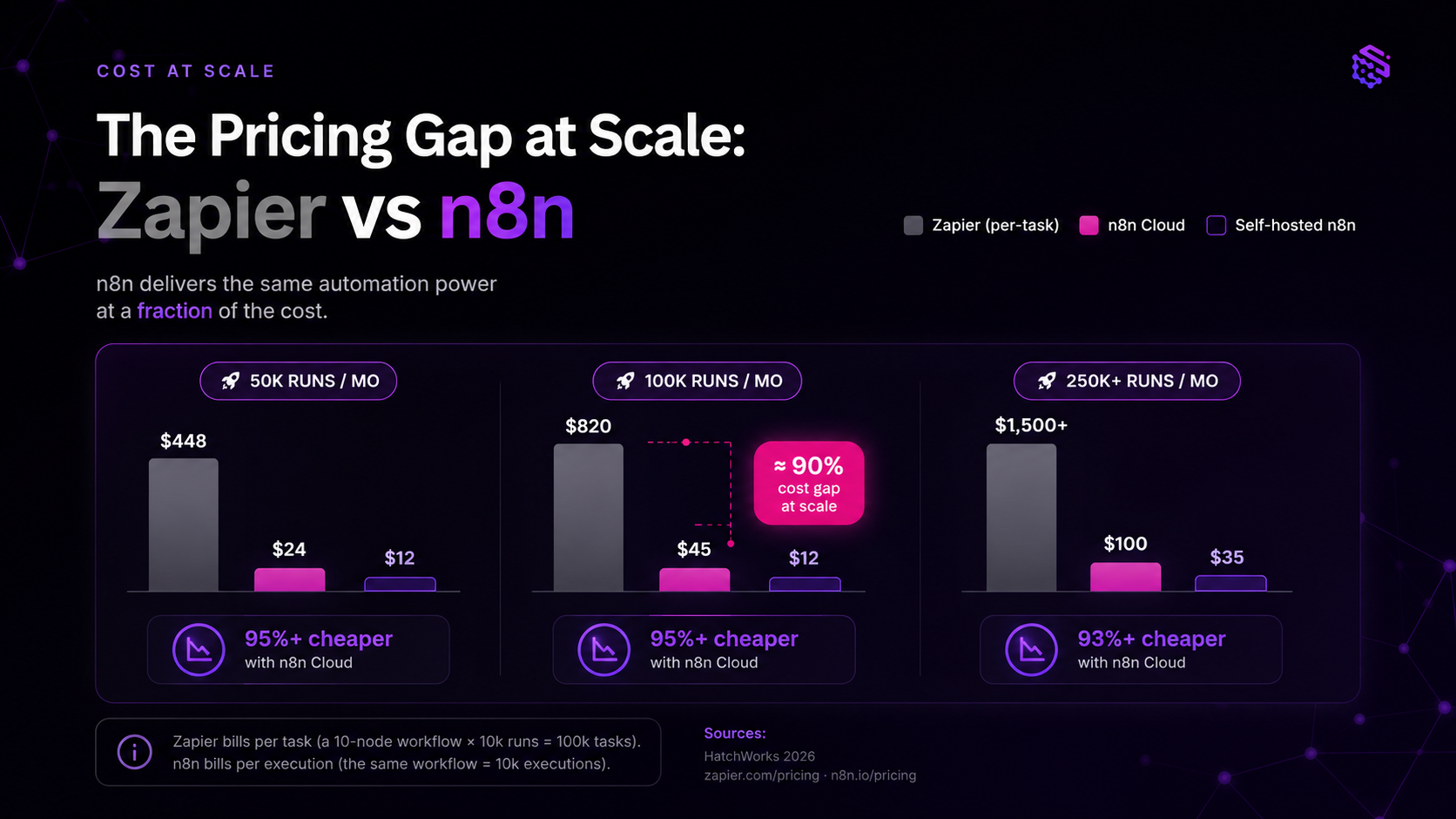
Zapier bills per task. Every individual step inside a Zap counts as one task.
A 10-step workflow running 10,000 times a month = 100,000 tasks billed. On n8n, that same workflow running 10,000 times = 10,000 executions billed. One execution per run, regardless of how many nodes are inside.
| Monthly volume | Zapier (Team: $448.50/mo, 50k tasks) | n8n Cloud | Self-hosted n8n |
|---|---|---|---|
| 50,000 runs | ~$448/mo | ~$24/mo | ~$5-20/mo (VPS) |
| 100,000 runs | ~$820/mo (overages apply) | ~$40-50/mo | ~$5-20/mo (VPS) |
| 250,000+ runs | $1,500+/mo | ~$100/mo | ~$20-50/mo (VPS) |
Sources: HatchWorks pricing analysis · Zapier pricing page · n8n pricing page
What practitioners are saying: Across r/nocode and r/automation threads on Zapier alternatives, the most common complaint about Zapier is not missing features. It is the bill. One r/nocode user put it plainly: "$49/month for 750 tasks for basic stuff like forms → sheets → email." Another reported watching their bill climb from $10/month to over $750 when their workflow volume scaled. The pricing model was not designed for complex multi-step workflows at volume, and it shows.
The deeper issue: as AI gets added to workflows, task counts multiply. Every reasoning call, every tool invocation, every data transformation adds to Zapier's counter. n8n charges the same one execution regardless of what happens inside that execution. The divergence accelerates the more complex your automations become.
What n8n 2.0 Actually Shipped
Cost savings alone would not drive a 10x migration. Something changed on the product side, and it is worth being specific.
n8n 2.0 launched January 2026 and turned the platform into a full AI agent development environment. Key additions:
- 70+ AI nodes: Chains, Agents, Memory, Vector Stores, and model-specific nodes built natively into the canvas
- Native LangChain integration: LangChain primitives (tools, memory, output parsers) wrapped in the visual workflow builder
- Persistent agent memory: WindowBuffer and SummaryBuffer memory across sessions, critical for use cases like sales follow-up sequences or multi-session support agents
- Vector store support: Pinecone, Qdrant, and Supabase connections for RAG workflows
- Self-hosted LLM support: Ollama integration and any OpenAI-compatible endpoint
- Multi-model execution: OpenAI, Anthropic Claude, Mistral, Google Vertex AI supported natively
This is AI as the primary build surface. Not a plugin, not an API call bolted onto a Zap. The agent memory feature alone enables use cases that Zapier's stateless trigger-action model structurally cannot support. For example, an agent that remembers what it learned about a lead across three separate interactions.
For teams building on SketricGen's AgentSpace canvas: this is the same underlying infrastructure. The n8n 2.0 upgrade validates the architecture that SketricGen ships on.
MCP: The Reason This Shift Is Permanent
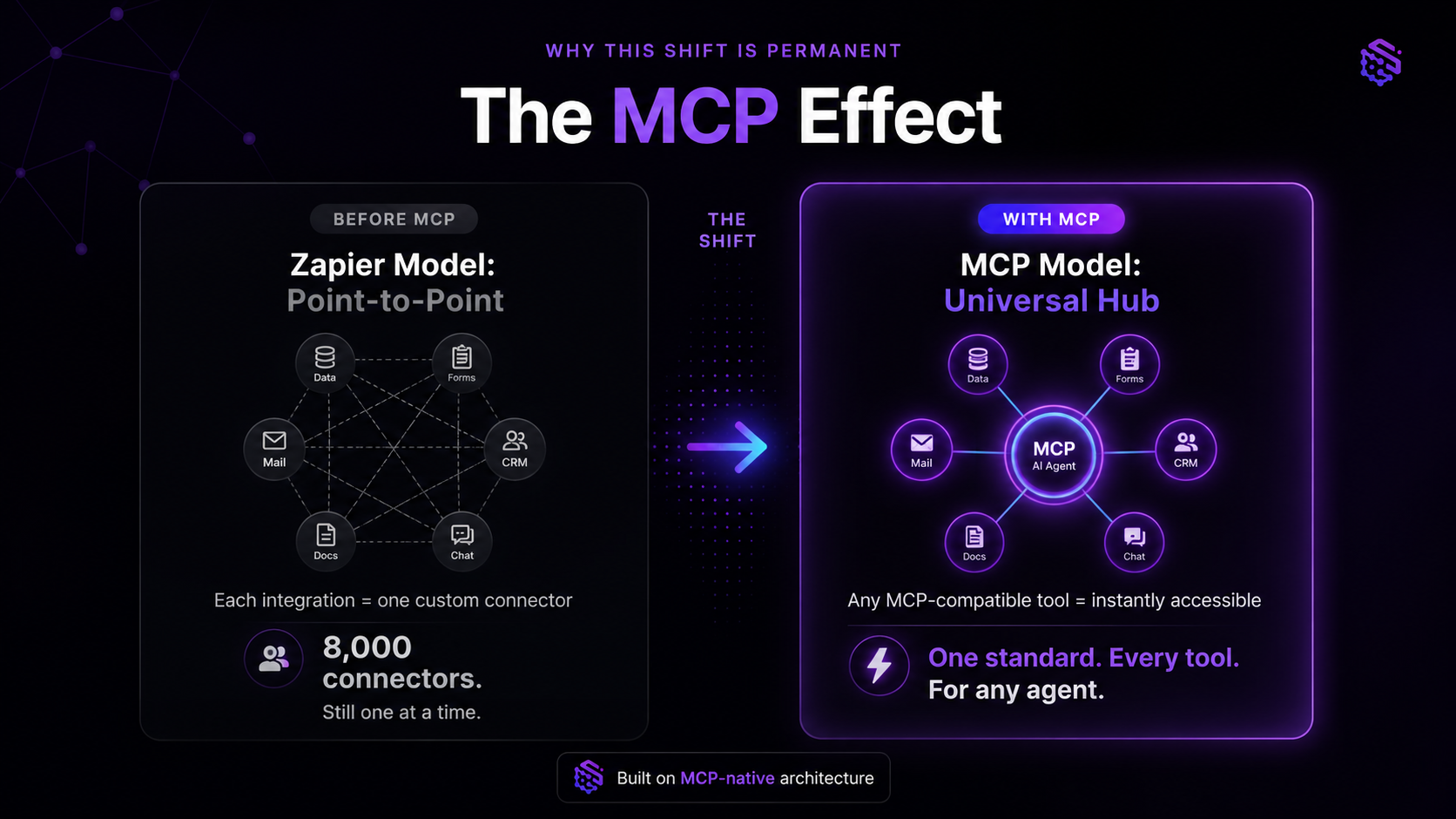
Model Context Protocol (MCP) was developed by Anthropic and released as an open standard in late 2024. In 2026, it has become the universal standard for how AI agents connect to tools and data sources.
The change in practical terms:
- Before MCP: each integration required a bespoke connector. Zapier's entire business model is built on owning this connector layer across 8,000+ apps.
- With MCP: AI agents access tools through a universal interface. Any MCP-compatible tool is discoverable and callable by any MCP-capable agent. No bespoke connector required.
n8n is now functioning as a native MCP hub. Claude, Lovable, Cursor, and other AI clients can access n8n workflows directly through MCP. Your n8n automation layer becomes a collection of addressable services, not a chain of manually wired triggers.
Zapier's Zap model assumes you define in advance which two apps connect and exactly what should happen. MCP assumes an AI agent will decide dynamically what tools it needs based on context. These are different architectures for different assumptions about how automation runs.
The teams moving to n8n are not just arbitraging cost. They are building on a standard that will compound.
What SketricGen Users Already Know
SketricGen was built on n8n and MCP-native architectures from day one. The market data from YipitData is validating that design decision, not prompting a pivot toward it.
For teams building on SketricGen, this means:
- Native MCP tool connections: agents access any MCP-compatible service dynamically, without a custom connector for each
- Multi-agent orchestration: AI-routed and deterministic handoffs, not a static pipeline of triggers
- Prompt-to-workflow generation: Max Orchestrator turns a plain-English brief into a working multi-agent workflow, built in real time on the canvas
- 2000+ app integrations: connected across the agent tool layer, with no per-task billing inside agent runs
- Full trace visibility: inspect exactly which agents ran, what tools were called, where latency happened, and iterate from there
SketricGen is not "n8n with a better UI." It is an AI-first agent builder that sits on top of this architecture and removes the infrastructure management, the node complexity, and the learning curve, while preserving the structural advantages that make n8n worth building on.
The SketricGen template library has ready-to-deploy agent workflows for sales qualification, customer support, content ops, and operational automation. No server setup required.
Zapier's Response: Is It Enough?
Zapier has not been standing still. In 2025 and early 2026, they launched:
- Zapier Agents: AI teammates that run Zap actions autonomously
- Zapier Canvas: drag-and-drop agent builder interface
- Zapier Tables: structured data layer for workflow context
- AI Copilot: natural language Zap creation from a prompt
These are real products. The Copilot works well for simple use cases. Canvas is a polished builder. For non-technical users who need AI-assisted automation without touching code or JSON, Zapier's direction is sensible.
The structural constraint has not changed, though. Every action inside a Zapier Agent workflow still counts as a task. Zapier Agents inherit the same per-task billing model. Adding an AI decision layer on top of the Zap engine does not change how the engine bills.
Zapier's long-term path is to own the non-technical, no-code market, and they do that well. The segment they are losing is the technical, AI-native, high-volume segment, which happens to be the fastest-growing one right now.
Decision rule: Simple automations (form triggers CRM update, which triggers a notification): Zapier works fine. Workflows involving AI reasoning, multi-step logic, high run volumes, or sensitive data you cannot route through a third-party SaaS: n8n is the right foundation. Want the AI-native architecture without managing infrastructure yourself: SketricGen is built for that.
Author Take - Sam
I have tracked the automation market since the "everyone should have Zapier" era. The thing that is different now is not that n8n is cheaper. It is that the unit of work has changed.
Two years ago, a typical automation was: form submitted, update CRM, send email. Three steps. Per-task billing barely mattered.
Now the same team is building: form submitted, agent evaluates lead quality against CRM history and website behavior, routes to a different follow-up sequence based on that evaluation, writes a personalized outreach draft, and logs everything. That is not three tasks. That is fifteen, minimum, and it runs thousands of times a month.
Per-task pricing was not designed for agents. It was designed for Zaps. The teams that realized this are the ones showing up in the YipitData migration data.
SketricGen was built on the assumption that this shift would happen. The data is confirming it faster than expected.
What to Do Next
The automation market is restructuring around AI agents and MCP. The question for your business is whether your current automation infrastructure can support the workflows you will need to run 12 months from now.
If you are evaluating options, start with the SketricGen template library. Deploy a working AI agent workflow in minutes: lead qualification, customer support, content automation. No server setup required.
For a broader view of the platform landscape, see the best Zapier alternatives for AI automation in 2026 and the leading n8n alternatives for no-code AI agent building on the SketricGen blog.
FAQs
Yes, meaningfully so. n8n requires understanding node-based logic, JSON data structures, and for self-hosted deployments, infrastructure management. Zapier is faster to get started with for simple automations. The tradeoff is straightforward: n8n's complexity comes with genuine power for AI-native, high-volume workflows. For teams that want n8n's architecture without that learning curve, SketricGen layers a visual no-code AI agent builder on top of the same infrastructure.
Because it charges per task. Every individual step in a Zap counts separately. A 10-step workflow running 1,000 times = 10,000 tasks billed. On n8n, that same workflow = 1,000 executions billed, regardless of how many steps are inside. The cost gap compounds as workflow complexity increases. See Zapier's pricing page and n8n's pricing page for current tier figures.
n8n 2.0 launched in January 2026. It added 70+ AI nodes, native LangChain integration, persistent agent memory, vector store connections, and self-hosted LLM support via Ollama. It is the version that turned n8n from a workflow automation tool into a full AI agent development platform. FinByz Tech has a detailed feature breakdown if you want specifics on the LangChain integration.
MCP is an open standard from Anthropic that defines how AI agents connect to external tools and services. Instead of requiring a separate connector for each tool, MCP provides a universal interface that any MCP-compatible agent can use to discover and call any MCP-compatible tool. It launched as an open standard in late 2024 and has been adopted widely across the AI ecosystem in 2026. WorkOS has a clear team-oriented overview if you are evaluating it for your stack.
Not likely. It holds nearly half the mid-market and continues to grow. It is the right tool for non-technical users who need simple app-to-app connections without developer involvement. The more accurate framing: Zapier and n8n are no longer competing for the same customer. Zapier owns the no-code business-user segment; n8n owns the AI-native technical segment. The two are diverging, and the technical segment is currently growing faster.
If your team has developer capacity, processes high automation volumes, or is building AI-agent workflows: n8n is worth a serious evaluation. If you want the AI-native architecture without managing infrastructure, SketricGen's multi-agent platform is built on that same foundation with a visual no-code layer on top. Compare plans on the pricing page to see which fits your scale and technical profile.
Related blogs
View more
The Claude "CEO" Experiment: What Project Vend Actually Proves About AI Agents
ai agent news
Cisco Gave 90,000 Employees an AI Agent - the Same Month It Cut 4,000 Jobs
ai agent news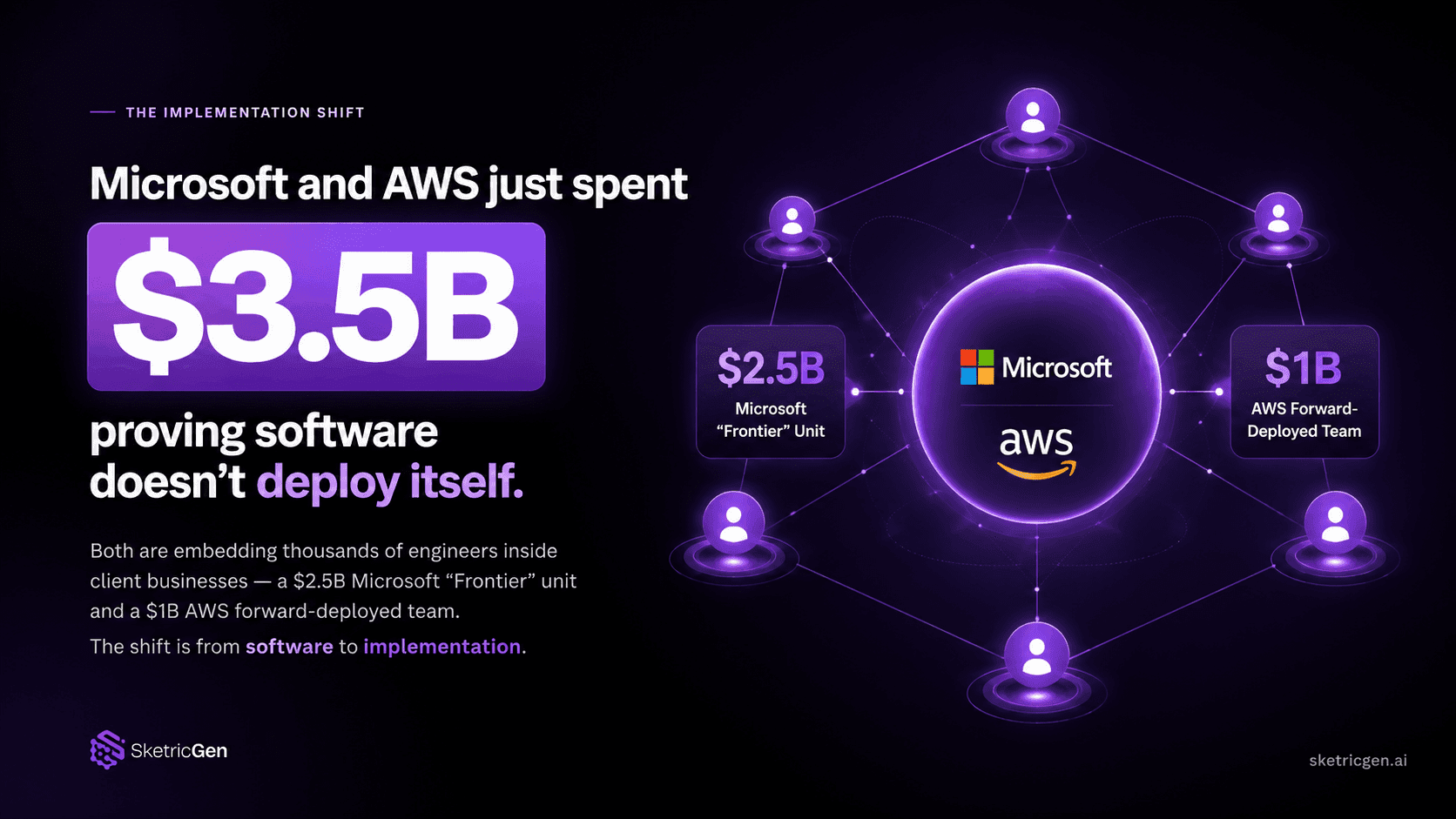
Microsoft and AWS Just Spent $3.5B Proving Software Doesn't Deploy Itself
ai agent news
Microsoft Scout: The AI Agent That Just Changed the Rules
ai agent news