OpenAI Agent Builder vs. Google Vertex AI Agent Builder vs. No-Code Alternatives (2026)
If you searched for OpenAI Agent Builder or Google Vertex AI Agent Builder, there's a good chance someone recommended one of them and you don't have an engineer to actually build it. That's the exact gap this post covers.
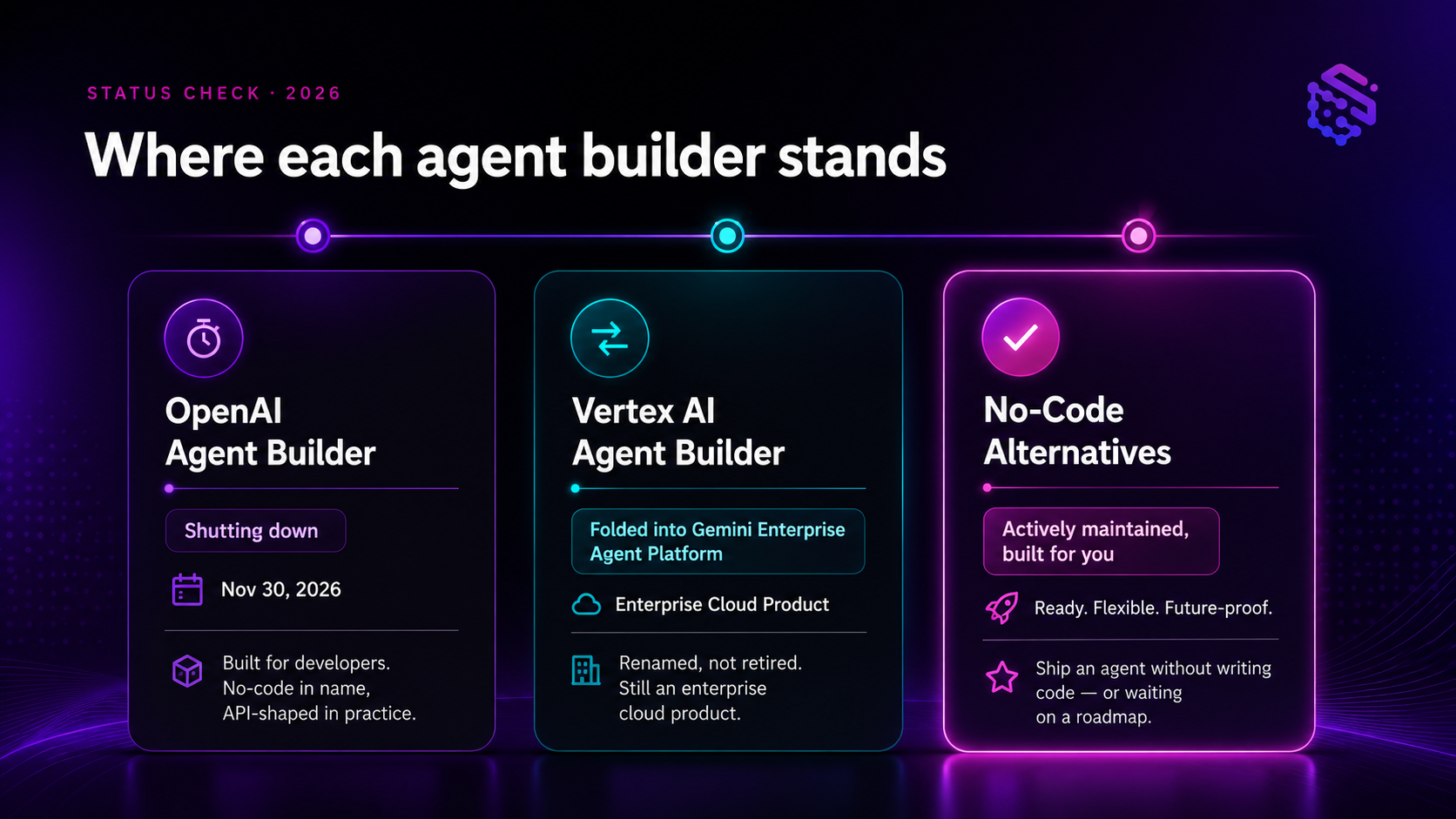
Here's the short version: OpenAI is shutting Agent Builder down on November 30, 2026. Google isn't killing Vertex AI Agent Builder, but it's folding it into a new platform with a new name. Both were built for developers first, with a no-code layer added on top. If you don't have engineering headcount, there's a longer list of tools built for you specifically, and we'll walk through it.
Tested against real Reddit and Quora threads from teams who tried these tools without an engineer on staff, not just vendor documentation.
Who this is for
- You found OpenAI Agent Builder or Google Vertex AI Agent Builder through a recommendation, a tutorial, or your own research, and you don't have an engineer available to build or maintain it.
- You're trying to decide whether to learn one of these tools, hire someone, or use a no-code alternative instead.
- If you're already comfortable in OpenAI's Agents SDK or Google's Agent Development Kit (ADK), this post isn't for you. Go straight to the official docs.
Key Points
- OpenAI announced on June 3, 2026 that Agent Builder is being wound down, with a shutdown date of November 30, 2026.
- Google isn't shutting down Vertex AI Agent Builder. It's folding it into the new Gemini Enterprise Agent Platform, which is why search results for the old name now point to a different product page.
- Both tools were dev-first products with a no-code layer on top, not no-code products built from the ground up.
- The real list of no-code alternatives is longer than n8n, Make, and Zapier. Tools like Lindy, Relevance AI, and Microsoft Copilot Studio solve different jobs.
- More automation doesn't automatically mean more leads. Targeting and governance matter more than volume, according to teams who've actually run these campaigns.
At a glance
OpenAI Agent Builder, Vertex AI Agent Builder, and no-code alternatives all promise the same outcome: build an AI agent without writing a full application. In 2026, only one of those three categories is stable enough to bet a quarter of work on without a backup plan. Here's how they compare on status, audience, and the no-code claim itself.
| Category | OpenAI Agent Builder | Vertex AI Agent Builder | No-code alternatives |
|---|---|---|---|
| Current status | Shutting down November 30, 2026 | Folded into Gemini Enterprise Agent Platform | Actively maintained (varies by vendor) |
| Built for | Developers, with a visual canvas layer | Enterprise dev/ML teams, with a low-code layer | Non-technical operators from day one |
| "No-code" claim vs. reality | Canvas is no-code; deployment, auth, and monitoring are not | Agent Designer canvas exports to ADK, which is code | Varies. Some are genuinely no-code end to end (Lindy, Relevance AI); others are workflow-first tools with agent features bolted on (Zapier, Make, Copilot Studio) |
| Hosting/infra | OpenAI-hosted, being retired | Google Cloud, ongoing | Vendor-hosted, no infra to manage |
| Biggest gap for a non-technical team | No one left to migrate you before November 2026 | Rebrand confusion; still assumes dev familiarity with ADK for anything custom | Fewer raw integrations than n8n/Make in some cases; pick based on the specific job, not the logo |
What is OpenAI Agent Builder, and is it being shut down?
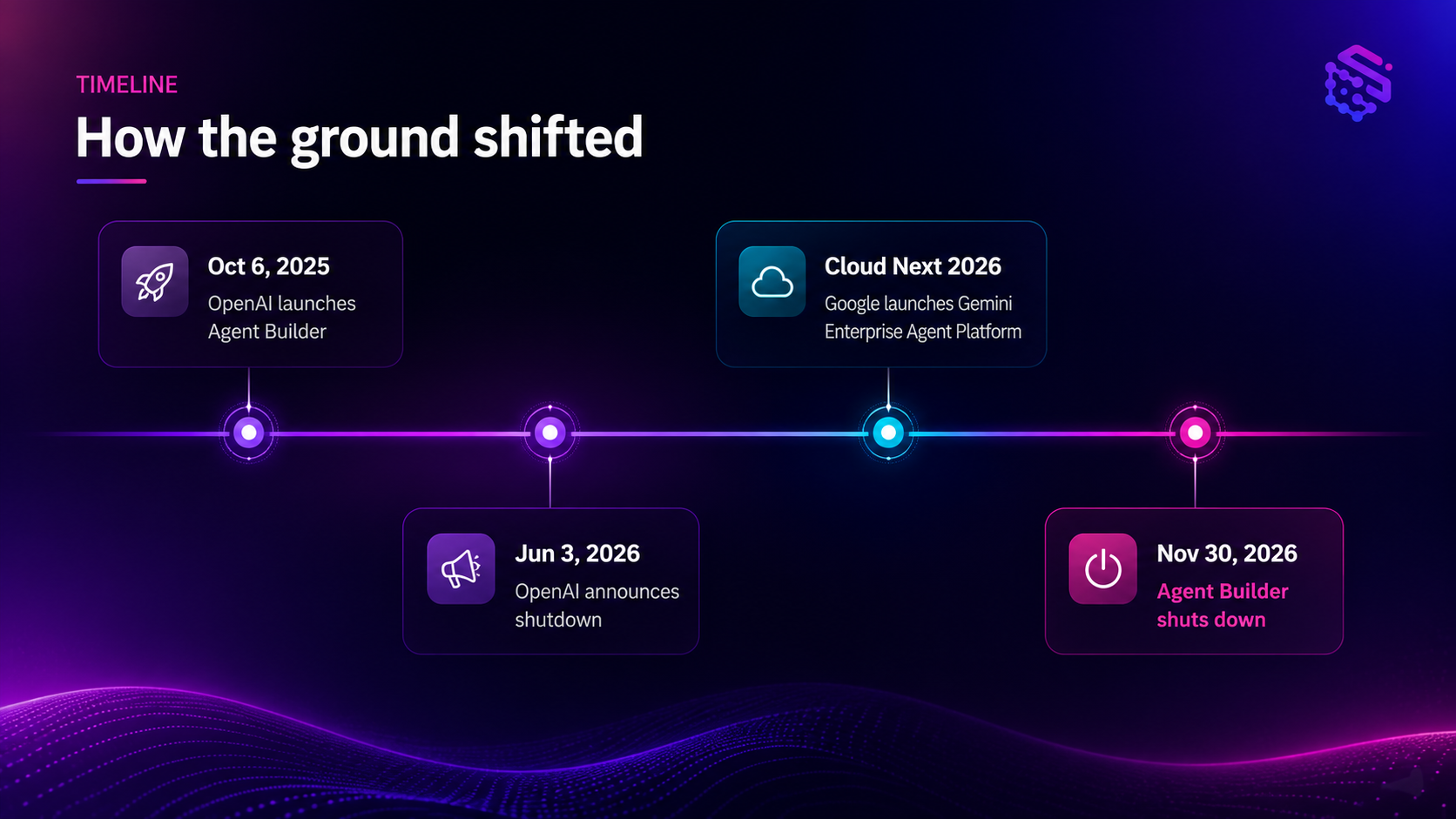
Yes. OpenAI announced on June 3, 2026 that Agent Builder is being wound down, with a hard shutdown date of November 30, 2026. OpenAI launched Agent Builder at DevDay on October 6, 2025, as the centerpiece of AgentKit, a visual canvas for composing agent workflows with drag-and-drop nodes, connected tools, and guardrails. Less than a year later, OpenAI's own deprecation notice confirmed the product is being retired.
OpenAI's recommended migration paths are the Agents SDK, for workflows that should stay in code, or Workspace Agents in ChatGPT, for use cases better suited to natural-language prompting. ChatKit, the embeddable chat widget, and the Connector Registry are not affected by this deprecation.
Here's the part that matters if you don't have an engineer: even the canvas version of this tool required someone to connect tools and APIs, handle authentication, and monitor what happens when a step fails. That was true before the shutdown announcement, and it's a big reason OpenAI is retiring the hybrid approach in favor of code-first and prompt-first tools instead.
Pro tip: If a tool's own vendor tells you to go back to code less than a year after launch, that's a signal the no-code layer wasn't the actual product. Read the fine print on any agent builder's roadmap before you invest a quarter building on it.
What is Google Vertex AI Agent Builder, and is it still called that?
Not exactly. Google hasn't discontinued Vertex AI Agent Builder, but it has folded the product into the newly launched Gemini Enterprise Agent Platform, announced at Cloud Next 2026. If you search for the old name, the top organic result now points to the new product page. This is a rebrand and repositioning, not a shutdown, but it's confusing if you landed on the old name expecting a stable product to learn.
The new platform bundles the code-first Agent Development Kit (name it once: ADK), a low-code visual builder called Agent Studio, access to 200-plus foundation models, a managed runtime, and enterprise governance tools into one product. The visual builder is real, and it can export what you design into ADK, which is code. For anything beyond the basics, that export step is where you need a developer again.
For a non-technical team, the practical answer is: the product you were looking for still exists. It just has a new name and a bigger scope, and it still assumes a developer will finish anything custom.
Why these tools are a rough fit for a team with no engineers
Both tools get you to a working demo fast. Neither gets you to a production-ready agent without someone who can debug what happens when a tool call fails, manage API credentials, and set up basic monitoring. That's an engineering job, even when the interface says "no-code."
One Redditor who tested OpenAI Agent Builder alongside Lindy, MindStudio, and Dify put it plainly in a head-to-head comparison thread: building an agent MVP is a three-step process now (define the job, build it, ship it to five or ten real users), and the process matters more than which tool you pick. That's true, but the "build it" step is exactly where a non-technical team gets stuck on a dev-first tool, because building it well means understanding what the canvas is abstracting away, not just what it's showing you.
Decision rule: If you can't explain what happens when a tool call fails in your agent, you're not ready to run it in production. Either get an engineer involved, or pick a tool built to handle that failure mode for you by default.
For more on how "agent builder" and "agent platform" differ as categories, see our breakdown of AI agent platforms vs. agent builders.
No-code alternatives that actually fit
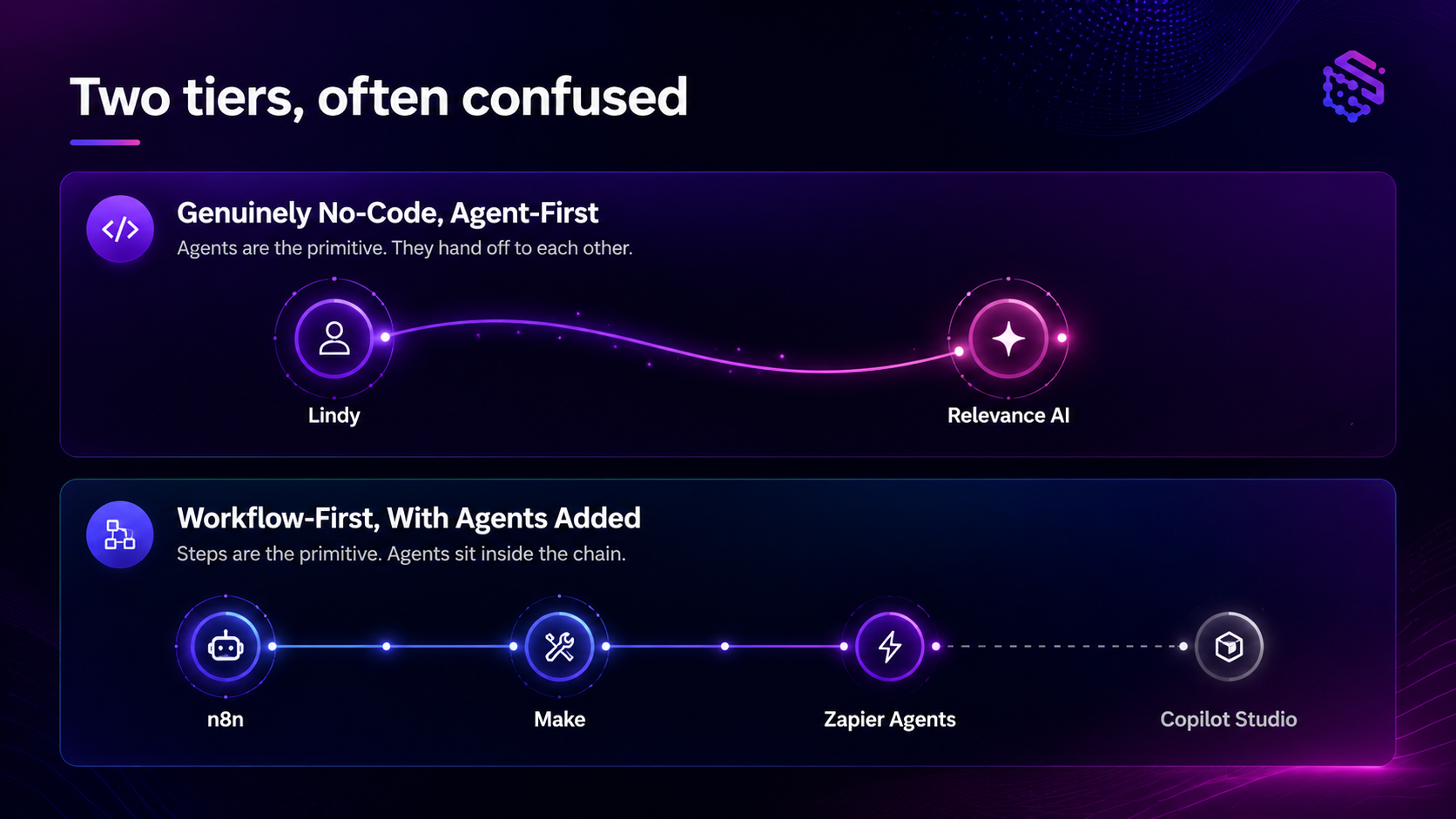
A Reddit thread ranking no-code AI agent builders by tier draws a useful line that most comparison articles skip: some tools are genuinely no-code end to end, and some are workflow automation tools with agent features added on. Both categories are useful. They solve different jobs.
Genuinely no-code, agent-first:
- Lindy: plain-English agent setup with a large integration library. Strong if you want to describe the job in a sentence and let the tool figure out the steps.
- Relevance AI: built around multi-agent handoffs, where one agent passes work to another. Useful for multi-step internal processes.
Workflow-first, with agent features added:
- n8n, Make, Zapier Agents: huge integration breadth. Strong if your job is mostly moving data between tools and taking an action, with an agent step somewhere in the middle.
- Microsoft Copilot Studio: a strong fit specifically if your team already lives in Microsoft 365 and Teams.
A law firm's lead-intake automation is a good example of the workflow-first category working well: an AI intake agent pre-screens callers and syncs bookings to a calendar through n8n, and the firm reported a 40% drop in no-shows. That's a workflow-first job (screen, classify, book), not a multi-agent handoff job, and the tool choice matched the job.
Want to see a lead-capture agent already built for this kind of job? Check out the web lead extractor template to see what a working setup looks like before you build your own.
For a longer list with more tools tested side by side, see our full breakdown of the best no-code AI agent builders, and if your team already relies on workflow automation, our n8n alternatives guide covers tools that don't require a workflow engineer either.
Where SketricGen fits (and where it doesn't)
To be direct about this: SketricGen is one option in the genuinely-no-code category, not the only one, and it's not the right fit for every team.
SketricGen splits into two things depending on the job. Brand Agents are built for customer-facing work, the kind of agent a website visitor or a customer talks to directly. AI Workforce is built for internal operations, with sub-agents, a file workspace, and a code interpreter for the kind of multi-step internal task a team would otherwise hand to a person. Both are set up through plain-language configuration inside a Teamspace, not a coding environment.
Where SketricGen is a strong fit: a non-technical team that wants an agent built for a specific customer-facing or internal-ops job without touching a workflow canvas or writing code.
Where it isn't: if your team already lives entirely inside Zapier, Make, or n8n and just wants to bolt an agent step onto an existing workflow, a workflow-first tool will feel more familiar and won't ask you to rebuild what you already have. If you need the largest possible integration count on day one, Lindy or n8n currently have more raw connectors.
For a deeper look at how lead-generation agents specifically should be structured, see our AI agent lead-generation playbook.
Common mistakes teams make picking a builder without engineers
Mistake 1: Assuming "no-code UI" means "no maintenance." A no-code canvas removes the need to write syntax. It doesn't remove the need to notice when an agent starts failing, or to update a prompt when a business rule changes. Budget time for upkeep regardless of which tool you pick.
Mistake 2: Chasing full autonomy when a simpler workflow would be safer. One Redditor summarized this well after building agents for clients: "autonomy is a bug, not a feature" for most business problems. A deterministic, human-in-the-loop workflow is usually easier to run and debug than a fully autonomous agent, and it fails in more predictable ways.
Mistake 3: Scaling automation volume before fixing targeting. A Reddit discussion on AI-driven lead generation points out that B2B contact data decays by roughly 2% a month, and that Gmail and Yahoo cap spam complaints at 0.3% before your sending reputation takes a hit. The same thread cites a claim, attributed to S&P Global, that 42% of companies abandoned most of their AI initiatives last year. More automated volume on stale, poorly targeted data makes that outcome more likely, not less.
What actually works: **teams that saw real lead-gen improvement switched to signal-based targeting (competitor engagement, relevant hiring, recent company news) instead of larger send volume, and reported reply rates moving from roughly 5 to 10 percent up to 30 to 35 percent, per a Reddit account of the switch.
What practitioners are saying
What practitioners are saying: The Reddit tier-list thread referenced above draws a sharp line between tools that are "genuinely no-code" (multi-agent handoff, no workflow canvas required) and tools that are "workflow-first," meaning integration breadth comes first and the agent step is secondary. Separately, the head-to-head tester who tried Lindy, MindStudio, Dify, and OpenAI Agent Builder concluded that the three-step build process, not the specific tool, is what determines whether a non-technical team ships something useful.
Author's Take
I've watched the "genuinely no-code vs. workflow-first" split play out with actual teams, and the mistake I see most often is picking the tool with the biggest logo instead of the one that matches the job. If you need an agent that hands work between steps without you touching a workflow canvas, start with a genuinely no-code tool. If you already live in Zapier, Make, or n8n and just need an agent bolted onto what you have, don't rebuild your stack around a new tool just because it says "AI agent" on the homepage. The OpenAI shutdown is a useful reminder either way: pick based on who's available to run the tool day to day, not just who built it.
Sam, SketricGen (LinkedIn)
Next steps
If your team fits the no-engineer profile this post describes, the fastest way to know if a genuinely no-code tool works for your job is to try building one real workflow, not a demo. Start building in the SketricGen dashboard or see current plans to check what fits your team's scale.
FAQs
Yes. OpenAI posted a deprecation notice on June 3, 2026 confirming Agent Builder is being wound down, with a shutdown date of November 30, 2026. OpenAI recommends migrating to the Agents SDK for code-based workflows or Workspace Agents in ChatGPT for natural-language use cases. ChatKit and the Connector Registry are unaffected.
It's renamed and repositioned, not discontinued. Google folded Vertex AI Agent Builder into the newly launched Gemini Enterprise Agent Platform at Cloud Next 2026. A Reddit thread on the Agent Designer launch confirms the low-code Agent Studio builder and the ADK are both still available under the new name; search results for the old product name simply point to the new platform's page now.
Agent Builder itself didn't carry a separate license fee on top of standard API usage, but running an agent still incurs the usual model and token costs through OpenAI's API pricing. With the product shutting down November 30, 2026, pricing is a secondary concern to migration timing at this point.
OpenAI Agent Builder was a visual canvas specifically for composing AI agent logic inside OpenAI's ecosystem, now being retired. n8n is a general workflow automation tool with agent-step support, built to move data between hundreds of apps and take actions, with a much broader integration library and no dependency on a single AI vendor's roadmap. A Reddit discussion on who's actually using Agent Builder raised this same question directly, well before the shutdown made it moot.
Largely yes, for a well-scoped job. A Quora discussion on this exact question suggests a non-technical team can typically build most of an agent on their own, but the last stretch, production hardening (handling failures, edge cases, and monitoring), is where it usually needs outside help. Pick a tool that absorbs that last stretch for you if you don't have that help in-house.
Sentiment has cooled since the October 2025 launch. Threads on r/ArtificialInteligence questioned whether it had any real competitive impact on established tools like n8n and Zapier even before the shutdown announcement, and threads on r/aiagents treated it as one option among several to test, not a default choice.
Depends on the job. A Reddit tier-list of no-code AI agent builders puts Lindy and Relevance AI in the genuinely no-code, agent-first category. For workflow-first automation with an agent step, n8n, Make, and Zapier Agents cover the most ground. For a Microsoft-centric team, Copilot Studio fits naturally. SketricGen is a fit if you want a customer-facing (Brand Agents) or internal-ops (AI Workforce) agent built through plain-language setup without a workflow canvas.
SketricGen is scoped around two specific jobs: Brand Agents for customer-facing interactions, and AI Workforce for internal operations with sub-agents and a file workspace. It's genuinely no-code, similar to Lindy, but with a narrower, job-specific setup rather than Lindy's broader general-purpose agent framework. It's not built to replace a workflow-first tool like Zapier Agents if your primary need is moving data between many apps.
Related blogs
View more
AI Executive Assistant vs. AI Chief of Staff: The Difference That Actually Matters
comparisons
AI Email Assistant: Why Drafting Isn't the Problem (and What Actually Fixes Inbox Overload)
comparisons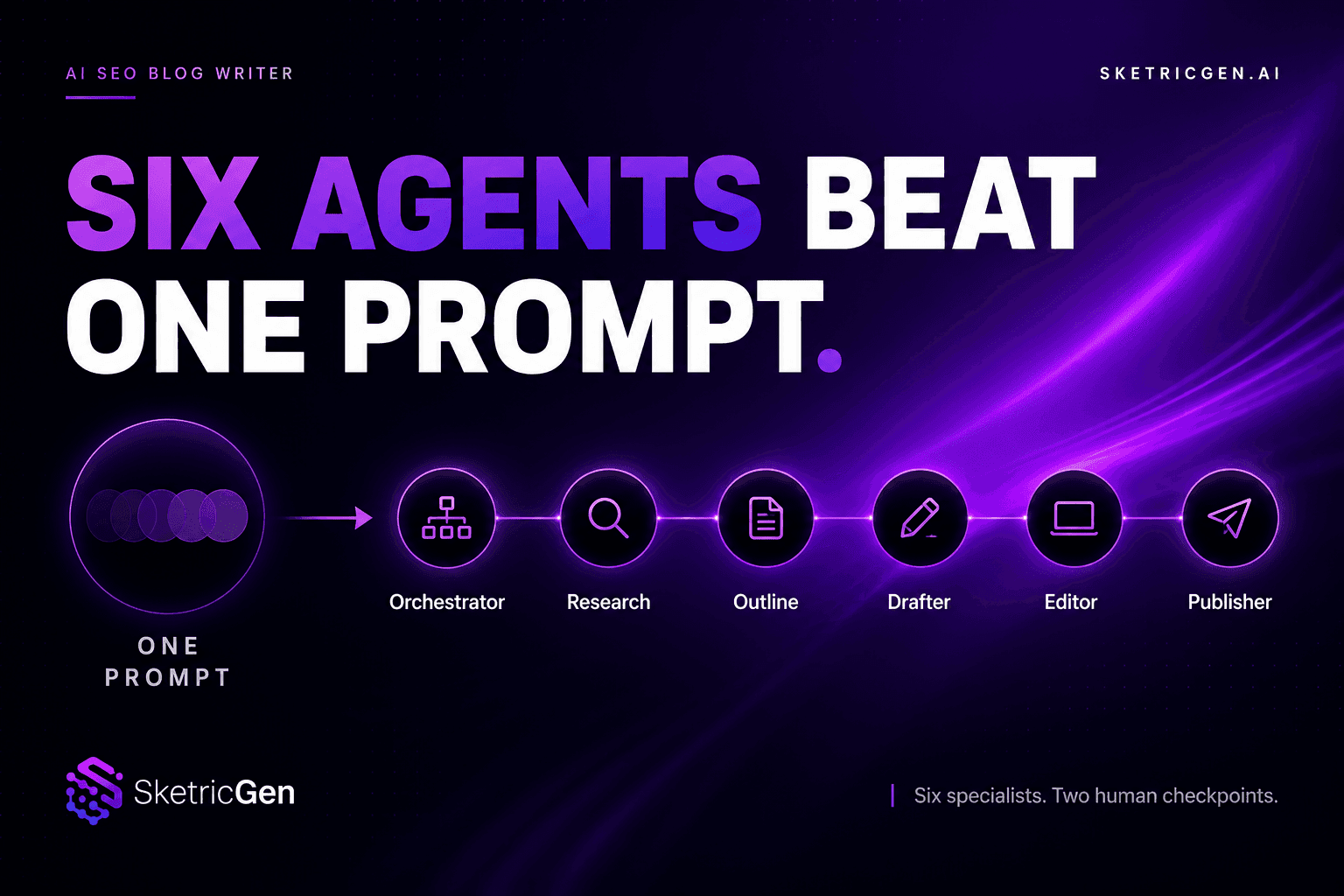
AI SEO Blog Writer: Six Agents Beat One Prompt
comparisons
Best AI Agent Builder for Small Business Teams (2026 Buyer's Guide)
comparisons