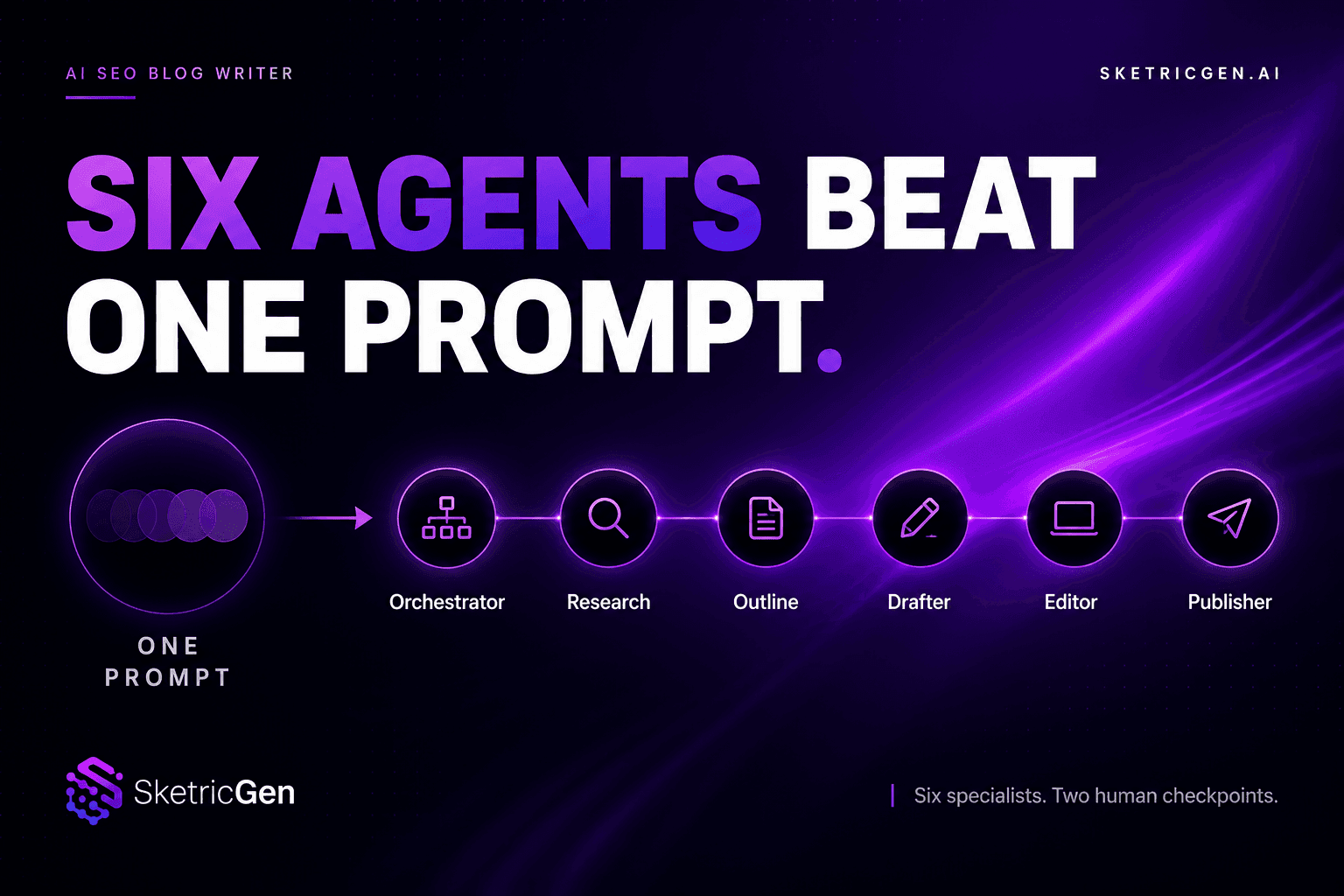
4 Best n8n Alternatives for No-Code AI Agent Building in 2026
If you are considering a switch from n8n, the issue is usually not ideas. It is execution. Workflows break on edge cases, debugging takes too long, and one technical teammate becomes the bottleneck for every change.
If your team is non-technical, the short answer is this: SketricGen is usually the best n8n alternative for AI-native agent workflows, while Make and Zapier are better for classic app-to-app automation.
n8n is still powerful for technical teams. It is open source, self-hostable, highly flexible, and packed with integrations and templates. But when there is no dedicated DevOps owner, operating it reliably becomes expensive in time, attention, and incident risk.
This guide compares four alternatives that are easier to run day to day, with practical tradeoffs for teams that need reliable automation without becoming part-time workflow engineers.
Who This Is For
- Startup founders who need AI agents deployed without hiring a DevOps engineer
- RevOps and operations leads whose teams cannot navigate n8n's technical setup
- SMB executives evaluating no-code AI automation tools their non-technical staff can actually own
- E-Commerce Stores with business and marketing teams but no technical support
Key Points
- SketricGen is the strongest alternative for teams that want AI-native multi-agent workflows with a visual builder and trace-level debugging
- Make is the best budget option for traditional workflow automation (not AI-native agents)
- Zapier has the largest integration library and lowest learning curve, but gets expensive at scale
- Lindy works for personal AI assistants (email, scheduling) but credit-based pricing frustrates teams
- n8n remains the right choice for technical teams that need self-hosting and deep API control
What Counts as an n8n Alternative for AI Agent Building?
For this comparison, an n8n alternative needs to meet at least one of these criteria:
- Build automations without writing code
- Support AI-assisted workflow building or AI agents
- Offer enough visibility to debug failures in production
- Be usable by operations, support, or growth teams without a dedicated DevOps owner
This is why tools focused only on developer orchestration were excluded, even if they are technically more flexible.
How We Evaluated These n8n Alternatives
To keep this useful for decision-making, each tool was evaluated on the same criteria:
- Time-to-first-working-workflow for a non-technical operator
- Operational overhead (setup, maintenance, incident recovery)
- AI-agent depth (orchestration, routing, and debugging visibility)
- Cost behavior at scale (task, operation, credit, or infra-based pricing)
- Deployment readiness (web, API, messaging channels)
Evidence comes from product docs, public pricing pages, and community feedback linked throughout this article, including n8n community discussions and third-party cost analyses.
At-a-Glance Comparison
| Feature | n8n | SketricGen | Make | Zapier | Lindy |
|---|---|---|---|---|---|
| Pricing | Free (self-hosted) / Cloud from EUR 20/mo | Subscription-based tiers | From $9/mo (per-operation) | From $20/mo (per-task) | From $49.99/mo (credit-based) |
| Learning curve | Steep (technical) | Low (no-code) | Low-medium | Very low | Low |
| AI-native agents | Via LangChain nodes (manual wiring) | Built-in (Max Agent Builder) | Add-on, not core | Zapier Agents (new) | NL-based agent creation |
| Visual builder | Node-based canvas | Drag-and-drop AgentSpace | Scenario builder | Linear Zap builder | Template-based |
| Text-to-workflow | No | Yes (Max Agent Builder) | No | Yes (Copilot, limited) | Yes (describe agent) |
| Multi-agent orchestration | Manual wiring required | AI-routed + forced handoffs | Not native | Limited | Single-agent focus |
| Trace/debug visibility | Execution logs | Full traces (handoffs, tools, latency, costs) | Execution history | Task history | Limited |
| Integrations | 1,200+ native | 2,000+ apps | 2,000+ apps | 7,000+ apps | 234+ apps |
| Deployment channels | API, webhooks | Website widget, WhatsApp, API | API, webhooks | API, webhooks | Web embed |
| Self-hosting | Yes (open-source) | No (managed) | No | No | No |
| Best for | Technical teams with DevOps | Non-technical teams building AI agents | Budget-conscious ops teams | Quick SaaS-to-SaaS connections | Personal AI assistants |
Why Users Look for n8n Alternatives
Users on the n8n community forum describe needing ChatGPT just to build basic workflows. One non-developer who managed to create 30+ workflows admitted: "I use ChatGPT to help me build these workflows, which has helped a lot." That is a workaround, not a workflow. A Vellum AI comparison put it plainly: "n8n's workflow builder is very complex and built for technical users."
This guide covers four n8n alternatives that solve the two problems users hit most: self-hosting complexity and steep learning curves. These are not 15 tools listed alphabetically. These are four platforms compared against real use cases, with clear tradeoffs.
Self-hosting is not free
n8n markets its self-hosted version as free. The software license is free. The infrastructure is not.
A detailed cost analysis by Latenode breaks down the real numbers: a production-ready n8n instance needs 4GB RAM and 2 CPU cores minimum, costing $40-$80/month for the server alone. Add database hosting ($25-$50/month), SSL and security ($15-$75/month), and the DevOps time to maintain it (10-20 hours monthly), and the total cost of ownership lands between $200 and $500+ per month.
That is before scaling. As workflows grow, RAM upgrades push hosting costs from $80 to $200-$400/month. Monitoring tools add $50-$150/month. The Latenode analysis found total annual costs ranging from $10,920 to $28,500.
For a 5-person startup, that is a significant line item for an "automation tool."
Pro tip: Before committing to self-hosted n8n, calculate your total cost of ownership, not just the license. Include server costs, database hosting, security, and the hours your team spends on maintenance each month. Compare that number to the subscription price of managed alternatives.The learning curve blocks non-technical teams
n8n's power comes from its flexibility. You can wire any API to any other API, inject custom JavaScript, and build complex conditional logic. That same flexibility means every workflow requires decisions that non-technical users are not equipped to make: which node type, how to structure JSON payloads, how to handle error branches.
On the n8n community forum, a non-developer who built 30+ workflows described building a separate AI agent workflow whose entire purpose was to help construct other n8n workflows by accessing documentation and GitHub repos. When you need to build a tool to use the tool, the learning curve is real.
n8n Cloud removes the self-hosting burden, starting at EUR 20/month. But the builder complexity remains. Cloud solves the infrastructure problem, not the usability problem.
When n8n is still the right choice
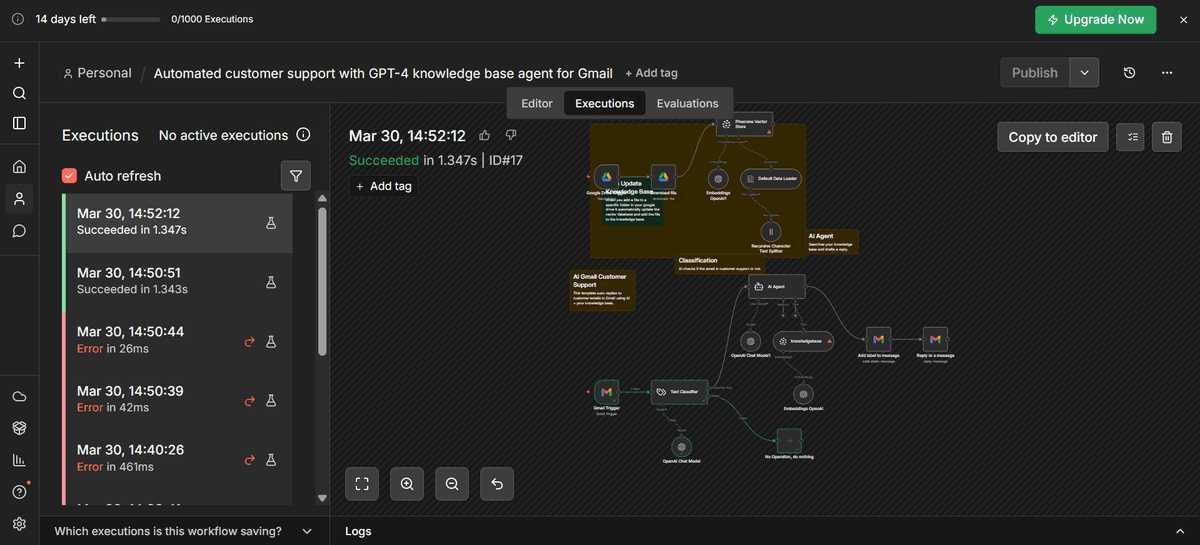
n8n is not the wrong tool. It is the wrong tool for the wrong team.
Stick with n8n if your team includes a developer or DevOps engineer who can own the infrastructure, if you have compliance or data-residency requirements that demand self-hosting, or if your workflows need deep API-level customization that managed platforms cannot match. For technical teams, n8n's open-source model and active GitHub community are real advantages.
Decision rule: If your team has someone who can debug a failed Docker container at 2 AM, n8n is a solid pick. If that sentence made you nervous, keep reading.4 Best n8n Alternatives for No-Code AI Agent Building
1. SketricGen: Best for AI-Native Agent Workflows

SketricGen was built for the exact use case where n8n struggles: non-technical teams that want to build, deploy, and manage AI agent workflows without writing code or managing infrastructure.
What makes it different from n8n:
The core difference is how you start. With n8n, you open a blank canvas and wire nodes manually. With SketricGen, you describe what you need in plain English. Max Agent Builder runs requirement gathering to clarify your goals, then generates a complete multi-agent workflow in real time. You refine it on the AgentSpace canvas, a drag-and-drop visual editor where you adjust agent roles, instructions, tools, and routing logic.
Key features:
- Text-to-workflow generation: Describe the outcome, Max builds the orchestration
- Multi-agent orchestration: AI-routed handoffs, designer-routed pipelines, or agent-as-tool patterns (orchestration docs)
- Trace-level debugging: See which agents ran, what tools they called, handoff sequences, latency, and costs (traces docs)
- Multi-channel deployment: Website widget, WhatsApp, API
- 2,000+ integrations: OAuth and API-key connections plus native tools (File Search, Web Search, Code Interpreter, MCP support)
- Structured inputs/outputs: Typed schemas for predictable data passing between agents (structured IO docs)
Pricing: Subscription-based tiers. See pricing.
Best for: Teams that need production-grade AI agent workflows with trace visibility and multi-channel deployment, without writing code or managing servers.
Tradeoffs: Smaller community ecosystem than n8n's open-source network. No self-hosting option (managed only).
Start building with SketricGen | Browse templates
Pro tip: If you are coming from n8n, start with a template. SketricGen's template library covers common patterns like lead capture and routing, support triage, and content operations. Pick one, customize it in AgentSpace, and you will have a working agent workflow in minutes instead of hours.2. Make: Best Visual Builder on a Budget

Make (formerly Integromat) is where you go when your automation needs are real but your budget is tight. It has one of the most intuitive visual builders on the market, with per-operation pricing that stays predictable at lower volumes.
Key features:
- Drag-and-drop scenario builder with branching and conditional logic
- 2,000+ app integrations
- Per-operation pricing (you pay for what runs)
- Data transformation tools built into the builder
- Rolling out AI-powered automation features (Make AI Agents)
Best for: Operations and marketing teams running traditional workflow automation (connect App A to App B with conditions) who want a visual builder without n8n's technical overhead.
Tradeoffs: Make is not built for AI-native agent workflows. There is no multi-agent orchestration, no text-to-workflow generation, and no trace-level debugging for agent behavior. If your use case involves AI agents that reason, collaborate, and hand off tasks, you will outgrow Make.
Pricing: Free tier available, paid plans from $9/month.
Decision rule: If your automation is mostly "when this happens in Slack, update that row in Google Sheets," Make handles it well and cheaply. If your automation involves agents reading context, making decisions, and coordinating with other agents, you need a platform built for orchestration.3. Zapier: Best for Plug-and-Play Simplicity
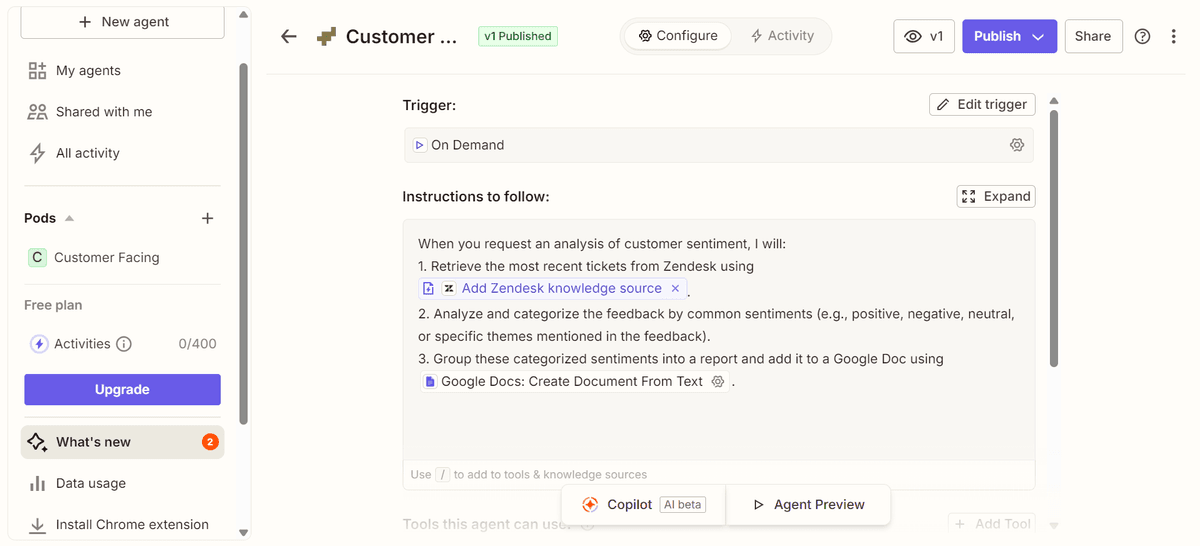
Zapier has the largest integration library in the automation space (7,000+ apps) and the lowest barrier to entry. If your primary need is connecting SaaS tools with minimal setup, Zapier gets you there faster than anything else.
Key features:
- 7,000+ pre-built app integrations
- Zapier Agents: autonomous AI systems that execute tasks across integrated apps
- Copilot: build automations using natural language descriptions
- Extensive template library for common workflows
- Tables and Interfaces for lightweight internal tools
Best for: Non-technical teams that need quick SaaS-to-SaaS connections. Marketing teams, small businesses, and solopreneurs who want automation running in minutes, not days.
Tradeoffs: Zapier gets expensive at scale. Task-based pricing means high-volume workflows rack up costs quickly. Multi-agent orchestration is limited. Zapier Agents are new and still maturing compared to purpose-built agent platforms. The linear Zap builder is simple but cannot handle the branching complexity that Make or SketricGen offer.
Pricing: Free tier available, paid plans from $20/month. Costs scale with task volume.
4. Lindy: Best for Personal AI Assistants

Lindy takes a different approach entirely. Instead of building workflows, you describe an "AI employee" that handles specific tasks: email triage, meeting scheduling, CRM updates, lead qualification. It is the closest to a personal AI assistant in this list.
Key features:
- Natural language agent creation (describe what you want, Lindy builds it)
- Pre-built "Lindy" agents for common tasks (scheduling, email, CRM)
- Drag-and-drop builder for custom workflows
- 234+ app integrations
Best for: Solopreneurs and individuals who want an AI assistant for personal productivity tasks like email management, calendar scheduling, and basic CRM operations.
Tradeoffs: Lindy's credit-based pricing starts at $49.99/month for 5,000 credits. Complex agent actions consume credits at variable rates, which makes cost unpredictable. Trustpilot reviews (2.4/5 stars) document issues with credits depleting faster than expected, charges after cancellation, and limited debugging when agents fail. Lindy is consumer-focused, not built for multi-agent team workflows.
What practitioners are saying: Lindy's credit model is a recurring complaint in user reviews. One reviewer described an agent "burning through over 2,000 paid credits just to decide it wasn't right and delete everything." At the time of writing, that pattern shows up repeatedly in public feedback. For teams that need to experiment and iterate, unpredictable credit burn can slow adoption.Which n8n alternative is best for non-technical teams?
If your goal is AI agent workflows, start with SketricGen. If your goal is classic app automation, start with Make or Zapier.
- Best for AI-native orchestration: SketricGen
- Best for low-cost visual automations: Make
- Best for fast SaaS connectivity: Zapier
- Best for solo assistant-style workflows: Lindy
How to Pick the Right n8n Alternative
The right tool depends on what your team actually looks like, not what you wish it looked like.
- Need AI agents in production with orchestration, text-to-workflow building and trace visibility? SketricGen is purpose-built for this. Easiest to use.
- Need deterministic traditional automation with a visual builder? Make handles it at the lowest cost.
- Need the most integrations with zero learning curve? Zapier has 7,000+ apps and a simple interface.
- Need a personal AI assistant for email and scheduling? Lindy is designed for individual productivity.
- Need full self-hosting control with open-source flexibility? Stay with n8n. It does this better than anything on the list.
Migration Checklist: Moving from n8n to These Alternatives
Use this checklist before you switch. It helps avoid broken automations, missing data, and surprise costs during migration.
| Tool | Necessary migration steps from n8n |
|---|---|
| SketricGen | 1) Audit and prioritize workflows by business impact.2) Rebuild priority flows in Max + AgentSpace and remap data schemas.3) Run side-by-side tests in traces, then cut over channel by channel. |
| Make | 1) Inventory workflows and operation volume.2) Recreate key scenarios and replace custom code nodes where needed.3) Validate mapping + projected operations cost before full cutover. |
| Zapier | 1) Break complex n8n flows into smaller Zaps.2) Reconnect apps and test trigger reliability with live sample events.3) Check task usage and roll out by team with fallback alerts. |
| Lindy | 1) Migrate only assistant-style workflows (email, scheduling, follow-ups).2) Set action guardrails and approval checkpoints.3) Test credit burn on real cases and keep a rollback path. |
Start Building
If n8n's complexity is slowing your team down, SketricGen lets you go from a text description to a deployed multi-agent workflow without code. Browse ready-made templates to see what is possible, or read the docs to understand how it works under the hood.
If you are still evaluating where AI agents fit in your stack, this background can help: AI agents guide and From static to dynamic: evolution of AI agents.
FAQs
n8n can work for non-technical users, but it requires significant support. On the n8n community forum, a non-developer described needing ChatGPT assistance and building a separate AI workflow just to help construct other workflows. If your team is not comfortable with JSON, API concepts, and node-based logic, a no-code alternative like SketricGen or Zapier will get you to production faster.
The software is free, but production hosting runs $200-$500+ per month. That includes server infrastructure ($40-$80/month), database hosting ($25-$50/month), security ($15-$75/month), and DevOps maintenance (10-20 hours monthly). Latenode's cost analysis estimates annual costs between $10,920 and $28,500 for production setups.
Yes. SketricGen lets you generate multi-agent workflows from a text description and refine them on a visual canvas. Zapier's Copilot feature supports natural language automation building, though it is less focused on multi-agent orchestration. Make has added AI features but is not AI-native.
For general automation, Zapier has the lowest learning curve with 7,000+ integrations and a simple trigger-action builder. For AI-specific workflows, SketricGen's Max Agent Builder lets you describe what you need in plain English and generates the workflow automatically.
n8n 2.0 has more advanced AI capabilities (LangChain integration, Tool Nodes, persistent memory) than Zapier. But those features require technical setup. Zapier's Agents feature is simpler but less powerful. For teams that want advanced AI automation without technical overhead, SketricGen is built specifically for AI-native agent workflows with visual editing and full trace-level debugging.
Related blogs
View more
7 SEO Automation Tools Compared (And the Reports They Actually Produce)
comparisons
9 Best AI Marketing Agents, Tested (2026)
comparisons
Agentic Marketing vs. Marketing Automation: Decision Framework
comparisons
AI Executive Assistant vs. AI Chief of Staff: The Difference That Actually Matters
comparisons
AI Email Assistant: Why Drafting Isn't the Problem (and What Actually Fixes Inbox Overload)
comparisons