AI Agent vs Chatbot: What's Actually Different in 2026
Who this is for:
- Founders and SMB owners evaluating AI for their website or customer workflows
- Buyers who got pitched an "AI agent" and aren't sure if it's the real thing
- Product Managers who need a clean framework to share with their team before a vendor demo
Summary
- Chatbots answer. AI agents act. The difference is what happens after the conversation.
- Decision rule: if your task needs fewer than 3 tool calls and no cross-session memory, a chatbot is sufficient. If it needs more, you need an agent.
- "Agentic AI" describes systems that reason across steps, use external tools, and complete tasks without a human doing the handoffs.
- Most products labelled "AI agents" in 2025 and 2026 are not. Gartner found fewer than 130 products out of thousands are verifiably agentic by any meaningful standard.
- If you can't tell the difference before you buy, you'll either overspend on capability you don't need or underspend and get a tool that falls short.
Why the Confusion Exists
The terminology got weaponised by marketing teams in 2025.
A Salesforce survey found 90% of IT leaders felt urgency to adopt AI agents, but fewer than half could explain what separates an agent from a chatbot or a copilot. Vendors noticed. Overnight, products that had been called "AI chatbots" got relabelled as "AI agents" with no architectural change underneath.
Gartner calls this agent washing, and it's widespread. Of the thousands of products currently marketed as AI agents, Gartner's analysis identified fewer than 130 that are verifiably agentic by any meaningful architectural standard.
The result: buyers make the wrong purchase, deploy something that doesn't close the loop, and either blame the technology or blame their team. Neither is fair.
Getting this distinction right before you evaluate a tool saves weeks of wasted pilots.
What Is a Chatbot?
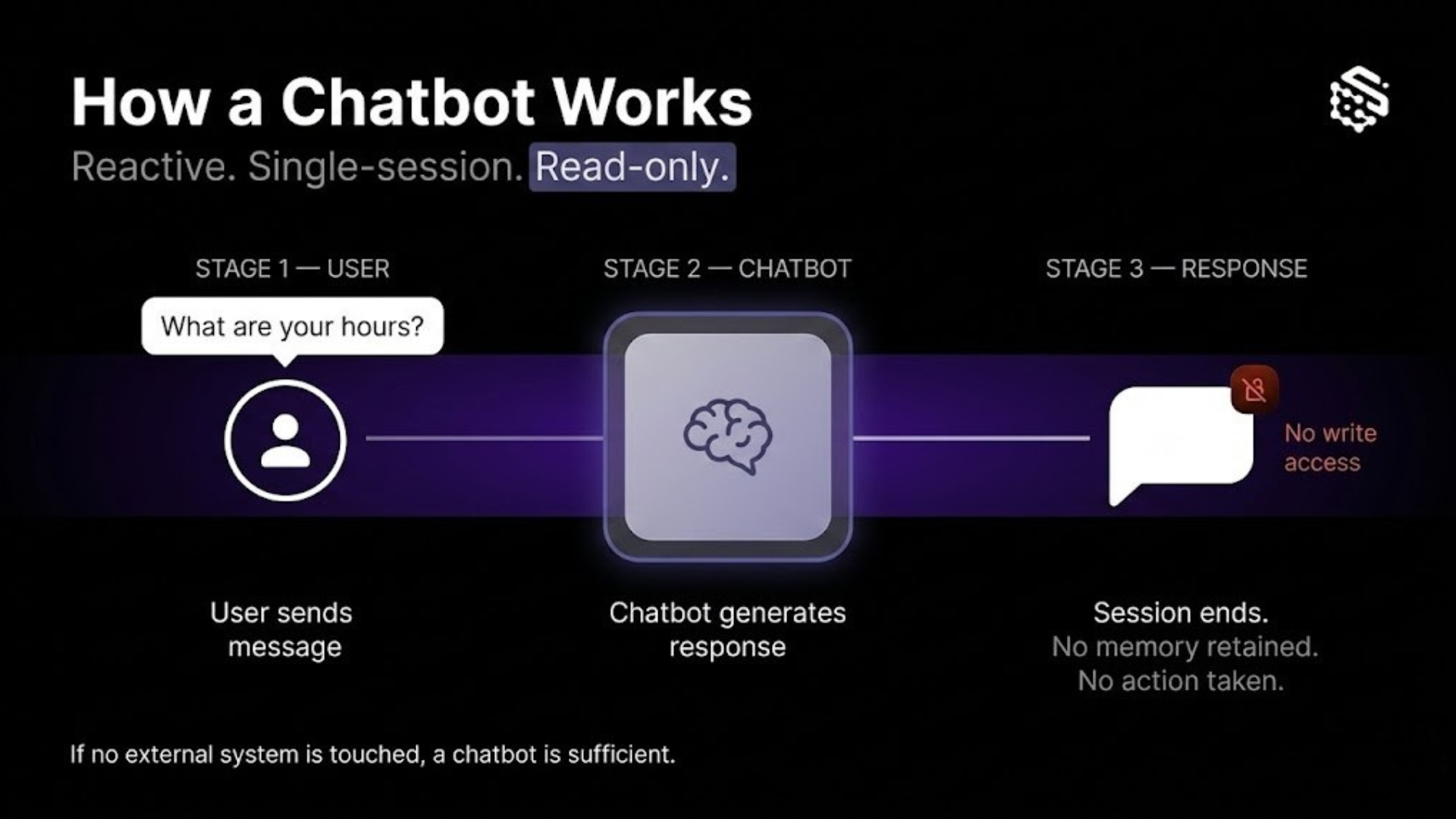
A chatbot is a conversational interface that generates responses to input. It does not take actions in external systems on its own.
There are two types:
- Rule-based chatbots follow scripted decision trees. They're deterministic: if the user says X, route to Y. Used heavily in customer support flows, lead capture forms, and FAQ widgets.
- LLM-based chatbots understand natural language and can handle freeform conversation. ChatGPT in its base form is this. Still reactive: it responds to what you say, but it doesn't initiate, remember you tomorrow, or update your CRM.
Where chatbots genuinely excel:
- Answering the same 50 questions 500 times per day at low cost
- Collecting contact details in a structured flow
- Routing users to the right resource or department
- 24/7 availability without adding headcount
What they can't do:
- Execute a multi-step task across systems (look up an order, check inventory, send a confirmation)
- Write to external databases, calendars, or inboxes
- Remember context from a conversation last week
- Adapt when the task takes an unexpected turn
Decision rule: If your task has a predictable answer that doesn't depend on what's happening in your other systems right now, a chatbot handles it well. If the answer requires looking something up, writing something back, or deciding what to do next, you're outside chatbot territory.
Related reading: Conversational AI vs Generative AI, what's the actual difference
What Is an AI Agent?
An AI agent is a system that reasons about a goal, decides what steps to take, calls external tools to complete those steps, and finishes the task without a human doing each handoff.
Four things separate an agent from a chatbot:
| Property | Chatbot | AI Agent |
|---|---|---|
| Reasoning | Pattern-matching or script | Goal decomposition and multi-step planning |
| Tool use | Read-only (generates text) | Read + Write + Act (updates external systems) |
| Memory | Single session only | Persists across sessions |
| Autonomy | Responds to prompts | Initiates, adapts, and completes tasks |
A practical example: a customer support AI agent receives a ticket, queries your order management system, identifies the delay, drafts a resolution message, sends it to the customer, and logs the resolution in your CRM. No human touches it between the ticket arriving and the CRM being updated.
That is what "taking action" means. Generating text about the ticket is not the same thing.
As one practitioner put it in r/learnmachinelearning:
"AI chatbot = turn-based conversation. You go, the chatbot goes, you respond. AI agent = perform multiple steps in a task." r/learnmachinelearning community thread
Related reading: What is agentic AI? Full explainer
What Is Agentic AI?
To understand AI Agents, we need to understand the broader term of, Agentic AI. Agentic AI describes the broader category of AI systems designed to act toward goals, as opposed to AI that only generates responses to prompts.
The distinction matters for buyers in 2026 because "agentic" has become a quality signal:
- An agentic system can decide which tools to use, in what order, and how to handle a result that wasn't anticipated
- A non-agentic system (chatbot, copilot) still needs a human to do the connective tissue work: copy a result from one app to another, click the "send" button, update the spreadsheet
The 2026 shift is from "chat with AI to get an answer" to "hand AI a goal and let it complete the work." That shift only applies to agentic systems.
If a vendor uses the word "agentic" but the product still requires you to manually copy outputs between tools, ask specifically: what can the system write to without human intervention?
Related reading: How multi-agent systems work together
The Real Differences
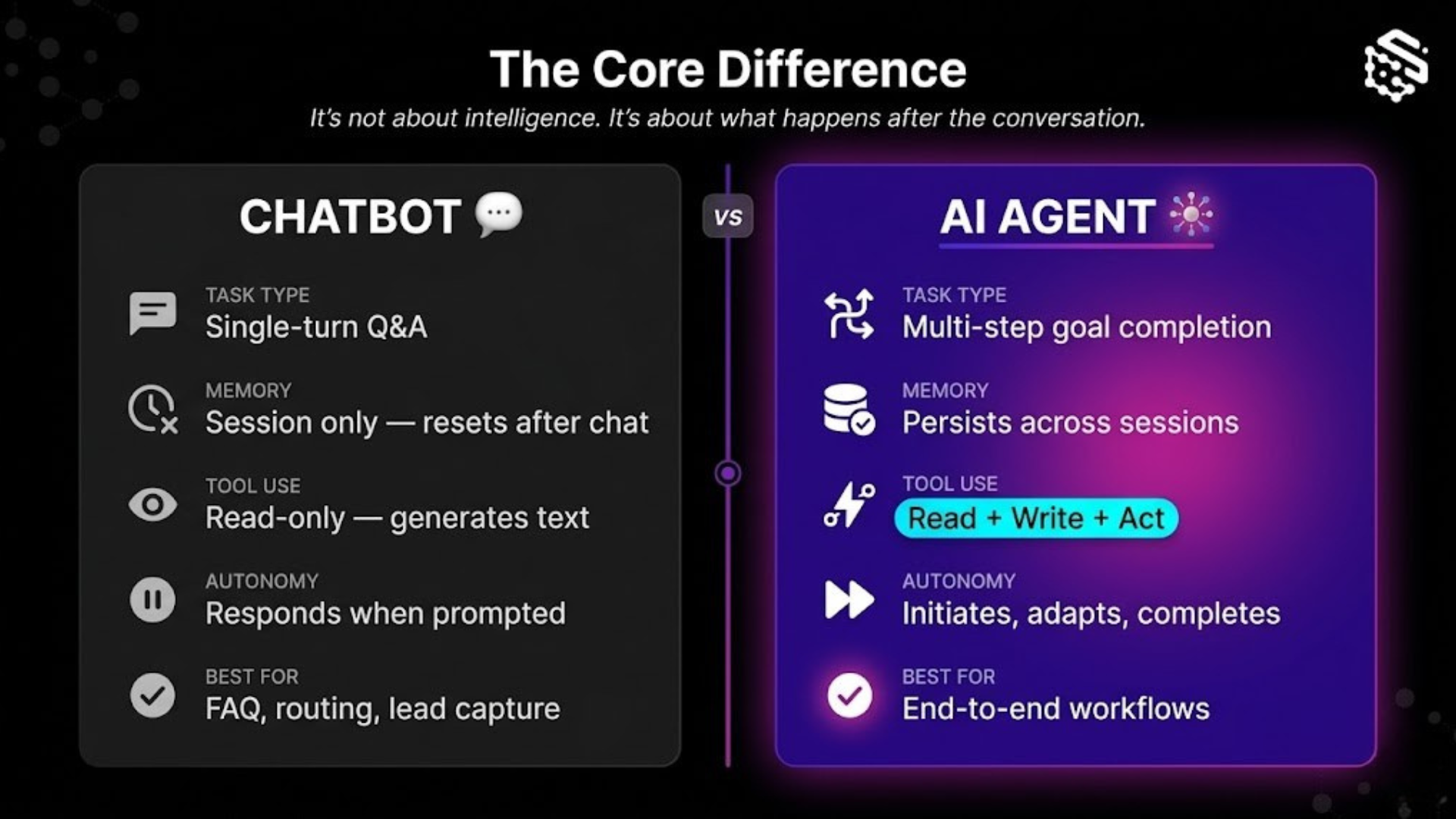
The core architectural difference: chatbots are read-only. AI agents read, write, and act.
| Dimension | Chatbot | AI Agent |
|---|---|---|
| Task type | Single-turn Q&A, scripted flows | Multi-step goal completion |
| Memory | Session only (forgets after conversation ends) | Persists across sessions |
| Tool use | None or limited (retrieve only) | Full read/write across integrated systems |
| Autonomy | Responds when asked | Can initiate, plan, adapt, and complete |
| Error handling | Returns an error or escalates to human | Can retry, reroute, or ask a clarifying question |
| Cost to run | Low per interaction | Higher per task (more compute, more tool calls) |
| Best for | FAQ, routing, lead capture, simple support | End-to-end task completion, multi-system workflows |
Use a chatbot when:
- Volume of identical queries is high and answers don't change
- The task has a defined start and end with no external system dependency
- Budget is a primary constraint and response speed matters more than completion depth
Use an AI agent when:
- The task requires reading from AND writing to at least one external system
- Completing the task involves more than 2 to 3 steps across tools
- The outcome needs to be verified and logged automatically
The Decision Framework
Three questions decide which tool your task needs.
Q1. Does the task require writing to an external system? Examples: update a CRM record, book a calendar slot, send an email, post a ticket update.
- Yes → You need an agent.
- No → A chatbot may be enough.
Q2. Does it need more than 2 to 3 distinct tool calls in a single workflow? Examples: retrieve customer data AND check inventory AND send a notification AND log the result.
- Yes → You need an agent.
- Only 1 to 2 steps, a chatbot or simple automation handles it.
Q3. Does it need to remember context from a previous session? Examples: "last week you said X, now I want to add Y", the system needs to know what happened before.
- Yes → You need an agent.
- No → A per-session chatbot is sufficient.
If none of the above apply, a chatbot is the right tool. Don't overspend on an agent for a use case that needs to answer "what are your office hours?"
When to choose Which? - Decision Matrix
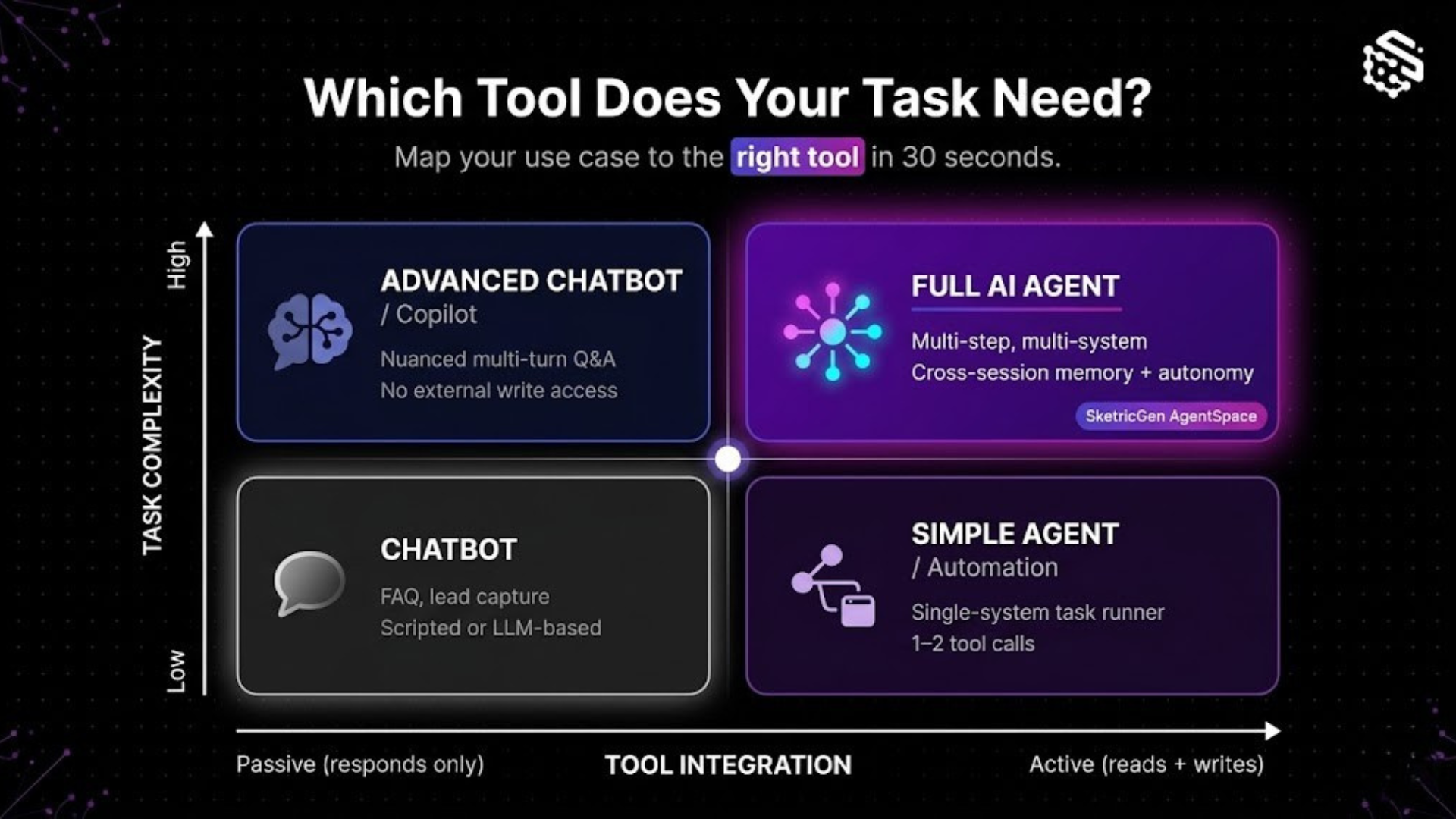
| Passive tool use (responds only) | Active tool use (reads + writes) | |
|---|---|---|
| Low task complexity | Chatbot: FAQ widget, lead capture, simple routing | Simple agent / automation: single-system task runner |
| High task complexity | Advanced chatbot / copilot: nuanced Q&A, no actions | Full AI agent: multi-step, multi-system, cross-session |
- Low complexity + passive: Chatbot. Clear winner. Don't complicate it.
- Low complexity + active: Simple agent or workflow automation, one integration, one defined task.
- High complexity + passive: Advanced chatbot, handles nuanced conversation but doesn't act outside the session.
- High complexity + active: Full AI agent. This is where platforms like SketricGen's AgentSpace operate, multi-step, multi-tool workflows with visible trace logs and structured handoffs.
Real Examples Side by Side
The same use case plays out very differently depending on which tool you deploy.
| Use case | Chatbot version | AI Agent version |
|---|---|---|
| Customer support | Answers "where is my order?" with a tracking link template | Reads the order ID, queries your fulfilment system, identifies the delay, sends a personalised update, and logs the resolution in your CRM |
| Lead qualification | Asks 4 pre-set questions and captures email | Enriches the lead against CRM data, scores based on ICP criteria, drafts a personalised outreach, and updates the pipeline stage |
| Website assistant | Answers "what's your pricing?" from a fixed script | Detects user intent, retrieves the relevant pricing tier, checks past interactions, tailors the response, and offers to book a demo |
| Sales follow-up | Sends a template email at a fixed interval | Reads the last interaction, decides whether to follow up or wait, personalises the message, sends it, and updates the deal stage |
"A chatbot tells you how to send an email. An agent writes it, opens your inbox, and sends it. That one shift changes everything." GenAI Works, LinkedIn
To see what a real multi-agent workflow looks like, with visible handoffs, tool calls, and trace logs, see the SketricGen getting-started overview.
Is ChatGPT a chatbot or an AI agent?
This is one of the questions which gets asked a lot. Is ChatGPT a chatbot or an AI agent? ChatGPT is fundamentally a conversational AI product. In basic chat mode, it is like a chatbot. However, when equipped with memory, tools, workflows, and task execution features, it can show many AI agent characteristics. So ChatGPT is best viewed as a spectrum: chatbot at baseline, agentic assistant in advanced modes.
What Practitioners Are Saying
What practitioners are saying:On Reddit and LinkedIn in early 2026, the most common complaint isn't "AI agents don't work", it's "what I bought isn't actually an agent."
As Austin Starks wrote in April 2026: "Calling ChatGPT an AI agent is like calling a calculator a data analyst. Same underlying math, completely different application." (Medium, Apr 2026)
The r/AI_Agents community notes that agents only meaningfully outperform chatbots when tasks cross tool and system boundaries. For single-system, single-turn interactions, an LLM chatbot is often faster, cheaper, and easier to maintain. The case for agents builds when the workflow has 3+ steps across 2+ systems, that's when the manual handoff cost becomes real and measurable.
The practical test practitioners use to evaluate any claimed agent: Does it take initiative or wait for every instruction? Does it use external tools or only generate text? Does it remember context without you repeating yourself? If the answer to all three is "no", it's a chatbot.
Mistake I see repeatedly: Teams deploy a chatbot, find it can't complete complex tasks, then assume AI agents don't work, because the "AI agent" they try next is also just a chatbot with better branding. Test the tool before you buy. Ask the vendor to complete a live task that includes at least one write action to an external system. If they can't demo that in real time, walk away.Next Steps
If your task needs fewer than 3 tool calls and no cross-session memory, a chatbot is the right tool. If it needs more, you need an agent. Most of the confusion in the market comes from vendors applying the word "agent" to products that don't meet that bar.
Want to see what a real agent looks like in practice, with visual workflow design, tool-call tracing, and multi-step task completion?
See what a real agent looks like → view the Brand Agents
Start with the SketricGen getting-started docs to understand how agentic orchestration works before evaluating any tool.
FAQs
If your goal is to answer visitor questions, capture leads, or route enquiries, a chatbot is sufficient and cheaper to run. If your goal is to qualify leads, update your CRM, book meetings, or deliver personalised multi-step experiences, you need an agent. Use the 3-question framework above before deciding.
Adding a single integration, for example "the chatbot can look up an order status", creates a smarter chatbot, not an agent. The agent threshold is crossed when the system can autonomously plan a multi-step workflow, use multiple tools in sequence, handle unexpected results, and write back to systems, without a human directing each step. The distinction is architectural, not additive.
Agent washing is when a vendor labels a product as an "AI agent" without the architectural properties that define one. Red flags: the product can only retrieve information but not write to external systems; completing a task still requires you to copy outputs between tools; there is no trace or audit log of what the system did; the "agent" forgets everything after the session ends. Any of those is a clear sign.
ChatGPT is fundamentally a conversational AI product. In basic chat mode, it behaves like a chatbot. When equipped with memory, tools, workflows, and task execution features, it can exhibit many AI agent characteristics. So ChatGPT is best viewed as a spectrum: chatbot at baseline, agentic assistant in advanced modes.
Chatbots are cheaper per interaction, typically a few cents per conversation at scale. AI agents cost more per task because they make multiple LLM calls, invoke external APIs, and run multi-step workflows. For high-volume, simple tasks the chatbot ROI is better. For complex tasks where the alternative is a human doing each step manually, the agent often wins on total cost, even at higher per-task pricing.
Related blogs
View more
AI Executive Assistant vs. AI Chief of Staff: The Difference That Actually Matters
comparisons
AI Email Assistant: Why Drafting Isn't the Problem (and What Actually Fixes Inbox Overload)
comparisons
AI SEO Blog Writer: Six Agents Beat One Prompt
comparisons
OpenAI Agent Builder vs. Google Vertex AI Agent Builder vs. No-Code Alternatives (2026)
comparisons
Best AI Agent Builder for Small Business Teams (2026 Buyer's Guide)
comparisons