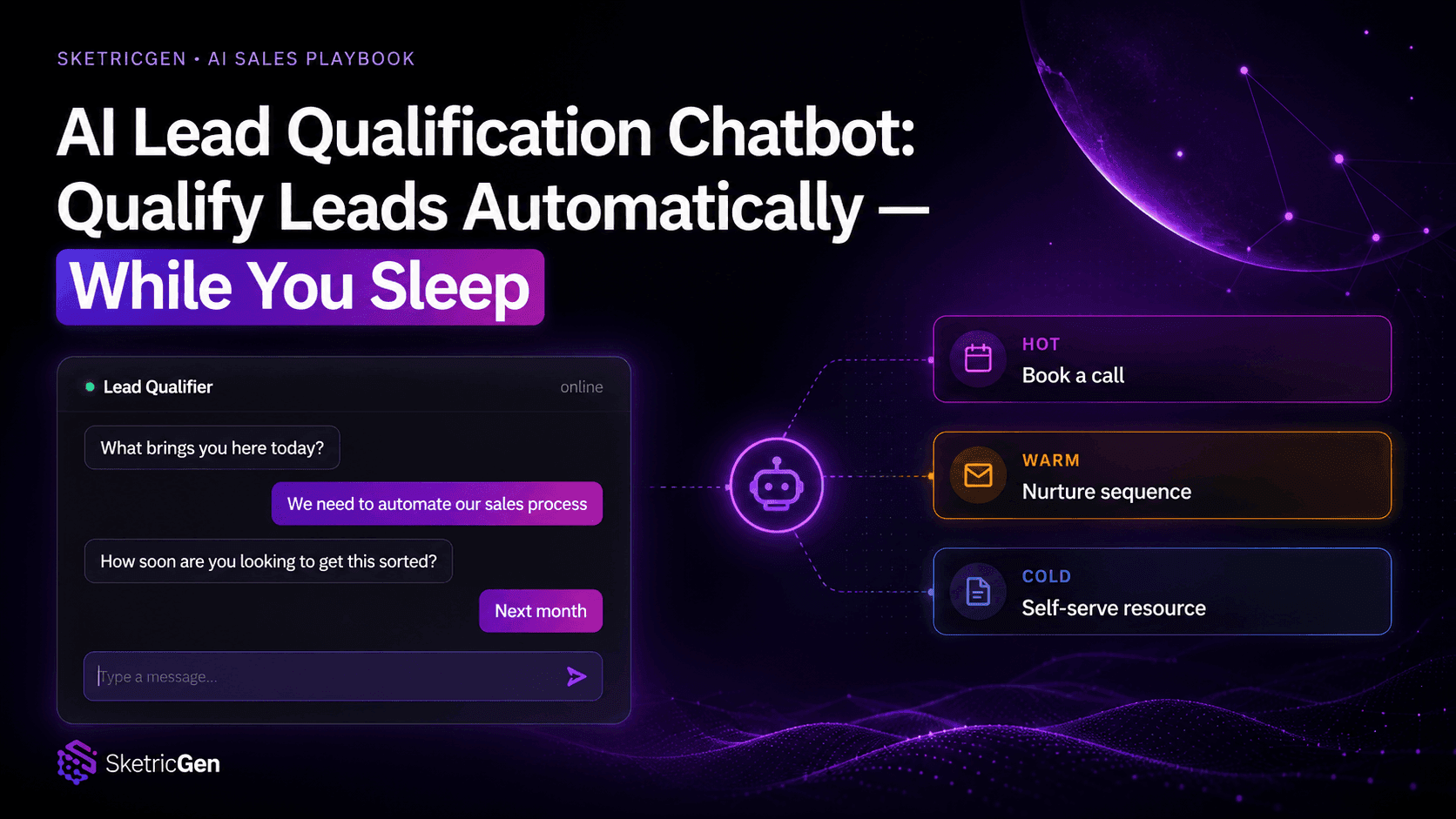
Website Lead Capture: How to Turn Silent Visitors Into Leads With an AI Chatbot
Mechanism and setup steps below are pulled directly from SketricGen's Website Lead Capture template, live and testable in about 2 minutes.
Most website visitors who leave without converting were not lost. They were never caught. Contact forms convert at 1-3% of visitors, and a generic chatbot that can't answer a real question does barely better. If you want to capture leads from your website instead of hoping visitors fill out a form, the fix is not "add a chatbot." It's answer first, capture second, on a signal you actually define.
This post breaks down that mechanism: the interest-threshold rule that decides when a chatbot should show a lead form, why answering first beats gating information behind one, and how to set it up on your own site.
Who This Is For
- Small business and solopreneur site owners with no one watching live chat around the clock.
- Agencies standing up repeatable lead-capture setups across multiple client sites.
- No-code builders and evaluators who want to see the actual architecture behind a lead-capture chatbot before adopting one.
Key Points
- Contact forms and generic FAQ chatbots share the same failure: they ask for contact details before they've given the visitor anything.
- A lead capture chatbot should answer from your real site content first, then call a form only when the visitor shows a defined signal of interest.
- The working rule: one strong signal (a pricing, demo, quote, or timeline question) or two moderate signals (substantive follow-up questions) triggers the form.
- One practitioner reported 71 leads captured over 83 days without manually watching the chat.
- Setting this up with a pre-built template takes about 2 minutes. Building the same logic yourself is a real engineering project, not a weekend script.
Why Forms and Generic Bots Both Lose Leads
A visitor lands on your site with one question. "Do you cover my area?" "What does this cost?" If the answer isn't there, they leave.
Practitioners on Reddit describe the same pattern from the other side. In r/LeadGeneration, one marketer noted that live chat, even a simple chatbot, "turned into more convos than expected" once people had a quick way to ask a question before committing. The same thread flagged what didn't work: generic newsletter signups and freebie forms. They collected emails, not leads.
Another commenter in that thread broke down why forms lose people specifically: the value isn't clear in the first five seconds, the form asks for too much upfront, and there's no clear next step after submitting. A bot that just replaces the form with a chat window and still asks for an email on message one has the same problem in a different wrapper.
The fix isn't the channel. It's the order of operations: answer first, using real content from the site, then ask.
Contact forms and static chatbot scripts aren't the only two options either. For the broader case for why a chatbot outperforms a form at all, see how an AI chatbot stops small businesses from losing website leads. This post goes one layer deeper, into exactly when that chatbot should ask for contact details.
What "Capturing Leads From Website" Actually Requires
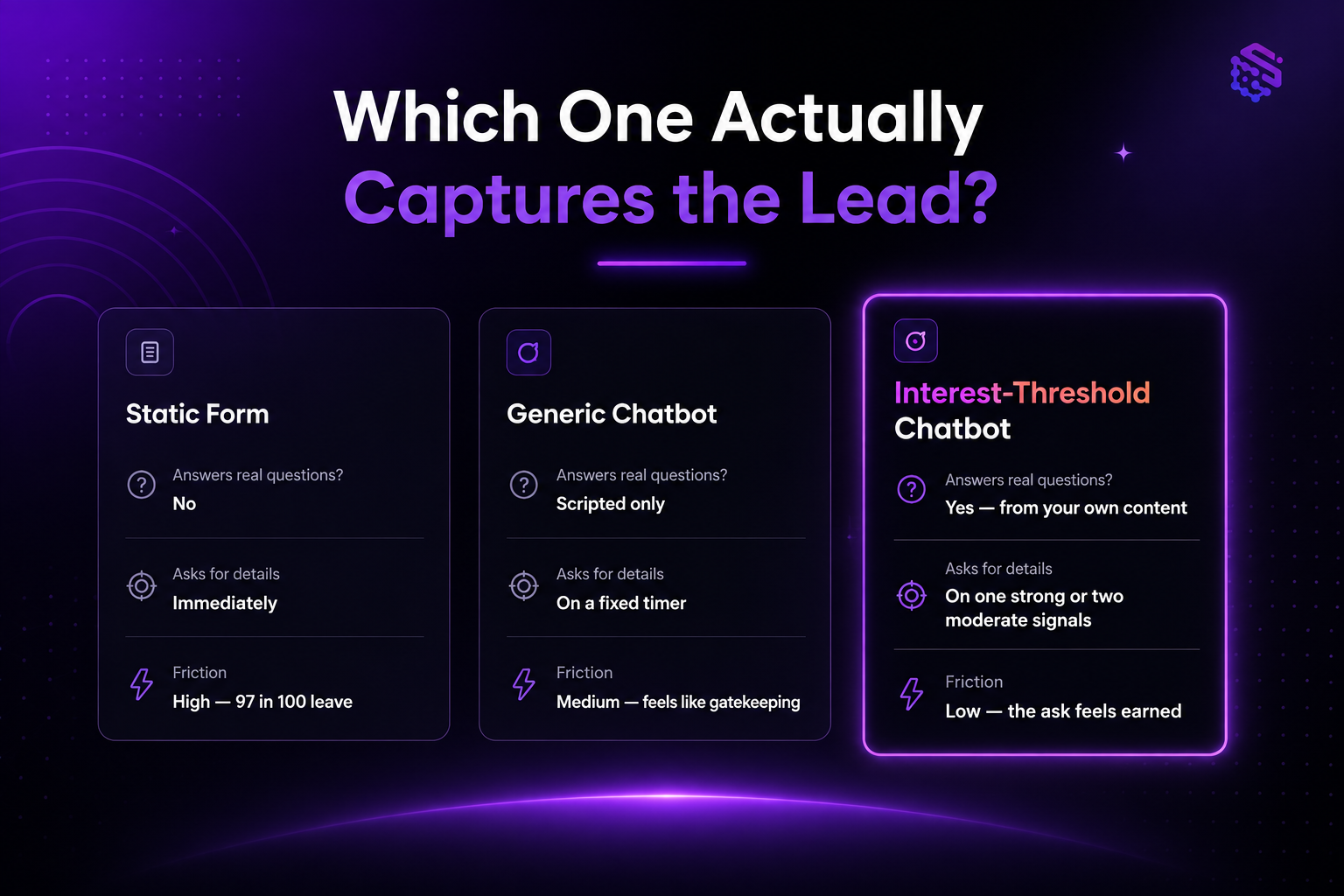
A lead capture chatbot that works needs to answer from the site's own content and know precisely when a visitor has shown real interest, not guess off page behavior like time-on-page or scroll depth.
Static form vs. generic chatbot vs. interest-threshold chatbot
| Approach | Answers real questions? | When it asks for contact details | Typical friction |
|---|---|---|---|
| Static contact form | No | Immediately, before any value given | High. 97 out of 100 visitors leave without submitting. |
| Generic FAQ chatbot | Sometimes, scripted only | On a fixed prompt or timer, regardless of interest | Medium. Feels like being gatekept when it can't answer. |
| Interest-threshold chatbot | Yes, from a knowledge base built off real site content | Only on one strong signal or two moderate signals | Low. The ask feels earned. |
The difference is not "chatbot vs. no chatbot." It's whether the bot answers before it asks, and whether the ask is triggered by something real.
The Interest-Threshold Rule (the Mechanism)
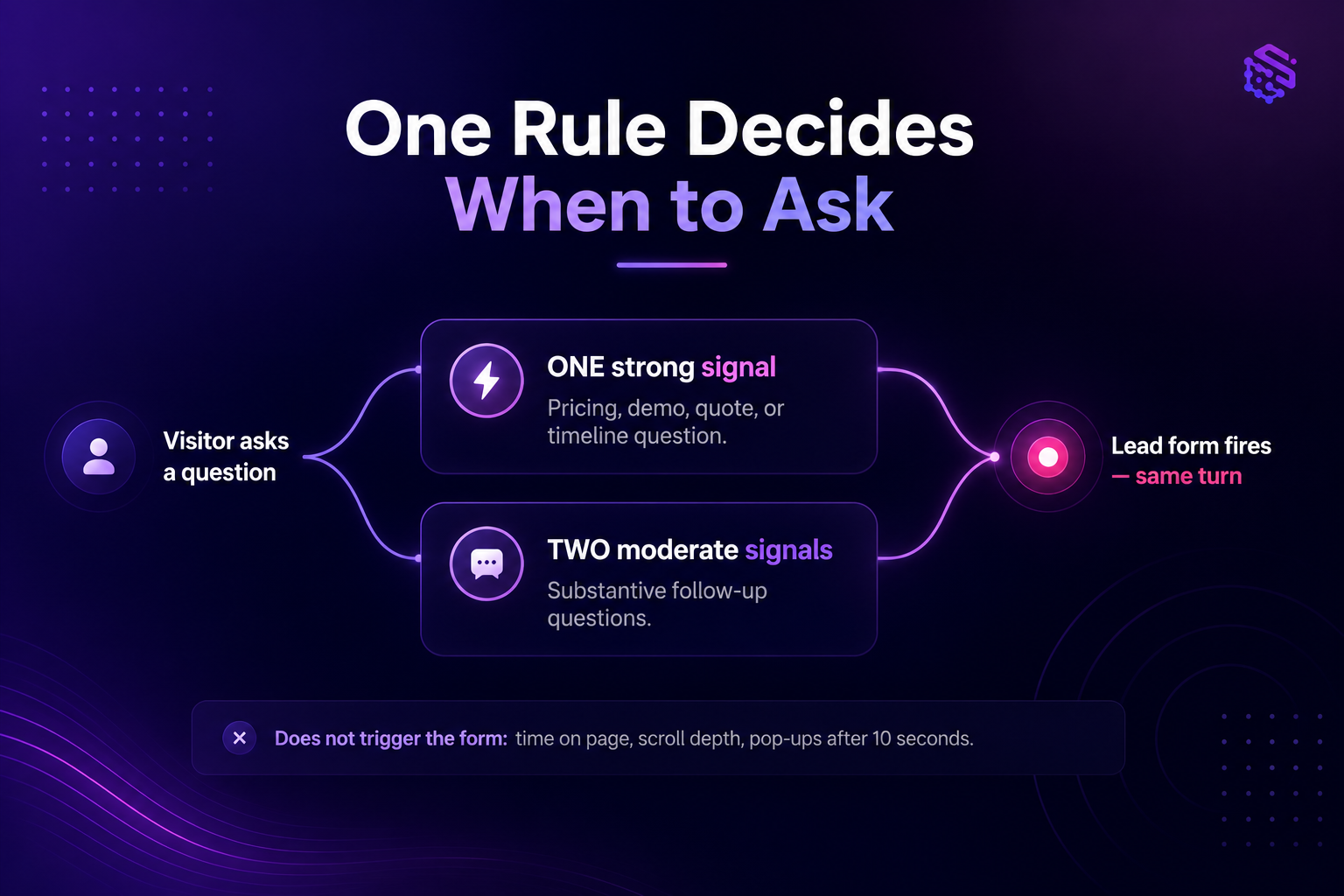
This is the part most lead-capture setups skip. SketricGen's Website Lead Capture template fires the lead form on exactly one of two conditions:
- One strong signal: a pricing, demo, quote, or implementation-timing question.
- Two moderate signals: substantive follow-up questions that show the visitor is actively evaluating, not just browsing.
Nothing else triggers it. Not time-on-page, not a second visit, not a generic "chat with us" popup after 10 seconds.
Decision rule: If a visitor asks a direct pricing, demo, or quote question, capture the lead in that same turn. If they haven't asked one of those yet, wait for a second substantive question before showing the form at all.
That specificity is what separates a chatbot people tolerate from one that converts passively. One practitioner in r/LeadGeneration described running an AI chat widget for 83 days: it handled over 103 conversations and captured 71 leads without needing a real-time response, calling it "one of the smartest moves I've made for my business." That result depends entirely on the bot knowing when to ask, not just being present.
Setup: Turning This On for Your Own Website
Building this logic from scratch is realistic if you have engineering time: you'd write the crawler or knowledge base ingestion, define your own interest-threshold rule, and wire the form or CRM push yourself. Using a pre-built template skips that build.
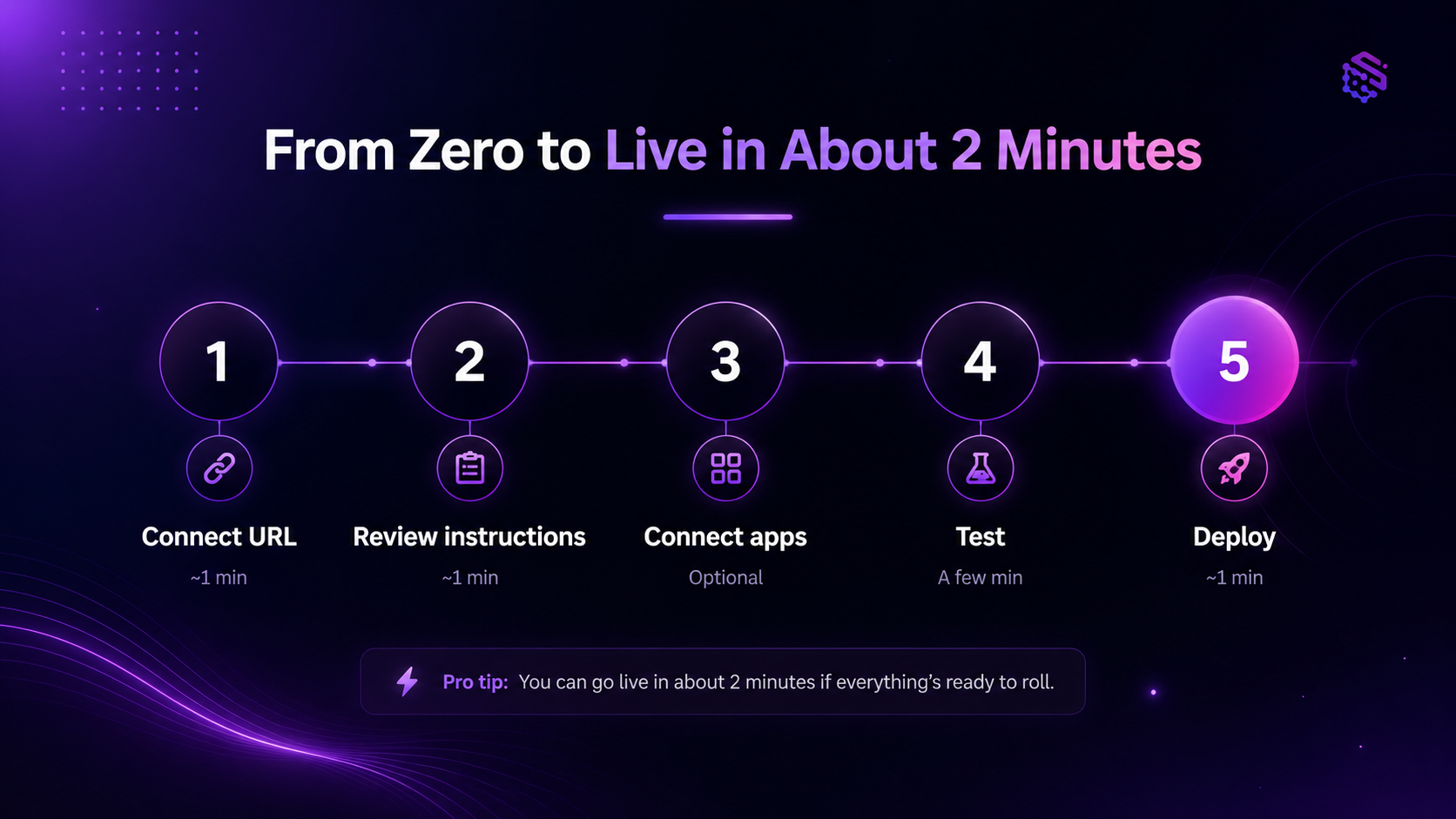
Setup steps (Website Lead Capture template)
| Step | What it does | Time |
|---|---|---|
| 1. Connect your URL or upload files | Crawls your site (or indexes uploaded docs) into a searchable knowledge base the bot answers from. | ~1 minute |
| 2. Review generated instructions | Confirms the bot's identity, tone, and interest thresholds match your business. Fully editable. | ~1 minute |
| 3. Connect optional apps | Push captured leads to a CRM or Slack if you want. The bot runs live without this. | Optional |
| 4. Test | Send real questions, including one pricing or demo-style question, to confirm the form fires at the right moment. | A few minutes |
| 5. Deploy | Publish the widget to your site. Thresholds and tone stay editable after launch. | ~1 minute |
Pro tip: Add the widget to your pricing and services pages first, not just your homepage. Visitors there are further along, so the strong-signal trigger fires sooner and the form feels timely instead of random.
For the fastest path to a live widget, SketricGen lets you add an AI chatbot to your website in about 2 minutes. To add a qualification flow after the lead is captured, the AI agent lead generation playbook and the AI lead qualification chatbot guide both cover that next step.
Common Mistakes When Setting This Up
- Gating answers behind the form. Asking for an email before answering the visitor's actual question recreates the exact friction a chatbot is supposed to remove.
- No defined threshold. Without a clear rule, the form either fires too early and feels pushy, or never fires and leads leak through anyway.
- Thin knowledge base. A bot without real site content to draw from falls back to generic answers or guesses, and visitors notice immediately.
Mistake I made: Testing a bot only with the questions I expected. The ones that broke it were edge cases real visitors actually asked, like coverage-area exceptions and multi-service pricing. Test with the ten most awkward questions your business gets before going live.
What Practitioners Are Saying
What practitioners are saying: A user in r/LeadGeneration described running an AI chat widget for 83 days: 103+ conversations, 71 leads captured, "one of the smartest moves I've made for my business." No real-time monitoring required, because the widget only asked once a real signal showed up.
Not every reaction to lead-capture bots is positive, and that's worth taking seriously. In the same thread, one visitor pushed back: "I always feel slightly offended when I have to chat with a sales bot rather than a human... they can never answer my questions, so it's just a waste of time." Another added that most bots "feel like they slow you down or gatekeep the human you're trying to talk to."
That objection is aimed at the right target. It's just aimed at bad bots, not chatbots as a category.
Author's Take: Sam
The "chatbots are annoying gatekeepers" complaint on Reddit is fair, and it describes a real, common failure. A bot that can't answer a real question and still stands between a visitor and a human is worse than no bot at all.
That's a design failure, not a chatbot failure. The fix isn't skipping automation. It's making the bot actually useful before it asks for anything: grounded in your real content, honest when it doesn't know something, and reaching for a lead form only once the visitor has shown a specific, definable signal.
If your chatbot can't pass that bar, the problem isn't that you added a bot. It's that you added the wrong one.
Next Steps
Pick one page on your site where visitors ask a real question and leave without converting. Point the Website Lead Capture template at your URL, review the generated instructions, and test it with your own most common question before deploying. Setup takes about 2 minutes.
Check SketricGen's pricing if you want plan details before committing.
FAQs
It checks the conversation against a defined threshold: one strong signal (a pricing, demo, quote, or implementation-timing question) or two moderate signals (substantive follow-up questions showing active evaluation). It should never fire on page behavior alone, like time-on-page or scroll depth, since that ignores what the visitor is actually asking.
Yes. A chatbot that answers from your site's own content can call a lead capture form itself once a visitor shows real interest, replacing the static form entirely. The visitor still provides contact details, but through a conversational prompt triggered by their own question, not a page they have to find and fill out cold.
Answer the visitor's question first, using content from your own site, before asking for anything. Static forms and scripted chatbots both underperform because they ask upfront. A knowledge-base-grounded chatbot that captures on a defined interest signal consistently converts more of the visitors who were already interested.
Connect your website URL or upload your content so the bot has a knowledge base to answer from, review the generated instructions and interest thresholds, optionally connect a CRM, test with a few real questions including one pricing-style question, then deploy. With a pre-built template like Website Lead Capture, this takes about 2 minutes end to end.
No. The knowledge base, lead capture form, and site navigation can all run with no third-party connection required. A CRM push is an optional add-on for later, useful once you want captured leads routed automatically instead of reviewed manually.
Only if it's built without a defined scope. One practitioner on Reddit put it plainly: a chatbot "works all right, and helps filter wrong conversations" once you carefully plan its scope and document what it should actually answer. A bot that answers real questions and stays quiet otherwise doesn't annoy people. A bot that can't answer anything and still interrupts them does.
Related blogs
View more
AI Agents for Small Business: What Actually Works at 1-20 People
use cases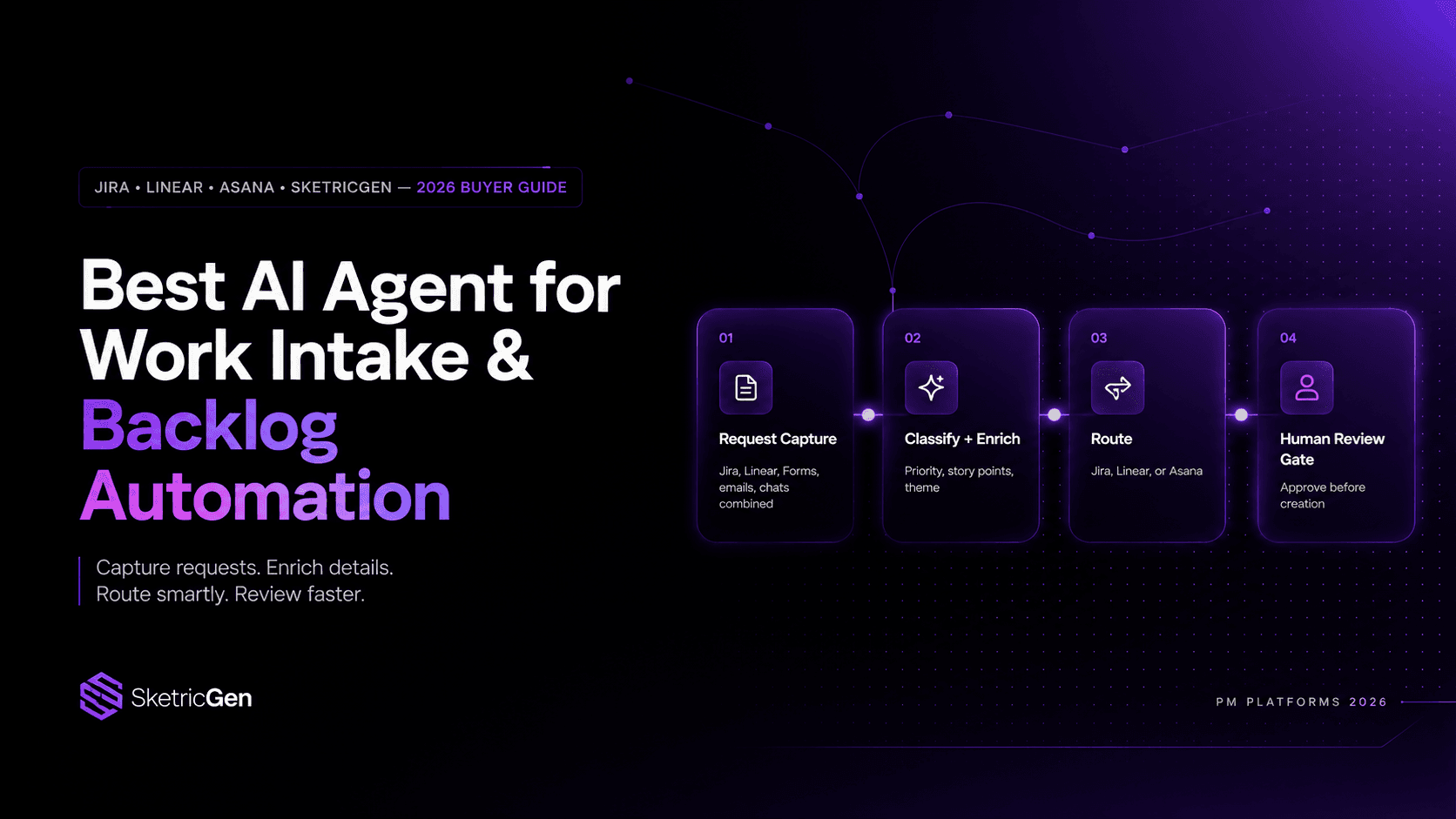
Best AI Agent for Work Intake & Backlog Automation in PM Platforms (2026)
use cases
How to Reduce Customer Churn with AI: Stop Losing Customers
use cases
How to Use AI Appointment Booking for Demos on Website
use cases