Brand Agents: Create AI Chatbots for Website in 2 Minutes
If you are trying to launch an AI chatbot for website support, you usually hit one of two problems: long chatbot scripting work or generic bots that do not understand your business.
Brand Agents gives you a better path. You paste your URL, get an AI agent trained on website content, and publish a brand-matched AI widget in about 2 minutes. This is why Brand Agents is one of the best no code AI agent builder experiences for customer-facing deployment.
Credibility note: this guide is based on the current Brand Agents, plus SERP and Reddit research across no-code and AI agent communities.
Who this is for
- Founders and small teams who need an AI Chatbot for website support without developer dependency.
- Support and CX operators who want a customer support AI agent no code setup.
- Growth teams that want a website AI assistant that can extend to WhatsApp and Instagram.
Key Points
- Brand Agents is a no-code AI agent builder workflow focused on speed and deployment.
- The system is trained on your website so it answers from your products, policies, pricing, and docs.
- You can launch a branded AI chat widget that matches your logo and colors.
- It is built for customer-facing AI agents, not only internal automation.
- You can deploy the same agent to website, WhatsApp, and Instagram channels.
- If you need Autonomous AI Agents behavior, add guardrails and escalation logic first.
What is a Brand Agent?
A brand agent is an AI agent for website conversations that is trained on your site content and presented in your visual identity. In practice, your AI chatbot uses your products, policies, and docs as source context, and your chat UI looks on-brand.
Brand Agents in SketricGen are designed as customer-facing AI agents. They are built to interact directly with visitors, answer support and pre-sales questions, and route next actions.
To put it plainly: Brand Agents is a no-code AI agent builder flow where you paste your URL, generate an AI agent trained on website content, and deploy a brand-matched AI widget in about 2 minutes.
Why traditional AI chatbots fail website teams
Many teams do not fail because AI is weak. They fail because setup is heavy.
Traditional chatbot projects usually require:
- Manual Q&A scripting for expected questions
- Decision tree setup before live traffic
- Constant updates when pricing or policy changes
- Separate setup per channel
That creates a predictable failure pattern:
- Visitors ask normal questions in unexpected phrasing
- The bot cannot map intent and returns dead ends
- Teams lose trust and stop maintaining the system
The core issue is implementation design.
A website-trained AI agent changes that baseline. Instead of predicting every question, you start from information users already need and the agent retrieves context from your own content.
How to build an AI agent for website without coding
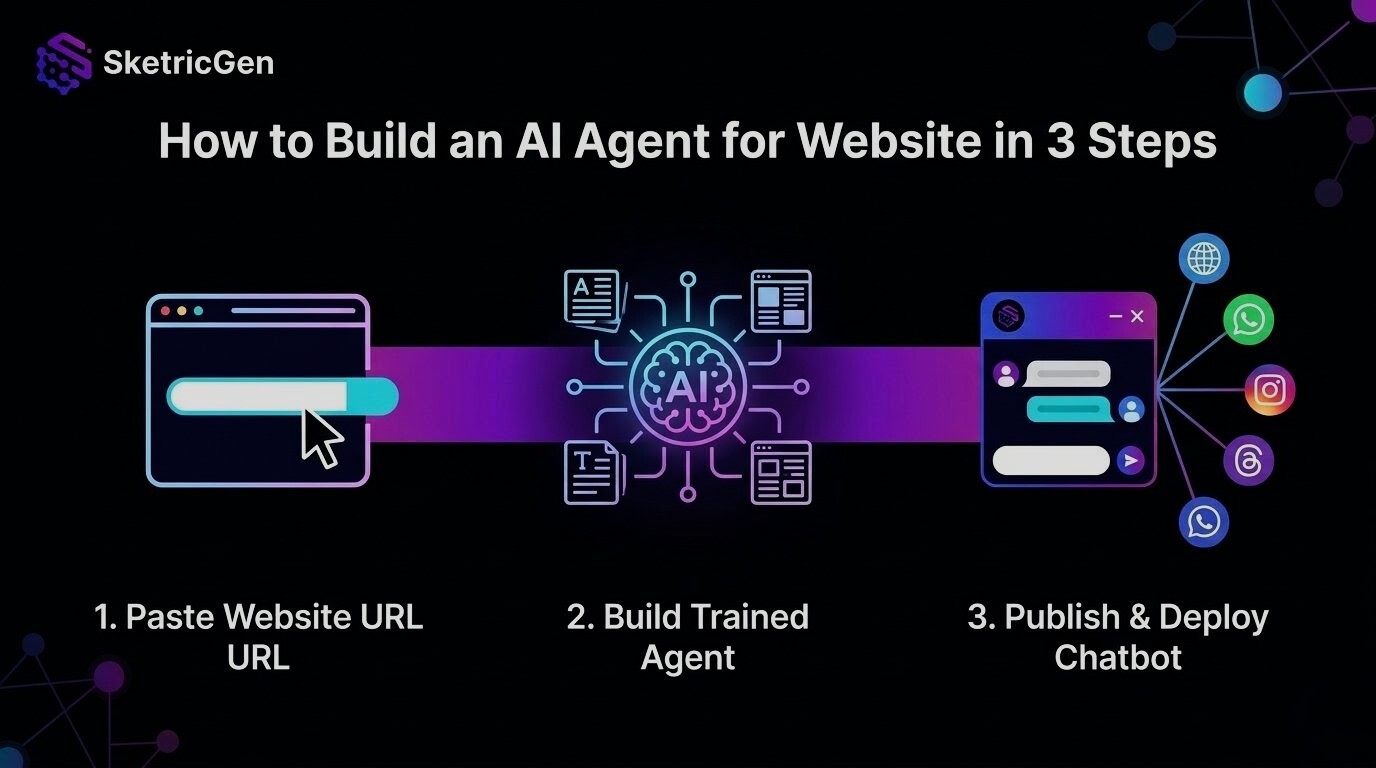
Here is the practical 3-step path behind Brand Agents.
Step 1: Paste your URL
You enter your website URL. The system crawls key pages and pulls high-signal content such as product pages, feature pages, pricing, FAQ, and policy pages.
This is the foundation for an AI agent trained on website data.
Step 2: Generate the brand agent
The platform creates a customer facing AI chatbot for website that answers from your content context, not only generic prompts. This is where many AI agent builder platforms differ in real outcomes. Training source quality drives answer quality.
Step 3: Deploy the branded widget
You copy the embed snippet and publish a branded AI chat widget on your website. The widget follows your logo and brand colors so the experience feels native. You can also deploy same chatbot acorss other channels like WhatsApp.
Pro tip: Start with one high-impact intent cluster first, usually pricing, support policy, and product fit questions. You get faster wins and cleaner analytics before widening scope.Brand Agents vs Traditional Chatbots
The table below reuses the core comparison structure from the Brand Agents internal draft.
| Feature | Brand Agents (SketricGen) | Traditional Chatbot Builder |
|---|---|---|
| Setup time | ~2 minutes | Hours to days |
| Training source | Auto-reads your website | Manual Q and A scripting |
| No-code setup | Full no-code | Limited no-code |
| Auto brand-matching widget | Logo and colors extracted | Not available |
| Channel deployment | Website, WhatsApp, Instagram, Slack, more | Website widget only |
| Agentic workflow support | Multi-agent orchestration | Limited |
| Best for | Fast customer-facing deployment and brand-matched agents | Basic FAQ bots |
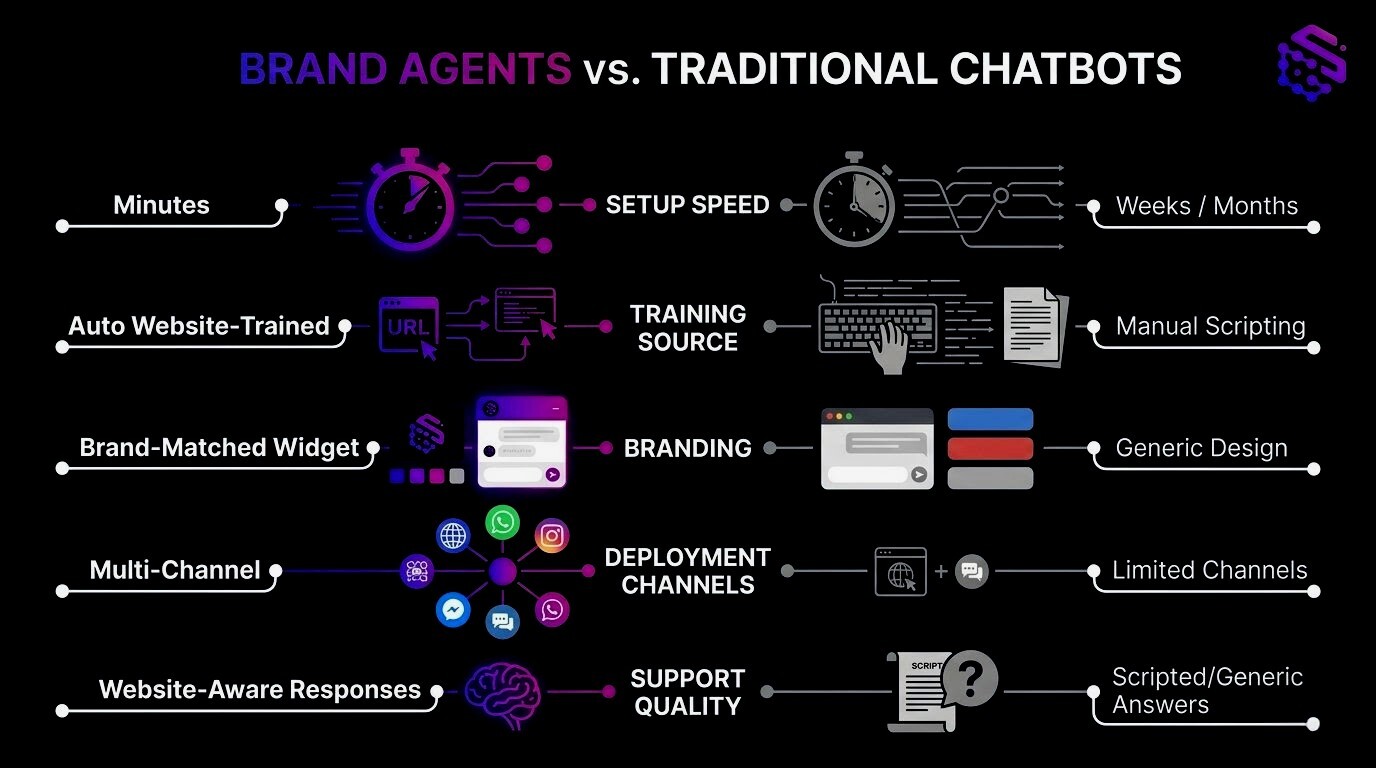
Interpretation for buyers:
- If your goal is immediate customer support coverage, speed and website training usually beat deep manual flow design.
- If your goal is only a static FAQ bubble, a traditional chatbot can still work.
- If your goal is an on-brand AI chatbot for websites plus channel rollout, Brand Agents has a clearer route.
Customer-facing deployment across website, WhatsApp, and Instagram
Most teams should start on website first, then expand.
Recommended rollout:
- Launch the AI agent for website support first
- Validate top intent categories and escalation routes
- Extend to AI agent for WhatsApp auto reply use cases
- Extend to AI agent for Instagram auto reply agent flows
This is how customer-facing AI agents become an operating layer, not just a widget.
Typical use cases:
- Customer Support Agent for website questions
- AI lead qualification agent for inbound conversations
- Website AI assistant for product discovery and routing
- On-brand AI agent for FAQ and policy clarification
If you are comparing top no-code AI agent builder platforms, check this first: can one setup power multi-channel deployment without rebuilding logic each time?
Common mistakes with Autonomous AI Agents in support
Autonomous AI Agents can be useful capability language, but risky expectation language.
Mistake 1: Promising full autonomy too early
Customer-facing systems need boundaries. Without controls, policy and trust issues appear quickly.
Mistake 2: Skipping guardrails
A safe setup includes:
- Confidence thresholds
- Fallback answers
- Escalation to human support
- Auditability
Mistake 3: No instrumentation
If you cannot track deflection, unresolved intent, and handoff quality, you cannot improve performance.
Decision rule: If a response can trigger financial, legal, or account-level impact, require human review or explicit confirmation.What practitioners are saying
Across no-code and AI communities, the signal is consistent:
- Teams value speed to first value more than large feature sets
- Operators are frustrated by overengineering support automation
- Buyers are skeptical of broad autonomy claims without controls
Source threads used in planning:
- r/Custom Chatbots Trained on Website and their Success
- r/Struggling to Automate Customer Support
- r/Problems with no Code
- r/Learning No-Code Chatbots
- r/Best No-Code Chatbots
Author take: For customer-facing AI agents, autonomous should mean autonomous, but, inside constraints. If your system is trained on your website, measured continuously, and regulated properly and correctly, it is useful. If it is unbounded, it becomes a support liability.
Next steps
If your website already has answers, you do not need a long scripting project to start.
- Create your Brand Agent: Brand Agents - SketricGen
- Explore all templates: Choose SketricGen Templates
- View pricing: Pricing Page
- Read the docs: Public Docs SketricGen
FAQs
Brand Agents is a no-code AI agent builder feature in SketricGen that turns your URL into a website-trained AI agent. It creates an AI chatbot for website deployment that can answer from your business content.
A traditional AI Chatbot often depends on manually written flows and Q and A sets. Brand Agents is trained on your website content directly and is built for customer-facing deployment with a brand-matched AI widget.
Use a URL-first workflow: paste URL, auto-train the agent on website data, then publish the embed widget.
For small businesses that need speed, low setup burden, and branded support experiences, this workflow is a strong fit. Content quality on your website still matters for answer quality.
Yes. Launch on website first, validate performance, then extend to WhatsApp and Instagram auto reply agent flows from the same core setup.
It is a chat widget aligned with your logo and brand colors so the interface matches your site experience instead of feeling generic.
No. Accuracy improves when pages are clear and up to date. Monitor unresolved queries and re-sync after major content changes.
They are safer when constrained. Use escalation logic, guardrails, and observability. Avoid unrestricted actions for high-risk requests.
It can do both. A website AI assistant can answer support queries and route high-intent prospects into an AI lead qualification agent flow.
Many AI agent builder platforms are strong for internal automation. Brand Agents is tuned for external customer-facing AI agents where fast launch, website-native training, and on-brand UX are primary requirements.
Related blogs
View more
AI Agents for Small Business: What Actually Works at 1-20 People
use cases
Website Lead Capture: How to Turn Silent Visitors Into Leads With an AI Chatbot
use cases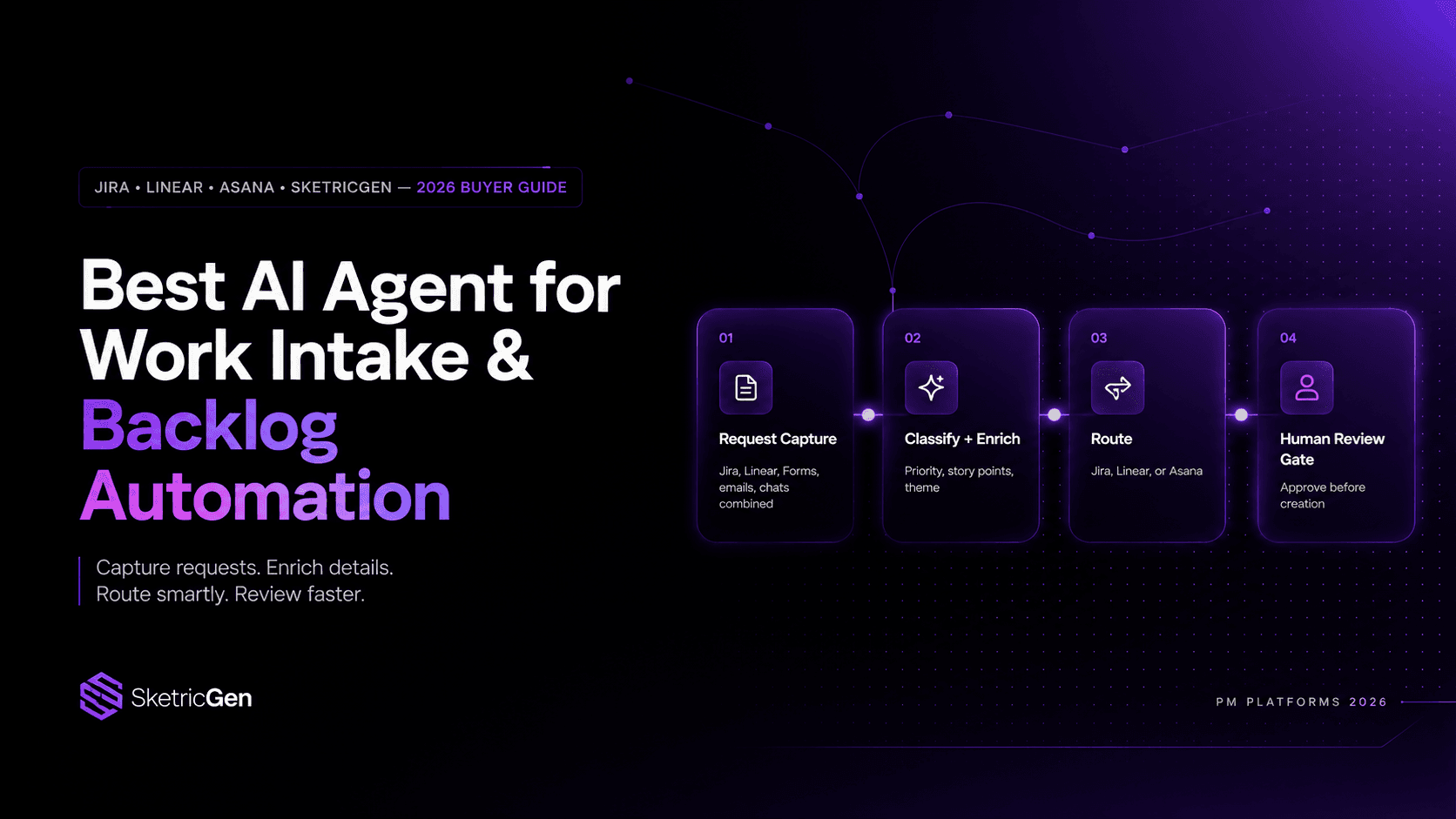
Best AI Agent for Work Intake & Backlog Automation in PM Platforms (2026)
use cases
How to Reduce Customer Churn with AI: Stop Losing Customers
use cases
How to Use AI Appointment Booking for Demos on Website
use cases