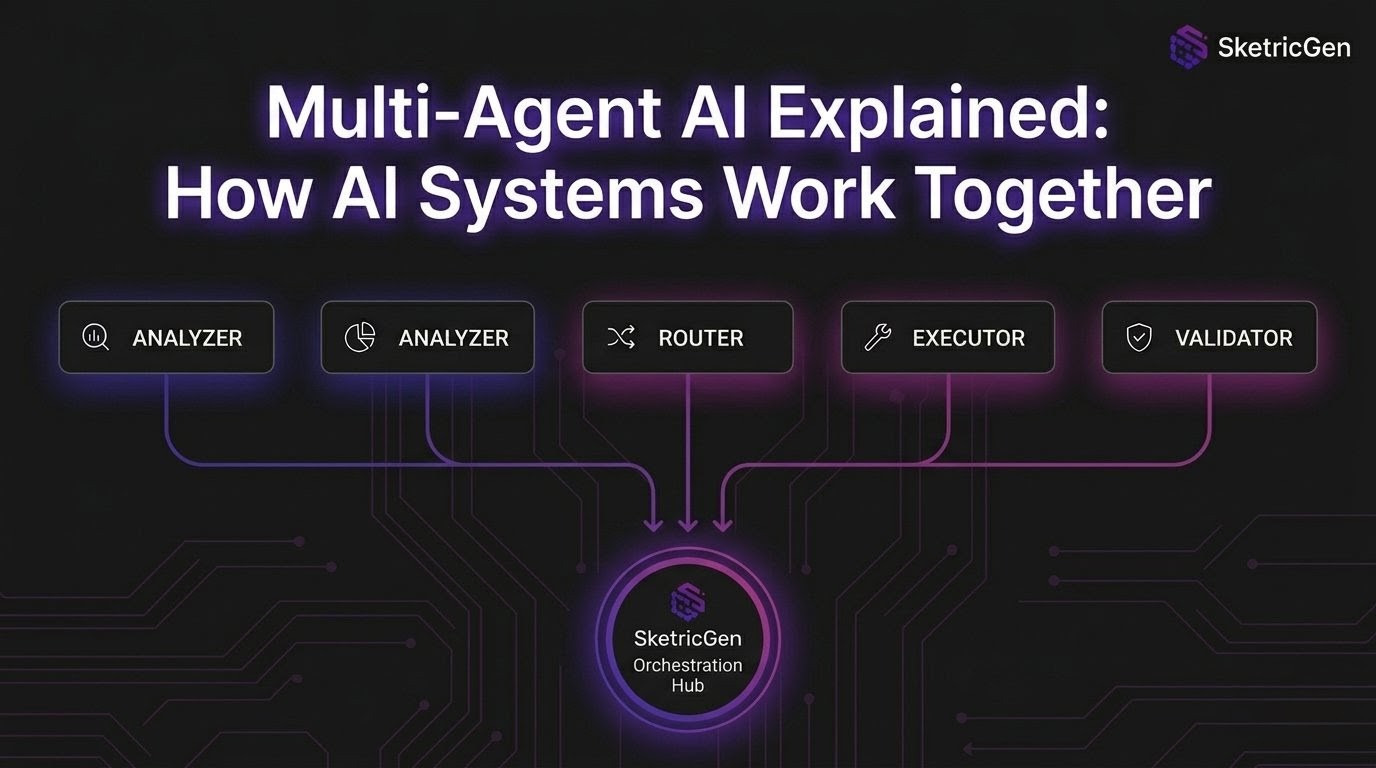
Multi-Agent AI Explained: How AI Systems Work Together
Multi-agent AI is a workflow architecture choice, not a default upgrade.
When AI agents working together are well orchestrated, you get specialization, clearer responsibilities, and better throughput on complex tasks. When orchestration is loose, you get handoff confusion, context drift, and rising cost.
This guide explains what multi-agent AI is, how multi-agent workflows work, how single-agent vs multi-agent AI differs in practice, and how to implement no-code multi-agent workflows with production guardrails.
Credibility line: This article combines architecture guidance from Microsoft, OpenAI, LangChain, Google Cloud, and IBM with recent practitioner discussions from r/SaaS and r/LocalLLaMA.
Who this is for
- Operators and product teams evaluating an AI workflow automation platform
- Founders deciding whether to move from one agent to multi-agent orchestration
- Teams implementing a visual AI workflow builder with reliability controls
Key Points
- Multi-agent orchestration helps when specialization, boundaries, or parallelism are real constraints.
- Single-agent systems often win on speed, cost, and maintainability for narrow workflows.
- AI agent handoffs and shared state are the main production failure points.
- Pattern choice drives latency and cost as much as model choice.
- A no-code AI workflow builder still needs contracts, checkpoints, retries, and approvals.
What is multi-agent AI?
Multi-agent AI is an orchestration model where multiple specialized agents collaborate to complete a shared workflow.
A compact definition:
Multi-agent AI is a system where specialized agents coordinate tasks, exchange scoped context, and combine outputs through orchestration logic.
That sounds simple, but there is an important distinction.
A single powerful agent with many tools is not always a multi-agent system. Multi-agent orchestration usually implies role boundaries, explicit handoffs, and stage-level governance.
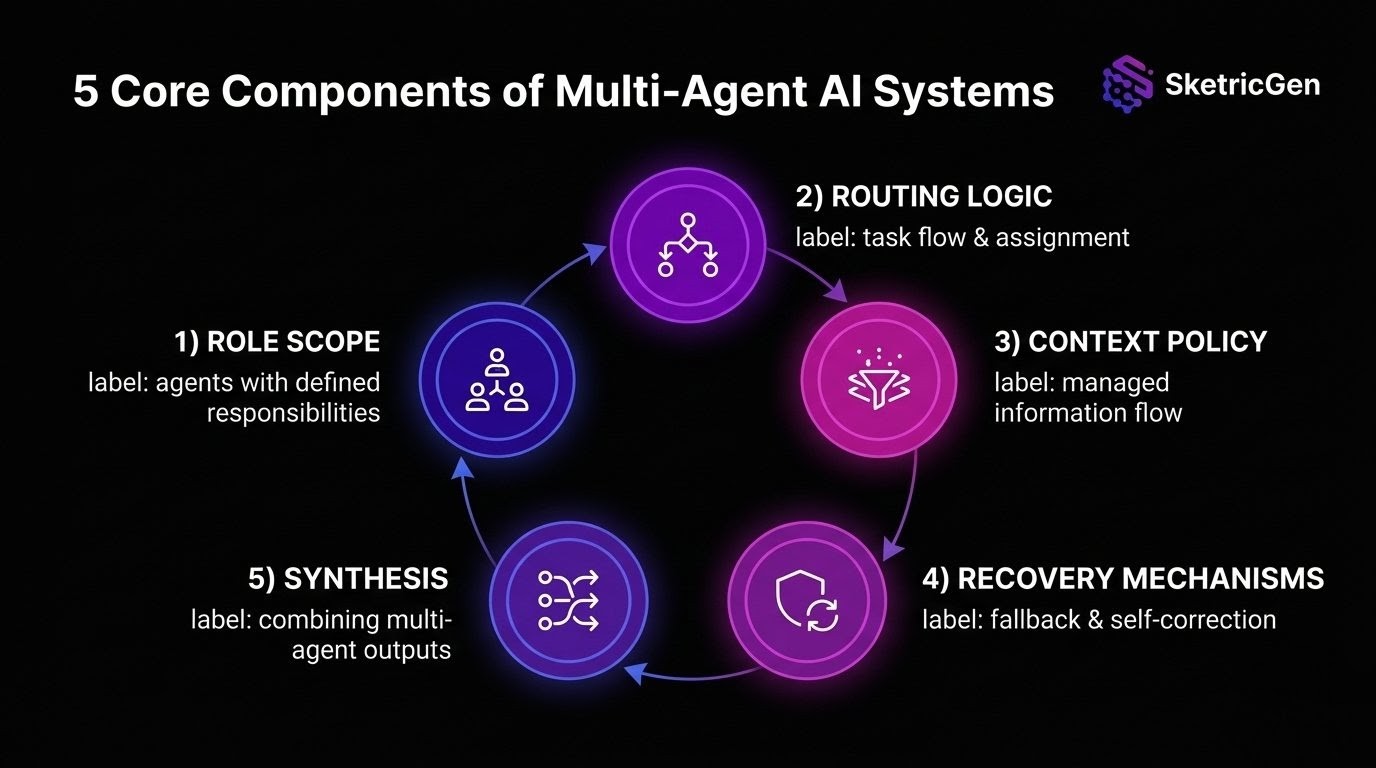
In practical terms, most multi-agent workflows contain five parts:
- Role scope: each agent has a clear responsibility.
- Routing: logic decides which agent runs next.
- Context policy: only relevant state is passed forward.
- Recovery: retries, fallbacks, or human escalation.
- Synthesis: a final step composes or validates output.
Without those, multi-agent orchestration often turns into expensive prompt chaining.
Single-agent vs multi-agent AI
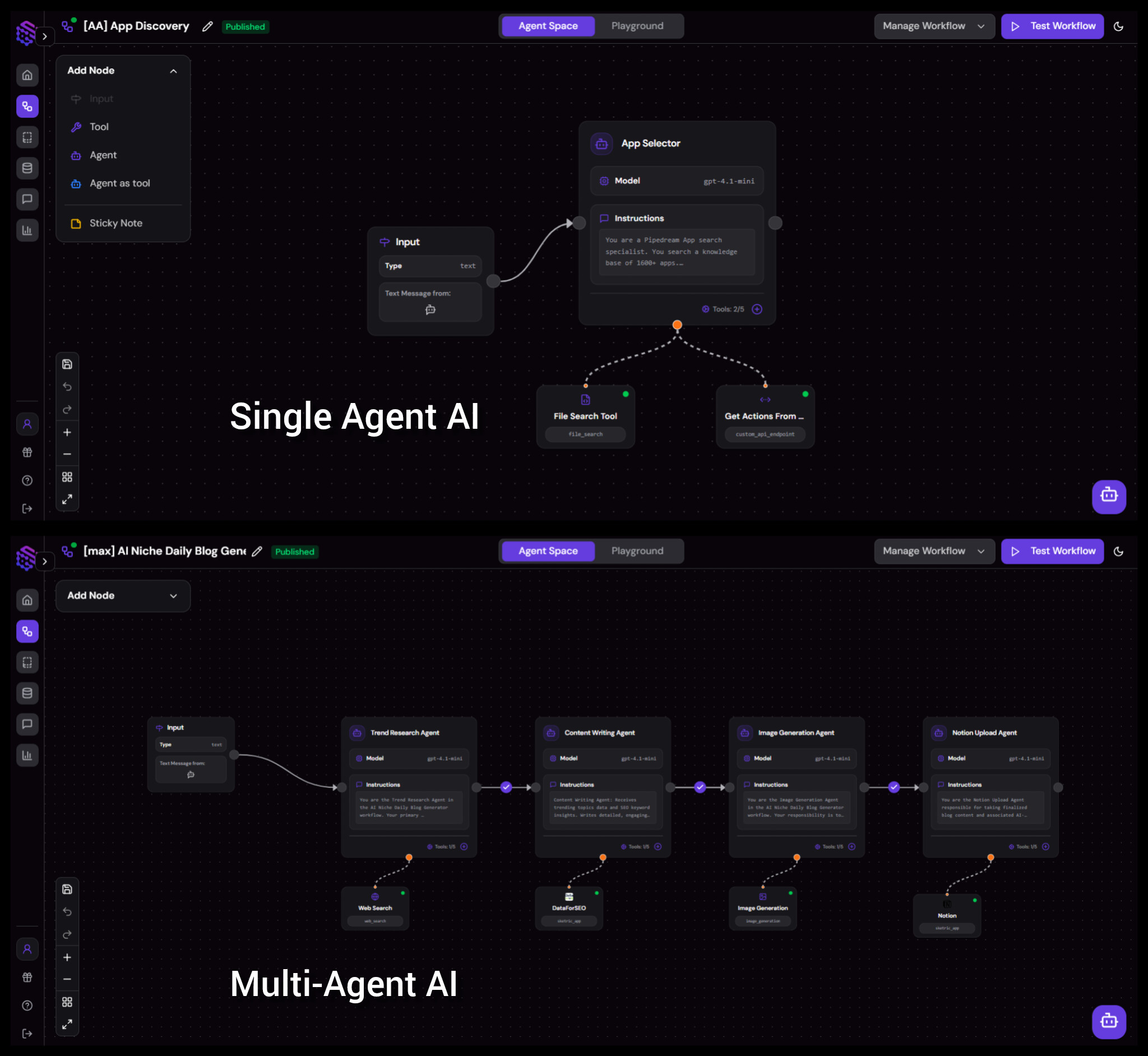
The real design question is not "which is better." It is "what is the least complex architecture that satisfies quality, reliability, and cost targets."
| Criterion | Single-agent AI | Multi-agent AI |
|---|---|---|
| Core model | One agent handles the full task | Multiple agents split the work |
| Best For | Narrow or medium-complexity workflows | Cross-functional or multi-step workflows |
| Build Speed | Faster | Slower |
| Latency Profile | Usually lower | Often higher due to handoffs |
| Main strength | Simpler setup, faster iteration, lower overhead | Specialization, modularity, clearer role separation |
| Main Risk | One agent gets overloaded | Handoffs, latency, and state management get messy |
| Specialization Depth | Limited in one context | Strong with scoped agents |
| Default Recommendation | Start here first | Add only when the workflow clearly needs it |
Use single-agent first when:
- The workflow is narrow and predictable.
- Time-to-market and cost are critical.
- Role differences can be handled by prompts and tool policies.
Use multi-agent orchestration when:
- You must enforce compliance or security separation.
- You need distinct specialist reasoning.
- Parallel branches create measurable throughput gains.
- One-agent quality collapses under tool and context overload.
A practitioner on r/SaaS put it bluntly after reliability issues: "We broke it into four narrow agents, each with a single job." That is the core lesson. Narrow scope reduces failure surface.
How AI systems work together
To explain how AI systems work together, map the full lifecycle.
1) Intake and classification
A triage step classifies the request by objective, risk level, and required capabilities.
2) Planning and routing
The orchestrator selects deterministic or LLM-guided flow. This is where an agent orchestration platform adds control.
3) Specialist execution
Agents perform bounded jobs like retrieval, analysis, formatting, policy checking, or action execution.
4) AI agent handoffs
Handoffs transfer control or outputs. Reliable handoffs include:
- objective and success criteria
- compact context summary
- structured output contract
- confidence or validation metadata
5) Validation and output synthesis
A manager or validator reviews results, merges outputs, and either returns, retries, or escalates.
The hidden issue is context discipline. Too much context increases cost and confusion. Too little context causes brittle decisions. Strong multi-agent orchestration depends on precise context engineering.
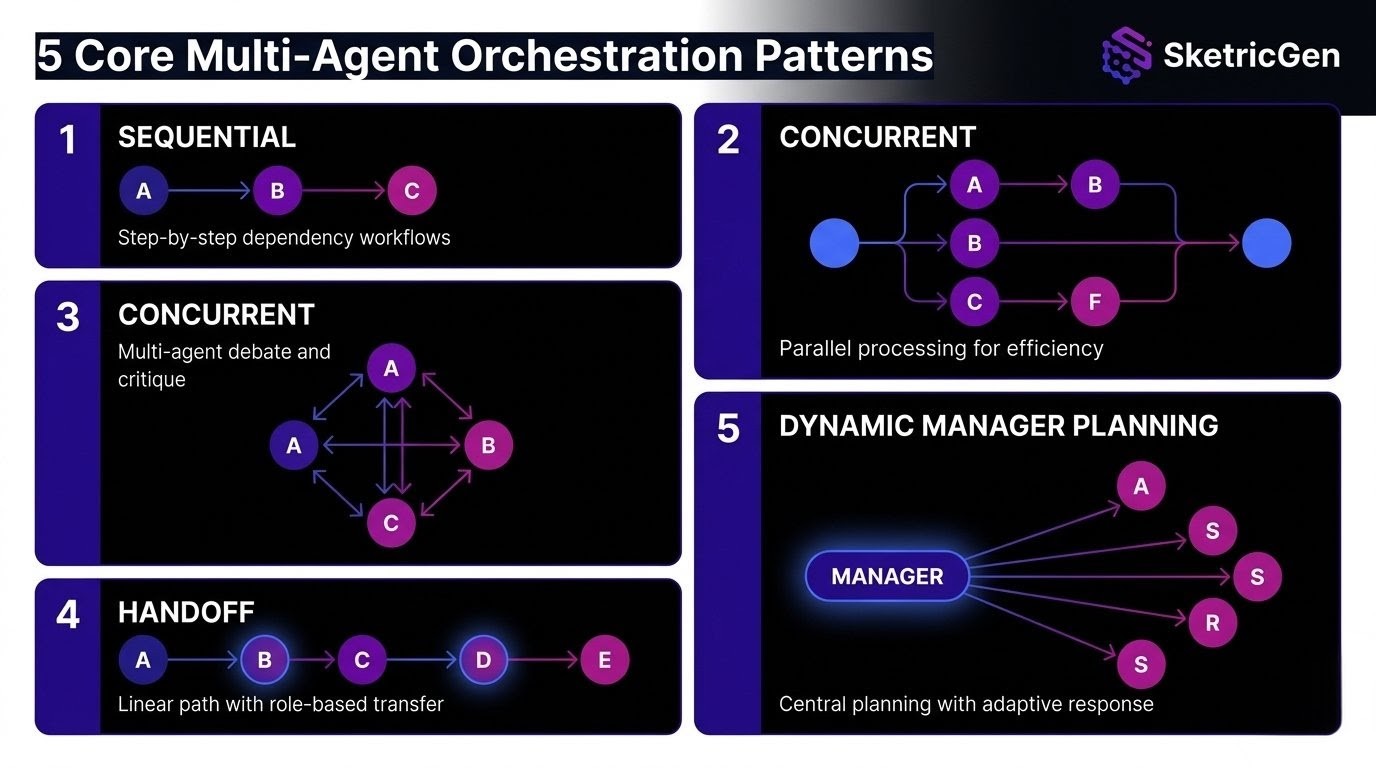
Core multi-agent orchestration patterns
Different patterns solve different coordination problems.
| Pattern | Best for | Avoid when |
|---|---|---|
| Sequential | Step-by-step dependency workflows | Work can run in parallel |
| Concurrent | Independent specialist analysis | Shared mutable state is fragile |
| Group chat or maker-checker | Debate, critique, quality loops | Hard real-time latency constraints |
| Handoff | Dynamic specialist routing | Loop controls are missing |
| Dynamic manager planning | Open-ended tasks with evolving plan | Deterministic pipeline is enough |
Two implementation patterns from OpenAI Agents SDK are useful in production:
- Agents as tools: a manager owns user interaction and calls specialists for bounded subtasks.
- Handoffs: control transfers to the selected specialist for direct handling.
Most practical systems are hybrid. You can hand off at macro level and still use helper agents as tools inside each specialist stage.
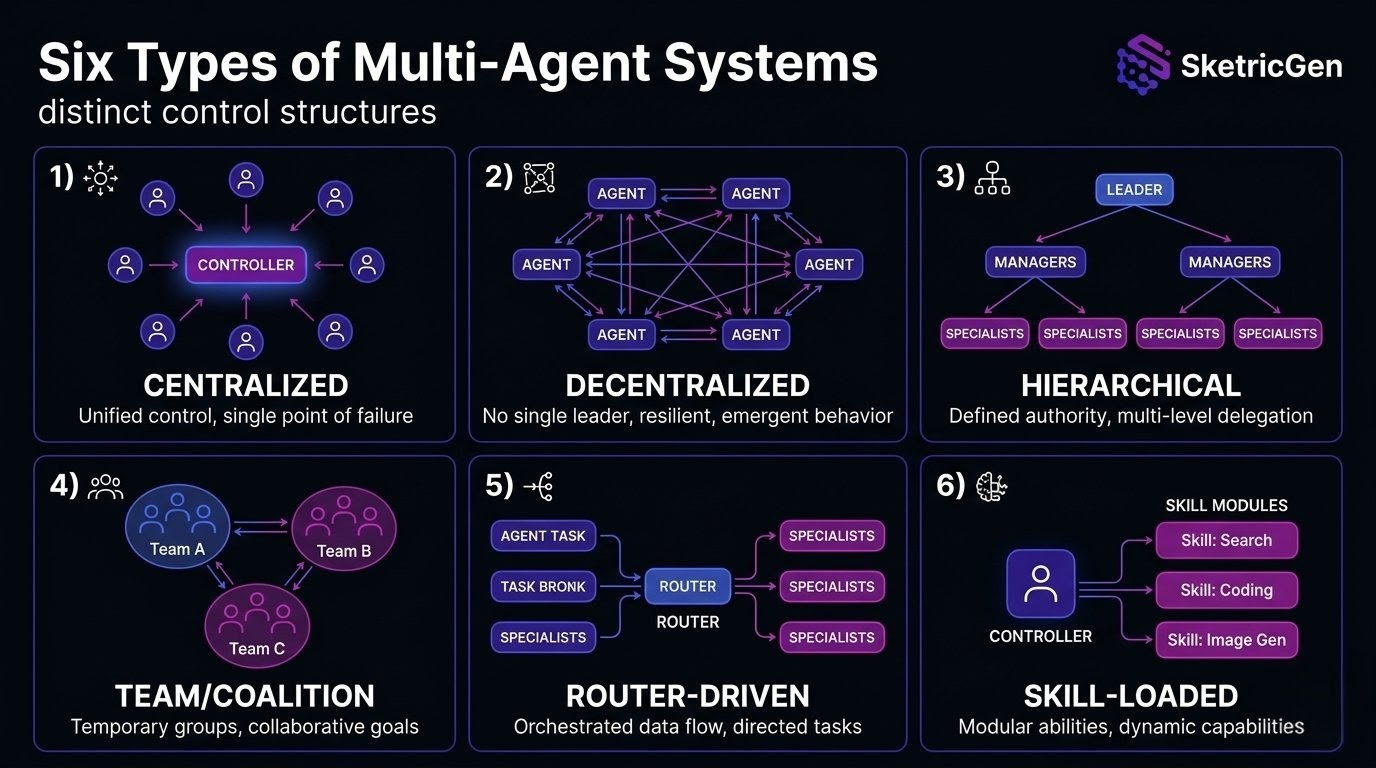
Different types of multi-agent systems
You can also classify systems by control structure.
Centralized systems
A controller routes and aggregates. Easier to audit. Higher dependency on central coordinator.
Decentralized systems
Agents coordinate with shared signals or peer communication. Better fault isolation. Harder observability.
Hierarchical systems
Parent-child delegation with clear authority and role boundaries.
Team or coalition systems
Temporary groupings around a subgoal. Good for dynamic workloads with strong conflict resolution.
Router-driven systems
A classifier routes tasks to specialist agents and combines outputs.
Skill-loaded controller systems
One controller loads specialized context on demand. Useful midpoint between single-agent and full multi-agent split.
How to optimize multi-agent workflows in production
Most teams do not fail because they picked the wrong model. They fail because orchestration mechanics are weak.
1) Keep role scope strict
One job per agent. Avoid broad role overlap.
2) Enforce contracts at every handoff
Use schema validation. Reject malformed outputs immediately.
3) Add durable execution
Checkpoint each stage so failures resume from last successful step.
A recent r/SaaS operator described the impact: "I moved our workflows to a system that checkpoints every step. Now, if a process dies, it doesn't start over." That is what removes restart tax.
4) Build layered recovery
Timeout, retry, fallback path, then human escalation.
5) Instrument key metrics
Track at minimum:
- handoff success rate
- retries per workflow
- stage-level latency
- cost per completed run
- validation pass rate
6) Externalize shared state
Store canonical state outside transient model context windows.
What practitioners are saying: As systems scale, teams report that shared state discipline and rationale logging matter more than adding extra models or extra agents.7) Add eval gates
Run rubric-based checks for quality, policy compliance, and factual grounding before execution in downstream systems.
Multi-agent AI for business automation
Where does multi-agent AI for business automation create clear ROI?
| Workflow | Why multi-agent helps | Typical pattern |
|---|---|---|
| Customer support operations | Triage, retrieval, policy checks, escalation | Handoff + validator |
| Revenue operations | Lead research, qualification, outreach prep | Concurrent + synthesizer |
| Compliance workflows | Evidence collection and policy checks | Sequential + maker-checker |
| Cross-functional operations | Multi-tool actions across departments | Router + specialists |
Where it usually hurts:
- If one agent already meets SLA and quality targets
- If handoff logic is invisible or untestable
- If ownership for each agent is unclear
This is why platform selection matters. A strong AI workflow automation platform should support replay, inspection, approvals, and rollback.
How to implement no-code multi-agent workflows
A practical rollout sequence for a no-code AI workflow builder:
Step 1: Pick one measurable workflow
Choose one repeated process with clear success criteria.
Step 2: Build a single-agent baseline
Measure quality, latency, and cost first.
Step 3: Split only at proven bottlenecks
Split by specialization need, security boundary, or parallel branch value.
Step 4: Add guardrails before scale
Minimum controls:
- schema validation at handoffs
- retry with limits
- stage checkpoints
- human approval for sensitive actions
Step 5: Operate with visibility
Do not scale agent count until you can explain failure patterns.
Step 6: Productize with templates
Turn validated flows into reusable orchestration templates.
Mistake I see often: Teams add agents before fixing handoff contracts. Complexity goes up, reliability does not.SketricGen maps directly to this path as a visual AI workflow builder and agent orchestration platform. Teams can design no-code multi-agent workflows, add governance controls, and iterate from observable runtime data.
If you want more context, review AI Agents Guide, Agentic AI Explained, and OpenClaw alternatives no-code AI agent builder. When you're ready to build your own multi-agent workflow, start from the SketricGen agent library.
Common mistakes in multi-agent workflows
Teams usually make the same mistakes when they move from prototype to production.
1) Splitting too early
They create multiple agents before proving a single-agent baseline. This increases overhead without proving business value.
2) Weak handoff contracts
Agents pass free-form text with no schema. The next stage misreads intent and silently degrades output quality.
3) No durable state
Workflow progress lives only in context windows. A timeout or restart causes repeat work, higher token spend, and inconsistent outcomes.
4) Missing observability
Teams track final output only, not stage-level latency, retries, and handoff failures. This makes root cause analysis slow and guess-driven.
5) Pattern mismatch
They use complex orchestration for simple tasks or force deterministic chains on dynamic tasks. Both choices reduce reliability and operator trust.
Quick summary: Start simple, define contracts, persist state, instrument every stage, and choose orchestration patterns based on workflow constraints, not trend pressure.5 best multi-agent AI systems/agent orchestration tools
There is no universal winner. The best tool depends on who builds the workflow, how much control you need, and how much reliability engineering you can support.
| Tool | Best fit | Strengths | Tradeoffs |
|---|---|---|---|
| SketricGen | Teams that want no-code multi-agent workflows with visual control | Visual AI workflow builder, multi-agent orchestration focus, business-friendly workflow automation model | Requires clear process design to get the most value from orchestration features |
| n8n | Technical teams that want flexible workflow logic and self-host options | Strong node ecosystem, broad integrations, high customization potential | Can become complex quickly for non-technical operators |
| Make | Operations teams building cross-app automation with visual scenarios | Accessible scenario builder, wide connector coverage, fast prototyping | Advanced orchestration logic can become hard to maintain at scale |
| Zapier | Teams optimizing fast deployment of standard automations | Huge app ecosystem, simple setup, low onboarding friction | Complex multi-agent behavior may need extra structure and governance layers |
| Lindy | Teams wanting AI-first assistant style automation workflows | Agent-oriented UX, quick use-case activation for business workflows | Platform depth for advanced orchestration controls can vary by use case |
How to choose your agent orchestration platform:
- Start with your highest-value workflow and a single success metric.
- Check handoff controls, schema support, and retry/checkpoint features.
- Validate observability before scaling agent count.
- Compare cost per successful workflow completion, not cost per run.
Next steps
If you are evaluating architecture now, use this sequence:
- Benchmark single-agent baseline on one real workflow.
- Split only where measurable constraints require it.
- Add handoff, state, and recovery controls before scaling.
- Deploy through a visual AI workflow builder so operators can continuously improve flow quality.
To move from concept to execution, build your first orchestrated workflow in SketricGen and track handoff quality, latency, and completion cost from day one.
FAQs
It is a system where multiple specialized AI agents collaborate through orchestration rules to complete a workflow.
Single-agent systems centralize logic in one runtime path. Multi-agent systems distribute logic across specialized roles and require explicit handoffs and state policies.
A handoff transfers control or output between agents. Reliable handoffs include objective, context summary, structured output, and validation metadata.
Sequential, concurrent, group chat or maker-checker, handoff, and dynamic manager planning are the most common patterns.
Avoid it when one agent already meets requirements, or when your team lacks monitoring and debugging capability for distributed workflows.
Frequent causes are weak state persistence, contract mismatch at handoffs, silent retry loops, and limited observability.
Minimize agent count, route low-complexity tasks to cheaper models, compact context between stages, and track cost per successful completion.
Yes, if the platform enforces contracts, guardrails, and approval controls. Without those, no-code setups can become fragile quickly.
Look for routing flexibility, schema validation, checkpointing, replayability, observability, and human-in-the-loop support.
No. Better outcomes depend on fit between workflow constraints and orchestration design. More agents can increase overhead without improving quality.
Related blogs
View more
SEO Automation: What You Can Safely Automate (and What Still Needs a Human)
ai trends and research
What Is an AI Marketing Agent? What It Automates, and What It Cannot
ai trends and research
AI-Proof Jobs in 2026: What the Data Actually Shows
ai trends and research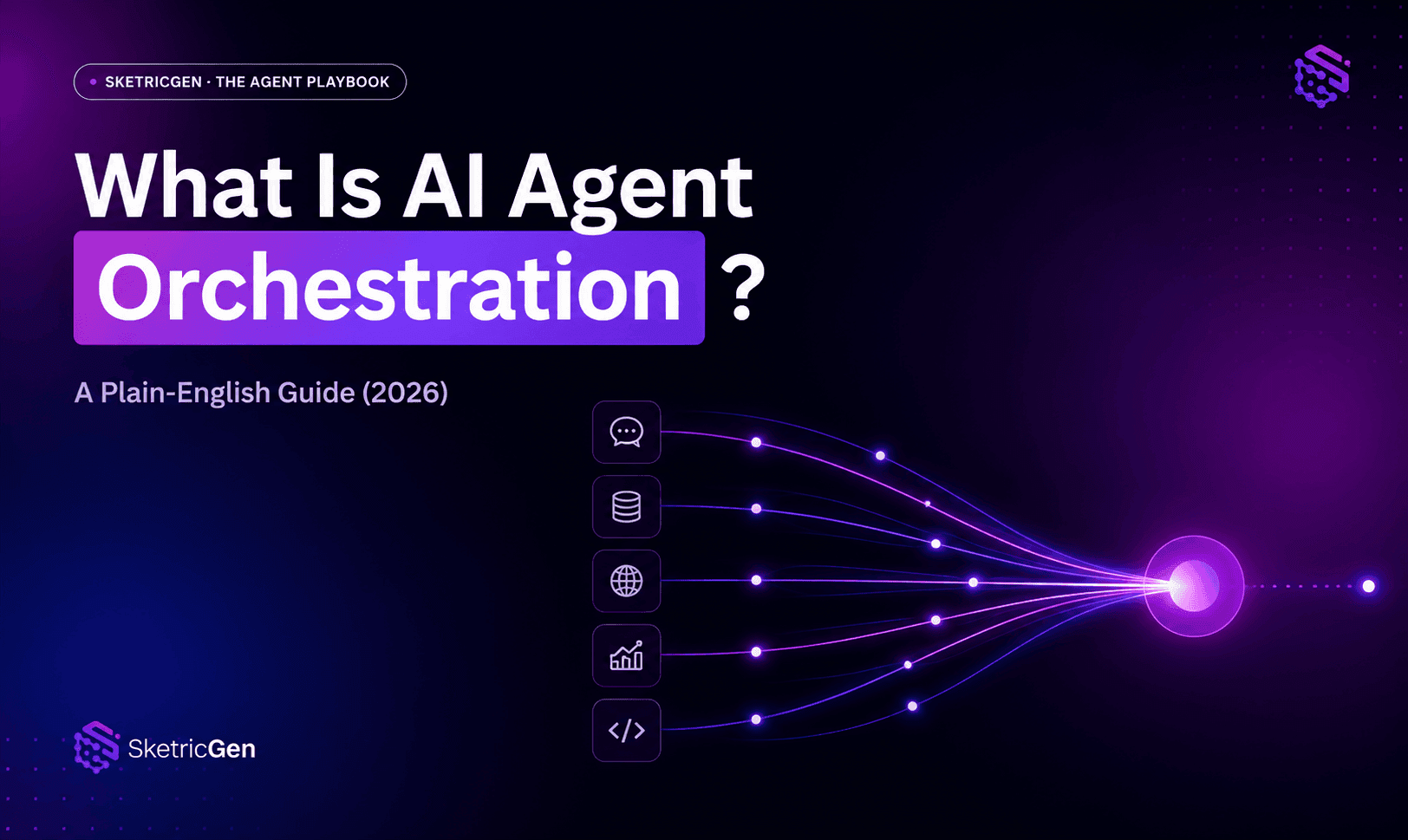
What Is AI Agent Orchestration? A Plain-English Guide (2026)
ai trends and research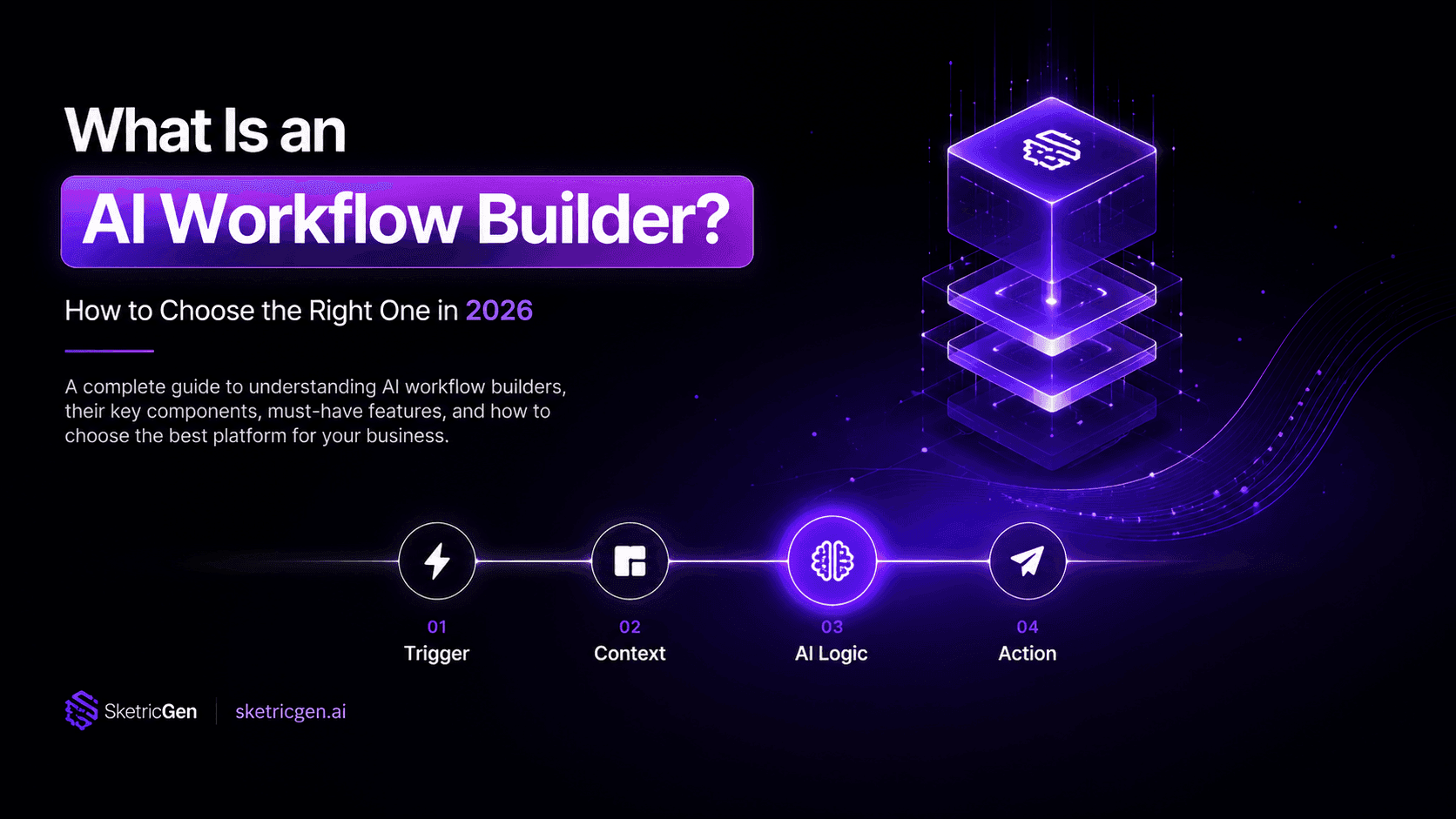
What Is an AI Workflow Builder? How to Choose the Right One in 2026
ai trends and research