SEO Automation: What You Can Safely Automate (and What Still Needs a Human)
"Is SEO dead?" gets asked every time Google ships a new AI feature, and 2026 has shipped a lot of them. Search results for "seo automation" itself now lead with an AI Overview before a single blue link shows up, a small, telling sign that search about search is already AI-mediated. SEO isn't dying, it's shifting from ranking a page to earning a citation inside an AI-generated answer, and automation is exactly where that shift succeeds or backfires.
SEO automation works when it touches data and drafts. It breaks SEO when it touches what gets published and who gets contacted. That's the whole split, and most of the "automation ruined my rankings" stories on Reddit trace back to skipping that line, not to automation being a bad idea.
This is checked against the top-ranked practitioner thread for this exact question (r/SEO, cited in Google's own AI Overview for "seo automation") and against the checkpoints already built into SketricGen's own SEO templates.
Who this is for
- Marketers and founders already running some automation who want to know where the line actually is.
- Small-agency operators evaluating tools before they wire anything into a client's site.
- Anyone who's read a "SEO is fully automated now" take and wants the honest version.
Key Points
- SEO automation splits into three zones: automate, assist, human-only, not one blanket yes or no.
- The riskiest failures happen in the assist zone when nobody reviews the output before it publishes.
- Reporting, audits, and first-pass analysis are the safest, highest-ROI automation targets and the most overlooked.
- A working no-code stack, starting with SketricGen's AI SEO Content Brief Generator, can run today without engineering time.
- Automation is a force multiplier: clean process, it scales wins; messy process, it scales mistakes.
What SEO automation actually means in 2026
SEO automation means using software to run one or more SEO tasks with less manual work: pulling keyword data, generating a content brief, drafting a first pass, tracking rankings, or building a report. It doesn't mean removing judgment from the process. SEO is a stack of different jobs, some mechanical, some strategic, and automation only helps when it clears out the mechanical ones so the strategic ones get more attention, a distinction practitioners raise directly when asked whether SEO can be automated at all.
The automate, assist, human-only framework
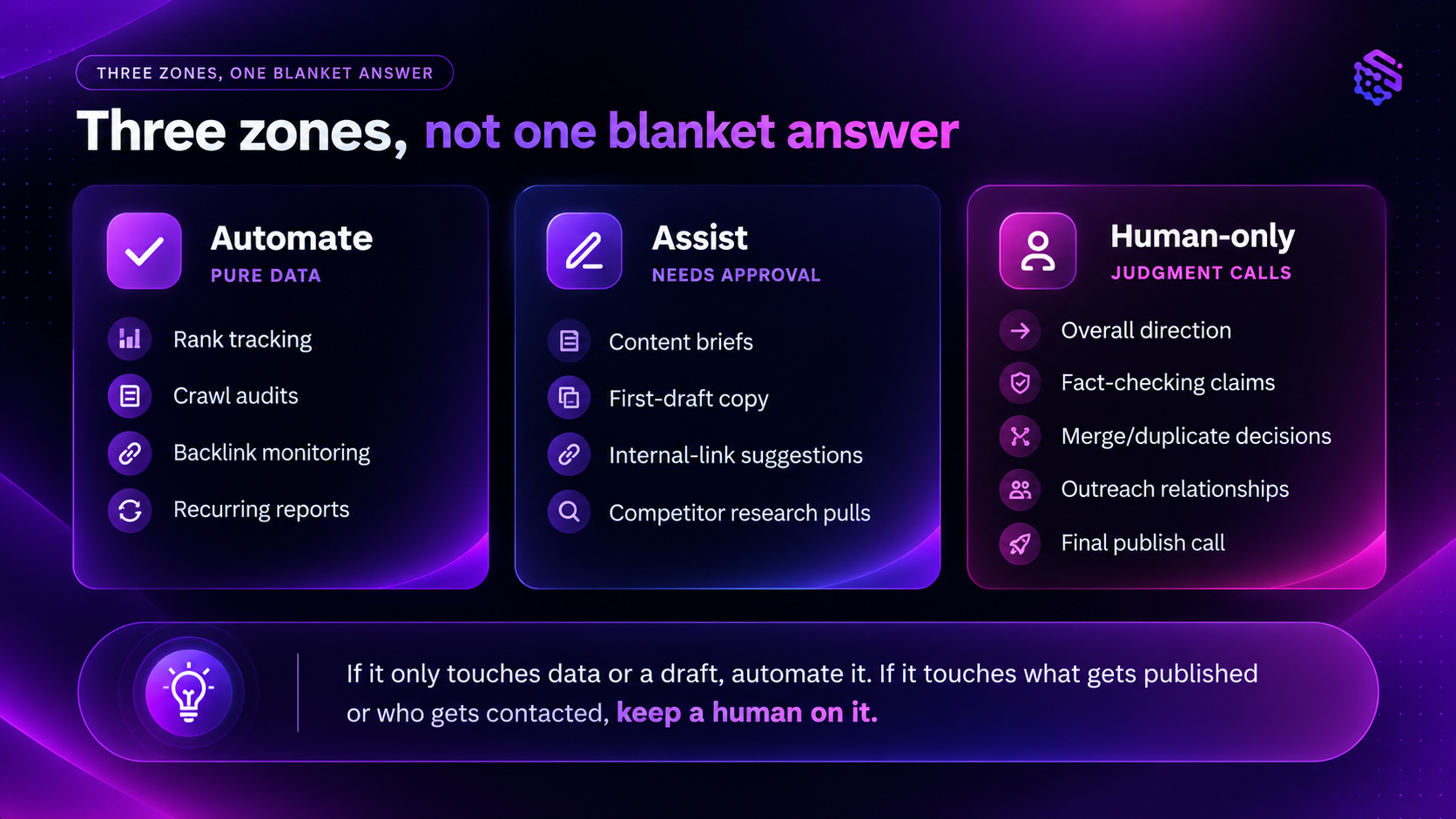
Here's the split that holds up across the practitioner threads and SketricGen's own template design:
| Zone | Tasks | Why |
|---|---|---|
| Automate | Rank tracking, crawl audits, backlink monitoring, recurring reports | Pure data collection. No judgment call in the loop, so there's nothing for automation to get wrong. |
| Assist | Content briefs, first-draft copy, internal-link suggestions, competitor research pulls | Automation does the heavy lifting, a human approves before anything ships or publishes. |
| Human-only | Overall content direction, fact-checking claims, merge/duplicate decisions, outreach relationships, final publish call | These require judgment, context, or a relationship automation can't hold. |
Decision rule: if a task only touches data or a draft, automate it. If it touches what gets published or who gets contacted, keep a human on it.
The human-only column isn't theoretical. It matches almost exactly what one founder listed after running an automated SEO process for six months: choosing overall direction, reviewing ideas, checking factual claims, finding duplicated topics, and deciding on merges or improvements stayed manual the whole time, even once the rest of the pipeline ran itself.
The impacts of SEO automation
Done well, automation changes more than your workload, it shows up in the traffic numbers. Done without a human layer, it shows up there too, in the wrong direction:
- Time back on mechanical work. Rank tracking, crawl audits, and reporting that used to eat hours now run unattended, freeing up time for strategy and content decisions.
- Faster first drafts. Briefs and first-pass copy that took days now take minutes, which is also where most of the risk concentrates if nothing reviews the output before it ships.
- A real traffic upside when a human reviews before publish. A 2026 NP Digital study found a 444% traffic increase on AI-drafted articles after a 20-minute human edit pass, across 744 articles and 68 websites.
- A real traffic downside when nothing does. In the same study, AI-generated content made up 52.1% of newly published articles but earned only 4.9% of new organic traffic, while human-written content was 14.5% of the volume and captured 87% of the traffic.
- Compounding ROI on reporting. Automated reports and audits, unlike a one-off brief, keep paying back every week they keep running.
- Reputational risk at scale. A missing review step doesn't cost one page, Google's spam guidance and the practitioner reports below both show it can drag an entire site's rankings down at once.
Where automation actually breaks SEO
The failures aren't usually about a bad tool. They're about a missing review step. As one practitioner put it on the thread that ranks for this exact question:
"Most SEO automation is just good orchestration... Automation is a force multiplier. If your process is clean, it scales wins. If it's messy, it scales mistakes." (via r/SEO)
Another commenter on the same thread was blunter about the downside: the only tasks safely automated right now are data gathering and prioritization, because letting scripts auto-publish tags or schema blindly "will eventually nuke your site." Google's own guidance on automatically generated content backs this up from the policy side, not just the practitioner side: content produced to manipulate rankings, with no meaningful human oversight, is treated as spam regardless of what generated it.
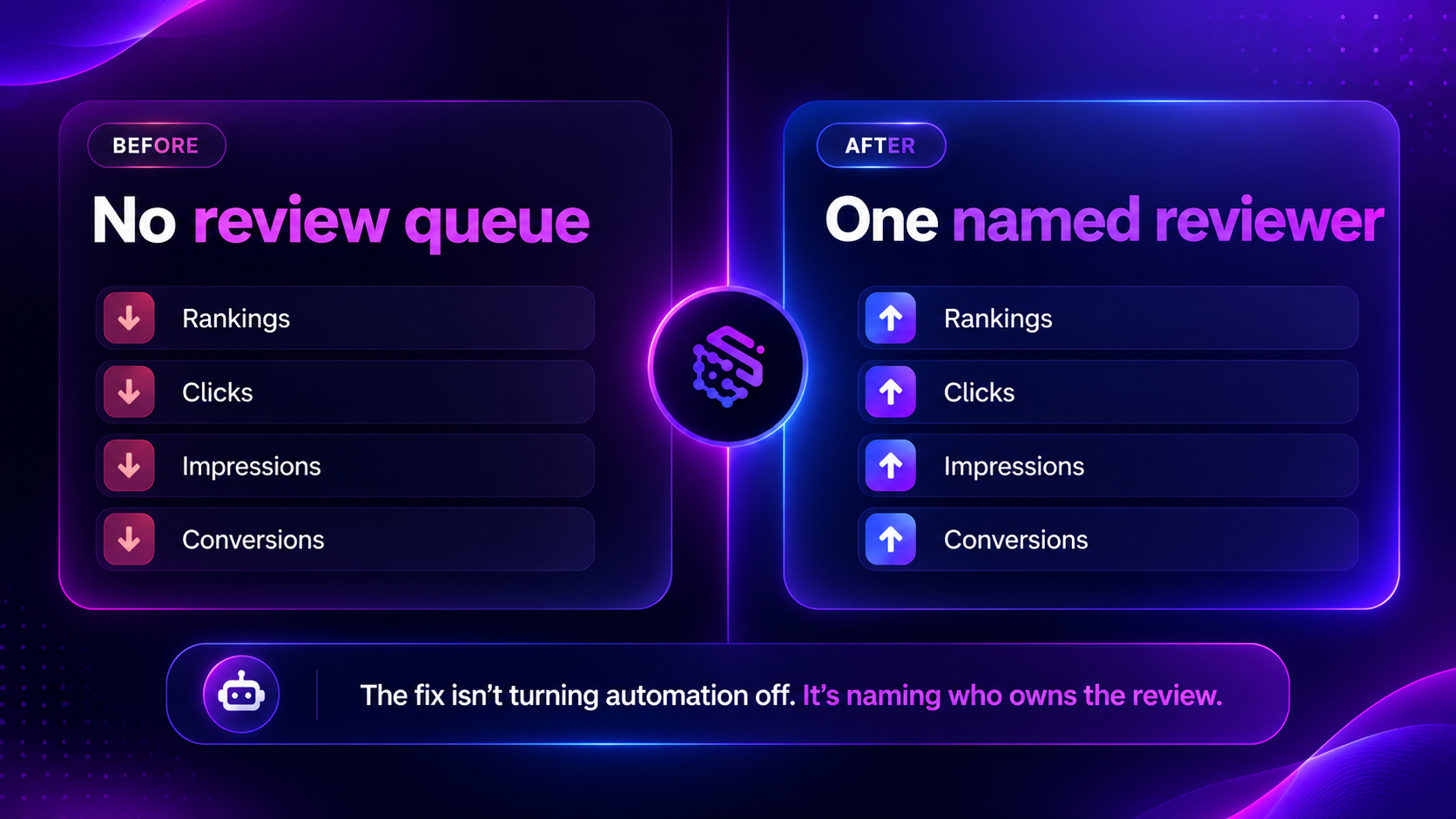
Mistake to avoid: one Redditor described a client whose previous agency ran automation with zero human intervention periodically. It tanked rankings, clicks, impressions, and conversions in one pass. The fix wasn't turning automation off. It was putting a review queue back in front of anything that publishes.
The 20-minute human layer, and why it works
The clearest outside validation of this framework comes from NP Digital's 2026 study, Google Watermarks Your AI Content: Here's the 20-Minute Fix, which tracked 744 AI-drafted articles across 68 websites before and after a short human edit pass.
The fix wasn't a rewrite. It was five moves: add firsthand experience the model doesn't have, add something AI couldn't know on its own (proprietary data, a real test, a named source), cut filler and tighten unverified claims, fact-check and refresh (freshness is the single most cited factor in the study, at 91%), and put a real named author on the piece. Articles that got this treatment saw a 444% traffic lift. Google's SynthID watermarking, already adopted across OpenAI, Anthropic, Nvidia, ElevenLabs, Microsoft, and Grok output, means the platform doesn't need to guess which pages skipped that step, it's increasingly ranking on trust signals, not policing for AI detection.
That's the same line this post has been drawing the whole way: automate the draft, keep a human on what ships.
A no-code stack that respects the framework
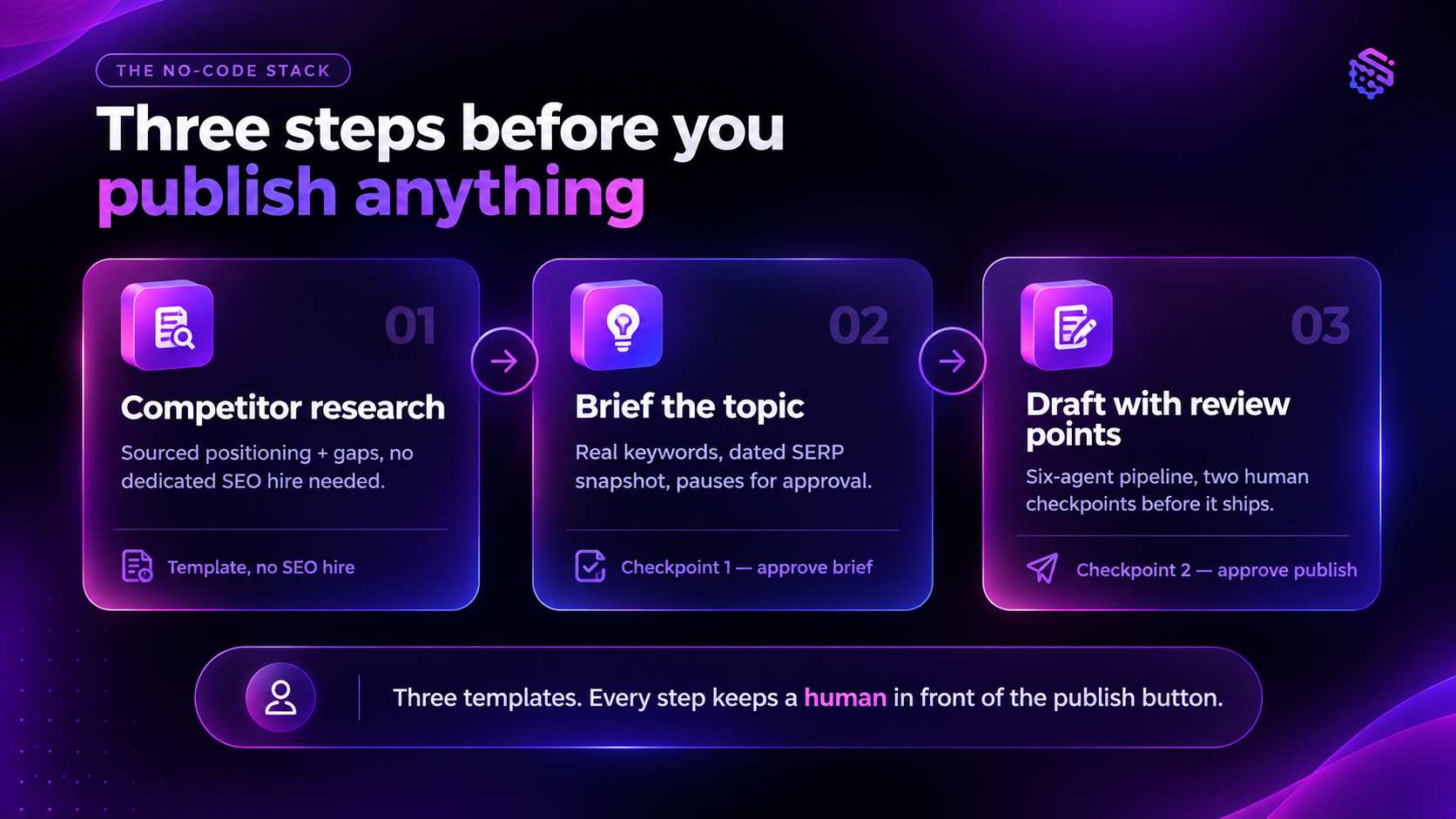
You don't need engineering time to build the assist zone correctly, you need the checkpoints in the right place. Three templates cover most of it:
- Brief the topic first. SketricGen's AI SEO Content Brief Generator (linked above) turns one topic line into a sourced brief, real keywords, a dated SERP snapshot, and a competitor-page teardown, then pauses for your approval before anything moves forward. That pause is the assist-zone checkpoint in practice, not just in theory.
- Draft with review points built in. The SEO Optimized Blog Generator runs a six-agent pipeline (research, outline, draft, edit, publish) with two human review checkpoints before anything ships. It's a good example of how an AI workflow builder coordinates specialist agents instead of one giant prompt, which is also why it outperforms a single-prompt approach on a straight comparison.
- Get competitor research done first, without waiting on a dedicated SEO hire. Even if your main use of AI agents so far has been customer-facing, a competitor intelligence agent is one of the fastest ways to get sourced positioning, SEO, and content-gap evidence on the board before you write a single brief. It's an agent template, not a chatbot, but it plugs into the same dashboard as everything else, so it's a genuinely easy first step.
If you're building this outside SketricGen, the shape is the same: connect a keyword/SERP data source, a content-gen step, and a human checkpoint before publish. That's why "seo automation n8n" shows up as a live related search, teams are wiring the same three-part pipeline with general-purpose automation tools instead (more on that tradeoff in the FAQ below). SketricGen is also building a dedicated SEO automation hub that walks through this exact stack end to end.
Reporting deserves its own mention because it's the most skipped easy win. One practitioner pointed out that reports, audits, and alerts have been safely automated "for years," treated as boring infrastructure rather than a differentiator, when it's one of the safest, highest-ROI things on this whole list.
Common mistakes
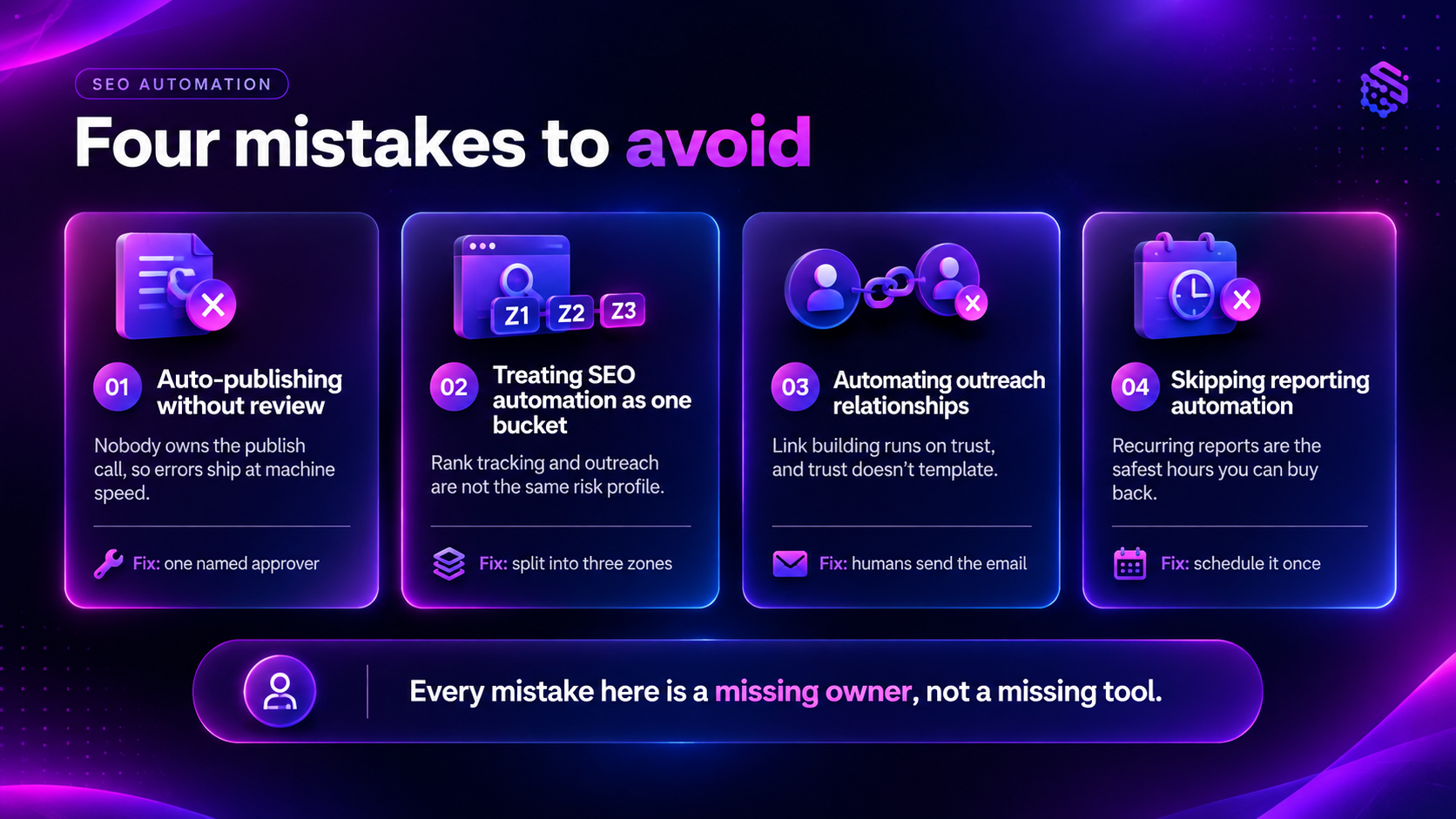
- Auto-publishing without a review queue. The single biggest cause of automation damage in every source reviewed for this piece.
- Treating "SEO automation" as one bucket. Data collection and publish decisions are not the same risk category.
- Automating outreach relationships. Timing, angle, and follow-up on link outreach still read as templated when a machine handles them end to end.
- Skipping reporting automation. It's the lowest-risk, easiest win, and the most commonly ignored one. If you also handle structured data work, the same "automate collection, keep decisions human" split shows up in text-to-SQL agent workflows.
Author's Take
I'd push back a little on the "just add a review queue" advice you'll see everywhere, including in this post. A review queue only works if one person actually owns it. Every damage story sourced for this piece has the same root cause: automation ran, and either nobody was assigned to check it, or the person assigned didn't have the authority to stop a publish. SketricGen's own templates bake the checkpoint into the workflow for exactly this reason, the pause isn't optional, it's structural. If you're wiring your own stack, don't just add a review step. Name the person who owns it and give them the authority to say no.
Next steps
Pick one assist-zone task, brief generation, drafting, or competitor research, and wire it into a workflow with a named reviewer before it publishes anything. The templates above are built with that checkpoint already in place, so you're not starting from a blank canvas. Explore the full template library in SketricGen's dashboard to see what fits your stack first.
FAQs
SEO automation is using software to run SEO tasks with less manual work, keyword pulls, content briefs, first-draft copy, rank tracking, and reporting are the most common examples. It doesn't remove judgment from the process. The mechanical, data-heavy tasks are the ones that automate well; strategic and creative decisions still need a person.
ChatGPT and similar tools can draft outlines, first-pass copy, and meta descriptions, and can speed up keyword clustering when paired with real search data. It can't verify facts, judge brand risk, or make the call on what to publish, which is why every source reviewed for this piece keeps a human on those decisions.
The practitioner consensus, including on threads asking this exact question, leans toward AI reshaping the job rather than eliminating it. AI takes over the repetitive, mechanical share of the work; strategy, judgment, and relationship-based tasks like outreach stay human.
Yes. Search volume for individual SEO topics fluctuates, but organic search remains a primary discovery channel, and AI Overviews still cite ranking pages as sources rather than replacing them outright. The tasks are shifting toward automation-assisted work, not disappearing.
Yes, teams commonly wire keyword/SERP data, a content-generation step, and a human approval gate together using general-purpose automation tools like n8n. The pipeline shape is the same as a dedicated SEO template; see SketricGen's n8n alternatives comparison for where a no-code, purpose-built option saves setup time versus building the flow from scratch.
Practitioners report real damage: one described a client whose previous agency ran automation with no human intervention, which tanked rankings, clicks, impressions, and conversions. Google's spam policies also treat content generated primarily to manipulate rankings, without meaningful oversight, as a policy violation regardless of the tool used to produce it.
Start with data collection and reporting: rank tracking, crawl audits, and recurring reports. They're the lowest-risk, fastest wins because there's no publish decision or judgment call involved. Move to the assist zone, briefs and first drafts, only once you have a named owner for the review step.
Yes, and it's the most underrated automation win in this space. Reports and audits have been safely automated for years; the time saved compounds because reporting is recurring, unlike a one-off content brief.
Related blogs
View more
What Is an AI Marketing Agent? What It Automates, and What It Cannot
ai trends and research
AI-Proof Jobs in 2026: What the Data Actually Shows
ai trends and research
What Is AI Agent Orchestration? A Plain-English Guide (2026)
ai trends and research
What Is an AI Workflow Builder? How to Choose the Right One in 2026
ai trends and research