Best Intercom Alternatives for Small Business in 2026 (Honest Comparison)
Tested across live customer support and lead capture workflows at small businesses in 2026.
Who This Is For
- Small business owners or ops leads currently paying $200+/month for Intercom and questioning whether it's worth it
- SMB teams that need AI-powered support and lead capture without per-resolution billing surprises
Key Points
v
- Intercom's Essential plan starts at $39/seat/month (billed annually). Add Fin AI at $0.99 per resolution, and a 3-person team handling 500 AI conversations pays over $600/month.
- Most SMBs use roughly 30% of what Intercom offers. The rest is enterprise tooling that sits unused.
- SketricGen is the strongest pick for small businesses that need web + WhatsApp + Voice from one platform with no per-seat billing.
- Tidio is the right tool for e-commerce businesses wanting live chat and AI together at an accessible price.
- Chatbase is the simplest way to train an AI on your existing docs, website, and help center content.
- Freshdesk fits teams that need a real helpdesk with ticketing, not just a chat widget.
- Botpress is the pick for technical teams that want an open-source-friendly AI agent builder with a visual studio.
- Zendesk only makes sense at enterprise scale (30+ agents, complex routing requirements).
- The most common SMB mistake: paying for the full Intercom suite when you only use the chat widget and AI replies.
Quick Comparison
| Tool | Starting Price | AI-Native | No Per-Seat Fee | Best For | |
|---|---|---|---|---|---|
| SketricGen | See pricing | Yes | Yes | Yes | SMBs needing AI + WhatsApp + Voice |
| Tidio | Free / $29/mo | Partial | Yes | Yes | E-commerce, live chat + AI |
| Chatbase | Free / $32/mo | Yes | Via integration | Yes | AI trained on your docs and website |
| Freshdesk | Free / $15/agent/mo | Partial | Yes | No | Full helpdesk + ticketing |
| Botpress | Free / $150/mo | Yes | Yes (Plus+) | Yes | Developers + open-source flexibility |
| Zendesk | $55/agent/mo | Partial | Yes | No | Enterprise scale, 30+ agents |
| Intercom | $39/seat/mo + $0.99/res | Partial (Fin) | Yes | No | Enterprise support teams |
Prices checked June 2026. Verify current rates on each tool's pricing page before purchasing.
Why SMBs Are Leaving Intercom in 2026
Intercom is a well-built product. For a 50-person company with a dedicated support team, it makes sense. For a 10-person SMB handling 300 conversations a month, the pricing math breaks down fast.
Here's what a 3-person support team actually pays. Three seats on the Essential plan at $39/seat (billed annually) = $117/month. Add Intercom Fin at $0.99 per resolution, and 500 monthly AI-resolved conversations adds another $495. That works out to $612/month for a 3-person team, before any add-ons.
A founder summarised it well in a recent r/AI_Customer_Support thread: "Most small to mid-size businesses are paying for a platform built for enterprise support teams and using maybe 30% of it."
Three other frustrations come up consistently across community discussions:
- Per-resolution billing scales against you. The more your AI agent works, the higher your bill. For a growing SMB, that's an unpredictable monthly cost with no ceiling.
- AI and helpdesk feel disconnected. When Fin escalates to a human agent, context doesn't always carry cleanly. The two systems were built separately and integrated together, not designed as one product.
- Plan lock-in. Users who miss a payment or want to change plans often get moved to current pricing at significantly higher rates than their legacy plan.
What practitioners are saying: "The Intercom frustration for a lot of teams isn't just cost. It's that the AI and the helpdesk feel bolted together rather than designed as one thing. When the AI escalates, context gets lost." Source: r/AI_Customer_Support, June 2026
What to Look for in an Intercom Alternative
Before picking a replacement, decide which problem you're actually solving. From working with SMB customer support setups, three distinct use cases stand out:
- Chat + AI deflection: You want an AI to handle common questions and hand off to a human when needed. Most tools cover this adequately.
- Lead capture + qualification: You want the AI to capture leads, qualify them, and route hot prospects to your sales team. Fewer tools handle this natively.
- Multi-channel support: You need web chat, WhatsApp, and voice all running from a single workflow. Very few tools do this without third-party setup.
A community contributor on r/AI_Customer_Support described a useful framework: "What one Intercom feature would break your day if it went away? If it's the chat widget and AI replies, cheaper options can cover that. If it's automation workflows and multi-step orchestration, you need something more robust." (source)
The five criteria that matter most for SMBs:
| Criteria | Why It Matters |
|---|---|
| Flat-rate vs. per-resolution pricing | Per-resolution billing is unpredictable as your AI usage grows |
| WhatsApp native support | WhatsApp is the primary support channel for many SMB customers globally |
| No-code setup | Non-technical founders need to build agents without a developer |
| Human handoff quality | Context must transfer cleanly when the AI escalates to a human agent |
| AI trained on your own data | Generic AI underperforms. The agent needs to know your product, policies, and FAQs |
6 Best Intercom Alternatives for Small Business
1. SketricGen - Best Overall for SMBs Needing AI Agents

SketricGen is an AI agent platform built specifically for small and mid-size businesses. You describe what you need in plain English, and Max Orchestrator generates a working multi-agent workflow. No code required. No developer needed.
What makes it the strongest Intercom alternative for SMBs:
- Multi-channel from one workflow. Deploy your AI agent on your website, WhatsApp, and voice channels without building separate bots for each channel. Intercom requires additional configuration for WhatsApp and does not offer native voice.
- No per-seat pricing, no per-resolution fees. Flat subscription. Your cost does not spike when your AI closes more conversations.
- Custom AI agent from day one. The agent trains on your product knowledge, FAQs, and business-specific context. It's not a generic chatbot you configure after the fact.
- Lead capture and qualification built in. The AI captures visitor details, qualifies leads by asking the right questions, and routes hot prospects to your sales team. See the AI lead generation playbook for SMBs for how to structure this workflow.
- Full trace visibility. AgentSpace shows every handoff, tool call, and response path. When something behaves unexpectedly, you see exactly where and can fix it directly.
- 2,000+ integrations. Connect your AI agent to CRMs, helpdesks, calendars, and external APIs through the tools and integrations library. No custom code needed.
Pricing: View current plans at sketricgen.ai/pricing. No per-resolution fees. No per-seat billing.
What it does well:
- Handles web, WhatsApp, and voice from a single agent build
- Generates complex workflows from a plain-English description using Max Orchestrator
- Runs AI-driven lead qualification without manual routing rules
- Provides trace-level debugging so you can iterate quickly on agent behavior
- Connects to 2,000+ apps via the integrations library
Where it has limits:
- SketricGen is an AI agent platform, not a traditional helpdesk. If your team needs a full ticketing inbox with SLA tracking and agent assignment queues, you'll need to connect it to a dedicated helpdesk tool like Freshdesk via integration.
- Setup requires some configuration to match your specific workflows. Max Orchestrator makes it fast, but it is not a one-click install.
Best for: SMBs that need web + WhatsApp + Voice coverage, want to combine support and lead capture in one AI agent, and won't accept per-resolution billing.
If you're weighing the difference between a basic chatbot and a true AI agent, the AI agent vs. chatbot breakdown explains the practical tradeoffs for customer support teams.
2. Tidio - Best for E-Commerce SMBs

Tidio combines live chat, a chatbot builder, and an AI assistant called Lyro in one product. It's widely used by Shopify and WooCommerce stores, and it's the tool most often recommended for an affordable Intercom replacement with live chat included.
Lyro AI works by reading your support articles and answering customer questions directly. It handles returns, FAQs, order status questions, and escalates to a human agent when needed.
Pricing: Free plan available. Starter from $29/month. Lyro AI from $39/month (sold separately from the base plan).
What it does well:
- Fast setup. Shopify and WooCommerce integrations connect in minutes.
- Live chat and AI in one product without a third-party integration.
- Free plan covers basic chat for very small teams starting out.
- WhatsApp integration available on paid plans.
- Clean mobile app for support agents on the go.
Where it has limits:
- Lyro AI caps at 50 conversations per month on the base plan. Additional conversations carry per-conversation charges, creating a similar billing unpredictability to Intercom Fin at scale.
- The chatbot builder is flow-based. There's no AI-generated workflow from a plain-English description.
- Less suited for complex multi-step lead qualification pipelines.
Best for: E-commerce businesses on Shopify or WooCommerce that want AI-assisted live chat at a straightforward monthly price without complex setup.
3. Chatbase - Best for Training AI on Your Own Content

Chatbase lets you build an AI chatbot by feeding it your existing content: website pages, PDFs, help docs, Google Docs, and Notion pages. The result is a chatbot that answers questions about your specific product or service, not a generic AI assistant.
It's used by 10,000+ businesses ranging from SMBs to enterprise brands. For teams leaving Intercom specifically because Fin doesn't know their product well enough, Chatbase solves that directly. You control exactly what the AI knows and how it responds.
Pricing: Free plan available (50 message credits). Hobby plan from $32/month (500 credits). Standard from $120/month (4,000 credits, advanced integrations, voice). Pro from $400/month.
What it does well:
- Trains on your actual content in minutes. Upload a PDF, paste a URL, or connect a knowledge base and the bot is ready.
- Integrates with Slack, WhatsApp (via integration on Standard+), Zendesk, Salesforce, HubSpot, and Intercom for handoffs.
- Free plan is enough to test and validate before paying.
- Supports voice and telephony on Standard and above.
- No per-seat pricing. Credits scale with usage, not headcount.
Where it has limits:
- The credit system means heavy usage on the Hobby plan ($32/mo, 500 credits) adds up. A business with real support volume needs the Standard plan at $120/month or higher.
- WhatsApp requires the Standard plan and third-party integration setup. Not native.
- Less capable for complex multi-step agent workflows. It's a trained chatbot, not a full multi-agent orchestration platform.
- Autonomous lead qualification and routing are limited compared to SketricGen or Botpress.
Best for: SMBs with existing documentation, help centers, or product content who want to deploy a trained AI chatbot quickly without rebuilding their knowledge base from scratch.
4. Freshdesk - Best for Full Helpdesk + Ticketing

Freshdesk is a full customer support platform with ticketing, automation rules, a self-service portal, and Freddy AI for intelligent assistance. It's the better fit for teams that receive support across email, phone, and chat rather than chat-only workflows.
Freshdesk is helpdesk-first. Freddy AI assists human agents by suggesting responses, summarising tickets, and routing automatically. It is designed to make your support team faster, not to replace agents with autonomous AI.
Pricing: Free plan for up to 10 agents. Growth plan from $15/agent/month (billed annually).
What it does well:
- Full ticketing system with SLA management and assignment automation.
- Free plan is genuinely usable for small teams, not just a limited demo.
- Freddy AI handles ticket suggestions, response drafting, and smart routing.
- Strong WhatsApp and social channel integrations on paid plans.
- Good reporting on team performance and resolution metrics.
Where it has limits:
- Freddy AI assists agents. It does not handle customer-facing conversations autonomously.
- The interface is more complex than Intercom. Expect a longer setup and onboarding time.
- Advanced AI features require higher-tier plans.
- Per-agent pricing adds up when your team grows past 5-6 people.
Best for: Small businesses that need structured ticket management with SLAs and multi-channel inbox, not just a chat widget and AI deflection layer.
5. Botpress - Best for Technical Teams and Developers
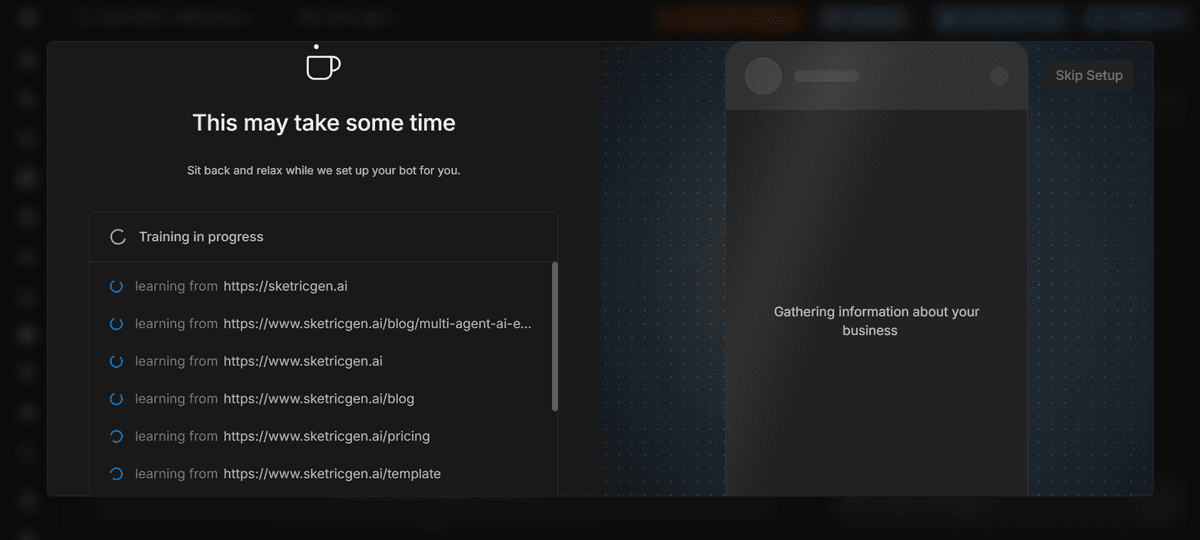
Botpress is an open-source-rooted AI agent builder with a visual studio, knowledge bases, and native channel deployment including WhatsApp. It's one of the most popular platforms among developers who want full control over their chatbot's logic and integrations.
Botpress Studio lets you build AI agents visually, attach knowledge bases, define conversation flows, and deploy to web, WhatsApp, Telegram, and other channels. The LLM inference cost is included in the plan (no separate API billing), which removes a layer of cost unpredictability that plagues other platforms.
Pricing: Free plan available (100 conversations/month, 3 AI agents). Plus from $150/month (250 conversations, WhatsApp included). Team from $750/month (1,500 conversations). Enterprise is custom.
What it does well:
- Open-source roots mean deep customizability and an active developer community.
- Visual Botpress Studio makes building conversation flows accessible to non-developers once set up.
- LLM costs included in plans. No separate OpenAI API billing.
- WhatsApp, Telegram, Slack, and web chat all supported on Plus and above.
- Knowledge bases let the AI pull from your product documentation automatically.
- Botpress Desk adds a helpdesk layer for agent handoffs on higher plans.
Where it has limits:
- Free plan's 100-conversation monthly limit is hit quickly by any active business. The jump to Plus at $150/month is steep for very small teams.
- More configuration required than no-code tools like SketricGen or Chatbase. It rewards teams with some technical ability.
- The Plus plan's 250 conversation limit can also feel restrictive for growing SMBs. Team plan at $750/month is a big jump.
- Not ideal if your use case is primarily lead capture and sales qualification rather than support automation.
Best for: Technical teams and developers who want an open, customisable AI agent platform with native WhatsApp deployment and full control over conversation logic, and can invest setup time upfront.
If you're thinking about how to structure a multi-channel AI support workflow, the guide to building an AI agent for customer service covers the architecture decisions clearly.
6. Zendesk - Best When You're Scaling Past 20+ Agents

Zendesk is Intercom's most direct enterprise competitor. It offers deeper CRM integrations, more advanced automation, and better scalability than anything else on this list. The pricing and setup complexity reflect that positioning.
For most SMBs, Zendesk is the wrong direction. You trade Intercom's complexity for Zendesk's complexity at similar price points. The scale that justifies Zendesk typically means 20+ agents, multi-department routing, and compliance requirements. Not a 5-10 person business team.
Pricing: Suite Team from $55/agent/month (billed annually).
What it does well:
- Enterprise-grade ticketing, routing, and SLA management at high volumes.
- Deep integrations with Salesforce, HubSpot, and other enterprise CRMs.
- Zendesk AI Copilot helps agents handle complex queries faster.
- Strong analytics and reporting across large support operations.
Where it has limits:
- Per-agent pricing at $55+ becomes expensive quickly for teams with more than 5 agents.
- Setup and full configuration typically takes weeks.
- Overkill for a 5-10 person SMB using primarily chat and AI deflection.
Best for: SMBs actively scaling past 20+ agents that need enterprise-grade automation, routing, and reporting to match their growing volume.
SketricGen vs. Intercom: Head-to-Head
This is the comparison most SMBs run when deciding whether to switch.
| Feature | Intercom | SketricGen |
|---|---|---|
| AI agent | Fin ($0.99 per resolution) | Custom AI agent (flat subscription) |
| Pricing model | Per-seat + per-resolution | Flat subscription, no per-resolution fees |
| Available, requires setup | Native, built-in deployment | |
| Voice | Not available natively | Built-in voice channel |
| Website widget | Yes | Yes |
| Lead qualification | Basic via workflow rules | AI-driven qualification, no-code |
| No-code setup | Partial (workflows need configuration) | Full no-code from plain English |
| Multi-agent orchestration | No | Yes (AI-routed and forced handoffs) |
| Trace and debug visibility | Limited | Full trace in AgentSpace |
| Help center / knowledge base | Built-in | Connect via integration |
| Integrations | Strong enterprise CRM focus | 2,000+ apps via tools marketplace |
| Best for | Enterprise teams (50+ seats) | SMBs needing AI + multi-channel from day one |
Intercom pricing | SketricGen pricing
Intercom is a more mature product with deeper enterprise CRM integrations and a well-established help center builder. For a company with 50+ agents, complex Salesforce workflows, and a predictable high-volume ticket queue, those features justify the investment.
For a 10-person SMB, the per-resolution model creates a structural problem. Every ticket Fin closes costs $0.99. A platform that becomes more expensive as your AI gets better at its job is not aligned with an SMB's interests. SketricGen's flat pricing removes that penalty entirely.
Decision rule: If your monthly support volume is below 500 AI-resolved conversations and you need WhatsApp + web coverage from one tool, SketricGen's total monthly cost will almost always be lower than Intercom's once Fin usage is factored in.
Author Take - Sam
I've watched a consistent pattern when SMBs switch away from Intercom: they don't actually miss the features. They miss the familiarity.
The real switching cost isn't the tool itself. It's rebuilding the muscle memory your support team has developed around existing workflows. That's worth acknowledging honestly. A tool your team uses confidently is worth more than a technically superior tool that's half-implemented six months after migration.
That said, the per-resolution pricing on Fin is a structural problem for SMBs, not a preference issue. As your AI handles more conversations, your monthly costs grow in a way you can't reliably predict or cap. For a small team trying to plan overhead, that is an operational risk with no upside.
My recommendation for anyone leaving Intercom: start with the one feature your team uses most heavily. Build that into your chosen alternative first. Get the team comfortable with it. Then migrate the rest. Don't switch everything on day one.
Start Without Per-Resolution Fees
Your support costs should not scale with how well your AI performs. That is the core problem with Intercom's Fin pricing for SMBs.
Try SketricGen as your Intercom alternative - flat pricing, web + WhatsApp + Voice from one platform, no per-resolution billing.
Compare current plans to see what the cost difference looks like for your team size.
Already have a support workflow you want to automate? The 10-minute customer support automation guide shows how to build and deploy your first AI agent from scratch.
FAQs
Chatbase has a free plan (50 message credits) and a Hobby plan at $32/month. Tidio starts from $29/month with a free plan. Freshdesk has a free plan for up to 10 agents with full ticket management. Botpress also has a free tier with 100 conversations/month. For teams needing an AI-first alternative with no per-resolution billing, compare SketricGen plans to see what fits your team size and volume.
For most SMBs, no. Intercom Fin charges $0.99 per resolution. A small business handling 500 AI-resolved conversations per month pays $495 in Fin charges alone, before per-seat subscription costs. When you run that math against your actual support volumes, flat-subscription alternatives are almost always cheaper. The per-resolution model works better for enterprise teams running thousands of daily tickets where predictable cost-per-resolution makes sense at scale.
Chatbase, Tidio, Freshdesk, and Botpress all offer free plans. Chatbase's free tier lets you train an AI on your content and test it before committing. Freshdesk's free plan supports up to 10 agents with ticket management. Botpress free covers 100 conversations per month with 3 AI agents. Tidio's free plan covers basic live chat. SketricGen also offers a free trial to test the AI agent setup before choosing a plan.
Yes. SketricGen supports WhatsApp natively as part of its multi-channel deployment, same agent build with no separate configuration. Tidio and Freshdesk also support WhatsApp on their paid plans. Botpress includes WhatsApp on the Plus plan ($150/month) and above. Chatbase supports WhatsApp via integration on the Standard plan ($120/month). The WhatsApp AI agent guide for lead qualification covers how to set up automated lead capture on WhatsApp.
A chatbot follows a decision tree. It answers questions it was programmed to handle and fails on anything outside that scope. An AI agent reads context, reasons about the situation, and can take actions: looking up order details, qualifying a lead, routing to the right person, or pulling from your knowledge base in real time. The AI agent vs. chatbot comparison covers the practical tradeoff for customer support teams in detail.
The technical migration is straightforward. Export your Intercom knowledge base articles, import them into SketricGen as training data, configure your deployment channels, and you're live. The harder part is team adoption, specifically rebuilding workflow habits and automation flows. Most SMBs complete the core setup in a few hours using the no-code Max Orchestrator. The 10-minute customer support automation guide covers the full setup process step by step.
At the enterprise level, Intercom's closest competitors are Zendesk, Freshdesk, Salesforce Service Cloud, and HubSpot Service Hub. For SMBs, the most frequently recommended alternatives in 2026 are Chatbase, Tidio, Botpress, and SketricGen. Featurebase is also worth a look for product-led teams: it combines a support inbox and AI chatbot with product feedback, roadmaps, and changelogs in one tool, starting from $29/seat/month, and explicitly positions against Intercom on pricing. The best AI chatbots for website in 2026 covers additional options across different use cases and budgets.
Related blogs
View more
7 SEO Automation Tools Compared (And the Reports They Actually Produce)
comparisons
9 Best AI Marketing Agents, Tested (2026)
comparisons
Agentic Marketing vs. Marketing Automation: Decision Framework
comparisons
AI Executive Assistant vs. AI Chief of Staff: The Difference That Actually Matters
comparisons
AI Email Assistant: Why Drafting Isn't the Problem (and What Actually Fixes Inbox Overload)
comparisons