Instagram Auto-Reply: How to Build an AI Agent That Actually Answers Your DMs
How many customers has your instagram auto reply quietly lost you this month? Search interest in "instagram auto reply" is up 230% year over year, and most of that surge is business owners realizing their bot answers keywords, not questions. If you're still sending the same canned message to every DM, here's what's actually breaking, and how to fix it in about 10 minutes.
Who This Is For
- Business owners and DTC/e-commerce operators running their own Instagram DMs and drowning in repeat questions about hours, pricing, and order status.
- Social media managers who own the inbox day to day but don't want to hand-build a flow chart or babysit a bot.
- Marketing heads and outreach or customer-facing leads who care about response time and lead conversion more than the technical setup.
Key Points
- Instagram's native auto-reply and keyword-trigger DM bots only match exact phrasing. The moment a customer asks a real question in their own words, they fail.
- "AI agent" and "keyword bot" are not the same thing. A knowledge-base agent answers from your actual site and docs. A keyword bot answers from a script you wrote in advance.
- Search demand for this exact problem is growing fast: "instagram auto reply" is up 230% year over year (DataForSEO, US, Aug 2026), with low competition.
- Automating DMs doesn't automatically put your account at risk. The variable that matters is whether the tool uses Instagram's official API or an unofficial scraper.
- A knowledge-base DM agent, like the one built on SketricGen's Instagram DM Automation template, takes about 10 minutes to set up and doesn't need a developer.
- The agent should never handle 100% of your DMs. It should handle the repeat 80% and hand off the other 20% (orders, refunds, partnerships, upset customers) to a person.
The Problem in Plain Terms
Tested against real setup flows on SketricGen's own Instagram DM Automation template, and checked against live Reddit and Quora threads on what business owners are actually running into.
Instagram auto-reply was built to solve a simple problem: too many DMs, not enough hands. It handles one job fine, a greeting, an out-of-office note, a single FAQ. It falls apart the moment a real customer asks a real question in their own words.
That gap is exactly why a jewelry brand owner on r/smallbusinessindia described losing cold leads because DMs sat unanswered for hours while they were busy running the business. Auto-reply didn't help, because the questions coming in weren't the one phrase the bot was scripted to catch.
This post covers why keyword-based auto-reply and flow-builder DM bots keep losing you customers, what actually separates them from a knowledge-base AI agent, and how to build the second kind in about 10 minutes using SketricGen's Instagram DM Automation template, no code required.
Why Instagram Auto-Reply Keeps Losing You Customers
Instagram's native Instant Reply and most DM bots (ManyChat, Chatfuel-style flows) work on exact-match keywords or button taps. They're fast to set up and fine for one job: a single canned greeting.
The problem shows up the moment a real customer types a real question in their own words. A keyword bot scripted to catch "hours" won't catch "when are you open today?" It sends the wrong canned reply, or nothing at all, and the customer assumes nobody's home.
| Approach | What it actually does | Where it breaks |
|---|---|---|
| Instagram Instant Reply | Sends one fixed message to every new DM | Can't distinguish question types; same reply to everyone |
| Keyword-trigger bot (ManyChat, Chatfuel-style) | Matches exact phrases or button taps to scripted replies | Fails on paraphrased questions; needs a new rule for every new way someone asks something |
| Knowledge-base AI agent | Reads your site, docs, and product info, then answers in plain language | Needs a real knowledge source set up first; not useful if you have nothing written down about your business |
Decision rule: If every question you get has exactly one answer that never changes ("Are you open Sundays?"), a keyword trigger is genuinely fine. If customers ask the same question five different ways, or ask something that depends on context, you need an agent that reads and reasons, not one that matches strings.
An Instagram DM Automation agent built on SketricGen's template solves this by reading your website and uploaded docs directly (SketricGen calls this a Brand Snapshot), so it answers in plain language instead of matching a script. See the Instagram DM Automation template for the full setup.
Auto-Reply vs. Auto-Reply DM Bots vs. AI Agents: What's Actually Different
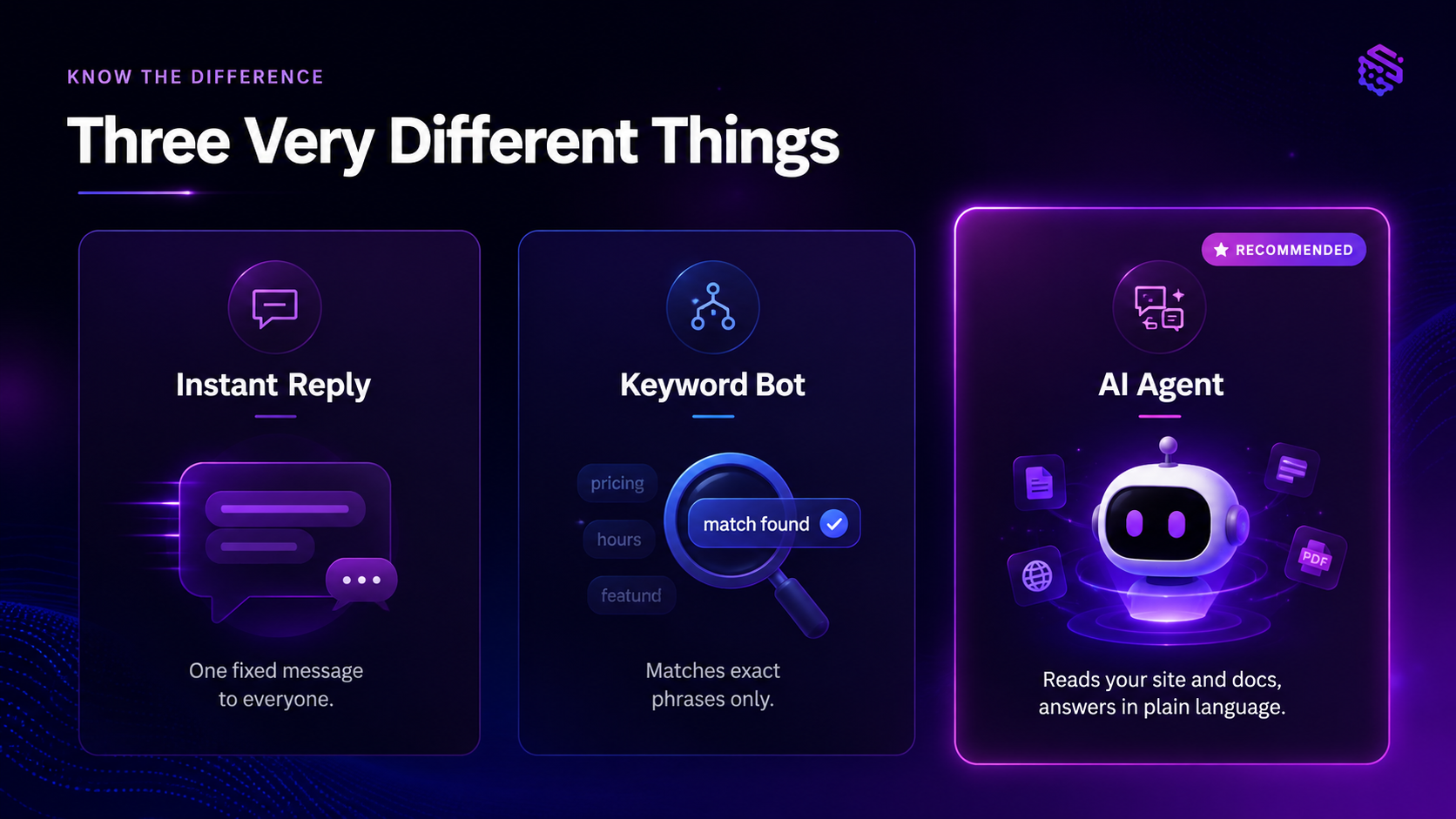 Here's the short version: auto-reply sends a fixed message, a DM bot follows a script, and an AI agent answers your actual question using your actual business information. That distinction matters more than most comparison posts admit.
Until recently, "social media automation" and "real AI agent" were treated as separate categories: flow builders for Instagram, proper agents for support desks. That line is already blurring in practitioner discussion. In a thread comparing ManyChat alternatives on r/AI_Customer_Support, one commenter pushed back directly on that split:
"You treat 'social-first' as a synonym for 'scripted flows,' but that split isn't clean anymore. Some Instagram-first tools now run actual intent-based AI agents, not keyword trees. The 'social equals scripted only' line has blurred."
Another reply in the same thread drew a useful line between two different needs: "I need a full support agent" versus "I need my Instagram comments and DMs sorted without hiring a VA." Both are real needs, but they call for different tools, and a lot of buying decisions go wrong because people don't separate the two before shopping.
This matches what shows up when you ask AI search tools the same question directly. Asked for general Instagram DM automation, ChatGPT (with web search) recommends the usual flow-builder tier: Meta Business Suite, ManyChat, respond.io, Jotform AI Agents, Chatfuel. Narrow the question to "an AI agent that replies using our own knowledge base," and Perplexity names a different, much smaller set of tools built specifically for that job, distinct from the flow-builder category. That's a real signal that "knowledge-base-first DM agent" is becoming its own recognized category, not just a feature bullet on a flow builder's pricing page.
The Instagram Automation Tools Landscape
Before you build anything, it helps to see where the common options actually sit, because the pricing model is often the real pain point, not the automation itself.
| Tool / approach | What it's built for | Known limitation (from real user reports) |
|---|---|---|
| Meta Business Suite / Instant Reply | One fixed auto-reply message | No real personalization; same message to every new DM |
| ManyChat | Keyword and button-flow automation | Free tier capped at 25 contacts; pricing scales with contact count, which gets expensive at volume |
| ReplyRush | DM/comment automation at scale | One user reported paying for a 7,500 DM limit, only to find the tool actually only worked on their last 50 posts, with no refund offered |
| Chatfuel | Flow-builder chatbot | Same category as ManyChat; still scripted-flow logic under the hood |
| Regional compliant tools (e.g. Interakt) | Meta-approved WhatsApp/Instagram automation | Priced around ₹999+GST/month in the Indian market; still flow-based, not knowledge-base-first |
| Knowledge-base AI agent (SketricGen Instagram DM Automation template) | Reads your own site/docs, answers in plain language, escalates what it shouldn't handle | Needs your knowledge base set up first; not a fit if you have nothing documented about your business yet |
Pro tip: Before you buy anything, ask the vendor exactly what counts toward their "DM limit" or "contact limit," and get it in writing. The ReplyRush case above is a good reminder that advertised caps and actual enforced caps aren't always the same thing.
How to Build an Instagram DM AI Agent That Answers From Your Own Knowledge Base
Here's the actual build, using SketricGen's Instagram DM Automation template. No code, and no developer needed.
Before you touch the template, do this first: map out the questions you actually get. On r/SaaS, one commenter put it plainly when someone asked about automating Instagram support:
"I'd map out the conversations first. If you're answering the same 5 to 10 questions over and over, almost any decent model can handle that. The real work is deciding when the AI should reply and when it should hand things over to you."
That's the right order of operations. The model isn't the hard part. Knowing what to automate and what to route to a human is.
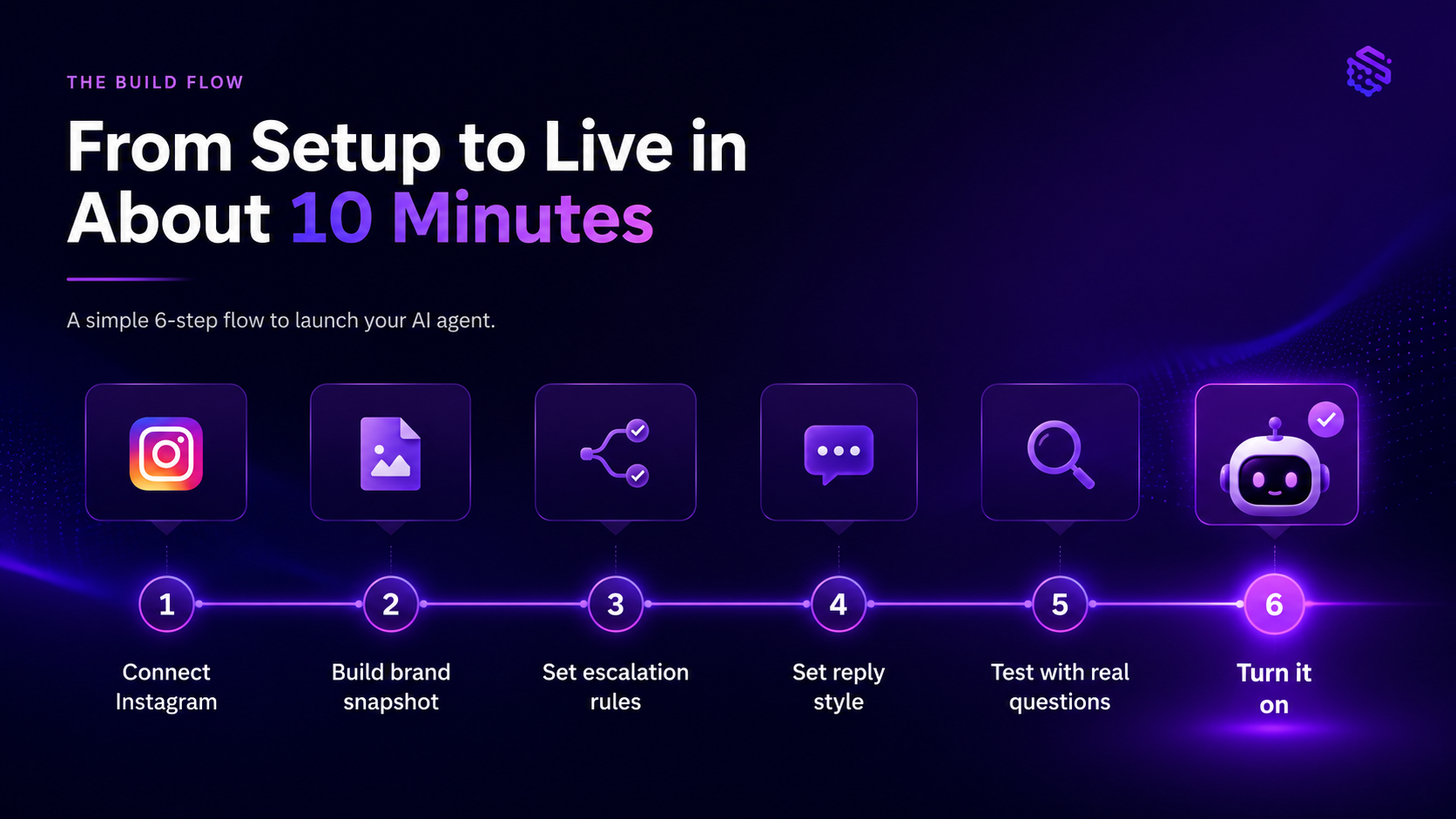
| Step | What happens |
|---|---|
| 1. Connect your Instagram account | Requires a Professional or Creator account (not a personal account), and a SketricGen Explorer plan or above |
| 2. Build your Brand Snapshot | The agent crawls your website and pulls in any docs you upload, so it has a real knowledge base to answer from |
| 3. Set escalation rules | Define what gets routed to a human: order issues, refunds, partnership requests, safety concerns, or anyone who directly asks for a person |
| 4. Set reply style | Plain text, no markdown, a light touch of emoji at most, links only when verified |
| 5. Test with real questions | Run the actual questions from your own DM history through it before going live |
| 6. Turn it on | Setup typically takes about 10 minutes end to end |
The escalation step matters more than it looks. The agent should never claim an action was completed that it didn't actually do, like "your refund is processed." It should recognize the request and route it to a verified contact instead. That single rule is what keeps an automated inbox from turning into a trust problem.
Will Automating Your Instagram DMs Get You Banned?
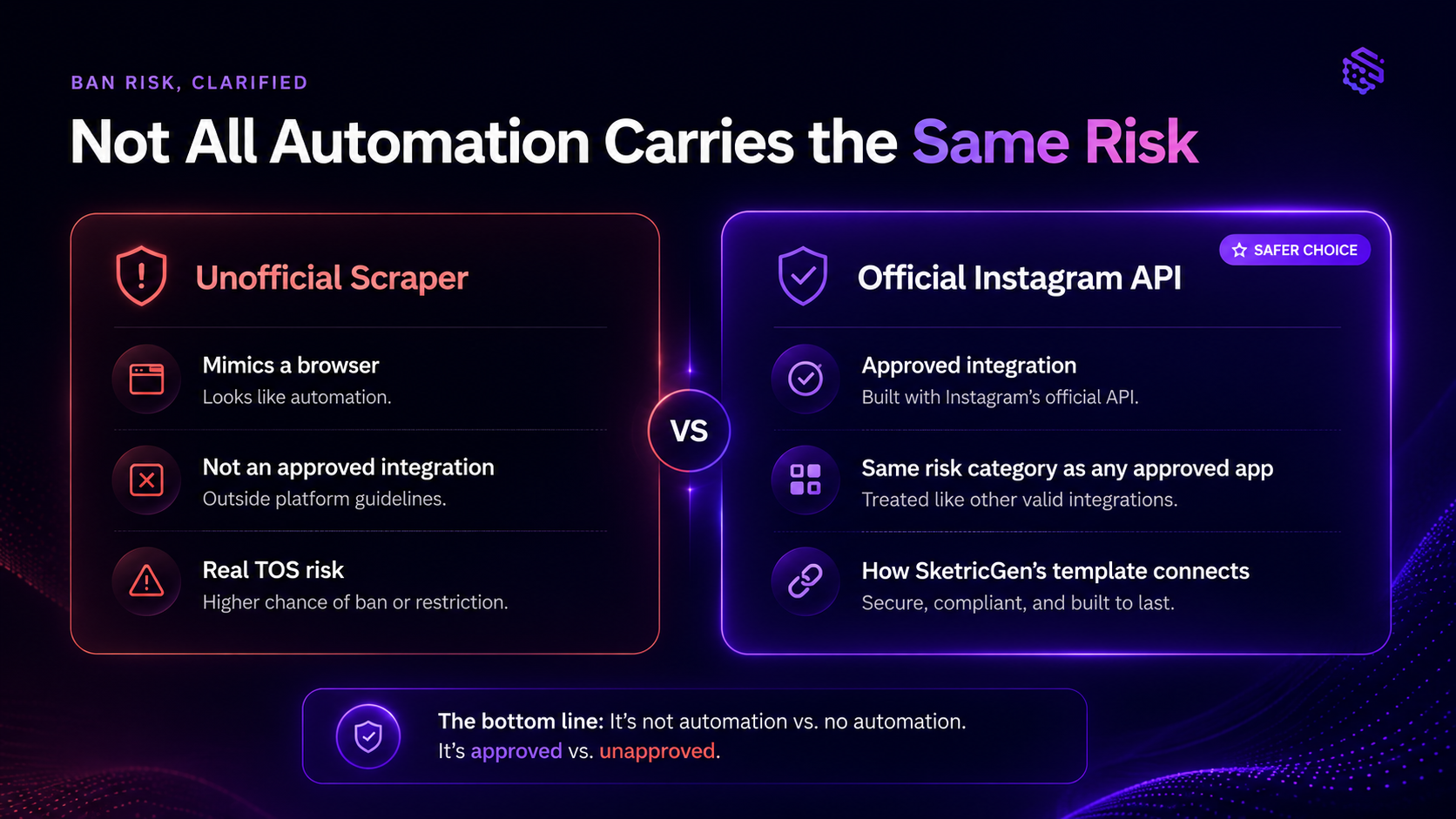
Short answer: it depends on how the tool connects to Instagram, not on the fact that it's automated.
Search Quora for this question and you'll find a lot of alarmist answers along the lines of "there is no safe way, Instagram will delete your account." That fear is real and worth taking seriously, but it's also imprecise. It usually skips the distinction between two very different categories of tool.
"It connects directly to the Meta API, not a third-party scraper, so there's no TOS risk."
That distinction, from a Reddit discussion on Instagram automation risk, is the one most alarmist answers miss. Tools built on unofficial scrapers, the kind that fake being a browser and hammer Instagram's servers directly, carry real terms-of-service risk. Tools built on Instagram's official Graph API, which is how a compliant DM agent like SketricGen's template works, don't carry that same risk category.
A more measured Quora answer on the same topic added a useful practical rule: automation is safest when it starts after a user has already engaged with your content, a comment, a Story reply, or a DM they sent first, rather than automation that reaches out cold. That's a good rule of thumb regardless of which tool you use.
Decision rule: Ask any Instagram automation vendor one question before you sign up: "Does this use Instagram's official API, or does it scrape the platform?" If they can't answer clearly, that's your answer.
Common Mistakes to Avoid
- Picking a tool by advertised DM or contact cap without checking the fine print. The ReplyRush case above (paid for 7,500 DMs, actually got 50 posts) is exactly why.
- Automating 100% of replies with no escalation path. A customer with a real problem who gets a canned reply is worse off than one who waits an hour for a real answer.
- Treating "auto-reply" and "AI agent" as interchangeable when shopping for a tool. They solve different problems, and buying the wrong one means redoing this setup in three months.
- Skipping the knowledge base step. An agent with nothing to read from will hallucinate or fall back to generic answers, which is worse than no automation at all.
Author's Take: Where I'd Draw the Automation Line
Sam here. The quote above about mapping your top 5 to 10 questions first is the right starting point, but the part people skip is the second half: deciding what the agent should never touch on its own.
My rule, and the one built into the escalation logic on SketricGen's template: automate the repeat 80%, the questions you could answer in your sleep, and route the other 20% to a person. That 20% is almost always orders, refunds, partnership pitches, and anyone who's upset. Those conversations need a human's judgment call, not a confident-sounding guess from a model. Get that split right and the agent earns trust instead of quietly losing it.
Who This Works Well For
| Role | What this solves for you |
|---|---|
| Business owner / DTC operator | Gets hours back from answering the same 5 to 10 questions every day |
| Social media manager | Owns a DM inbox that answers accurately without hand-building flow logic |
| Marketing head | Faster response time on inbound leads without adding headcount |
| Outreach / customer-facing lead | Repeat questions off the team's plate, with a clear rule for what still gets escalated |
Next Steps
If you're running your own Instagram DMs and recognize the "same five questions, every single day" problem, the fastest way to see this in action is to set it up directly. The Instagram DM Automation template walks through the Brand Snapshot and escalation setup described above, and it's built to work alongside other channels if your team also handles support over WhatsApp or web chat.
FAQs
Map your most common questions first, then use a knowledge-base AI agent, not a keyword bot, to answer them from your actual site and docs. Keyword bots work fine for a single fixed message, but they break down once customers start asking real questions in their own words. For most small businesses, the fastest path is a template-based agent that connects to your existing Instagram account and website without custom development.
No. Instagram DM automation is the umbrella term for anything that replies on your behalf, including basic auto-reply and keyword-trigger bots. An AI agent is a specific type of DM automation that reads your actual business information and answers in plain language instead of matching a pre-written script. All AI agents automate DMs, but not all DM automation involves an AI agent.
It depends on how the tool connects to Instagram, not on the fact that replies are automated. Tools that use Instagram's official API carry no more risk than any other approved app. Tools built on unofficial scrapers do carry real terms-of-service risk, since they're not an approved way to access the platform. Confirm which category a tool falls into before connecting your account.
Instagram's native Instant Reply is free but limited to one fixed message for all new DMs. Most third-party keyword bots offer a free tier, though usually capped at a small number of contacts (ManyChat's free plan, for example, caps at 25 contacts). Knowledge-base AI agents typically require a paid plan, since they need to crawl and store your business information, but setup usually takes about 10 minutes.
On SketricGen's Instagram DM Automation template, setup takes about 10 minutes: connecting a Professional or Creator Instagram account, letting the agent build a Brand Snapshot from your website and docs, and setting escalation rules for what should go to a human. No developer or code is required.
Yes, that's the core difference from a keyword bot. A knowledge-base agent crawls your website and any documents you upload, then answers questions using that real information instead of a fixed script. If your business information changes, you update the source docs and the agent's answers update with it, instead of you rewriting bot rules by hand.
Related blogs
View more
SEO Automation: The No-Code Build, Start to Finish
tutorials
How to Build an AI Marketing Agent (End to End)
tutorials
No-Code Automation Platforms for Marketing Teams: Grow Business without Employees
tutorials
AI LinkedIn Post Generator: How to Research, Write & Publish Posts on Autopilot (2026)
tutorials