Agent Orchestration Framework: Build vs. Buy Guide (2026)
You've got more than one agent now, and someone just asked "why don't we just build our own orchestration layer instead of paying for one?" That question is reasonable. It's also the wrong first question.
At SketricGen, we sit on both sides of this conversation daily — teams who spent four months building an orchestration layer that a no-code platform already handled, and teams who bought a platform for a job that genuinely needed custom code. This guide is the decision we walk them through, minus the sales pitch.
Key Points
- SketricGen exists because most teams don't need to build an orchestration layer from scratch — but a real minority genuinely do, and guessing wrong costs months, not days.
- "Build vs. buy" isn't binary. It's five separate layers (model, orchestration, integrations, domain logic, observability), and most teams should split their answer across all five instead of picking one side for everything.
- Building buys you control and no vendor ceiling. It costs 3-6x more in year one and carries a documented failure rate well above buying.
- Buying (a no-code platform or an as-is open framework) gets you to a working agent in weeks, not quarters — but only if your workflow is common enough that a platform already solved it.
- The fastest-growing regret in 2026 isn't picking the wrong framework. It's building orchestration logic for a problem that was never actually differentiated.
What "Build vs. Buy" Actually Means Here
This is a different question than what orchestration actually is or which orchestration platform to choose. Those two answer "what is this layer" and "which vendor." This one answers a question that comes before both: should you stand up an AI agent orchestration framework of your own, or run your workflow on infrastructure someone else already built and maintains?
Three real options sit on the table, not two:
| Option | What it is | Who owns it |
|---|---|---|
| Build custom | Hand-rolled orchestration logic, usually on top of a raw LLM API | Your engineering team, indefinitely |
| Adopt an open framework | LangGraph, CrewAI, or AutoGen, used largely as-is | Your team configures it; the framework's maintainers own the core |
| Buy a platform | A no-code or low-code orchestration platform (SketricGen, Lindy, Relevance AI, n8n) | The vendor owns the infrastructure; you own the workflow logic |
Most "build vs. buy" content collapses the middle option into "build," which is why the framing feels harder than it is. Adopting LangGraph is not the same commitment as writing your own state machine.
Where This Debate Actually Lands on Reddit
Search r/AI_Agents on any given week and you'll find the same argument restarting under a new title. The pattern is consistent enough to treat as data.
One builder, describing what happened after stacking agent after agent into a custom multi-agent orchestration framework, put it bluntly: "Every agent you add is a new failure point. Every handoff is where context dies." Their fix wasn't a better framework — it was fewer agents and a boring stack (a single tight prompt plus a workflow tool) that just worked.
Another thread, arguing the industry has gotten distracted by the wrong metric, made the pain point explicit: "People don't care about 'RAG pipelines' or 'multi-agent orchestration.' They care about time saved, money earned, or headaches removed." That's the buyer's side of this decision in one sentence — the orchestration approach is a means, not the win condition.
On the framework side, a long-running r/LangChain thread comparing LangGraph, CrewAI, and AutoGen surfaced a recurring warning about one specific option: multiple commenters flagged AutoGen as not yet production-ready, warning of breaking changes and steering newcomers toward CrewAI or a no-code tool instead. On Quora, the pattern repeats — when asked which frameworks scale best, the top answer names LangGraph, LangChain, and AutoGen as the established options, not a from-scratch build.
The consistent thread across both platforms: people who build custom rarely regret the control. They regret underestimating the maintenance tax — the wiring, monitoring, and debugging that "everything around the model" requires, as one widely-discussed r/AI_Agents post on the operational mess of running agents described it.
The Five Layers You're Actually Deciding On
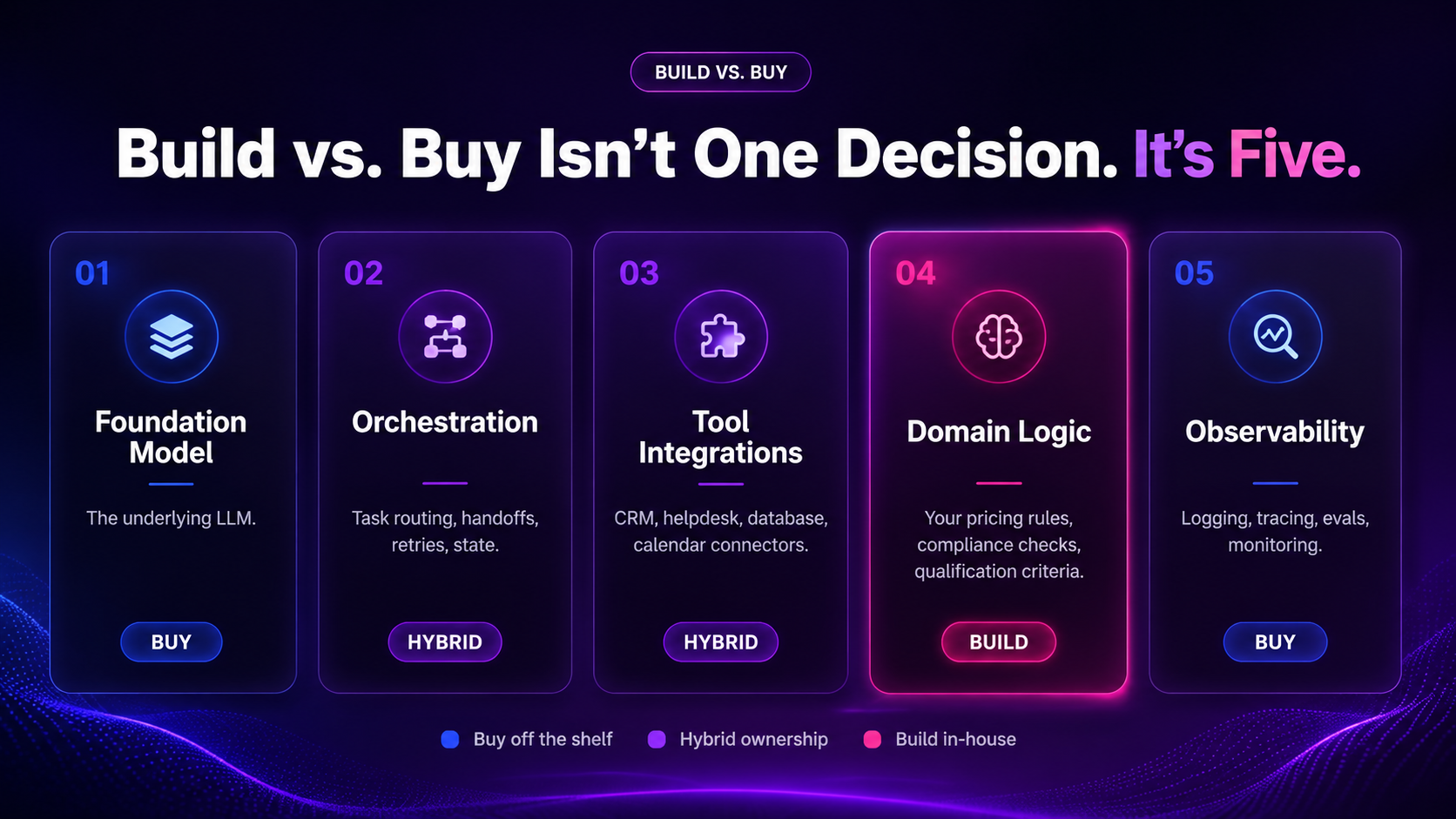
"Build vs. buy" sounds like one decision. It's really five, and they rarely land the same way.
| Layer | What it covers | Default lean |
|---|---|---|
| Foundation model | The underlying LLM (Claude, GPT, open-weight models) | Buy via API — almost nobody should train their own |
| Orchestration | Task routing, handoffs, retries, state management | Hybrid — open-source or platform, rarely fully custom |
| Tool integrations | Connectors to your CRM, helpdesk, database, calendar | Hybrid — buy the standard ones, build the unusual ones |
| Domain logic | Your pricing rules, compliance checks, qualification criteria | Build — this is where your actual differentiation lives |
| Observability | Logging, tracing, evals, monitoring | Buy — building your own eval harness rarely pays off |
Decision rule: if you can't name the specific competitive advantage your orchestration logic protects over the next 12 months, you're building infrastructure, not a moat. That's a buy signal, not a build one.
This is also where most build-vs-buy write-ups oversimplify. A 2026 hybrid-framework analysis makes the same point from the enterprise side: nearly half of enterprises are already running hybrid build/buy models, most of them by accident rather than design. The fix isn't picking a side — it's being deliberate about which of the five layers gets which answer.
What Practitioners Are Saying
On a thread comparing building agents/workflows from scratch vs. using frameworks, the top response summed up the entire case for building in one line: greater control and customization, because you can tailor the architecture to your specific needs instead of working within someone else's abstractions.
The same r/LangChain comparison thread that flagged AutoGen's production issues made a second point worth keeping: AutoGen's learning curve is genuinely easy, commenters said, but its flexibility and scalability lag behind LangGraph and CrewAI — a reminder that "adopt a framework" still needs its own build-vs-buy analysis one level down.
The Real Cost Comparison
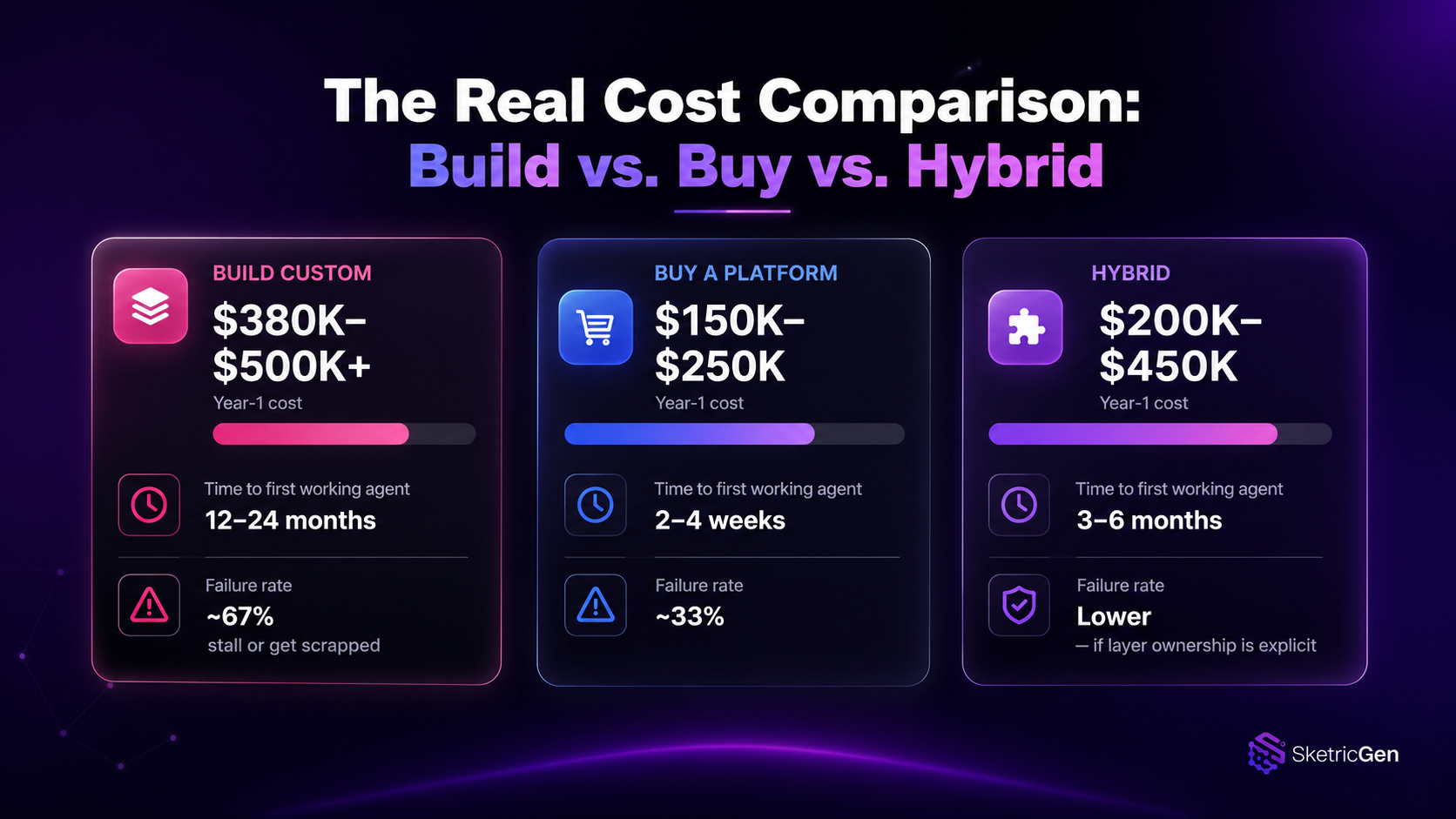
This is where "it depends" needs numbers attached, so here they are.
| Dimension | Build custom | Buy a platform | Hybrid |
|---|---|---|---|
| Year-1 cost | $380K–$700K+ | $150K–$350K | $200K–$450K |
| Time to first working agent | 12–24 months | 2–4 weeks | 3–6 months |
| Reported failure rate | ~67% of custom builds stall or get scrapped | ~33% (still real — vendor fit matters) | Lower, if layer ownership is explicit |
These figures come from a 2026 TCO breakdown of build-vs-buy AI agent decisions, and they line up with what we hear directly from teams evaluating SketricGen: the sticker price of building is rarely the real cost. Operational upkeep — the 65-75% of total ownership that shows up after launch — is what actually breaks budgets.
The same research also found that enterprise buying behavior has already shifted: roughly 76% of AI agent use cases in 2026 are purchased rather than built, up from 53% two years earlier. That's not an argument to always buy. It's evidence that most workflows turn out to be more common than teams initially assume.
A Simple Decision Framework
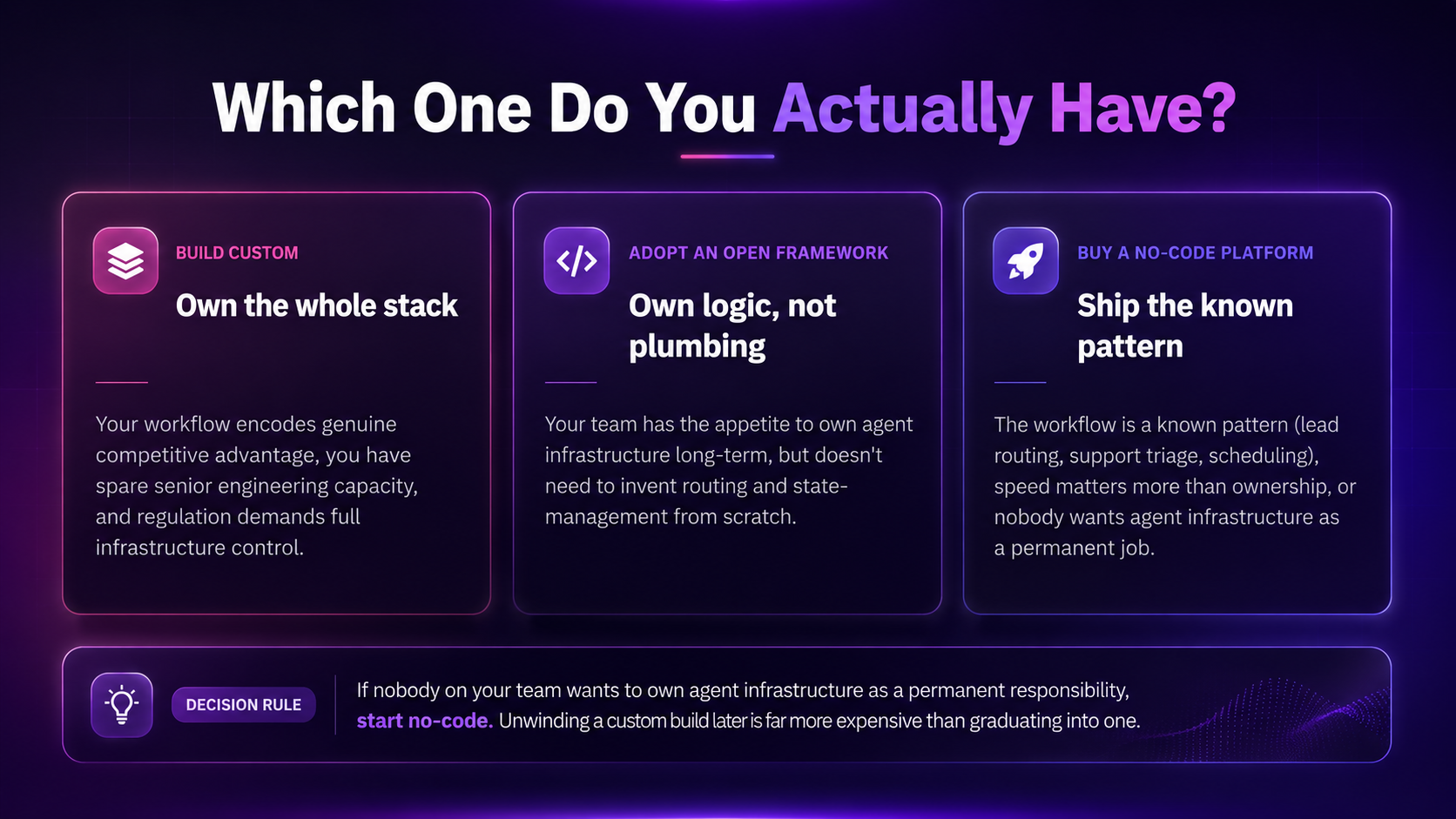
Skip the essay. Here's the shortcut version:
- Build custom if your workflow encodes genuine competitive advantage, you have spare senior engineering capacity, and a regulatory requirement demands full infrastructure control.
- Adopt an open framework (LangGraph, CrewAI) if your team has the engineering appetite to own agent infrastructure long-term, but you don't need to invent the routing and state-management primitives yourselves.
- Buy a no-code platform if the workflow is a known pattern (lead routing, support triage, meeting scheduling), speed matters more than infrastructure ownership, or you don't have an engineer who wants agent orchestration as an ongoing job.
That last clause is worth repeating on its own, because it's the single cleanest test we've found: if nobody on your team wants to own agent infrastructure as a permanent responsibility, start no-code. You can always graduate later — going the other direction, unwinding a custom build, is far more expensive.
Common Mistakes Teams Make When Deciding
| Mistake | What happens | Fix |
|---|---|---|
| Treating it as one decision | Domain logic gets bought, differentiators get outsourced | Split the decision across the five layers above |
| Building because "buying feels like giving up control" | Six months later, the team is maintaining infrastructure instead of shipping the product | Ask what the custom layer protects that a platform's config can't |
| Buying without checking the failure modes | Routing edge cases and context loss surface in production, not the demo | Test the four things that actually break before committing to any vendor |
| Assuming "framework" and "platform" are the same buy | Teams adopt LangGraph expecting a managed product, then inherit an engineering project | Decide build vs. adopt vs. buy as three separate options, not two |
Where SketricGen Fits
If your five-layer answer comes out mostly "buy" — which for most GTM, ops, and support workflows it does — SketricGen is built for exactly that gap. It's a no-code AI agent builder with designer-routed orchestration and forced handoff logic built in, so you're not hand-coding state transitions to get one agent to reliably pass work to another.
Under the hood, it runs on structured inputs and outputs and a proper orchestration and handoffs layer, with traces and optimizations exposed so you can see why an agent made a decision instead of guessing from logs. It connects to 2,000+ integrations and deploys across the channels your workflow already lives in, which covers most of the "tool integrations" layer without a custom connector for every system.
The parts that should stay yours — your qualification rules, your pricing logic, your compliance checks — stay yours. You configure them inside AgentSpace rather than rebuilding the routing engine underneath them. If you want the deeper mechanics of how that routing works, multi-agent handoffs are explained here, and if you're still comparing no-code options generally, this rundown of no-code agent builders covers where SketricGen sits against the rest of the field.
Author Take
I've watched two versions of this mistake play out. One team spent five months building a custom orchestration layer for a support workflow that three no-code platforms already handled out of the box — the "control" they were protecting turned out to be a config screen. Another team bought a platform for a compliance workflow that genuinely needed custom audit logic, then spent longer working around the platform's limits than a custom build would have taken.
My decision rule now: write down, in one sentence, what your orchestration layer needs to do that a competitor using the same platform couldn't replicate by next quarter. If you can't finish that sentence, you're not protecting an advantage. You're just building a platform nobody's paying you to build. — Sam
The Bottom Line
Build vs. buy isn't a personality question about control versus convenience. It's five smaller questions about five layers, and most teams already know the answer to four of them — they just haven't written it down. Do that first. The framework or platform choice gets a lot easier once you have.
FAQs
Buy if your workflow is a known pattern (support triage, lead routing, scheduling) and you don't have engineering capacity dedicated to agent infrastructure long-term. Build only if the orchestration logic itself protects a competitive advantage you can name today.
Adopting LangGraph, CrewAI, or AutoGen still makes your team responsible for infrastructure, upgrades, and debugging — you're configuring a toolkit, not buying a managed product. A no-code platform like SketricGen owns that infrastructure layer for you, so your team only owns the workflow logic on top of it.
Claude agent orchestration refers to coordinating multiple Claude-powered agents (or Claude alongside other models) through a routing layer that decides which agent handles which step. The build-vs-buy answer doesn't change based on which model you use — it changes based on whether your routing and handoff logic needs to be custom, which is a workflow question, not a model question.
The strongest no-code options in 2026 include SketricGen, Lindy, Relevance AI, and n8n, each with different tradeoffs on integration depth and routing control. For a developer-owned build, LangGraph and CrewAI are the most cited options in current Reddit and Quora discussions, with AutoGen flagged repeatedly as less production-ready than the other two.
LangChain is the broader toolkit that LangGraph's orchestration layer is built on top of. If you're comparing frameworks for building, LangChain plus LangGraph is typically evaluated as one option against CrewAI and AutoGen, not as a separate fourth choice.
The common patterns are sequential (one agent, then the next), concurrent (agents working in parallel), group chat, handoff, and manager-led delegation. These patterns are broken down in detail here — knowing which pattern your workflow needs is a useful gut-check before deciding whether to build or buy the layer that runs it.
Yes — treat it as a second decision inside "adopt an open framework": LangGraph offers more explicit control over state and stronger observability, CrewAI trades some of that control for a faster, role-based setup experience, and AutoGen is the option most frequently flagged by builders as not yet production-stable.
Related blogs
View more
AI Executive Assistant vs. AI Chief of Staff: The Difference That Actually Matters
comparisons
AI Email Assistant: Why Drafting Isn't the Problem (and What Actually Fixes Inbox Overload)
comparisons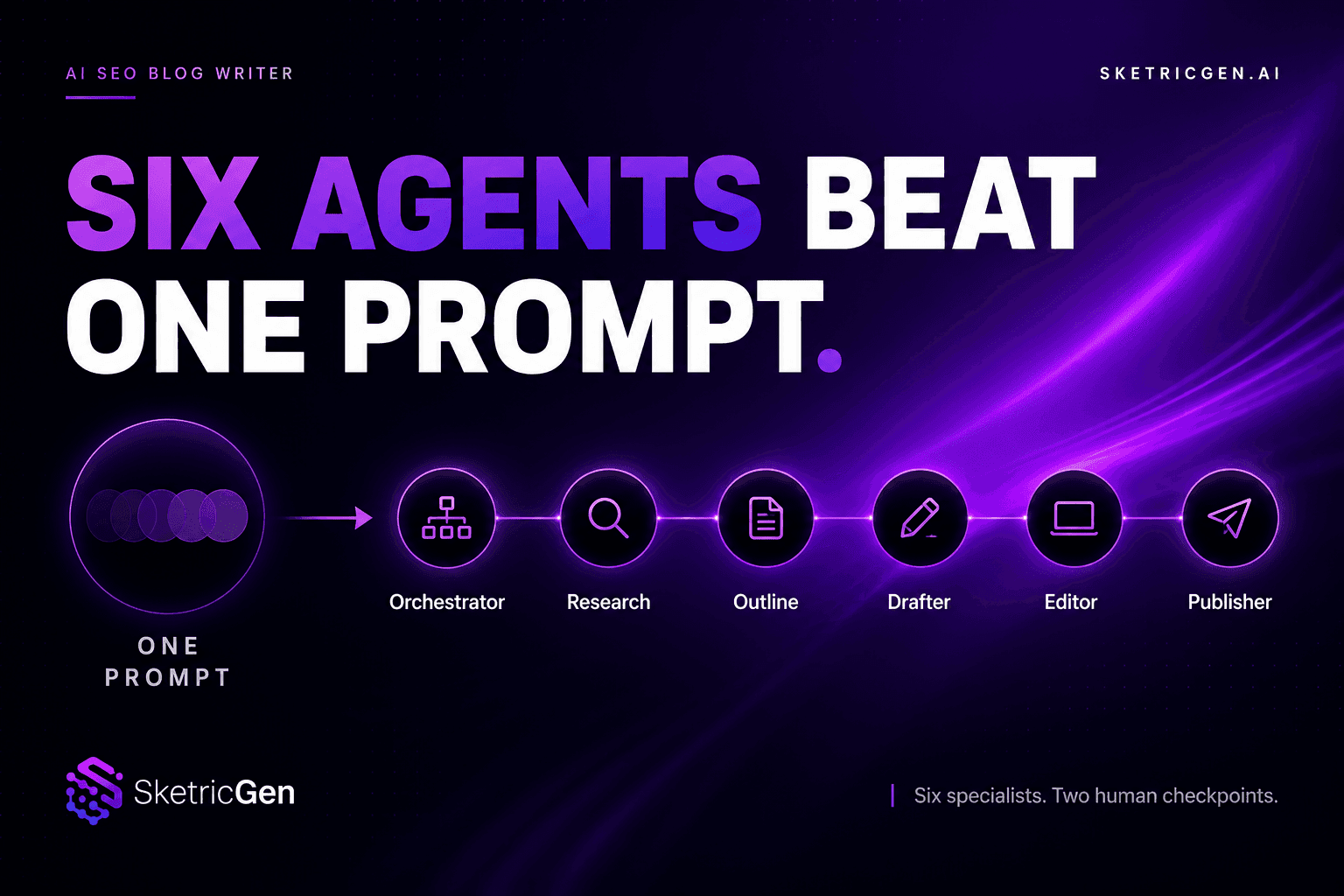
AI SEO Blog Writer: Six Agents Beat One Prompt
comparisons
OpenAI Agent Builder vs. Google Vertex AI Agent Builder vs. No-Code Alternatives (2026)
comparisons
Best AI Agent Builder for Small Business Teams (2026 Buyer's Guide)
comparisons