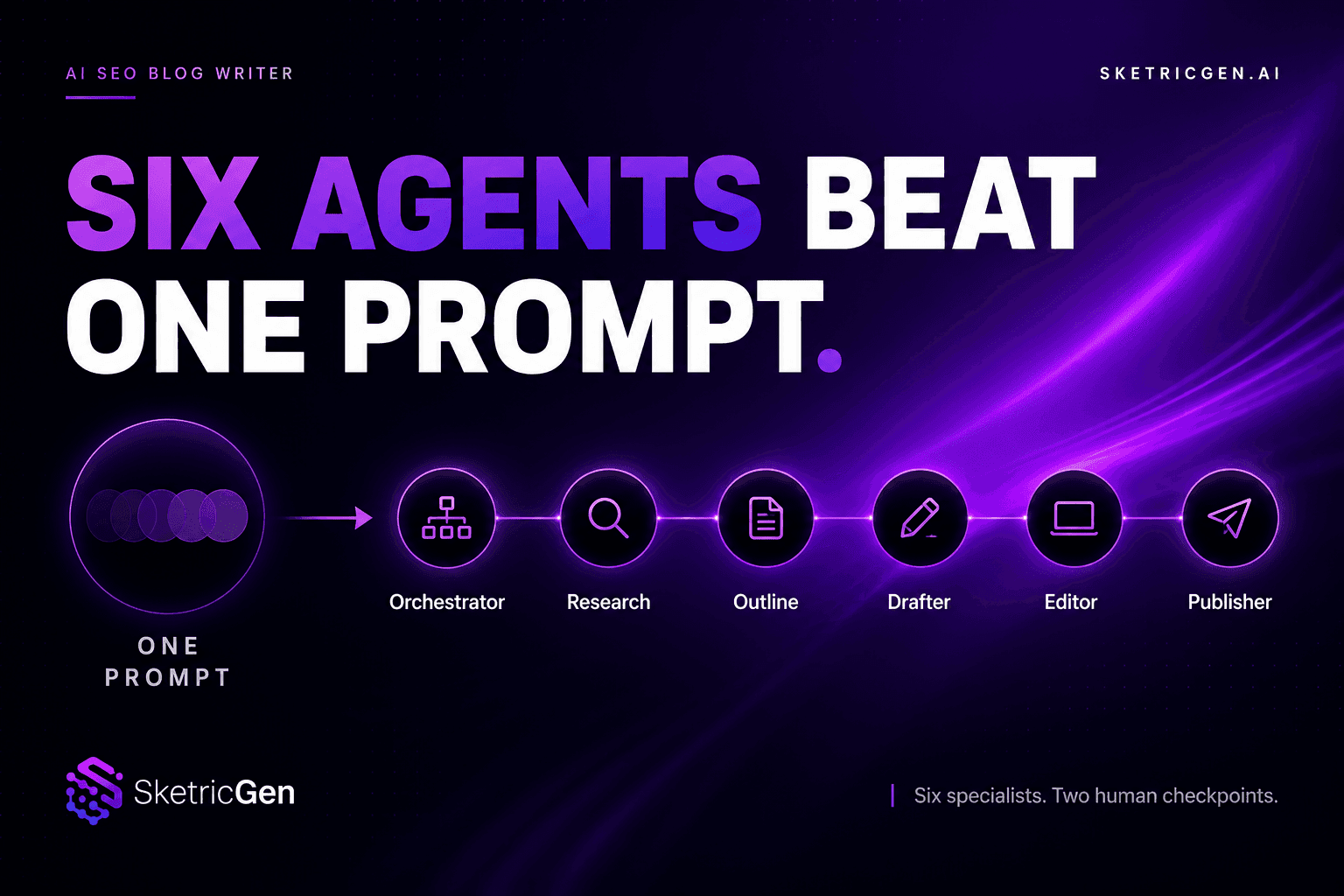
Enterprise AI Agent Platform: What to Look for Before You Buy (2026)
Who this is for: procurement leads, IT security, and the buying committee evaluating an AI agent platform for enterprise rollout, not solo builders picking a weekend tool.
Key Points
- Most enterprise AI agent platform evaluations fail on governance, not on model quality. Security, SSO, and audit logs decide the shortlist before anyone talks about accuracy.
- Data residency and audit log export are now table stakes. Ask for them in the first vendor call, not the final one.
- Integration depth beats AI quality. A platform that reads your real systems beats a smarter one you have to copy-paste into.
- Orchestration is a separate decision from the base model. Evaluate how agents hand off work and where context gets lost (read more on orchestration).
- Ease of use for business teams, not just engineers, is what determines whether the platform actually gets adopted after the pilot.
- Run a 30-day pilot with real data and a defined failure condition before any enterprise-wide commitment.
What Counts as "Enterprise" Here
An enterprise AI agent platform is not just an AI agent platform with a bigger price tag. It is one built to survive procurement: SSO and role-based access from day one, audit trails that satisfy a compliance team, data residency controls, and integration depth into systems that were never designed to talk to an AI agent.
One clarification worth making early: if you searched enterprise AI agent platform expecting Google's own Gemini Enterprise Agent Platform product page, this guide is not that. This is a vendor-neutral checklist for evaluating any AI agent platform for enterprise use, Google's included.
Small teams can get away with a fast, flexible tool and a founder who fixes things by hand when they break. Enterprises cannot. Security, IT, and the business owner all sit on the buying committee, each with veto power, and each checking a different box.
The Procurement Checklist: Security, SSO, Audit Logs, Data Residency
This is where most enterprise AI agent evaluations actually get decided. A practical guide to evaluating enterprise AI platforms for security and compliance puts it plainly: SOC 2 Type II, clear data handling policy, and audit logging are no longer nice-to-haves; they're the baseline.
| Requirement | What to ask the vendor | Why it matters |
|---|---|---|
| SSO / identity | Do you support SAML or OIDC, and is it available on every plan tier? | Without this, IT cannot enforce your existing access policy on the agent |
| Role-based access | Can permissions be scoped per agent, per workflow, and per data source? | Limits blast radius if one agent or credential is compromised |
| Audit logs | Is there a log export API, and does it cover every agent action, not just chat transcripts? | Compliance teams need a record of what the agent did, not just what it said |
| Data residency | Where is data stored and processed, and can that be restricted by region? | Required for GDPR, and increasingly for sector-specific regulation |
| Encryption | Is data encrypted in transit and at rest, and is this documented, not just claimed? | Baseline expectation for any vendor touching customer or internal data |
| Compliance attestations | Do you hold SOC 2 Type II, and can we see the report, not just a badge? | Type II proves controls worked over time, not just on paper |
A SANS Institute checklist for zero-trust AI agents frames this as building an agent inventory first: know what agents exist, what they can touch, and who owns them, before you evaluate a new platform to add to that inventory.
Decision rule: if a vendor cannot answer the SSO, audit log, and data residency questions in the first call, they are not ready for enterprise procurement, regardless of how good the demo looks.
Integration Depth and Orchestration at Scale

Enterprise AI agents rarely fail because the underlying model is weak. They fail because the agent cannot reliably reach the systems it needs, or because five agents hand off work and nobody can trace where it broke.
Integration depth means the platform connects to your actual CRM, ticketing system, data warehouse, and legacy tools, not a demo-friendly subset of them. Orchestration means you can define how agents hand off work to each other, where a human has to step in, and what happens when a step fails.
| Layer | Question to answer before buying | Red flag |
|---|---|---|
| Integrations | Does it connect to the specific systems you run today, including anything legacy? | "We support APIs" with no named connectors for your stack |
| Handoffs | Can you force a deterministic handoff, not just let the model decide? | Only AI-routed handoffs, no override |
| Observability | Is there full trace logging per run: inputs, tool calls, latency, and failure point? | Logs only show final output, not the path to it |
| Failure handling | What happens when a tool call fails mid-workflow? | No defined rollback or escalation path |
| Governance | Can you set guardrails per agent, not just per account? | Guardrails are global only, no per-workflow constraint |
Our guide to choosing an orchestration platform breaks this down layer by layer if orchestration is the part of your evaluation you are least confident about. And if you are still deciding whether to build this in-house or buy it, the build vs. buy framework for agent orchestration has the cost math: buying typically runs $150K to $350K in year one against $380K to $700K+ to build, with a 2 to 4 week time-to-first-agent instead of 12 to 24 months.
If you are still unclear on the difference between the tool you build agents in and the system that runs them in production, platform vs. builder is worth reading before you shortlist vendors.
Ease of Use and Time-to-Value: The Part Procurement Checklists Miss

Security and integration get the attention. Ease of use decides whether the platform gets used after the pilot.
A roundup of buyer questions for evaluating AI agent platforms keeps landing on the same point: platforms built for engineers stall inside enterprises because business teams cannot create or modify a workflow without opening a ticket to IT. If the operations or sales team wants to change a lead-qualification rule and has to wait two weeks for an engineering sprint, the automation loses most of its value before it ships.
This is also where the lead-generation and automation angle matters most for buying committees. Enterprise teams evaluating an AI agent platform for lead qualification, routing, or customer response are not just buying accuracy, they are buying speed to first value and the ability for non-engineers to keep tuning the workflow. A platform that's fast to set up and lets a revenue operations lead adjust routing rules directly is worth more in practice than one that's marginally smarter but locks every change behind engineering.
Ask two questions here that most checklists skip:
- Can a business user, not an engineer, build or modify a workflow after the initial setup?
- What is the realistic time from signed contract to first agent live in production, not the sales deck number?
Questions to Ask Vendors Before Signing

| Category | Question |
|---|---|
| Security | Do you hold SOC 2 Type II, and can we see the current report? |
| Identity | Is SAML/OIDC SSO included, or is it an enterprise-tier add-on? |
| Data | Where is our data stored, and can we restrict processing to a specific region? |
| Audit | Is there an audit log export API, and does it log every agent action? |
| Integration | Which of our specific systems do you already connect to, by name? |
| Orchestration | Can we force deterministic handoffs, or is routing always model-decided? |
| Adoption | Can business teams edit a live workflow without engineering involvement? |
| Exit | If we leave, can we export our workflows and data in a portable format? |
Common Mistakes Buying Committees Make
Two patterns show up repeatedly in why enterprise AI agent deployments fail, and both start at procurement, not implementation.
The first is buying for the demo instead of the workflow, the classic software-versus-implementation trap. A vendor can make almost any agent look sharp on a scripted use case. The real test is your messiest legacy system and your actual data, not a sanitized sample.
The second is skipping the pilot's failure condition. Teams that define what failure looks like before the 30-day pilot starts catch problems early. Teams that don't tend to discover the gap only after a company-wide rollout is already underway, which is a much more expensive place to find it.
Mistake to avoid: approving a platform based on a security questionnaire alone. Ask for the SOC 2 Type II report directly, and ask when the observation period started. A questionnaire response and a live report are not the same thing.
What Practitioners Are Saying
A 28-point compliance checklist for shipping AI agents into enterprise environments that circulated on r/artificial groups the requirements into five buckets: logging, access control, data handling, security testing, and runtime protection, which lines up closely with the checklist above.
In a r/AI_Agents thread comparing platforms for enterprise use, one commenter summed up the split in the market this way: "LangGraph fits engineering-led teams," while noting that Microsoft-centric organizations tend to land on Copilot Studio instead. The takeaway for a buying committee is not which name wins, it is that platform fit depends on who inside the org will actually own the workflow.
A separate r/nocode discussion on agentic platforms made a similar point about integration depth: the best fit for an enterprise usually is not the platform with the most features, it is the one that can actually reach the legacy systems the business already runs on.
Author Take
I sit in on a fair number of vendor evaluation calls from the SketricGen side, and the pattern is consistent. Security and IT ask about SSO, audit logs, and data residency in the first fifteen minutes. The business team asks how fast they can get value and whether they will need an engineer every time they want to change something. Both groups are right, and most procurement checklists only cover one of them.
My decision rule: if a vendor cannot answer the compliance questions in the first call, or if every workflow change requires an engineering ticket, keep looking. Neither gap gets smaller after you sign the contract.
Where SketricGen Fits
SketricGen's AI Workforce platform runs on AWS-backed infrastructure with account-scoped access controls and full trace logging on every agent run, which covers the audit and observability side of the checklist above. The AI Workflow Builder handles the orchestration side: deterministic or AI-routed handoffs, 2,000+ app connectors for integration depth, and portable workflow configs you can export if you ever need to leave.
On the ease-of-use side, Brand Agents is built so a non-technical team can set up lead capture and routing in under two minutes, with TLS 1.2+ encryption, audit trails, and role-based access already in place, rather than bolted on later for enterprise buyers.
If your committee is past the checklist stage and ready to compare a live platform against it, talk to our team and bring the checklist above. We'd rather answer the hard questions on a call than have them surface after rollout.
Next Steps
Take the procurement checklist table to your next vendor call. Ask the eight questions above before you ask for a demo. Run the 30-day pilot with a defined failure condition. That order catches the expensive mistakes early, before they turn into a stalled rollout.
FAQs
Start with SSO, audit logs, data residency, and integration depth into your actual systems, not a demo environment. Ease of use for non-engineers matters just as much for adoption after the pilot.
At minimum: SAML/OIDC SSO, role-based access control, audit logging for every agent action, encryption in transit and at rest, and a SOC 2 Type II report you can actually review, not just a compliance badge.
An AI agent platform is the broader system for building and running agents. An orchestration platform (or feature within a platform) specifically manages how multiple agents hand off work, share context, and recover from failures. Enterprises usually need both.
Enterprise AI agents need governance an SMB tool typically skips: SSO tied to your identity provider (SAML or OIDC), audit logs that cover every agent action, data residency controls, and role-based access scoped per agent and workflow. SMB tools can get away with a single shared login and basic activity history because there's no compliance team or IT security function reviewing the purchase. Once a buying committee, not just an owner, is involved, those governance features stop being nice-to-haves and start being the reason a deal does or doesn't close.
Related blogs
View more
7 SEO Automation Tools Compared (And the Reports They Actually Produce)
comparisons
9 Best AI Marketing Agents, Tested (2026)
comparisons
Agentic Marketing vs. Marketing Automation: Decision Framework
comparisons
AI Executive Assistant vs. AI Chief of Staff: The Difference That Actually Matters
comparisons
AI Email Assistant: Why Drafting Isn't the Problem (and What Actually Fixes Inbox Overload)
comparisons