How Small Businesses Are Using AI Agents to Skip the Next Hire in 2026
Real cost data, case studies from TIME Magazine and BizTech, and a role-by-role decision framework. Cost figures sourced from BLS, SurFox, and voicei.ai benchmarks (June 2026).
Who This Is For
- Owners of 5-to-50 person businesses thinking about their next support, reception, or sales hire
- Founders who have heard "use AI" but are not sure which role to start with
- Operators managing volume growth without adding payroll
Key Points
- 52% of small businesses already use AI; 16% have replaced at least one role (BizTech, 2025)
- Four roles drive most of the AI-first opportunity: receptionist, support agent, lead qualifier, appointment booker
- AI handles these roles for $2,400-24,000/year vs. $38,000-173,000/year for a human
- The principle: AI handles volume, humans handle judgment
- 55% of employers who cut headcount for AI regret it. This post gives you the framework that avoids that mistake.
A 10-Person Team Doing the Work of 25
This is already happening. Not at big tech companies. At small businesses.
Spencer Handley runs Sonora, an online guitar school. He cut his team from 48 to 30 people using AI agents without losing revenue. He eliminated his outreach team, onboarding staff, and operations roles. His AI agents replaced HubSpot, Calendly, Vimeo, and DocuSign with custom-built workflows. Annual savings: around $250,000. His assessment: "We actually get slightly better results." (TIME Magazine, May 2026)
Hospitable, a 140-person short-term rental SaaS, has not let anyone go -- but they stopped hiring. AI now handles 70% of customer support queries and generates 90% of the company's code.
According to BizTech Magazine, 52% of small businesses are already using AI, and 16% of those have replaced at least one role.
The pattern is consistent: AI absorbs high-volume, predictable work. Humans handle the edge cases.
The Four Roles SMBs Are Replacing First
Not all roles are equally good candidates. Start where the cost of inaction is highest.
1. The AI Receptionist
Every missed call is a missed lead. For most small businesses, the phone goes quiet after 5 PM. That is when your competitor's AI picks it up.
One business owner switched to an AI receptionist in mid-2025. Nine months later, they were handling 40% more calls and had added $180,000 in revenue from calls that would have gone to voicemail. One HVAC contractor analyzed his after-hours missed calls and found $27,600 in lost emergency revenue in a single year.
Cost breakdown:
| Human Receptionist | AI Receptionist | |
|---|---|---|
| Annual cost | ~$45,000 (salary + benefits + tools) | $2,400-3,600 ($199-299/month) |
| Hours covered | 8-9 hours/day, 5 days/week | 24/7/365 |
| Calls handled simultaneously | One at a time | Unlimited |
That is a 92% cost reduction for round-the-clock coverage.
For service businesses -- HVAC, plumbing, salons, clinics -- AI handles 85-95% of inbound calls without any human involvement. The remaining 5-10% get routed to a human.
For setup details, see our complete guide to AI receptionists for small business.
Or deploy in minutes using SketricGen's AI receptionist template.
Decision rule: If you miss more than 10 calls per week, an AI receptionist pays for itself in under a month on recovered leads alone. Calculate your average deal value, your close rate on inbound calls, and your current missed-call rate. The math usually surprises people.2. The AI Customer Support Agent
20-40% of support tickets are the same 10 questions. Your customers ask them. Your team answers them. Repeatedly.
Hospitable's AI handles 70% of support queries across its team -- not by replacing staff, but by absorbing repetitive volume so humans can focus on complex cases.
For a smaller business, the math is sharper. A full-time customer support hire costs $42,000-50,000/year including benefits. An AI support agent runs $1,200-2,400/year. The AI does not take lunch, does not call in sick, and never forgets to follow up.
Where AI support works best:
- Product FAQs and return policies
- Order status and tracking
- Account changes and basic troubleshooting
- After-hours inquiries that cannot wait until morning
Pro tip: Deploy AI for Tier 1 support first -- anything answerable from your FAQ or knowledge base. Route everything else to a human. Do not try to automate the whole function on day one. Absorb the repetitive volume and measure the result.
SketricGen's AI customer service guide walks through setup in under 15 minutes.
3. The AI Lead Qualifier
The economics of hiring a sales development rep (SDR) are tough for a 10-to-30 person business.
A fully-loaded SDR costs $98,000-173,000/year -- salary, commission, benefits, and tools. They work 8-hour days. They miss leads that come in overnight. And they quit.
AI lead qualifiers run $6,000-24,000/year. They respond in seconds, not hours. They work around the clock. According to SurFox's 2026 SDR cost analysis, businesses using AI lead qualifiers see an average 317% annual ROI with a payback period of 5.2 months.
McKinsey's research on AI-enabled sales teams shows up to 15% conversion rate improvement -- not because AI is better at selling, but because it qualifies faster and never drops a lead.
The clear tradeoff: For deals above $100,000 ACV with sales cycles longer than 6 months, human SDRs still outperform AI on close rate. For everything below that threshold, the economics are strongly in AI's favor.
See the full playbook: AI Agent Lead Generation Playbook 2026.
In SketricGen you can build a lead capture and qualification agent in minutes, no code required.
4. The AI Appointment Booker
Scheduling eats 5-10 hours per week in most small businesses. Back-and-forth messages. Time zone confusion. No-shows because a reminder never went out.
An AI appointment agent handles calendar sync, sends reminders, reschedules automatically, and manages time zones without anyone touching it. For consultants, agencies, clinics, and service businesses, this is often the fastest win -- the lowest setup time with the quickest payback.
- Human cost: $20,000-30,000/year (part-time admin or the scheduling portion of a role)
- AI cost: $600-1,800/year
SketricGen's meeting scheduler template is built for exactly this.
The Real Math: AI vs. Hiring
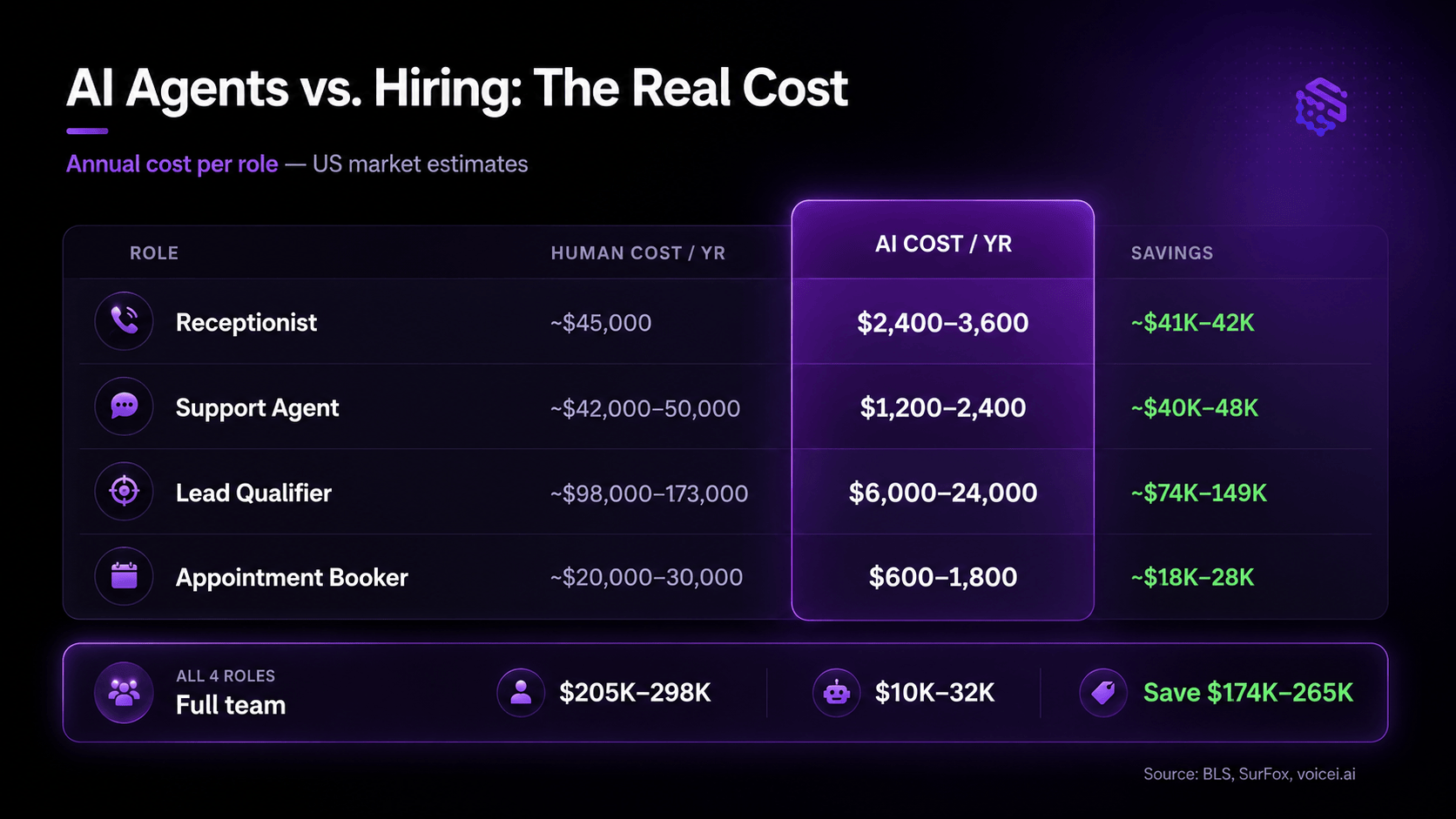
| Role | Human Cost/Year | AI Cost/Year | Annual Savings |
|---|---|---|---|
| Receptionist | ~$45,000 | $2,400-3,600 | ~$41,400-42,600 |
| Customer support | ~$42,000-50,000 | $1,200-2,400 | ~$39,600-48,000 |
| Lead qualifier (SDR) | ~$98,000-173,000 | $6,000-24,000 | ~$74,000-149,000 |
| Appointment booker | ~$20,000-30,000 | $600-1,800 | ~$18,200-28,400 |
| All four roles | ~$205,000-298,000 | ~$10,200-31,800 | ~$174,000-265,000 |
Human costs include salary, benefits, and tools. AI costs are platform subscription only. Figures are US market estimates. Sources: U.S. Bureau of Labor Statistics, SurFox 2026, voicei.ai benchmarks. Individual results will vary by industry and region.
Running four AI agents instead of four hires saves $174,000 to $265,000 per year.
The "AI First, Hire Second" Framework
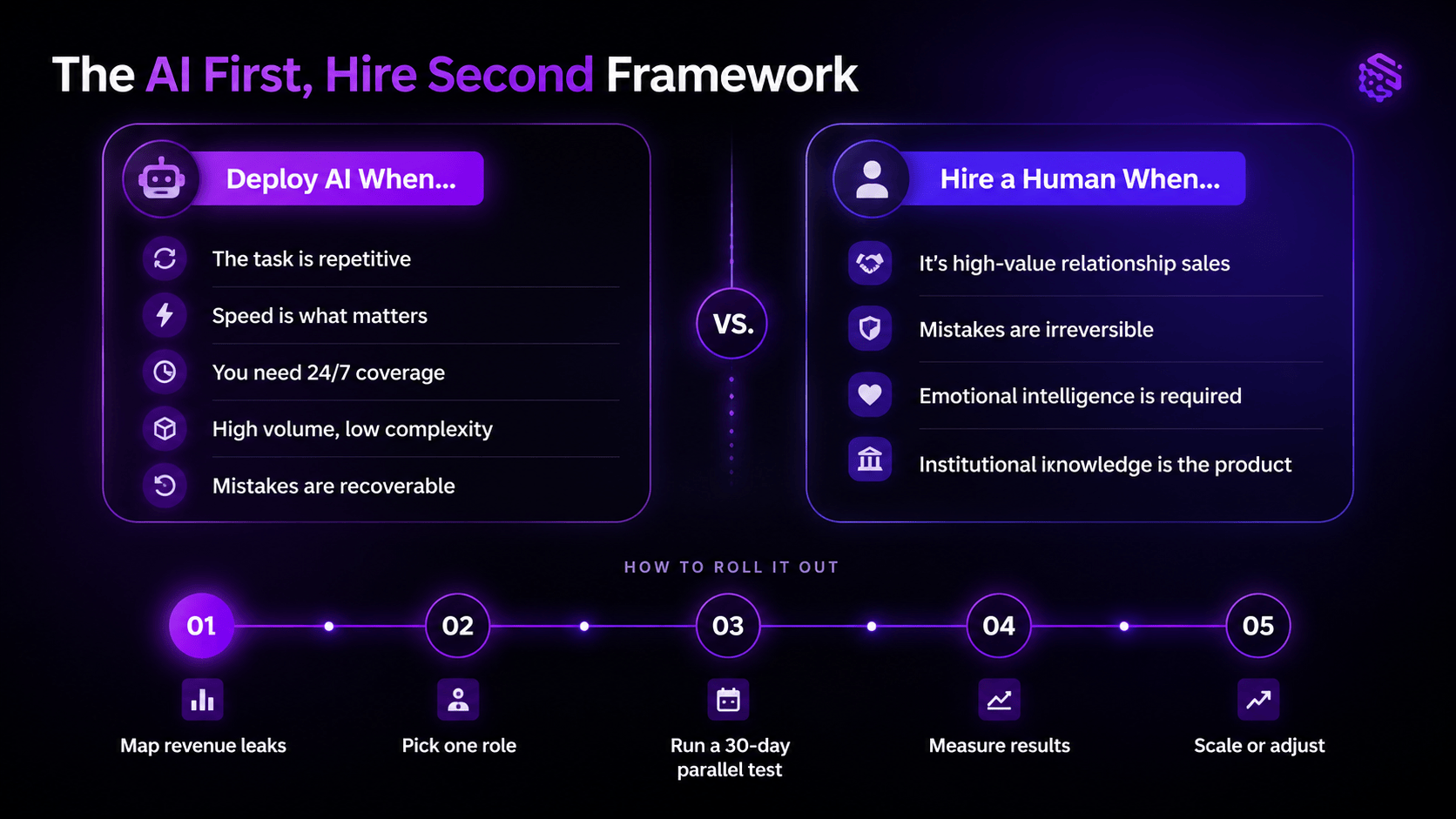
Before you post a job listing, run this check.
AI handles volume well when:
- The task is repetitive (same questions, similar formats)
- Speed of response is a key metric
- After-hours or 24/7 coverage matters
- Volume spikes are common but unpredictable
- A wrong answer is recoverable (an apology, a re-book, an escalation)
Hire a human when:
- Deals are high-value and relationship-dependent
- Mistakes have serious or irreversible consequences
- The role requires reading emotional signals
- Institutional knowledge is a core part of the job
Deployment sequence:
- Map where you lose money from missed volume -- missed calls, slow lead response, unqualified demos
- Pick one role. Start narrow.
- Run the AI agent in parallel with your current process for 30 days
- Measure: calls handled, leads qualified, hours recovered
- Scale what works; adjust what does not
The discipline is starting with one function, not five. Measure it, then expand.
What AI Can't Replace Yet
Anyone telling you AI replaces everything is selling something.
Complex B2B sales. Deals above $100,000 ACV with multi-stakeholder sales cycles still close better with human reps. Relationship management and navigating organizational politics remain genuinely difficult for current AI.
Crisis and emotional situations. A customer whose order is three weeks late and threatening a chargeback needs a human on the line. AI can log the ticket and send a holding response; a human has to own the resolution.
Strategic judgment. Decisions that require institutional knowledge -- reading your customer base, knowing which prospect to prioritize, managing a partnership -- still belong with people.
The evidence says go carefully. Forrester research found that 55% of employers who reduced headcount based on AI capabilities now regret those decisions. Many cut positions based on AI that did not actually exist yet. There is even a term for what happened next: the "AI boomerang," referring to companies quietly rehiring staff they had let go.
Gartner's 2024 research found 64% of customers still prefer not to deal with AI for customer service. That preference is shifting -- but it is a real constraint for businesses where the relationship is the product.
What practitioners are saying:"The general AI rule we follow is that no implementation of AI is allowed to 'replace' an employee. The idea is we might not hire new and expand..." -- Business owner, r/Entrepreneur (Oct 2024)
Gene Marks, a CPA and SMB columnist, observed on LinkedIn in March 2026: "Most small business owners I talk to aren't trying to replace employees -- they're trying to find them. They're using AI because they can't hire fast enough."
The real opportunity is not replacement. It is absorbing volume at the AI layer so your humans can focus on what actually requires human judgment.
Author's Take: Sam
The cost argument for AI is real. But the risk argument is the one most people miss.
Hiring someone locks you in for months. You pay through ramp time, through mistakes, and through replacement cycles when someone leaves. AI agents have a different failure mode: they handle an edge case wrong and you fix the prompt.
The threshold I use: if the role is mostly answering the same question in under 50 words, AI handles it. If the role requires reading a room, reading between the lines, or making a judgment call that matters -- it needs a human.
Start with one AI agent. Measure what it handles. Hire the human when AI genuinely cannot keep up.
Build Your AI Team on SketricGen
You can build each of these agents in SketricGen in minutes, no code required. Train the agent on your business knowledge (FAQs, pricing, policies), then put it to work on your website, WhatsApp, or phone.
Where to start for each of the four roles in this post:
| Role | Build it here |
|---|---|
| AI Receptionist | Build an AI receptionist |
| Lead Qualifier | Build a lead capture agent |
| Appointment Booker | Build a meeting scheduler |
| Support Agent | Build one from scratch in the dashboard |
Start from the dashboard or browse all templates at sketricgen.ai/template.
Start With One
The cheapest hire you will make is an AI agent. It works overnight, never asks for a raise, and scales without another onboarding cycle.
Pick one role. Run it for 30 days. Measure the result. Then expand.
Browse AI agent templates on SketricGen or open the dashboard to build your first agent today.
Related reading: AI Agents vs. Chatbots -- What's the Difference? | Will AI Agents Replace Recruiters? | Sam Altman and the AI Job Debate
FAQs
Yes, significantly. A full-time customer support hire costs $42,000-50,000/year including salary and benefits. An AI support agent runs $1,200-2,400/year and handles around 70% of routine queries -- FAQs, order status, basic troubleshooting. Complex or emotionally charged cases still need a human. The hybrid model (AI for Tier 1, human for Tier 2) is where most businesses see the best results.
For most service businesses, yes -- for the majority of calls. AI receptionists handle 85-95% of inbound calls for trades like HVAC, plumbing, and salons without human involvement. They operate 24/7, never miss a call, and cost $199-299/month versus $45,000/year for a human hire. See our full AI receptionist guide for setup details and use case specifics.
It varies by role. AI lead qualifiers show an average 317% annual ROI with a 5.2-month payback period, according to SurFox's 2026 analysis. AI receptionists often pay for themselves in the first month from revenue recovered on missed calls. Across all four roles in this post, the cost differential versus hiring humans is $174,000-265,000/year.
Start where you lose the most money from missed volume. For most businesses, that is either the receptionist (missed calls = missed revenue) or the lead qualifier (slow follow-up = lost deals). If you are spending 5-10 hours/week on scheduling, the appointment booker has the fastest ROI. Support automation makes the most sense when you have high ticket volume with repetitive questions.
Complex B2B sales (high ACV, multi-stakeholder), crisis management, strategic decision-making, and relationship-heavy roles requiring emotional intelligence. The 55% employer regret stat exists because companies moved too fast on these categories. Current AI is strong on volume and speed; it is weak on judgment and relationship depth.
With a no-code builder like SketricGen, a basic agent is live in 15-30 minutes. Getting it to handle 80%+ of queries well takes more iteration -- usually 2-4 weeks of monitoring, reviewing what it gets wrong, and refining. The day-one version will not be perfect. The 30-day version usually is.
Related blogs
View more
AI-Proof Jobs in 2026: What the Data Actually Shows
ai trends and research
What Is AI Agent Orchestration? A Plain-English Guide (2026)
ai trends and research
What Is an AI Workflow Builder? How to Choose the Right One in 2026
ai trends and research
87% of Small Businesses Use AI. Only 14% Have It Running Their Business.
ai trends and research
What Is Collaborative AI? The Future of AI in Team Collaboration (2026)
ai trends and research