AI-Proof Jobs in 2026: What the Data Actually Shows
Meta cut 10% of its staff in April 2026 and cited AI-driven efficiency as the reason. Block went further, cutting 40% of its workforce that same quarter, with CEO Jack Dorsey telling shareholders that "a significantly smaller team, using the tools we're building, can do more and do it better."
Two months later, Upwork released its 2026 Future Workforce Index and found the opposite problem was also true: freelancers who use AI well are earning 34% more per hour than those who don't. Some are earning 45% more.
Both things are happening at the same time, in the same labor market, to the same generation of workers. This piece is about what that actually means if you're job hunting, hiring, or running a small team that can't afford either extreme.
Key Points
- Meta cut roughly 8,000 jobs (10% of staff) in April 2026; Block cut over 4,000 (40% of staff) in February 2026, both citing AI-driven efficiency.
- Upwork's 2026 Future Workforce Index found AI-savvy freelancers earn 34% more per hour on average, and up to 45% more for complex, judgment-heavy work.
- PwC's 2026 Global AI Jobs Barometer found AI-exposed entry-level roles are now 7x more likely to demand senior-level skills like judgment and stakeholder management, a pattern PwC calls "seniorization."
- A British Standards Institution survey of 850 business leaders found 39% have already cut junior roles because of AI, and 43% expect to cut more in 2026.
- There is no fixed list of "AI-proof jobs." What holds up is judgment, accountability, and the ability to operate AI tools rather than just prompt them once.
- For small teams, the practical response isn't hiring less or hiring more. It's automating the repeatable 80% of a role (screening, scheduling, first-touch lead qualification) so the humans you do hire spend their time on the 20% that actually needs judgment.
What "AI-Proof" Actually Means (It's Not a Job List)
Most content ranking for "AI-proof jobs" right now is a listicle: nursing, plumbing, therapy, skilled trades. That's not wrong, but it's incomplete, and it doesn't explain why AI-savvy freelancers on Upwork are out-earning everyone else in white-collar categories that are supposedly "at risk."
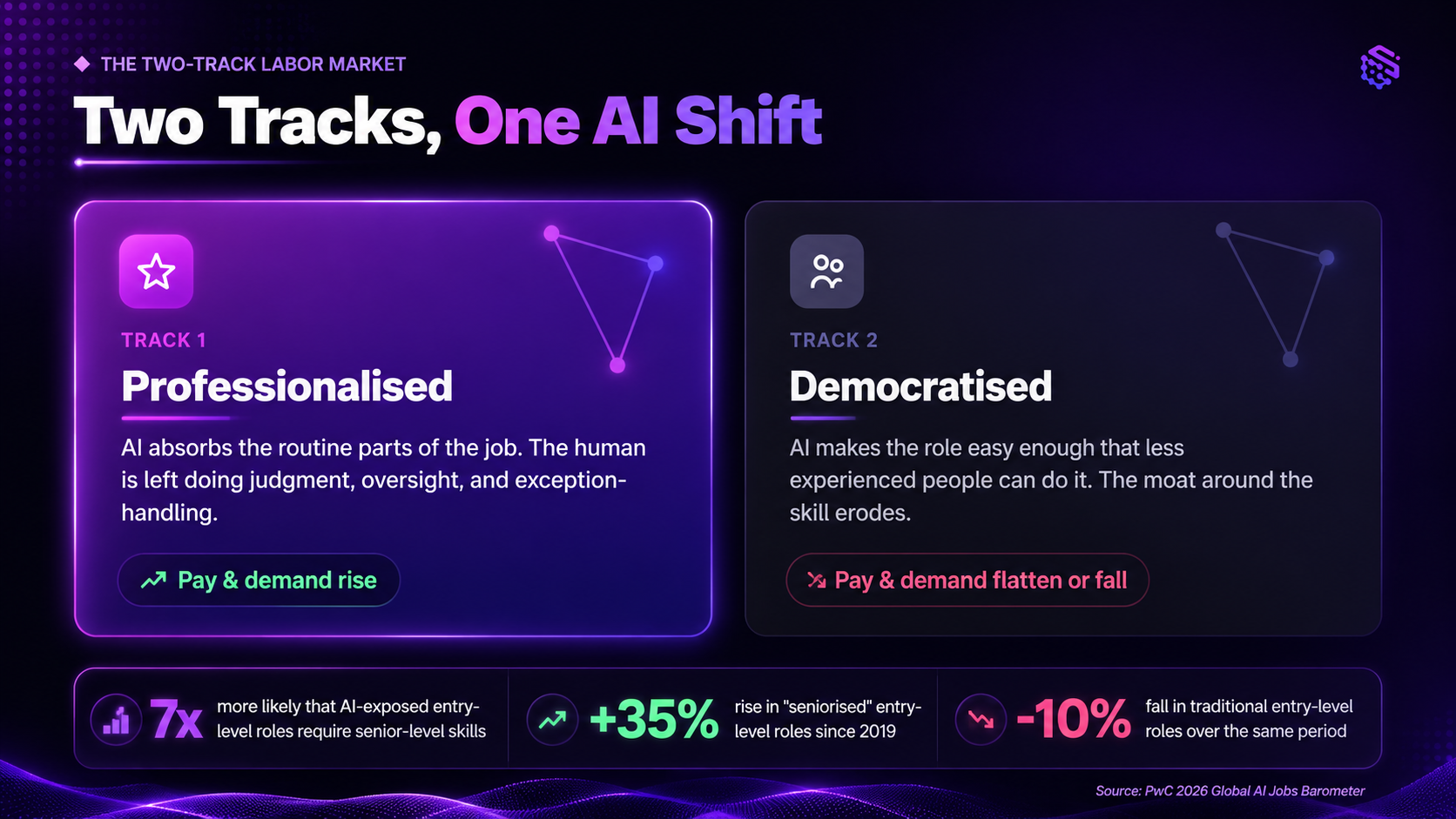
The more useful frame comes from PwC's 2026 Global AI Jobs Barometer, which analyzed over a billion job postings across six continents. PwC found that the labor market is splitting into two tracks:
| Track | What happens to the role | What happens to pay |
|---|---|---|
| Professionalised | AI absorbs the routine parts of the job; the human is left doing judgment, oversight, and exception-handling | Pay and demand rise |
| Democratised | AI makes the role easy enough that less experienced people can do it | Pay and demand flatten or fall |
PwC's 2026 Global AI Jobs Barometer found that in the most AI-exposed occupations, 52% of new skills appearing in entry-level job postings were skills that used to belong to experienced workers. Job openings for these "seniorized" entry-level roles have grown 35% since 2019, while traditional, lower-judgment entry-level openings shrank 10% over the same period, according to Fortune's coverage of the report.
That's the mechanism behind the layoffs. Meta and Block didn't just cut headcount; they cut the layer of the org chart that used to exist so junior people could learn on the job before being trusted with judgment calls. Bloomberg reported that Meta's cuts came with a freeze on roughly 6,000 additional open roles it had planned to fill. Fortune's reporting on Block noted Dorsey expects most companies to make similar cuts within the next year.
The Data Behind the Story
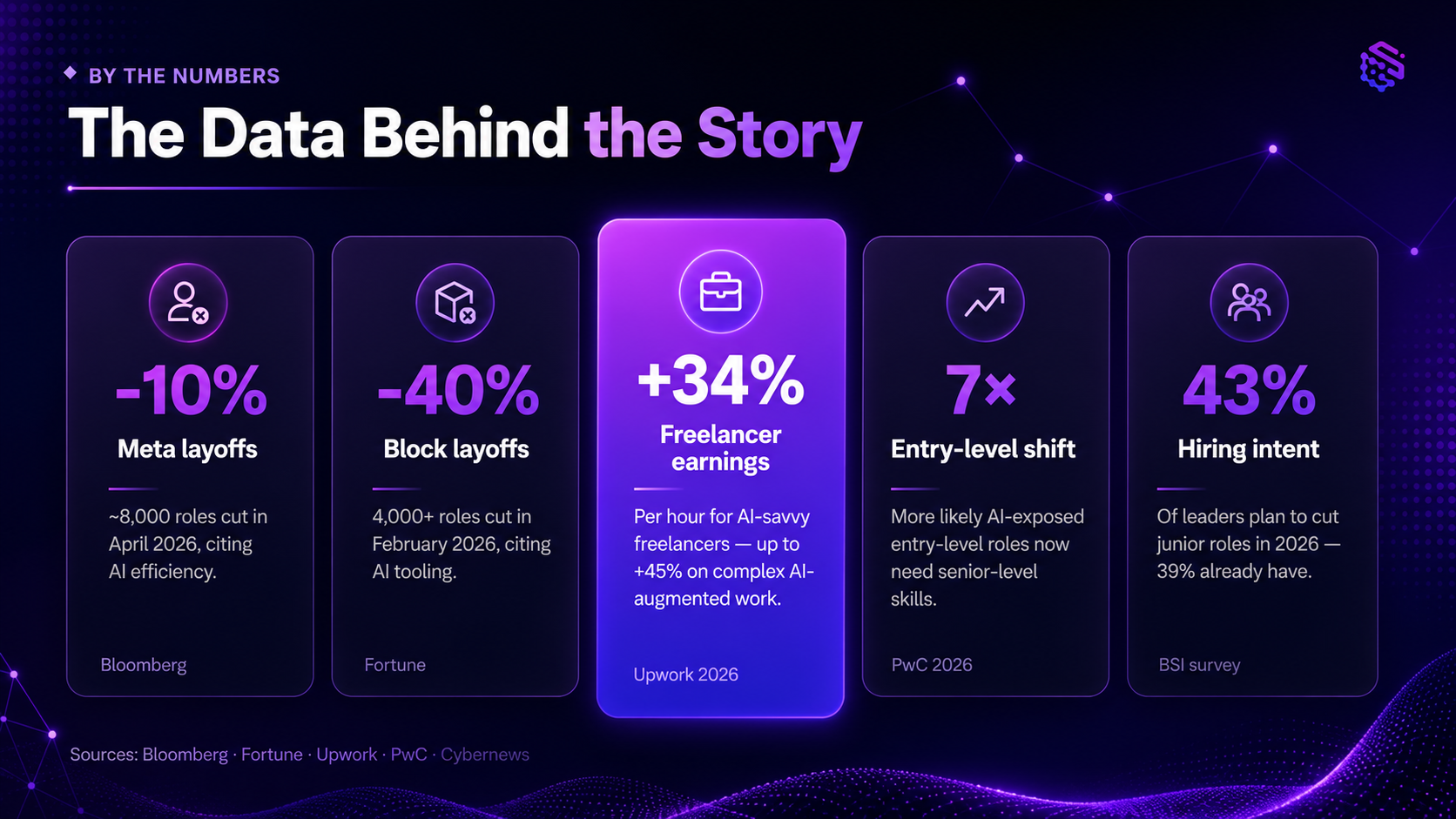
Here's the fuller picture, pulled from primary sources rather than secondhand summaries:
| Signal | Data point | Source |
|---|---|---|
| Big Tech layoffs | Meta cut ~8,000 roles (10% of staff), froze ~6,000 more | CNBC |
| Fintech layoffs | Block cut 4,000+ roles (40% of staff), citing AI tooling | Fortune |
| Freelancer earnings | AI-savvy freelancers earn 34% more per hour; complex AI-augmented work up 45% | Upwork 2026 Future Workforce Index |
| Entry-level skill shift | AI-exposed entry-level roles 7x more likely to require senior-level skills | PwC 2026 AI Jobs Barometer |
| Hiring intent | 39% of leaders already cut junior roles; 43% plan to in 2026 | Cybernews on the BSI study |
Two things stand out. First, the layoffs and the freelancer earnings boost are the same trend viewed from two sides: routine, low-judgment work is being absorbed by AI regardless of who used to do it, employee or contractor. Second, none of this data supports a clean "AI-proof job" list. It supports a skill profile: people who can direct AI, check its output, and own the decision at the end are getting paid more for it, whether they're salaried or freelance.
What People Hiring and Job-Hunting Are Actually Saying
The stats explain the trend. The day-to-day frustration explains why it feels so much worse than the stats suggest.
On the hiring side, a small business owner described posting an entry-level customer service role and receiving roughly 4,000 completed applications for 7 hires. Screening manually, they found AI-written answers to basic questions, applicants with a WPM test score of 11 despite the job requiring 55, and candidates typing interview questions into ChatGPT live on camera. Their conclusion: "there is also an equally amount of shitty people trying to get a quick one and lie to companies to get a job," alongside their own admission that skipping AI-assisted screening tools "was my biggest mistake."
"The Death of Entry-Level Jobs: 43% of CEOs plan to slash junior roles over the next two years, shifting hiring to older, mid-level workers as AI takes over routine tasks." From r/Futurology, 10,000+ upvotes
On the job-seeker side, the frustration is less about AI directly and more about what it's done to the application process itself. Recruiters on r/askrecruiters describe applicant tracking systems scoring resumes as "A+" simply for copy-pasting the job description back at them, drowning out the small number of genuinely qualified candidates. Job seekers on r/jobs describe applying to 200+ entry-level roles with zero interviews. A related Quora thread on whether AI will change how small businesses hire administrative staff lands on the same point PwC's data shows: it's not that entry-level jobs vanished, it's that the skill bar for the ones left has moved up.
The Automation Gap Nobody's Naming
Here's the part most "AI-proof jobs" content skips entirely: the SERP for this topic is full of generic career-advice listicles, and none of them connect the entry-level bifurcation to what a small business actually needs to do differently.
Small teams are getting squeezed from both directions. They can't compete with Meta or Block on AI infrastructure spend, but they're facing the exact same problem: too many applicants to screen manually, too many routine tasks eating time that should go to judgment work, and a real cost to hiring the wrong junior person in a market this noisy.
The Reddit thread on r/aiToolForBusiness that lists "things I genuinely recommend doing with AI for your small business" makes the practical case: the highest-value use of AI for a small team isn't replacing a role wholesale, it's automating the repeatable front door of that role, screening, first-response, scheduling, so a human only steps in once judgment is actually needed. A separate thread on r/growmybusiness raises the flip side: AI speeds up content and outreach creation, but it doesn't solve the distribution problem. Producing more doesn't matter if nobody sees it or if leads aren't followed up on fast enough to convert.
That gap, between "we can produce more" and "we can actually convert and staff for it," is where automation earns its keep for a small business. Not as a replacement for entry-level hiring, but as the layer that handles the repeatable 80% (lead capture, qualification, scheduling, first-line support) so the one or two people you do hire spend their time on the judgment calls that PwC's data says are getting more valuable, not less.
If you're deciding whether to make your next hire or automate the role instead, our breakdown of how small businesses use AI agents instead of hiring in 2026 walks through the actual cost comparison. If the bottleneck is specifically lead response time or after-hours coverage, our no-code guide to AI chatbots for your website and our guide to AI scheduling assistants cover the two most common starting points.
Common Mistakes Small Teams Make Here
- Treating "AI-proof" as a job title search instead of a skill profile. The data shows judgment and accountability are what hold up, not any single job category.
- Automating the whole role instead of the repeatable part of it. PwC's "seniorization" data suggests the judgment layer is becoming more valuable, not less needed.
- Using AI-generated screening on the applicant side while ignoring that applicants are using AI too. The result, as the r/recruitinghell thread shows, is noise on both sides of the hiring funnel with no real signal.
- Assuming more AI-produced content or outreach automatically means more customers. Per the r/growmybusiness thread, production speed and lead conversion are two different problems that need two different fixes.
- Waiting for a fixed "safe jobs" list before making a hiring or automation decision, instead of looking at what's actually repeatable in the role today.
Author Take
I don't think the useful question is "which jobs are safe." Every list I found chasing that phrase, including the ones ranking on page one right now, reads the same six months from now: nurses, electricians, therapists, repeat.
The more useful question, especially if you're running a small team, is which parts of a role are repeatable enough to automate this quarter, and which parts genuinely need a person exercising judgment. PwC's own data backs this up: the entry-level roles that are growing are the ones that got harder, not the ones that stayed the same. If you're hiring, don't try to hire your way around that shift. Automate the repeatable front end of the role first, then hire for the judgment work that's left. That's a smaller, cheaper, and honestly more defensible bet than either mass layoffs or mass hiring.
Next Steps
If you're hiring for a small team right now, start by mapping which parts of the open role are repeatable (screening, scheduling, first-touch qualification) versus which parts need judgment. Automate the first category before you post the job. If you want a concrete cost comparison between a new hire and an AI agent for common small-business roles, see how small businesses are using AI agents instead of hiring in 2026.
FAQs
Not in a single clean sense. Big companies like Meta and Block have cut headcount and cited AI efficiency directly. But PwC's 2026 Global AI Jobs Barometer found entry-level roles in AI-exposed occupations grew 35% since 2019 when they required senior-level skills, while traditional, lower-judgment entry-level roles shrank 10% over the same period. The honest answer is that entry-level work is changing shape faster than it's disappearing outright.
There's no fixed list that holds up over time. The pattern in the data is that jobs requiring judgment, accountability, and oversight of AI output are becoming more valuable, while jobs that are purely routine execution are being absorbed by AI regardless of industry. Upwork's 2026 Future Workforce Index found this exact pattern among freelancers: those doing complex, judgment-heavy AI-augmented work saw earnings rise 45%, while lower-complexity AI execution work saw per-contract earnings fall 13% even as volume grew.
Upwork's research attributes this to what it calls the "AI orchestrator" pattern: freelancers who combine AI fluency with domain expertise, judgment, and workflow design command a premium, while freelancers only using AI for basic execution do not see the same gains.
Estimates vary widely depending on methodology and haven't converged into one reliable number. What the current data does show clearly is a bifurcation already underway in 2026: routine entry-level tasks are being automated now, while judgment-heavy entry-level roles are growing in both number and required skill level.
Automate the repeatable front end of a role, screening, scheduling, first-response, lead qualification, rather than eliminating the role entirely. That frees up the person you do hire to focus on judgment calls, which is exactly the part of entry-level work that PwC's data shows is growing in value, not shrinking.
Producing content or outreach faster with AI doesn't automatically solve distribution or conversion. Small business owners discussing this on Reddit note that AI speeds up creation but the harder problem, getting leads seen, qualified, and followed up with quickly, still needs a dedicated workflow or tool, not just more AI-generated output.
For candidates, yes, in practice. Recruiters report applicant tracking systems scoring AI-copy-pasted resumes higher than genuine ones, while hiring managers describe wading through thousands of AI-assisted applications to find a handful of real fits. Both sides describe the same underlying problem: high volume, low signal, and not enough judgment applied early enough in the process.
Related blogs
View more
What Is AI Agent Orchestration? A Plain-English Guide (2026)
ai trends and research
What Is an AI Workflow Builder? How to Choose the Right One in 2026
ai trends and research
87% of Small Businesses Use AI. Only 14% Have It Running Their Business.
ai trends and research
What Is Collaborative AI? The Future of AI in Team Collaboration (2026)
ai trends and research