What Is Collaborative AI? The Future of AI in Team Collaboration (2026)
Based on the Harvard Business School P&G study on AI teamwork, Microsoft's 2026 Work Trend Index, and practitioner threads from r/AI_Agents.
Key Points
- Collaborative AI is when AI agents work alongside humans, or other AI agents, to complete the shared goals. It is a design choice, not a product category.
- It differs from fully autonomous AI in one key way: humans are part of the decision loop for anything that carries real consequence.
- Multi-agent systems are the infrastructure that makes collaborative AI scalable. Each agent handles a specific role and hands tasks off to the next.
- Human-in-the-loop AI is not a compromise. It is what makes agents production-safe and trustworthy for real teams.
- Gartner predicts 40% of enterprise apps will have task-specific AI agents by 2026, up from less than 5% in 2025. Teams that understand how to design for collaboration will outperform those chasing full autonomy.
- A Harvard Business School study of 791 Procter & Gamble developers found that ideas from AI-using teams ranked in the top 10% three times more often than those from individuals working without AI.
- SketricGen is built around this exact pattern: visual multi-agent workflow design, defined agent handoffs, and human checkpoints you can set without writing a line of code.
What Is Collaborative AI?
Most teams using AI are still stuck in single-agent mode. One prompt, one answer, one person at a time. That works for drafting an email. It does not work for running a sales qualification pipeline, handling support at scale, or coordinating a content team across five channels.
Collaborative AI is what happens when you wire agents together and keep humans in the right places. Multiple AI agents with each having a specific role, working in sequence or in parallel. There are human checkpoints at the decisions that actually matter. The AI handles the volume. The humans handle the judgment calls.
That is not a vision. According to Microsoft's 2026 Work Trend Index, active agents on Microsoft 365 grew 15x year over year. That growth is not from single-user tools. It is from agents embedded in real team workflows, handing work to each other and escalating to humans when they need to.
The shift happening right now: AI stopped being a tool one person uses. It became something a whole team works alongside.
Collaborative AI vs Agentic AI: What Is the Difference?
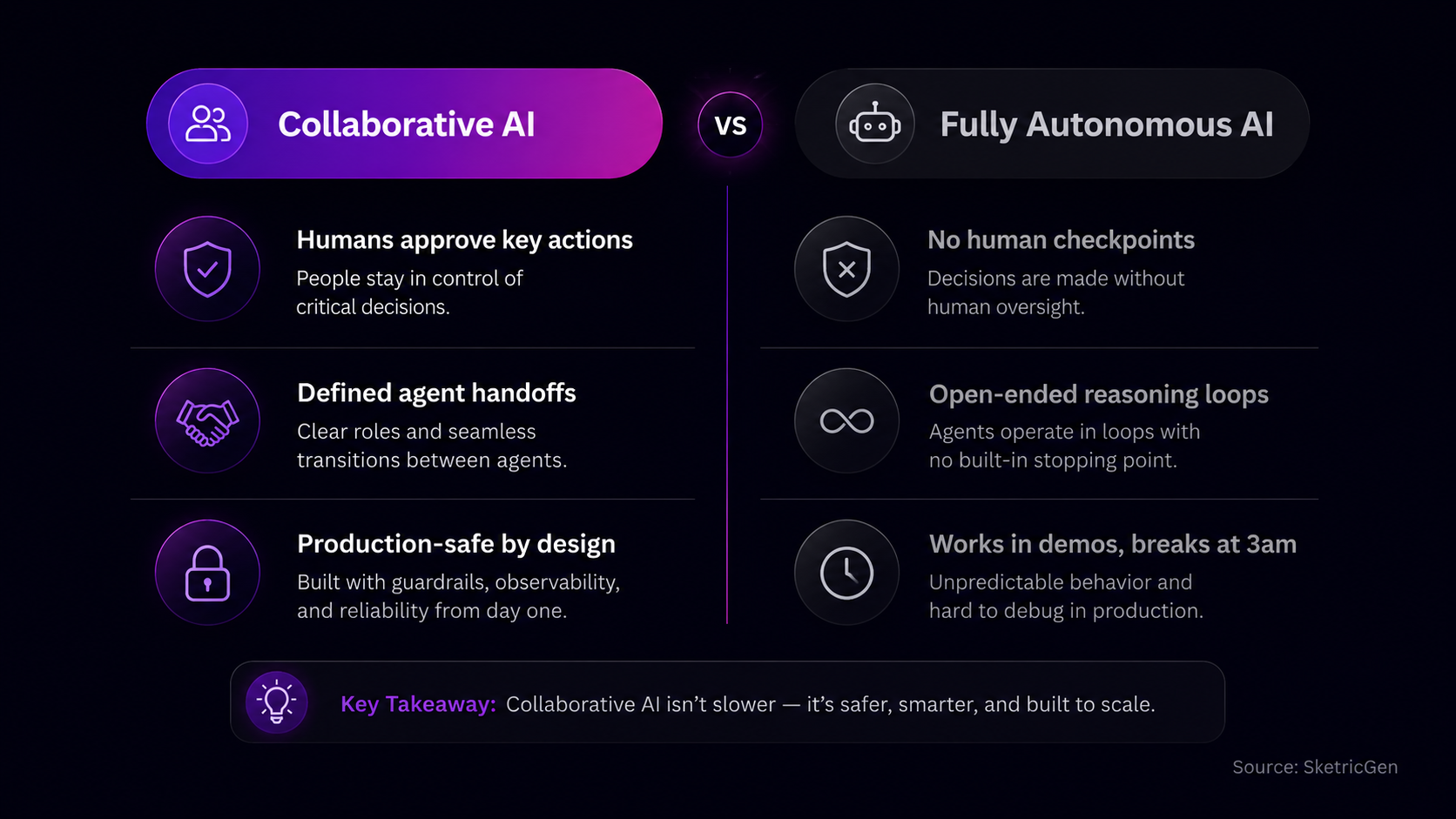
You have probably noticed "collaborative AI" getting replaced by "agentic AI" in most conversations. The vocabulary shifted because the technology shifted. But the two concepts are not the same thing, and mixing them up leads to bad design decisions.
Here is how the terms map in practice:
| Collaborative AI | Agentic AI | Traditional Chatbot | |
|---|---|---|---|
| Core behavior | Coordinates between agents and humans | Acts autonomously toward goals | Responds to prompts |
| Human involvement | Built in at key decision points | Optional, often minimal | Required for every action |
| Task scope | Multi-step, multi-agent workflows | Long-horizon, end-to-end processes | Single-turn Q&A or task |
| Best for | Team workflows needing reliability and scale | Long-running automation with guardrails | Support, FAQs, simple lookup |
| Risk profile | Managed | Higher, requires governance | Low |
Agentic AI is about capability. Collaborative AI is about how you deploy that capability in a team context. Most production systems blend both. Agents that act independently on bounded tasks, with humans reviewing anything that has downstream consequences.
For a deeper look at what is agentic AI and how it differs from earlier AI systems, that post covers the full breakdown.
How Collaborative AI Works in Practice
Multi-Agent Systems: The Engine Behind Collaborative AI
Multi-agent system is like a team in which each member has a specific job. One agent researches. Another writes. A third checks for accuracy. They hand work to each other rather than dumping everything on a single model trying to do it all.
Why does this work better? Because each agent can be tuned for its job. A research agent is optimized to pull and summarize. A review agent is optimized to catch errors. When agents work in sequence, mistakes get caught before they reach a human instead of after.
How multi-agent AI systems work together, this blog covers the architecture in detail, including orchestration patterns and when a single-agent setup more useful to system.
Human-in-the-Loop AI: The Guardrail That Makes It Work
Human-in-the-loop (HITL) AI means the agent does the work, finalizes the actions and a human reviews before anything material happens. Not every action, just the ones that matter.This ensures that the final verdict is always human, particularly on what actually matters.
People sometimes treat this as a limitation of current AI. It is not. Research from agentbuild.ai found hallucination rates as high as 79% in newer reasoning models. That number is exactly why you want a human checkpoint on anything consequential, not because the AI is bad, but because the cost of a mistake in a customer-facing workflow is real.
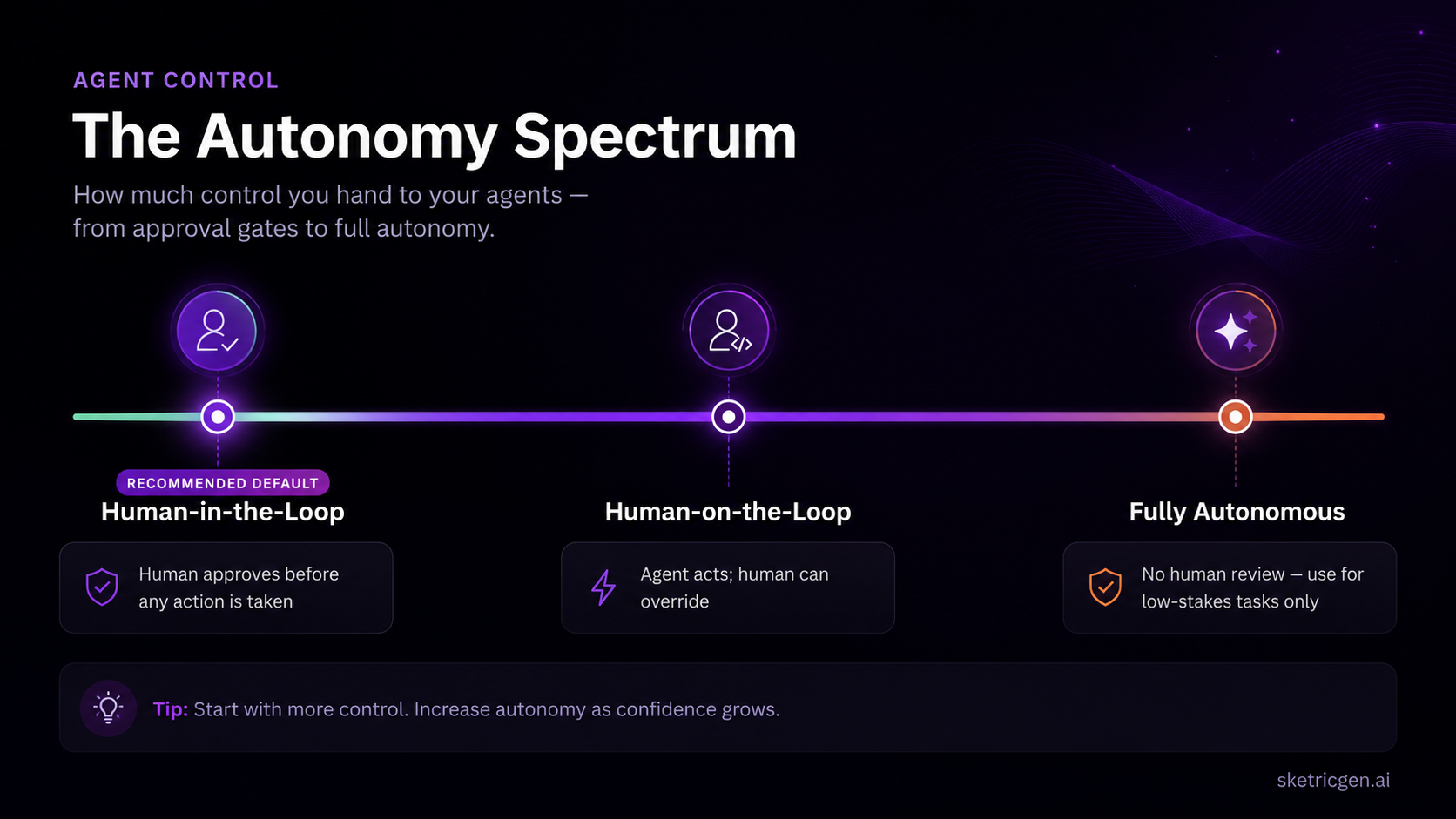
There are 3 ways this works:
- Human-in-the-loop: Human approves at the start before any major action is taken.
- Human-on-the-loop: Agent acts, but a human can intervene or override.
- Fully autonomous: Agent completes the full task with no human involvement.
Most teams doing serious work sit in the first two. Fully autonomous makes sense for narrow, reversible, low-stakes tasks only.
Why Full Autonomy Usually Fails in Production
The pitch is appealing. Build an agent, hand it a goal, walk away. In demos, agents do impressive things. In production, they do impressive things until 3am when something breaks and nobody is watching. And such fails are much more difficult to diagnose and even more importantly to correct.
A developer on r/AI_Agents described it after a year of building fully autonomous systems for clients:
"For most business problems, autonomy is a bug, not a feature. Clients don't want a black box that might accidentally hallucinate a new company policy; they want a reliable, repeatable result." -- u/Cold_Bass3981, r/AI_Agents
His fix was not to build less capable agents. It was to replace open reasoning loops with deterministic handoffs and add human approval before any action that could not be undone. The agents got more capable. The systems became usable.
Decision rule: If an agent action cannot be fully reversed within one hour, put a human checkpoint in front of it. The cost is a few seconds of review. The cost of skipping it is trust.
What Teams Are Actually Getting From Collaborative AI
The returns are there. They just do not look like the pitch decks suggest.
A Harvard Business School study of 791 P&G product developers found:
- Ideas from AI-using teams were 3x more likely to rank in the top 10%
- Teams reduced development time by 13%
- Less experienced employees matched the output of senior colleagues when working with AI
- Lead researcher Fabrizio Dell'Acqua put it plainly: "A full human team plus AI seems like the recipe for success."
Microsoft's 2026 Work Trend Index adds scale:
- 58% of AI users report producing work they could not have completed a year earlier
- 86% treat AI output as a starting point, not a final answer
- When managers model AI use, employees report 30-point gains in confidence toward agentic AI
People also just feel better about their work when AI is in the mix. HBS researchers found that employees using AI reported higher enthusiasm and less anxiety than those working alone. That is harder to put in a ROI slide, but it matters for retention.
Collaborative AI in Action: Use Cases by Team
Here is what collaborative AI looks like when it is actually running, broken down by function:
| Team | Pain Point | What Collaborative AI Does | Human Role |
|---|---|---|---|
| Sales | Reps spending time on low-intent prospects | Research agent qualifies inbound leads; drafting agent writes personalized outreach | Rep approves messages; handles high-intent calls |
| Support | High ticket volume; repetitive queries | Support agent resolves FAQs and tracks order status around the clock | Human handles escalations, billing disputes, complex complaints |
| Marketing | Content bottleneck across too many channels | Research agent pulls trends; drafting agent creates copy; review agent checks brand consistency | Marketer reviews final copy; approves anything public-facing |
| Operations | Status update overhead; manual handoffs | Orchestration agent coordinates task handoffs; sends automatic updates | Ops lead monitors the dashboard; steps in on blockers |
| Product / Research | Too much input, not enough synthesis | Research agent aggregates data; summary agent produces structured briefs | PM adds strategic context; makes the product calls |
If you need a sales-specific walkthrough, how to build an AI sales assistant for lead qualification shows an end-to-end setup.
What Makes an AI Agent Actually Collaborative?
Not every tool that says "AI" on the label earns the collaborative label. Four things separate agents that actually work in teams from ones that just look good in a demo:
- It coordinates with other agents. It can receive a task from one agent and pass output to another. It is not a standalone tool pretending to be part of a system.
- It has defined handoff rules. It knows when to escalate to a human, when to route to another agent, and what to do when it hits a decision it should not make on its own.
- It lives inside your team's tools. Email, Slack, CRM, ticketing. An agent that cannot read or write to the systems your team already uses is not collaborative. It is just another tab.
- It gets better with context. Collaborative agents carry memory of what the team has tried, what worked, what did not. They do not start from zero every time.
For a clear breakdown of the difference between AI agents and chatbots, that post has a 3-question test and 2x2 matrix.
Author take - Sam
The teams I have seen get the most from collaborative AI are not necessarily the ones chasing the most autonomous setup. They drew a clear line: this is what the agent owns, this is what a human owns, and this is how the hand off occurs between the two.
That line is almost always in a different place than where they started. The work is in finding where it belongs for your workflow specifically, not lifting someone else's architecture and hoping it fits.
Building Collaborative AI With SketricGen
SketricGen is a no-code multi-agent builder. You design agent roles visually, set the handoff logic between them, and define exactly where humans review before anything goes out.
No infrastructure to write. No framework to learn. You pick a pre-built agent template for your use case, or start from scratch in the dashboard and wire it together yourself. Most teams are running their first workflow within a day.
If you want to understand what is on each plan before committing, the pricing page breaks it down clearly.
What Practitioners Are Saying
The clearest framing on what collaborative AI actually means is not in any whitepaper. It is from the people building and breaking these systems every day.
One developer on r/AI_Agents:
"An agent only starts feeling valuable when it can grow with you a little. It remembers what you tried, what failed, what you care about, what you keep changing your mind about. Not 'AI as a magic employee.' More like a long-term collaborator that slowly learns how to work with you." -- u/Similar_Boysenberry7, r/AI_Agents
That is the actual bar. Not the number of agents. Not the automation rate. Whether the system fits how your team works, and whether it earns trust over time by being predictable.
For a broader look at where this is heading for workplace tools specifically, how AI agents are reshaping workplace communication covers the coordination layer in depth.
Next Steps
Collaborative AI works when the design is right: clear agent roles, defined human checkpoints, workflows built around your actual constraints.
The fastest way to understand what that looks like is to build one. How to build a multi-agent workflow in under 10 minutes walks through a real lead qualification example from scratch.
Ready to run it for your team? Start building on SketricGen or explore agent templates built for common workflows.
FAQs
Collaborative AI is when AI agents work with humans, or with other AI agents, toward a shared goal. The key word is coordination. These systems are built to fit into how a team works, not to replace human judgment entirely. One agent researches, another writes, a third reviews, and humans step in at the decisions that actually carry weight.
Human-AI collaboration is a working arrangement where humans and AI each do what they are better at. AI handles speed, scale, and consistency. Humans bring context, judgment, and accountability. In practice: AI agents handle first drafts, data retrieval, and repetitive tasks. Humans review outputs and make calls that have real consequences. Neither replaces the other. Together they cover more ground.
Human-in-the-loop (HITL) AI is when a human reviews or approves an agent's output before it becomes a real action. The agent does the work; the human checkpoints anything material. It is the standard for teams deploying agents in production, partly because hallucination rates in newer AI models can reach 79% in complex tasks. HITL is not a workaround. It is the design pattern that makes agents trustworthy enough to put in front of real customers.
Agentic AI is about what the agent can do: set goals, plan, and act autonomously. Collaborative AI is about how it is deployed: alongside humans and other agents, with oversight built into the workflow. Most production systems blend both. The distinction matters because building for collaboration means designing handoffs and human checkpoints from the start, not adding them later. For the full comparison, see what is agentic AI.
Multi-agent systems are used when a task is too complex or too large for a single agent to handle reliably. Each agent covers one job: research, drafting, review, routing, execution. Common setups include lead qualification pipelines, support triage, content production workflows, and operational coordination. For a step-by-step build, how to create a multi-agent workflow in under 10 minutes walks through it with a real example.
Teams using AI outperform individuals without it, and the combination of humans plus AI beats either alone. A Harvard Business School study of 791 P&G developers found 3x more top-10% ideas and 13% faster development times. Microsoft's 2026 Work Trend Index found 58% of AI users doing work they could not have done a year ago. The reason: AI takes the coordination, drafting, and data work off people's plates so they can focus on the things that actually need judgment.
Partly. The hype is in the demos. The results are in the implementations where someone put in the work to define agent roles, design real handoffs, and keep humans in the loop where it mattered. The r/AI_Agents community is full of people who chased full autonomy and had to walk it back. The teams with real ROI started small, stayed bounded, and expanded only after the first workflow was stable.
Depends on what you actually need to automate. For teams that want to build multi-agent workflows without code, SketricGen lets you design agent roles, set handoff logic, and add HITL checkpoints visually. Start from a pre-built template for your use case, or build from scratch. The best tool is the one your team can configure, trust, and ship within a sprint.
Related blogs
View more
SEO Automation: What You Can Safely Automate (and What Still Needs a Human)
ai trends and research
What Is an AI Marketing Agent? What It Automates, and What It Cannot
ai trends and research
AI-Proof Jobs in 2026: What the Data Actually Shows
ai trends and research
What Is AI Agent Orchestration? A Plain-English Guide (2026)
ai trends and research
What Is an AI Workflow Builder? How to Choose the Right One in 2026
ai trends and research