7 Best AI Chatbot for Website in 2026 (Scored on 8 Criteria)
Based on SERP analysis, pricing research, and hands-on product evaluation across 7 platforms. Updated May 2026.
Who This Is For
- Founders and operators doing a final vendor comparison before buying
- Support or marketing leads who have been burned by per-resolution pricing before
- SMBs that need a customer-facing chatbot* live fast, without a months-long integration project
Key Points
- Most chatbot comparison posts skip the scoring criteria. This one starts there.
- The $0.99/resolution pricing model can triple your monthly bill after one campaign or product launch spike
- 7 tools scored across 8 criteria: deployment speed, pricing model, custom data training, integrations, human escalation, brand customization, multi-channel, and no-code access
- SketricGen is strongest for SMBs needing fast multi-channel deployment (36/40). Intercom Fin matches it on total score (29/40) but serves enterprise CX teams instead.
- Tidio and Botpress both score 29–30/40 and are genuinely competitive for their target use cases: ecommerce and developer-led builds respectively
- Tawk.to is fully free but has near-zero AI capability—best for bootstrapped teams needing baseline live chat only
Why Most Chatbot Lists Fail Buyers
A thread on Reddit's r/AiForSmallBusiness titled "Which AI chatbot is actually worth paying for?" It went up in May 2026 with dozens of responses from small business owners who already tried at least one tool. Not discovery. Course correction.
That thread exists because most chatbot comparison content answers the wrong question. It tells you which tools exist. It does not give you a framework to evaluate them.
"Best" means nothing without criteria. A tool that charges $0.99 per resolution looks affordable until your support volume spikes after a launch. A tool that demos beautifully can require a developer for every meaningful configuration change.
We defined 8 evaluation criteria, scored each tool 0 to 5 per criterion, and let the numbers rank them.
The 8 Criteria We Used
Max score per tool: 40.
1. Deployment Speed — Time from signup to first live conversation, for a non-technical person. Score of 5 means live in under 10 minutes with no developer involvement.
2. Pricing Model — Is the monthly cost predictable? Flat monthly or credit-based billing scores higher. Per-resolution or per-conversation models with overage charges score lower.
3. Custom Data Training — Can the bot learn from your own website, PDFs, or knowledge base? Generic LLM responses that have never seen your product page are not sufficient for customer-facing agents.
4. Integration Depth — How many real integrations does it support — CRM, helpdesk, email, WhatsApp, and other tools? Documented API or OAuth connections that let agents take actions in external systems score higher than logo walls.
5. Human Escalation Quality — When the AI cannot resolve a query, does it hand off with conversation context and routing logic — or does the customer start over from scratch?
6. Brand Customization — Does the chat widget look like your website? Logo, color matching, and tone control matter for trust. Generic-looking widgets reduce completion rates.
7. Multi-Channel Deployment — Does one configuration cover website plus WhatsApp, Instagram, or other channels? Rebuilding the agent per channel is a hidden time cost.
8. No-Code Accessibility — Can a non-developer build, configure, and update the bot without filing a dev ticket? For small teams, this is the real constraint.
The Pricing Trap to Understand Before You Compare Tools
Intercom Fin charges $0.99 for every conversation it marks as resolved. On paper, performance-based pricing sounds fair. In practice, it ties your support costs to your marketing calendar.
Run a product launch. Send an email blast. Get a spike in support volume. Your bill spikes with it — at $0.99 per resolved conversation, with no ceiling.
One documented case: a 40-person team's Intercom bill went from $4,000 to over $9,000 in a single month after increased traffic drove support volume up. A 120% cost increase without changing plans or seats. (Source: Kommunicate, Intercom Pricing Breakdown)
The second issue: Intercom can mark a conversation as resolved even when a human agent stepped in. You may pay $0.99 for resolutions the AI did not actually complete.
Pro tip: Before signing any chatbot contract, ask this: "What triggers a billable event, and what is my worst-case monthly cost if support volume doubles?" If the vendor cannot give you a clear number, that is the answer.Here is the pricing model at a glance across all 7 tools:
| Tool | Pricing model | Predictable? | Entry cost |
|---|---|---|---|
| SketricGen | Credit-based tiers, flat add-ons | Yes | See pricing |
| Intercom Fin | $0.99/resolution + seat fees | No | $39/month + usage |
| Tidio | Per-conversation tiers | Mostly | $24.17/month (100 conversations) |
| Botpress | Per-message tiers + AI spend pass-through | Mostly | Free / $79/month |
| ChatBot.com | Flat monthly | Yes | From ~$52/month |
| Chatbase | Message-based tiers | Mostly | Free tier available |
| Tawk.to | Free | Yes | $0 |
Scoring Table: All 7 Tools at a Glance
| Criteria (0–5) | SketricGen | Tidio | Botpress | Intercom Fin | ChatBot | Chatbase | Tawk |
|---|---|---|---|---|---|---|---|
| Deployment speed | 5 | 4 | 3 | 3 | 3 | 4 | 3 |
| Pricing model | 4 | 4 | 4 | 2 | 4 | 4 | 5 |
| Custom data training | 5 | 3 | 5 | 4 | 3 | 5 | 1 |
| Integration depth | 4 | 3 | 4 | 5 | 3 | 2 | 2 |
| Human escalation | 4 | 4 | 4 | 5 | 3 | 3 | 4 |
| Brand customization | 4 | 3 | 5 | 3 | 3 | 2 | 2 |
| Multi-channel | 5 | 3 | 3 | 4 | 2 | 1 | 1 |
| No-code access | 5 | 5 | 2 | 3 | 4 | 5 | 4 |
| Total /40 | 36 | 29 | 30 | 29 | 25 | 26 | 22 |
| Best for | Multi-channel SMB builds | Ecommerce (Shopify/WooCommerce) | Developers needing control | Enterprise with mature docs | Simple, stable FAQ flows | Knowledge base Q&A | Free live chat baseline |
Tool-by-Tool Breakdown
1. SketricGen Brand Agents — Best for Multi-Channel SMB Deployment (36/40)

SketricGen's Brand Agents takes a website URL as input and produces a customer-facing AI agent trained on your site content — ready to embed in about 2 minutes. That is the documented workflow, not a marketing claim.
What separates it from the other tools in this comparison:
- Multi-agent workflows vs single chatbot: SketricGen orchestrates routing, CRM lookup, lead qualification, escalation — all in one AgentSpace canvas. Most competitors (Tidio, Chatbase, Tawk) are single-agent widgets. Intercom and Botpress also support workflows, but require more configuration.
- One build, multiple channels: Website + WhatsApp + Instagram share the same agent logic. Tidio, Botpress, and Intercom require separate configuration per channel. For SMBs running multi-channel campaigns, this saves meaningful setup time.
- Integration depth via MCP: 2000+ app connections through native + MCP protocol. Intercom has deeper out-of-box integrations for CRM/helpdesk; SketricGen's MCP approach is more extensible but requires more custom work.
- Trace visibility: Full logs of which agents ran, what tools were called, where conversations dropped. This matters for iteration but adds UI complexity—some users won't need it.
- Speed to deploy: 2-minute URL-to-live path is genuinely fast. Intercom requires more setup (team config, routing). Tidio is comparable. Botpress requires more developer involvement.
Honest limitations: SketricGen is newer and has a smaller installed base than Intercom or Tidio, which matters for enterprise procurement (SOC 2, SLAs, proven track records at scale). The MCP integration ecosystem is powerful but less battle-tested in production than Intercom's native integrations. For large support teams managing 100+ daily conversations, Intercom's escalation workflows and analytics are more mature. The pricing model is predictable credit-based, but the cost-per-conversation scales higher than Tidio's if you stay within tier limits. Best for: teams building novel workflows across channels, not enterprise support operations.
Pricing: Tiered credit-based plans (Explorer, Builder, Scale). No per-resolution charges. Annual billing saves 10%. Full pricing here.
Best for: SMBs and growth teams needing a fast-deploying website chatbot with predictable costs and the ability to extend beyond basic FAQ responses.
Mistake I made: I spent two weeks comparing chatbot feature lists — workflow builders, analytics dashboards, AI model options. Checking boxes. The question that actually mattered was simpler: can a non-technical person on my team launch this, update it when our pricing changes, and improve it without filing a dev ticket? That question cut the shortlist from twelve tools to three.
2. Tidio — Best for Ecommerce (29/40)

Tidio combines live chat with its Lyro AI agent, which handles up to 70% of customer inquiries automatically when trained on your support content. It integrates natively with Shopify, WooCommerce, and WordPress — and the no-code builder is genuinely accessible for non-technical teams.
Pricing: Starter at $24.17/month (100 billable conversations, annual billing). Growth from $49.17/month (250 conversations). Conversations above your plan limit incur overages, so monitor volume before choosing a tier.
Weaknesses: Conversation limits feel tight during promotional periods. Multi-channel reach outside ecommerce-specific channels is limited versus SketricGen. If your store runs promotions that spike chat volume, model your worst-case conversation count before committing to a tier.
Best for: Shopify or WooCommerce stores wanting combined AI plus live chat with strong native ecommerce integrations.
3. Botpress — Best for Developers (30/40)
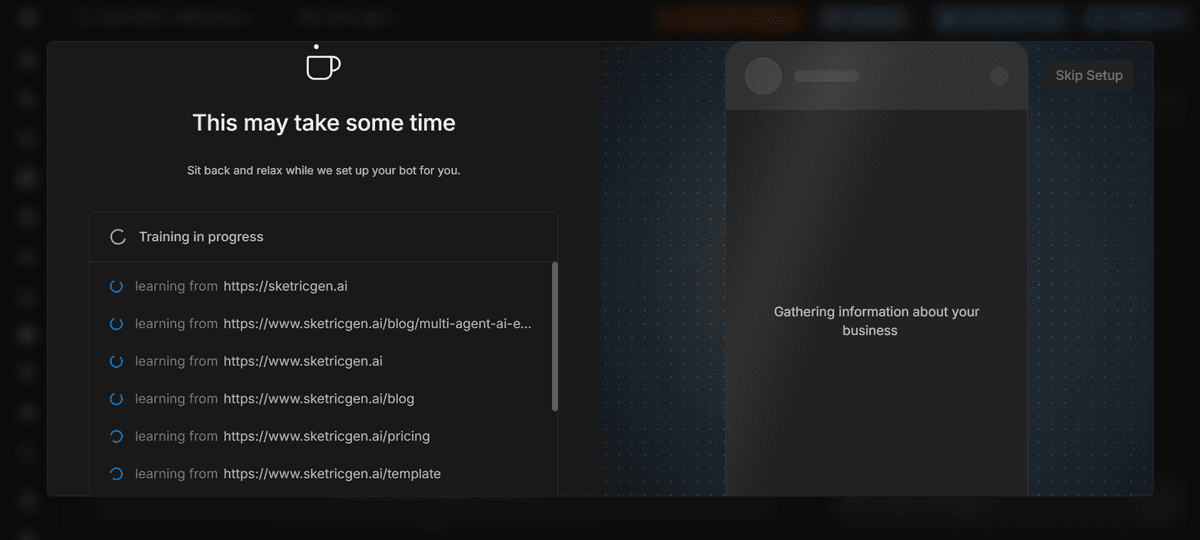
Botpress is the most technically capable option in this comparison. LLM-powered logic flows, custom code injection, advanced branching — Botpress handles conversation complexity that pure no-code tools cannot match. The free plan (500 messages/month + $5 AI credit) is enough to build a production-quality prototype, which is generous. Even teams with light volume can get meaningful value without spending money upfront.
Pricing: Free plan with 500 messages/month and $5 monthly AI credit. Plus at $79/month (5,000 messages, 2 bots). Team at $445/month (50,000 messages). AI spend is charged at provider cost with no markup — an honest model for AI-heavy builds.
Weaknesses: No-code score is 2/5 for a reason. Configuring anything beyond basic flows requires either developer time or a steep self-learning investment. The documentation assumes technical familiarity. Without engineering resources available, this is not the right choice regardless of capability.
Best for: Technical teams building complex, custom conversation logic who want full control over the AI and integration layer.
4. Intercom Fin — Best for Enterprise CX (29/40)

Intercom has the most mature customer experience platform in this comparison—and it shows. Analytics dashboards, SLA enforcement, routing logic, and integration depth (especially with helpdesk/CRM/email ecosystems) are unmatched. If your support team is large and your documentation is strong, Fin consistently achieves 70%+ containment rates on well-documented query types. The platform scales predictably for high-volume operations.
Strengths over competitors: Intercom's escalation and human handoff workflows are industry-leading. When AI cannot resolve a query, the system routes to the right team (by skill, availability, language), with full conversation context intact. This is far superior to competitors' simpler escalation. Integration depth with Salesforce, HubSpot, Zendesk, and email is deeper than SketricGen's MCP approach. For CX teams already in Intercom, adding Fin feels natural. Botpress also supports complex workflows, but requires developer involvement.
The pricing model catch: Per-resolution billing ($0.99 per resolved conversation) means your bill scales with support volume. A 25% traffic spike can be a 25% cost spike. For teams with stable, predictable support volume and strong documentation, this model can work. For others, it creates unpredictable spend. You still pay per attempt, even if a human agent steps in and completes the conversation.
Best for: Enterprise SaaS or large CX operations with high ticket volume, strong existing documentation, and a dedicated support ops function managing quality.
5. ChatBot.com — Best for Simple, Quick Setups (25/40)

ChatBot.com (now part of the Text platform) offers a visual drag-and-drop builder with flat monthly pricing. Setting up basic FAQ flows and lead capture is quick. Predictable billing is easy to budget against.
Weaknesses: Integration ecosystem is narrower than SketricGen or Intercom. Custom data training is available but less sophisticated. Multi-channel support is primarily website-focused. Works well for simple, stable use cases. Less suited for teams that need the chatbot to connect to a CRM or qualify leads dynamically.
Best for: Small teams needing basic chatbot functionality, flat-rate billing, and minimal setup complexity.
6. Chatbase — Best for Knowledge Base Bots (26/40)

Chatbase trains on uploaded PDFs, documents, and URLs. For static knowledge base queries — product docs, policy pages, support FAQs — the accuracy is strong and setup is fast. The freemium entry reduces the commitment to test.
Weaknesses: Not built for multi-step workflows or deep integrations. Multi-channel deployment is minimal. If your use case is accurately answering questions from your documentation, Chatbase does it well. For lead qualification, CRM hand-off, or cross-channel deployment, it is the wrong tool.
Best for: Businesses with strong existing documentation who want accurate, focused FAQ automation with low setup overhead.
7. Tawk.to — Best Free Option (22/40)

Tawk.to is free live chat software with basic automation. No AI training. No custom data learning. Single channel (website only). Any automation requires manually built flows. For an early-stage team that needs a chat presence before budgeting for AI, it covers the baseline.
Best for: Pre-revenue or bootstrapped teams that need a website chat widget with zero ongoing cost.
What Practitioners Are Saying
What practitioners are saying: On Reddit's r/AiForSmallBusiness (May 2026), the chatbot comparison thread is not a discovery conversation — it is a course-correction one. Most commenters have already tried a tool and are looking for something better. On r/automation, agencies building chatbots for client websites report that reliability and consistency matter more than features. A bot that handles 80% of queries predictably beats a technically impressive bot that fails in unexpected ways. The Shopify community echoes this: merchants want to know if the ROI is real before committing, not after. (r/AiForSmallBusiness | r/automation | Shopify Community)Author note — Sam: The per-resolution pricing model is the single biggest trap in this category for SMBs. It is framed as fair — you only pay when it works. But "works" is defined by the vendor, not you. A visitor who gets a wrong answer and gives up can still count as resolved. A conversation that a human agent completes may still generate a charge. The pricing model that actually aligns vendor incentives with buyer outcomes is flat monthly or credit-based — where the vendor benefits from you getting value from what you already paid for, not from each individual conversation closing. That is why pricing model is criterion two in this rubric, not an afterthought on the features checklist.
Which Tool Fits Your Situation
| Your situation | Best pick | Real tradeoff |
|---|---|---|
| Multi-channel SMB (web + WhatsApp + Instagram) | SketricGen | One agent deploys everywhere; fastest multi-channel path. Tradeoff: smaller team, fewer enterprise features. |
| Shopify or WooCommerce store | Tidio | Native ecommerce integrations, 70% AI resolution on product queries, live chat included. Tradeoff: conversation limits can feel tight during promotions. |
| Developer building complex workflows | Botpress | Full control, LLM-powered logic, free plan viable for meaningful work. Tradeoff: non-developers can't iterate without dev help. |
| Large support team with mature docs | Intercom Fin | Industry-leading escalation, SLA enforcement, deep CRM/helpdesk integrations. Tradeoff: per-resolution pricing creates variable costs. |
| Bootstrapped team, zero budget | Tawk.to | Free website live chat, zero ongoing cost. Tradeoff: no meaningful AI, manual flows only. |
| Strong documentation, simple Q&A | Chatbase | Accurate knowledge base bot, minimal setup, freemium. Tradeoff: can't do multi-step workflows or cross-channel. |
| Simple FAQ flows, predictable billing | ChatBot.com | Flat monthly pricing, visual builder, easy setup. Tradeoff: narrow integrations, basic customization. |
Next Steps
The fastest path is to test your top pick with real traffic before committing to a paid tier.
For the top-ranked tool in this comparison:
- Start with SketricGen Brand Agents — live in 2 minutes
- Read how Brand Agents is built and deployed
- View pricing plans
- Browse pre-built agent templates to start faster
FAQs
Tawk.to is the strongest free live chat option. For free AI capabilities, Botpress has a free plan covering 500 incoming messages per month with a $5 AI credit. Chatbase also offers a free tier with limited conversations. None of these free plans are suitable for production use at meaningful volume — they are best for testing or pre-revenue teams.
For most SMBs, no. The $0.99 per-resolution model makes costs unpredictable. A product launch or email campaign can spike your bill significantly, as documented above. Intercom makes financial sense for enterprise teams with high ticket volume, well-maintained documentation, and budget headroom to absorb variable costs.
Tidio is the most purpose-built for ecommerce — native Shopify and WooCommerce integrations, a chatbot that handles returns, FAQs, and cart questions well, and pricing starting at $24.17/month. SketricGen is a strong alternative if you also need the same agent deployed on WhatsApp and Instagram from one configuration, which matters for brands running social commerce alongside their website.
Yes. SketricGen, Tidio, ChatBot.com, and Chatbase all support no-code setup. SketricGen goes furthest on automation — paste your website URL, and the agent trains on your site content automatically. The embed is a single snippet. See how Brand Agents works.
Containment rate is the percentage of conversations the AI handles fully without human intervention. Industry benchmarks for well-implemented customer-facing chatbots range from 50% to 80%. Below 40% usually means the training data is insufficient for the query types you receive. Start by identifying the top 10 questions your visitors ask, and make sure your chatbot can answer every one accurately before expanding scope.
Per-resolution pricing charges you each time the AI marks a conversation closed. The risk is that "resolved" is vendor-defined, not outcome-defined. A visitor who gets a wrong answer and leaves can still count. A conversation a human agent completes may generate a charge. This creates a variable cost that scales with traffic volume rather than your budget. For SMBs, flat monthly or credit-based pricing gives better control.
If your primary channel is Shopify or WooCommerce and you want a combined live chat and AI tool with strong native ecommerce features, Tidio is the easier starting point. If you need one agent deployed across website, WhatsApp, and Instagram; want 2000+ app integrations; or need the agent to do more than answer questions — qualify leads, route to teams, update a CRM — SketricGen is the stronger fit. Both are no-code. Neither charges per-resolution.
Related blogs
View more
7 SEO Automation Tools Compared (And the Reports They Actually Produce)
comparisons
9 Best AI Marketing Agents, Tested (2026)
comparisons
Agentic Marketing vs. Marketing Automation: Decision Framework
comparisons
AI Executive Assistant vs. AI Chief of Staff: The Difference That Actually Matters
comparisons
AI Email Assistant: Why Drafting Isn't the Problem (and What Actually Fixes Inbox Overload)
comparisons