Microsoft and AWS Just Spent $3.5B Proving Software Doesn't Deploy Itself
On July 2, 2026, Microsoft announced it was spending $2.5 billion and embedding roughly 6,000 engineers and specialists directly inside client companies. Two days earlier, AWS committed $1 billion to the same idea.
Neither company is selling a new model. Neither is selling new software. Both are selling human beings whose job is to physically deploy AI inside your operations until it works.
That is not a product launch. It's an admission. Microsoft and AWS just told the market, in the clearest way two trillion-dollar companies can, that buying AI software and successfully deploying AI are two different problems, and most of the industry has only ever solved the first one.
Key Points
- Microsoft launched "Microsoft Frontier Company" on July 2, 2026: a $2.5B investment embedding roughly 6,000 engineers and specialists inside client companies to deploy AI, not sell more software
- Two days earlier, AWS launched its own $1B forward-deployed engineering (FDE) unit; OpenAI and Anthropic launched comparable units in May 2026
- The driver, cited across coverage of the launch: an MIT Project NANDA study found 95% of enterprise generative AI pilots produce no measurable P&L impact
- Purchased AI solutions from vendors succeed roughly 67% of the time. Internal builds succeed about a third as often
- SMBs can't hire a Frontier Company pod, but platforms like SketricGen already package that same buy-an-outcome model at SMB scale, no enterprise budget required
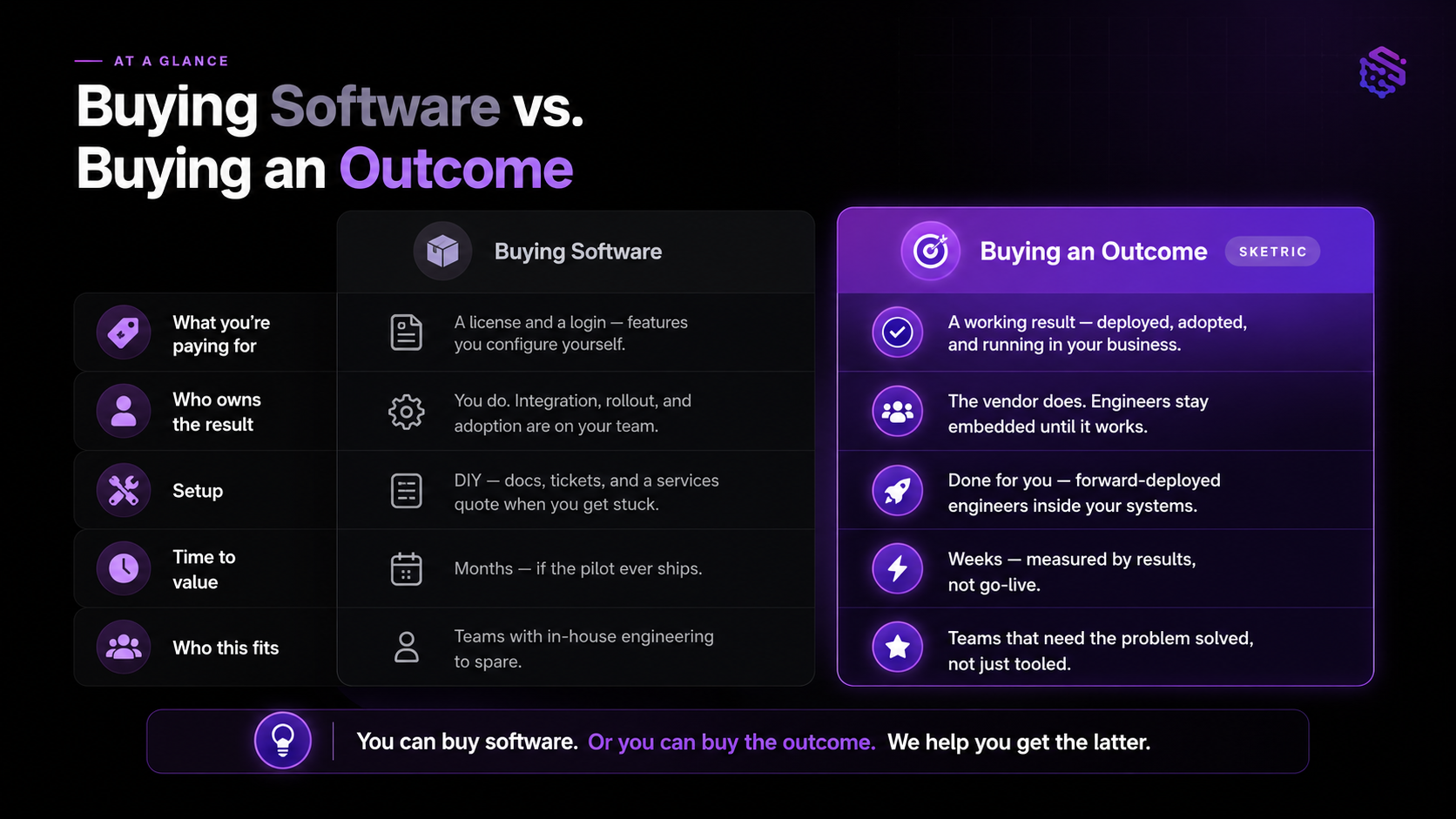
| Question | Buying Software | Buying an Outcome |
|---|---|---|
| What you're paying for | Access to a tool | A working result in your actual workflow |
| Who owns the result | You do | The vendor/partner does |
| Setup | Your team configures it | Partner handles deployment |
| Time to value | Depends on your team's bandwidth | Defined upfront, tracked to completion |
| Who this fits | Teams with in-house technical capacity | Most SMBs and mixed-stack teams |
Two Announcements, 48 Hours Apart, Same Bet
Microsoft Frontier Company is a $2.5 billion investment in roughly 6,000 industry and engineering experts who embed inside client organizations. Judson Althoff, CEO of Microsoft's commercial business, described the mission directly: the unit exists to "co-design, co-innovate, deploy and continuously improve AI systems at scale based on measurable business outcomes." Rodrigo Kede Lima, who has spent six years leading enterprise transformation work across the Americas and Asia for Microsoft, is president of the new unit.
Althoff went out of his way to distance Frontier Company from the "forward-deployed engineering" label everyone else is using, calling it "the largest, most capable, outcome-driven engineering organization in the industry." The unit is model-agnostic: customers can run OpenAI, Anthropic, Microsoft, or open-source systems, and Microsoft says client data and IP stay out of any model training pipeline. Early engagements include LSEG, Land O'Lakes, Unilever, and Novo Nordisk, with Accenture, Capgemini, EY, KPMG, and PwC brought in as delivery partners. See Microsoft's announcement covered by CNBC and GeekWire's breakdown of the launch.
AWS moved first. On June 30, 2026, it committed $1 billion to its own forward-deployed engineering unit, led by Francessca Vasquez, AWS's VP of Frontier AI Engineering and Services. The model: pods of five or six engineers embed with a client for roughly 45-day cycles, priced on fixed outcomes rather than billable hours. Vasquez was blunt about why: "the currency that the customers are always talking about right now is speed." Early customers include the Allen Institute, Cox Automotive, the NBA, the NFL, Ricoh, and Southwest Airlines. Full detail in CNBC's coverage of the AWS launch and CIO Dive's reporting on the new unit.
This isn't a two-company story. OpenAI and Anthropic each launched comparable forward-deployed units in May 2026, backed by outside capital (Anthropic's roughly $1.5B consortium includes Goldman Sachs, Blackstone, and Hellman & Friedman). Four of the largest AI vendors on earth converged on the identical operating model inside about ten weeks. The forward-deployed engineer concept itself isn't new. Palantir built its entire company around it more than a decade ago. What's new is who's copying it, and how much money they're putting behind the copy.
Why This Is Happening Now: The 95% Problem
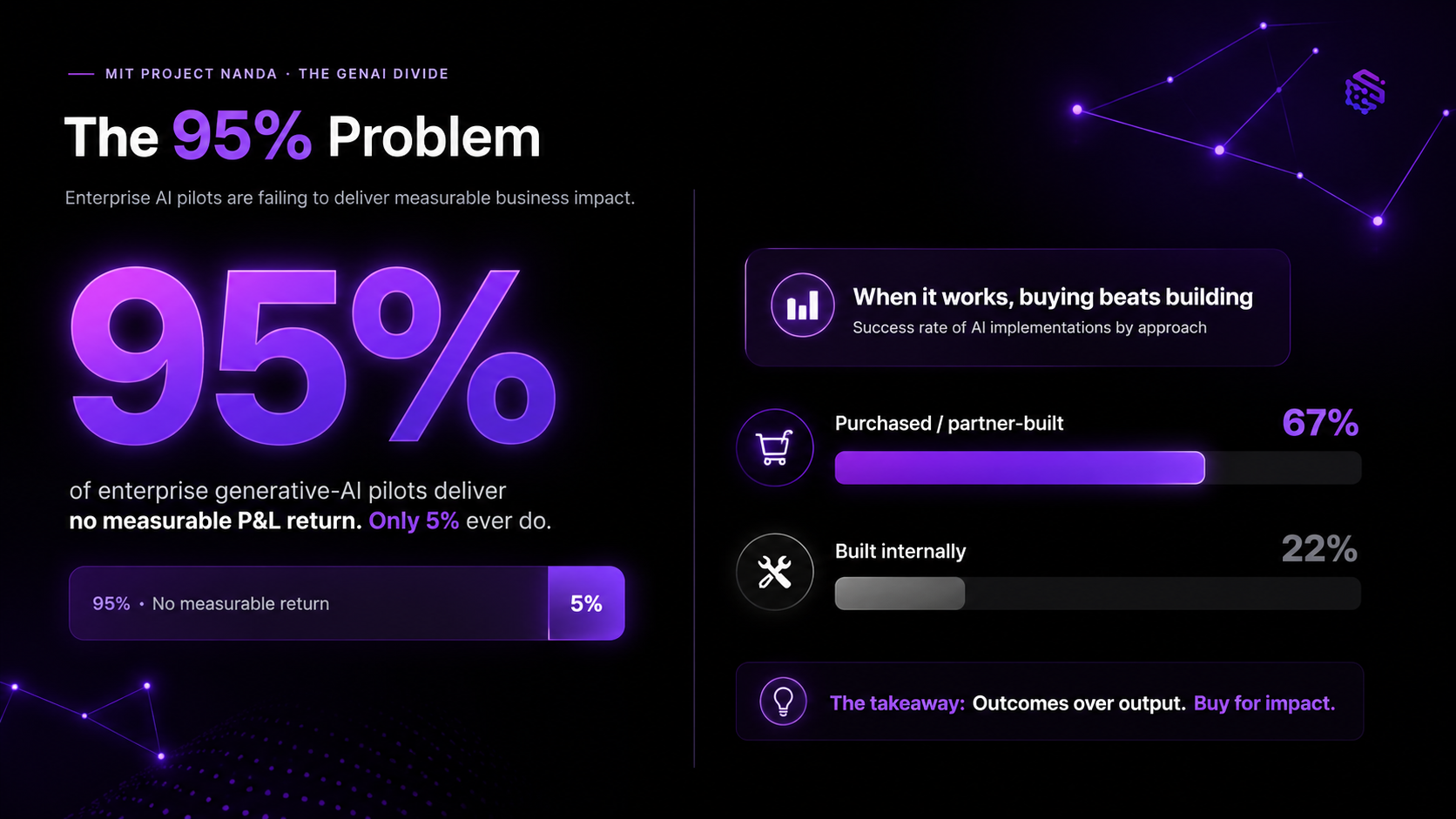
The number behind all four of these launches is one you've probably already seen. An MIT Project NANDA study, "The GenAI Divide: State of AI in Business 2025," found that despite $30 to $40 billion in enterprise generative AI spending, 95% of organizations saw no measurable return on their investment. Only about 5% of pilots produced real, trackable P&L impact. Coverage of Microsoft's launch has directly tied Frontier Company to this exact statistic, treating it as the reason the company decided software alone wasn't going to close the gap. See TechTimes' reporting connecting the launch to the pilot-failure data and the original MIT findings as reported by Fortune.
One detail in that research matters more than the headline stat: how a company adopts AI changes its odds dramatically. Purchased AI solutions from vendors and platforms succeeded roughly 67% of the time. Internal builds succeeded at about a third of that rate. Buying an implementation, not attempting to build one from scratch, is already the more reliable path, and it was true before Microsoft or AWS spent a dollar on it. More on the friction-avoidance pattern behind failed pilots is in Forbes' coverage of the MIT findings.
Reddit's own AI communities have been describing this exact pattern in real time, independent of any Microsoft or MIT framing. One founder building AI-driven logistics automation described watching a pilot "look promising" before it "collapsed" once pushed into real-world complexity. Another practitioner surveying enterprise teams put the failure rate at 70 to 95%, and traced it not to model capability but to gaps in readiness, governance, and realistic ROI modeling.
A builder who has run AI implementations for more than 20 small businesses summed up the actual blocker plainly: the business wants AI, the business isn't ready for AI, and the reason is never the technology. It's the data. Customer records scattered across five or six disconnected tools, thousands of dead contacts, and processes that live only in someone's head are the real reason pilots stall, long before the model gets a chance to fail on its own.
Software vs. Implementation: The Real Decision Most Buyers Get Wrong
Most SMBs evaluating AI right now are asking the wrong question. "Which AI tool should I buy" assumes the tool is the hard part. It usually isn't. The hard part is what happens after you buy it: connecting it to your actual data, your actual workflow, and your actual team, and getting it to a working result without abandoning the project three weeks in.
Buying software means you get access to a tool and you own everything that happens after checkout. Buying an outcome means someone else is accountable for that tool actually working inside your business, on a defined timeline, against a defined result. Microsoft and AWS just built billion-dollar internal organizations around the second definition. Most AI vendors selling to SMBs are still only offering the first.
A nonprofit employee described exactly what "software, not implementation" looks like from the buyer's side: they hired a consultant who ran all of their data through a generic AI tool and sent back the results without even proofreading the output. That's not an isolated complaint. It's what buying software dressed up as a service looks like, and it's worth watching for regardless of vendor size.
For more on where AI agent deployments specifically go wrong at the enterprise level, see our breakdown of why 89% of enterprise AI agents never ship, and what happens when AI gets deployed without clear ownership, covered in the BCG study on AI agents backfiring when misdeployed.
What to Ask Any AI Vendor Before You Buy
Four questions separate a software sale from an implementation partner, regardless of company size:
- Who is accountable if this doesn't produce a result in my actual workflow? If the answer is "you, once we hand it off," that's a software sale.
- What does "done" look like, and who defines it? A real implementation partner defines a measurable outcome before work starts, not after.
- How long until I see a working result, not a demo? AWS's own FDE model runs on 45-day cycles for a reason. If a vendor can't give you a number, they haven't done this before.
- Does this work across my actual tools, or just inside one ecosystem? An agent that only sees one vendor's data isn't an implementation. It's a locked-in add-on.
For a deeper look at what a real automation build looks like end to end, see our playbook on AI agents for lead generation and why more businesses are moving to AI workflow platforms instead of point tools.
What This Means If You're Not a $2.5B Enterprise
You are not getting a Frontier Company pod. You don't need one. The point of this news isn't that Microsoft and AWS built something SMBs should envy. It's that two of the largest software companies on earth just spent billions confirming what SMBs already suspected from their own failed pilots: software alone doesn't deploy itself, and paying for implementation is now the default assumption at every tier of this market, not a premium enterprise add-on.
SketricGen is built on that same premise, at SMB scale. Implementation-first, stack-agnostic, and priced for teams that don't have a six-person internal AI pod on staff. The agent template library shows automation workflows already built and ready to deploy, and our guide on building an AI sales assistant for lead qualification walks through one of the highest-value quick wins available right now.
View pricing if you're comparing options.
Author Take - Sam
This isn't really Microsoft or AWS news. It's a market-structure signal. When the two biggest software vendors on earth both conclude that the fix for their own product's failure rate is to hire thousands of humans to sit inside client companies, that tells you the "just ship better software" era of enterprise AI is over.
The MIT stat behind this, 67% success for purchased implementations versus roughly a third of that for internal builds, was true before either company spent a dollar. It's the same math that applies to a 12-person SMB deciding between building an internal automation from scratch and buying one that's already built to deploy.
The businesses that treat this as enterprise-only news will keep buying tools and living with the same 95% odds everyone else is getting. The ones that start asking every vendor who owns the outcome, today, regardless of company size, are the ones who won't be a statistic in next year's version of this same report.
What to Build Next
Microsoft and AWS just proved the deployment layer, not the model, is where AI actually gets won or lost. You don't need a $2.5 billion budget to act on that. SketricGen lets you build implementation-first automation across your actual tech stack: lead qualification, customer support, scheduling, and more, without an enterprise procurement cycle.
Explore agent workflow templates to see what's already built, or view pricing to compare options for your team.
The businesses winning this next phase won't be the ones with the biggest AI budget. They'll be the ones who demanded an outcome instead of settling for software.
FAQs
Microsoft Frontier Company is a $2.5 billion internal unit Microsoft launched on July 2, 2026, embedding roughly 6,000 engineers and industry specialists directly inside client organizations. Its job is to deploy and continuously improve AI systems against measurable business outcomes, not to sell additional software licenses. It's led by Rodrigo Kede Lima and works across AI models from OpenAI, Anthropic, Microsoft, and open-source providers rather than locking clients into one ecosystem.
A forward-deployed engineer (FDE) is a technical specialist embedded directly inside a client's business to build and deploy AI systems in that company's actual environment, rather than working remotely on a generic product. The model originated at Palantir over a decade ago. Microsoft, AWS, OpenAI, and Anthropic have all launched FDE-style units in 2026 because research shows most enterprise AI pilots never reach production without this kind of hands-on deployment support.
AI software is the tool itself: the model, chatbot, or platform a business licenses. AI implementation is the work of getting that tool to actually function inside a specific company's data, workflows, and team, and stay working. A business can own great AI software and still get zero value from it if nobody owns the implementation. Microsoft Frontier Company and AWS's FDE unit both exist specifically to sell implementation, not software.
An MIT Project NANDA study found that 95% of enterprise generative AI pilots failed to produce measurable P&L impact, largely due to messy or disconnected data, undocumented processes, and unclear ownership of the outcome, not model quality. The same research found that purchased AI implementations succeeded roughly 67% of the time, compared to about a third of that rate for internally built projects.
Look for an implementation-focused AI platform or partner rather than a standalone software tool. The right partner should define a measurable outcome before work starts, connect to your actual tools instead of requiring you to switch ecosystems, and get you to a working result in weeks, not months. SketricGen is built specifically for teams without in-house AI engineering capacity.
It depends entirely on what you're actually buying. A consultant who runs your data through a generic AI tool and hands back the output isn't providing implementation, they're reselling software with a service fee attached. A consultant or platform worth paying for takes ownership of a measurable outcome, works inside your existing tools, and can tell you upfront how long it will take to see a working result.
Related blogs
View more
The Claude "CEO" Experiment: What Project Vend Actually Proves About AI Agents
ai agent news
Cisco Gave 90,000 Employees an AI Agent - the Same Month It Cut 4,000 Jobs
ai agent news
Microsoft Scout: The AI Agent That Just Changed the Rules
ai agent news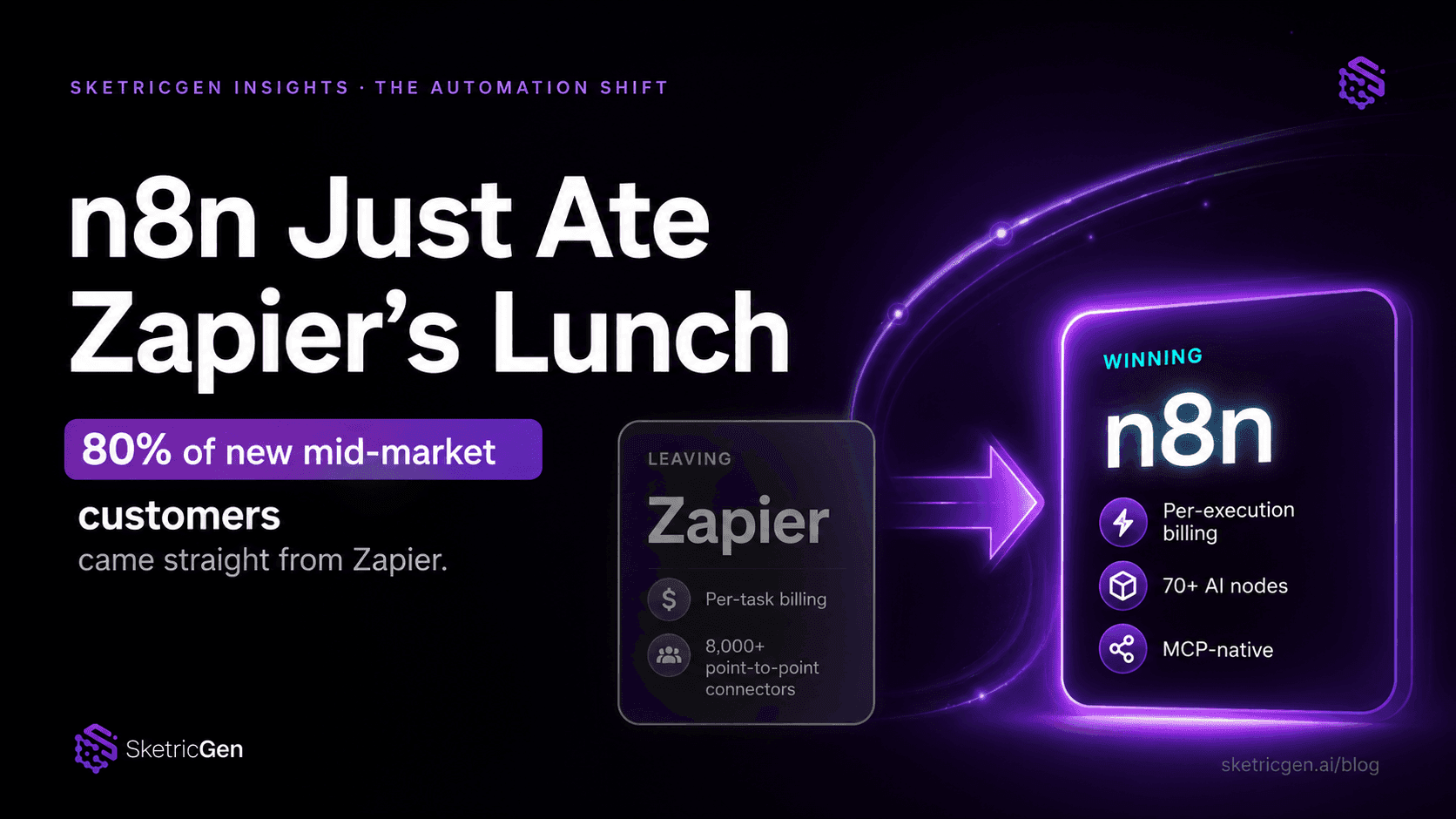
n8n Just Ate Zapier's Lunch: 80% of Its New Mid-Market Customers Were Already Paying for Zapier
ai agent news