$800K for AI Agents That Never Shipped. Here's the Problem Nobody's Talking About.
The Stanford AI Index 2026 buried a stat that deserved its own press conference: 89% of enterprise AI agent deployments never reach production.
The average implementation spend sits between $150,000 and $800,000 per project. Thousands of companies wrote six-figure checks, built internal demos that impressed the board, and shipped precisely nothing. One researcher described the pattern as "AI science fair projects for enterprise budgets."
The same report showed AI agents hitting 66% task success on real computer work, up from 12% the year before. The models improved dramatically. The deployment record didn't.
This post explains why — and what SMBs can take from it.
Who this is for
Founders and operators evaluating AI agents who want the unfiltered picture, not the demo. If you've seen the 89% stat and want to understand what's actually behind it, this is the right place.
Key Takeaways
- 89% of enterprise AI agent deployments never reach production (OneReach AI research, cited in Stanford AI Index 2026 context)
- Average year-one implementation cost: $150,000 to $800,000 per project
- Average cost of a failed project: $340,000 in direct engineering spend
- There is a 37% gap between AI agent benchmark performance and real-world production performance
- The failure is mostly organizational — workflow design, governance, scope — not technical
- SMBs have a structural advantage: lean teams, no legacy complexity, and the ability to start with one workflow
- SketricGen is built around this deployment model — no-code workflow builder, pre-documented templates, and an AI orchestrator that builds your first agent from a plain-English description
The Stat That Deserves Its Own Press Conference
89% of enterprise AI agent deployments never reach production.
That number comes from OneReach AI research, cited in 2026 enterprise implementation studies alongside the Stanford AI Index data. It sits alongside average implementation costs of $150,000 to $800,000 for a single deployment — covering development, infrastructure, and integration. Annual operating costs add another $50,000 to $200,000 on top.
When a project fails, the average direct engineering spend lost is $340,000 per failed project.
None of this is especially visible in the public conversation about AI agents, which tends to focus on benchmark performance and model releases. But it's what the enterprise deployment data actually shows: the hype is real, the shipping rate is not.
| Metric | Data |
|---|---|
| Enterprise AI agents reaching production | ~11% |
| Average year-one implementation cost | $150K–$800K |
| Average cost of a failed project | ~$340K |
| Lab-to-production performance gap | 37% |
| Organizations deploying with security/IT approval | 14.4% |
The table is not a case against building AI agents. It's a case against how most enterprises are building them.
The Benchmark Gap: Lab Scores vs. Real Work
There is a 37% gap between how AI agents perform on benchmarks and how they perform in actual production environments.
Stanford's AI Index 2026 put agent task success at 66.3% on OSWorld — a benchmark that tests agents on real computer work: file navigation, application use, multi-step workflows. That's a meaningful result. It's also not what your production environment looks like.
Benchmarks run in controlled conditions: clean inputs, predictable interfaces, defined tasks with measurable outcomes. Production runs in the opposite — legacy software with inconsistent APIs, users who don't follow the expected path, edge cases nobody documented, and real consequences when the agent gets it wrong.
AWS research on multi-agent systems found a 37% gap between lab benchmark performance and real-world production performance, meaning an agent that scores well in testing can fall apart under actual business conditions. MIT Technology Review published a March 2026 analysis calling the broader benchmark problem systemic — evaluation environments are increasingly divorced from what production deployment requires.
The "jagged frontier" problem compounds this. The same agents that hit 66% on computer task benchmarks read analog clocks correctly only 50.1% of the time. High performance on one class of task doesn't automatically transfer to adjacent tasks in the same workflow.
Pro tip: When evaluating AI agent platforms, ask for production case studies, not benchmark scores. The useful question is not "what did this agent score in testing?" — it's "what specific workflow is this agent running in production right now, for how long, and what's the error rate?" If a vendor can't answer that, the benchmark number doesn't tell you much.The benchmark gap is not a reason to avoid AI agents. It's a reason to design for production from day one rather than optimizing for a demo.
Four Reasons Enterprise AI Agents Fail in Production

Most enterprise AI agent failures are not caused by the model being wrong. They're caused by the deployment being poorly designed. Research across 2026 enterprise implementation post-mortems points to four consistent failure modes.
1. Open-ended prompting instead of defined workflows
The most common pattern: a company gives an agent broad access to systems and tells it to "handle customer inquiries" or "manage the pipeline." Without a defined workflow — specific inputs, expected outputs, explicit decision rules — the agent behaves unpredictably. It improvises where it should follow a process.
Agents that perform well in production have a specific job. Not "handle support" but "answer questions about order status, escalate anything involving a refund to a human." The narrower the brief, the more reliable the output.
2. Integration gaps with legacy systems
Enterprise environments run on systems built over decades. An AI agent deployed on top of a CRM that pulls from three different data sources — one of which is a spreadsheet someone manually updates on Fridays — will fail in ways that are hard to predict and expensive to diagnose. Agents that reach production have clean, reliable data piping. Most enterprise environments don't, and fixing that is a significant project before the agent can function.
3. No governance, audit trail, or escalation path
Only 14.4% of organizations deploy AI agents with full security or IT approval. That means most agents go live without defined oversight structures. When something goes wrong — an agent sends the wrong response, takes an incorrect action, or hits a case it wasn't designed for — there's no clear escalation path and often no audit trail to diagnose the failure. This is fixable, but it requires designing for it before deployment, not after the first incident.
4. Scope creep and over-ambitious rollouts
Narrow-scope projects — single workflow, defined use case — deliver on time 65% of the time. Broad-scope projects — multiple workflows, company-wide automation — deliver on time just 16% of the time, with a median schedule slip of 9.6 months.
The pattern in failed enterprise deployments is consistent: the project started as "automate our customer support queue" and expanded into "and also do lead qualification, onboarding, and internal helpdesk." By the time scope is finalized, the deployment is six months behind, the budget is exhausted, and the demo that looked great in the boardroom has never seen a real customer.
Mistake I see consistently: The most expensive AI agent mistake is trying to prove the technology at maximum scale in the first project. The organizations that ship fastest start with one workflow that has a clear success metric, get it to production, measure what changes, and then expand. A running workflow that reduces ticket volume by 30% is a better target than a demo that impresses the board.
The Organizational Problem
The technology is not the bottleneck.
AI agents that achieve 66% task success on benchmarks are legitimately capable. The models are good. The tooling has improved. What isn't improving at the same rate is organizational readiness to deploy.
The average cost of a failed project — $340,000 in direct engineering spend — is almost entirely organizational waste. Money spent on building something the organization wasn't structured to run, on workflows that weren't documented before the agent was designed, on integrations that failed because the underlying data wasn't clean.
Only 14.4% of organizations send agents to production with full security or IT approval. That means most are deploying without the governance structures that make agents auditable and recoverable when they fail.
What practitioners are saying: Across 2026 post-mortems on failed enterprise AI agent projects, the consistent finding from engineers and operators who worked on them is this: the agent wasn't the problem. The workflow it was supposed to own wasn't designed for an agent to run. It had too many exceptions, too much dependency on informal knowledge, and too many edge cases that lived only in someone's head. One engineering lead put it plainly: "We built a great agent for a workflow that didn't actually exist in a clean enough form to automate." Agents that succeeded had their workflows redesigned around them before deployment — not the other way around.
The framing most enterprises use — "let's deploy an AI agent to handle X" — skips the prior question: "Is X a workflow that's actually deployable?" Getting to a deployable workflow requires documentation, data cleanup, and defined decision rules. That work is the hard part. The model is not.
What SMBs Get Right That Enterprises Get Wrong
SMBs have a structural advantage in AI agent deployment that most enterprise framing misses.
Enterprise AI agent projects fail because they're large. Large scope, large integration surface, many stakeholders, many legacy systems to connect. Every additional variable in a deployment is another place for it to break.
SMB deployments don't have those problems. A 20-person company deploying its first AI agent to handle inbound lead qualification has a defined workflow, a small data surface, and one person who can make decisions. That's not a limitation — it's exactly the deployment profile that works.
The data supports this: narrow-scope, single-workflow deployments ship on time 65% of the time. That's the natural starting point for an SMB. Broad-scope, multi-workflow deployments ship on time just 16% of the time. That's the default mode for an enterprise trying to transform multiple departments simultaneously.
SMBs that have already shipped working agents aren't doing anything technically sophisticated. They're doing one thing well: picking a single high-volume, repeatable task, designing a clean workflow around it, and deploying an agent to own it. The agent handles the standard cases; humans handle the exceptions.
For the performance side of this picture — what the Stanford benchmark gains actually mean for business deployment decisions — see our coverage of AI agents hitting 66% task success.
Decision rule: If a task (1) happens more than 20 times a week, (2) follows a predictable pattern most of the time, and (3) has clear success criteria you can measure before deployment — it's deployable with an AI agent now. If any of those three conditions don't hold, fix the workflow first. The agent won't fix them for you.How to Deploy an AI Agent That Actually Ships
The practical difference between the 11% that ship and the 89% that don't is not technical sophistication. It's workflow discipline before deployment. Step 1: Pick one workflow, not one department
"Customer support" is a department. "Answer questions about order status and return a structured response with a tracking link" is a deployable workflow. Start with the second type. The deployable unit is always a specific workflow, never a function. Step 2: Document it before you build it
Write out every step: what triggers the workflow, what inputs it needs, what the output looks like, and what happens in the cases that don't fit the standard path. If you can't write it out clearly, the agent can't run it reliably. Documentation often surfaces the edge cases that would have caused the deployment to fail. Step 3: Give the agent a narrow job with a defined escalation path
The agent owns the standard cases. A human owns the exceptions. Define that boundary before deployment and make it explicit in the agent's configuration. Agents fail when they're expected to handle exceptions they weren't designed for. They succeed when they know exactly when to stop and hand off. Step 4: Measure outcomes, not capabilities
Set a baseline before deployment: how many hours per week does this task take, and what's the current error rate? Measure against it at 30 days. If the numbers move in the right direction, expand to the next workflow. If they don't, diagnose before expanding — not after building three more agents on top. SketricGen templates give you pre-built starting points designed around this framework — workflows already documented, with defined inputs and outputs, built by teams that have run them in production. You skip the documentation step that most first deployments skip and later regret.
Author's Take - Sam
The 89% failure rate is not a reason to avoid AI agents. It's a map of where other organizations went wrong.
Having worked through AI agent deployments with SMB teams across different industries, the pattern is remarkably consistent. The teams that ship fast share three things: a single workflow with a written spec before anything is built, a clear definition of what the agent hands off to a human, and a success metric they can check at 30 days. The teams that stall are trying to automate a department before they've automated a task. The failure modes are known, documented, and avoidable. Over-scoping is the most common. Skipping workflow documentation is the second. Deploying without governance is the third. None of these require technical sophistication to fix. They require discipline before deployment. What the Stanford AI Index 2026 tells us — taken as a whole, not just the performance headline — is this: the models are ready, the tooling is accessible, and the deployment gap is the real competitive variable. The companies building working agents now are not waiting for the technology to improve. They're executing on a straightforward playbook that most of their competitors have not started. The 89% figure also tells you the field is still early. Most of your competition has not shipped a working agent. The ones that tried at enterprise scale mostly failed. The window to build a compound advantage is still open. Ship one workflow. Measure it. Then ship the next one. If you want to start without a six-figure implementation budget, SketricGen lets you build a multi-agent workflow from a plain-English description — no code required. Start with a template to see what other operators are already running, or describe what you want automated and Max builds the workflow for you.
For the broader context on how AI agents are changing the jobs equation, see: Sam Altman and the AI Job Apocalypse — What the Data Actually Shows.
Sources and Further Reading
- Stanford AI Index 2026 Report
- THE D[AI]LY BRIEF: Stanford AI Index 2026 — 89% Never Reach Production
- Digital Applied: 88% of AI Agents Never Reach Production — Failure Framework
- Ampcome: Why Agentic AI Projects Fail
- MIT Technology Review: AI Benchmarks Are Broken
- Glivera: Agentic AI for Small Business — Why SMBs Have the Advantage in 2026
- The AI Consulting Network: Stanford AI Index 2026 — Production Gap Analysis
FAQs
The most common failure modes are organizational, not technical. They are: deploying against an undocumented workflow, giving the agent too broad a scope, missing clean integration with underlying data systems, and lacking any governance or escalation structure. Research from 2026 enterprise post-mortems consistently finds the agent itself is rarely the root cause of a failed deployment. The root cause is almost always a workflow that wasn't designed to be run by an agent in the first place.
Year-one costs run $150,000 to $800,000, covering development, infrastructure setup, and integration work. Annual operating costs after that run $50,000 to $200,000. The average direct spend on a project that fails before reaching production is approximately $340,000. These figures reflect enterprise-scale deployments connecting agents to existing ERP, CRM, and data systems. SMB deployments with narrower scope are substantially cheaper — and substantially more likely to ship.
Benchmarks test agents in controlled conditions: clean data, defined tasks, predictable interfaces. Production runs in the opposite conditions. AWS research on multi-agent systems found a 37% gap between benchmark performance and real-world production performance. An agent that scores 66% on a controlled computer-task benchmark will typically underperform that figure when deployed against actual business workflows with messier inputs and unexpected edge cases. Benchmark scores are useful for comparing models. They are not a reliable predictor of production performance on your specific workflows.
Yes, and often more easily than enterprises. The deployment profile that works — single workflow, clean data, narrow scope, defined escalation path — is the natural default for a small team. The failure modes that hit enterprises hardest (legacy system integration, multi-departmental scope creep, governance gaps across multiple stakeholders) are less common at SMB scale. Narrow-scope projects deliver on time 65% of the time. That's a reasonable baseline expectation for an SMB starting with one workflow.
Pick one workflow that happens at least 20 times a week, follows a predictable pattern, and has a measurable outcome. Document every step of that workflow — including what the edge cases are and who handles them. Deploy an agent to own the standard cases, with a clear handoff for exceptions. Measure results at 30 days before expanding. This is the playbook the 11% who ship are following.
Three conditions: (1) You have a workflow that happens frequently and follows a consistent pattern most of the time. (2) The data that workflow depends on is clean enough for an agent to read reliably. (3) You can define what "working" looks like before you build. If all three hold, you're ready. If your workflow is mostly exceptions, your data is inconsistent, or you can't define success in advance, fix those things first. The agent will not fix them for you.
Related blogs
View more
The Claude "CEO" Experiment: What Project Vend Actually Proves About AI Agents
ai agent news
Cisco Gave 90,000 Employees an AI Agent - the Same Month It Cut 4,000 Jobs
ai agent news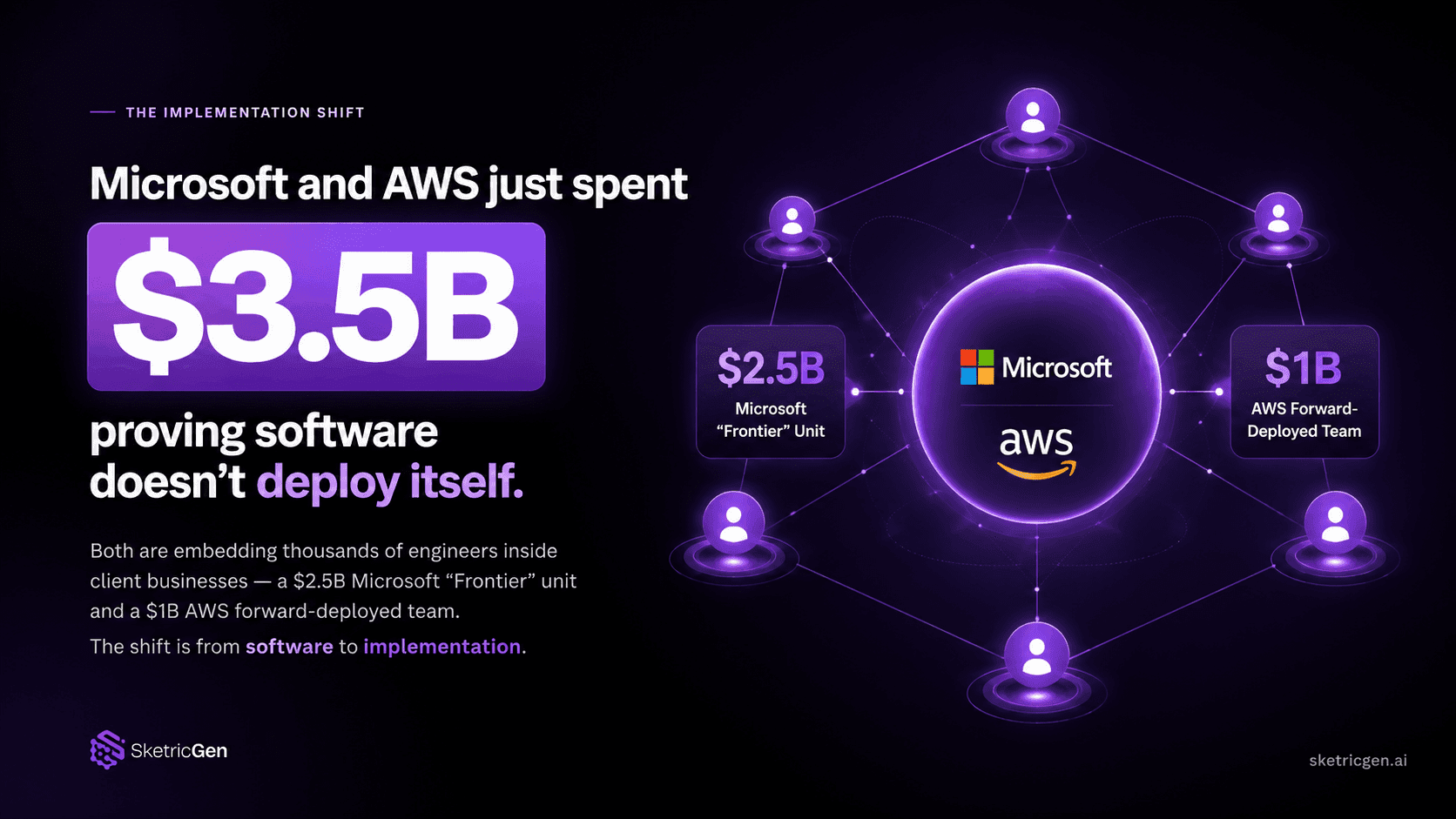
Microsoft and AWS Just Spent $3.5B Proving Software Doesn't Deploy Itself
ai agent news
Microsoft Scout: The AI Agent That Just Changed the Rules
ai agent news
n8n Just Ate Zapier's Lunch: 80% of Its New Mid-Market Customers Were Already Paying for Zapier
ai agent news