BCG Study: Companies Putting AI on Their Org Charts Are Getting Burned
More than 20% of companies are now listing AI agents on their official org charts. Some are giving them names. Some are assigning them reporting lines. A few are running performance reviews for software.
And according to a major new study from Boston Consulting Group, it's making their human employees measurably worse at their jobs.
Key Takeaways
- BCG surveyed 1,261 managers across the US, Canada, and EU. 23% of their companies already list AI agents on org charts
- Workers caught 18% fewer errors when output was labeled as coming from a named AI "employee" vs. a human
- Personal accountability dropped 9 percentage points; blame attributed to AI rose by 8 points
- Escalation requests spiked 44%. Humans started asking peers to double-check AI work, adding load across the org
- 91% of executives do not want to fully replace their teams with AI; the replacement narrative is running far ahead of reality
- The fix: deploy AI as a precision tool with a human in the accountability seat, not as a named coworker
What the BCG Study Actually Found

The BCG Henderson Institute ran a randomized experiment with 1,261 HR and finance managers across the US, Canada, and EU. Participants were split into three groups. Each reviewed the same workplace document, one containing deliberate errors. The only variable was how the document's author was framed:
- Group 1: Attributed to a human employee ("Alex")
- Group 2: Attributed to an unnamed AI tool
- Group 3: Attributed to a named AI "employee" ("ALEX-3")
The results were consistent across every measure. The AI employee group came last.
| Metric | AI Tool Group | AI Employee Group | Direction |
|---|---|---|---|
| Errors caught | Baseline | 18% fewer | Worse |
| Personal accountability | Baseline | -9 percentage points | Worse |
| Blame attributed to AI | Baseline | +8 percentage points | Worse |
| Escalation requests | Baseline | +44% | Worse |
| Trust in AI deployment | Baseline | -10% | Worse |
| Job replacement fear | Baseline | +7% | Worse |
The group that saw AI presented as a named employee caught fewer mistakes, felt less responsible for outcomes, showed lower trust in AI deployment overall, and reported more anxiety about job security, without any actual change in their AI adoption intent.
As Matthew Kropp, Managing Director at BCG, said directly:
"AI doesn't have responsibility. It isn't a person...Some human person has to be responsible for that process." Matthew Kropp, BCG Henderson Institute, HBR May 2026
Why This Happens
The mechanism matters here. It's not that employees are lazy. It's that the org chart is a signal system.
When output has a name and a reporting line, our brains apply the same social trust shortcuts we use for human colleagues. We expect accountability to travel with the name. We expect "Alex" to catch their own errors.
But AI can't be fired. It can't be promoted. It has no stake in the outcome. So when you put it on the org chart like a person, accountability doesn't stay with the AI. It diffuses. Nobody owns the result.
One study participant put it clearly: "If you want people to feel like they will lose their job to AI...then put it on the org chart." (HBR, May 2026)
Pro tip: The org chart is a signal. What you put on it tells your team what is responsible and what is not. An AI agent with a job title sends the message: "this thing owns outcomes." It doesn't. Your team will act accordingly.The Real Cost
The error-catching drop gets the headlines. But the downstream costs compound.
The 44% spike in escalation requests means AI output is creating more human review work, not less. Workers who distrust the output offload the review onto colleagues. The efficiency gain from automation disappears into team overhead.
Add in the 10% drop in trust in AI deployment overall, and you've also made future AI rollouts harder. Your team now associates AI with accountability fog, not capability.
There's also the output quality problem. HBR research from April 2026 found that employees forced to adopt AI report a 65% higher rate of producing and accepting low-quality AI output without pushback, compared to teams that adopted it by choice. The org-chart framing accelerates this. When employees believe AI is being used to eventually replace them, they disengage from quality review. Errors surface later, at higher cost.
Decision rule: If a mistake happened and nobody in your org knows whose fault it is. Your AI is deployed wrong. Accountability must live with a human. Always.What Winning Teams Do Instead
The best-performing teams in the BCG data weren't the ones with the most AI agents. They were the ones where a real human clearly owned the process and used AI to execute it faster.
Here's what that looks like in practice:
- AI handles the task. A human owns the outcome. The agent drafts, routes, processes, or responds. A person reviews, approves, and signs off.
- No naming AI after people. Names trigger social trust patterns that don't apply to software.
- Define checkpoints before deployment. Put in writing: what does the AI do, where does human review happen, who is accountable if something goes wrong.
- Measure accuracy and speed, not headcount replacement. The signal for a good AI deployment is quality plus throughput, not "how many hires did we avoid."
According to Goldman Sachs and US Chamber of Commerce research in 2026, 82% of small businesses using AI actually grew their workforce. The companies winning aren't replacing people; they're making their existing teams more capable.
The 3 Org-Chart Theater Mistakes SMBs Make
Most of the accountability failures BCG identified fall into three patterns. If any of these are familiar, you have a deployment design problem, not an AI problem.
Mistake 1: Giving AI a job title and assuming accountability follows
It doesn't. The moment you write "AI Customer Support Lead" in your org chart, your human team mentally offloads accountability to that title. When errors surface, nobody owns them.
Fix: Name your agents by function, not by role. "Support Queue Automation" is accurate. "Support Specialist ARIA" is a liability.
Mistake 2: No human review checkpoint in the workflow
AI agents can generate responses, summarize documents, and route tickets at scale. But without a human sign-off step for anything that touches a customer or a business decision, errors compound quietly over weeks before anyone notices.
Fix: Every AI-generated output that leaves your system needs a review gate. Even a 30-second spot-check is better than none.
Mistake 3: Using AI headcount replacement as a public internal metric
CIO Magazine's June 2026 survey found that only 9% of executives actually want to fully replace their teams with AI. But companies signaling to employees that AI headcount replacement is the goal trigger the exact disengagement and trust collapse the BCG study measured.
Fix: Frame AI deployment internally as capability expansion. Your team will work with the AI if they're not afraid of it. They'll work around it if they are.
What practitioners are saying: Eric Kingsley, an employment lawyer quoted in CIO Magazine (June 2026), said: "Employees use judgment, discretion, and create workplace culture, which AI is simply incapable of replicating." The leaders who understand this distinction are building teams that use AI well, not teams that fear it.Author's Take - Sam
We've built SketricGen around one operating principle: AI agents should make your team faster, not redundant.
In every workflow we've seen perform well, the pattern is the same. The agent handles the repeatable, high-volume, time-consuming work: routing queries, generating first drafts, processing data, handling FAQs at scale. The human sets the parameters, reviews exceptions, and owns the output.
The companies putting AI on org charts with names and performance reviews aren't operating at a higher level. They're confusing optics with operations. The BCG study confirmed what good operators already knew: accountability doesn't transfer to software. It has to live with a person.
If you're building AI agents for your team, start with one question: when something goes wrong, who is responsible? If the answer is immediate and it's a human, you're deploying correctly. If the answer is "well...the AI did it," you have a problem worth fixing before it costs you.
Next Steps
The BCG study is a warning for companies chasing AI optics. It's also a green light for the ones building it right.
If you want to build AI agents that make your team measurably more effective, without the accountability fog, SketricGen is built for exactly that use case. Our agents handle the repeatable work. Your team owns the outcomes. No job titles required.
Start with a pre-built workflow template and have a working agent running in under 10 minutes. Or read our breakdown of enterprise AI agent deployment failures in 2026 to see the most common patterns and how to avoid them.
For broader context on the AI workforce narrative, our take on Sam Altman's AI job predictions covers what the replacement hype gets right and what it misses entirely.
FAQs
When output is attributed to a named entity, people apply the same social trust they'd extend to a colleague. They assume the "employee" already reviewed their own work. The BCG study found this reduced error detection by 18% in the AI employee group versus the AI tool group. The name triggers misplaced trust. We offload scrutiny when we perceive shared accountability. But AI has no accountability to share.
Yes. BCG's May 2026 study found 23% of surveyed companies already list AI agents on official org charts, and 31% frame AI as a teammate or employee. One company cited in the study formally listed an HR agent named "Scout" on its org chart with a full reporting structure. This is not fringe behavior; it's becoming common practice, and the BCG data shows the costs clearly.
Augmentation means AI handles a specific, repeatable task while a human owns the overall outcome and quality gate. Replacement means AI takes over a role entirely with no human accountability checkpoint. HBR research from April 2026 found that augmentation-focused companies generate sustained competitive advantage, while automation-only approaches trigger predictable cycles of resistance, attrition, and talent erosion. The practical test: does a human still own the result?
It depends on how you frame and deploy it. The BCG study found that the AI employee framing alone caused a 7% spike in job replacement fear and a 10% drop in trust, without any actual job changes. The framing caused the damage, not the technology. Deploy AI as a tool that makes your team more capable and fear stays low. Use headcount replacement language or org-chart optics and fear rises, quality drops, and adoption stalls.
Three rules cover most deployments:
- Assign AI to tasks, not roles. "This agent handles tier-1 support responses" is clear. "This agent is our Support Associate" is not.
- Define the human review point before you go live. Know exactly who checks what, at what frequency, and who is accountable for errors.
- Measure AI by output quality and throughput, not by headcount avoided. If your team is doing better work faster, the deployment is working.
Keep humans accountable for anything that requires judgment, relationship management, or escalation. Specifically:
- Final approval on customer communications that involve disputes or complex cases
- Decisions carrying legal or financial risk
- Any interaction where the customer asks for a human
- Quality review of AI outputs, even at spot-check frequency
- Process design for the AI itself. The agent should work within rules a human set and can revise
AI handles the volume. Humans handle the judgment. That split is where the ROI actually lives.
Related blogs
View more
The Claude "CEO" Experiment: What Project Vend Actually Proves About AI Agents
ai agent news
Cisco Gave 90,000 Employees an AI Agent - the Same Month It Cut 4,000 Jobs
ai agent news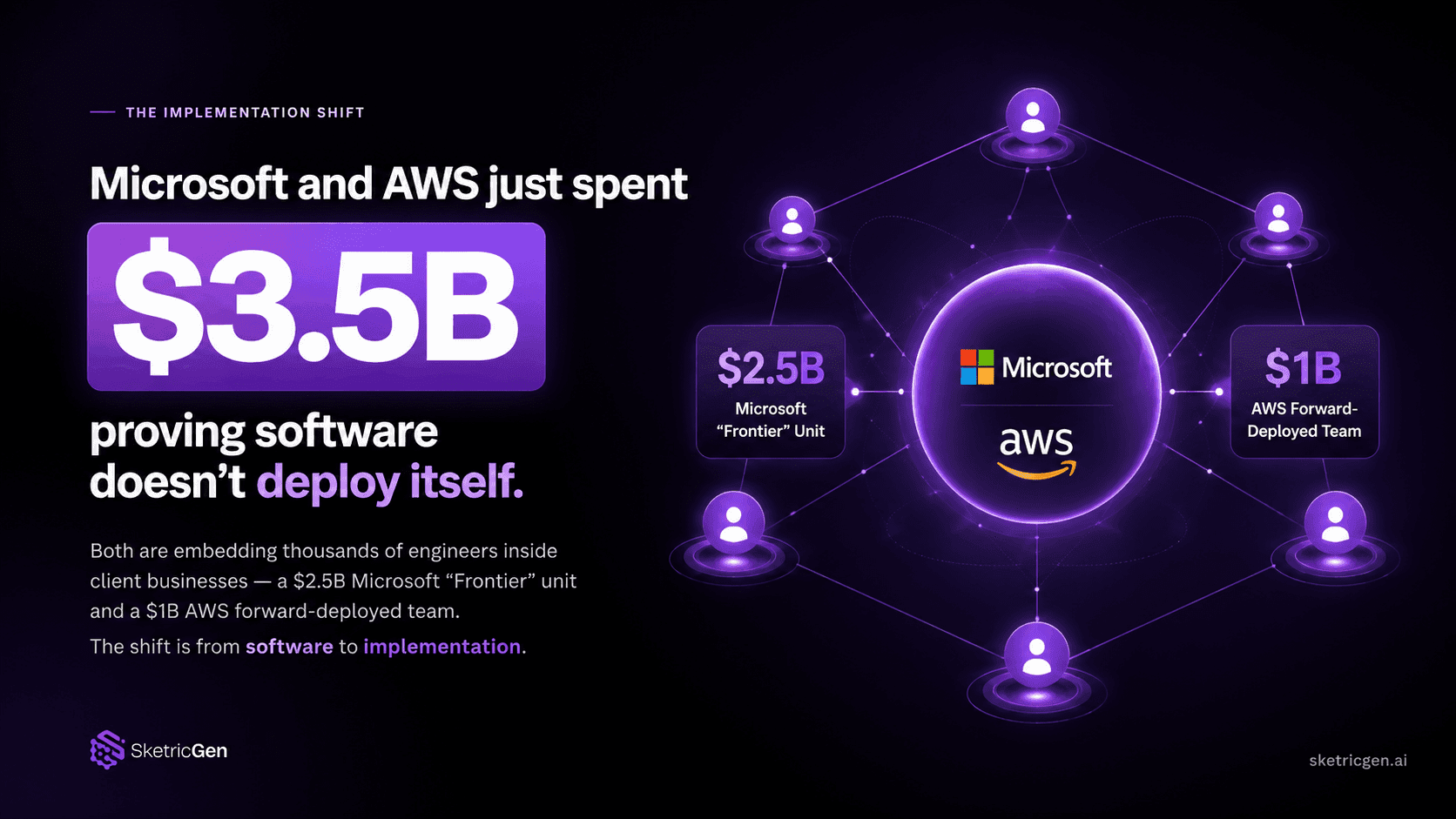
Microsoft and AWS Just Spent $3.5B Proving Software Doesn't Deploy Itself
ai agent news
Microsoft Scout: The AI Agent That Just Changed the Rules
ai agent news