AI Agents Hit 66% Task Success: What Stanford's 2026 Data Means for Your Business
Stanford's annual AI Index published in April 2026 with a number that circulated quickly: AI agent task success on real computer work jumped from 12% to 66.3% in a single year. The same benchmark that put agents at 12% twelve months ago now puts them within 6 percentage points of an average human's performance on the same tasks.
That's a real inflection point. It's also one that gets misread in both directions — as proof that AI agents will replace your whole team, or dismissed as a benchmark that doesn't translate to the real world. Neither reading is accurate. The actual picture has concrete implications for operators deciding whether to build or wait.
This post breaks down what the Stanford data actually says, where the caveats live, and what the numbers mean for a business not yet running agents in production.
Who this is for
Founders, operators, and business owners who want to understand what the Stanford benchmark results mean, not just what the headlines say. If you saw the stat on LinkedIn and are not sure whether to act on it or ignore it, this is the right place to start.
Key Takeaways
- AI agents jumped from 12% to 66.3% on the OSWorld benchmark in 12 months (Stanford AI Index 2026)
- The human baseline on that benchmark is approximately 72% — agents are within 6 percentage points
- On coding (SWE-bench Verified), AI performance went from 60% to near 100% of the human baseline in one year
- The honest caveat: agents still fail about 1 in 3 structured tasks, and 89% of enterprise deployments never reach production
- The actual edge right now: most businesses have not shipped a working agent — those building now are compounding an advantage their competitors have not started
If you're already convinced and want to start building, SketricGen lets you go from a plain-English description to a deployed multi-agent workflow — no code required. The rest of this post gives you the data to understand why now is the right time.
What is OSWorld, and why does it matter?
OSWorld is a benchmark that tests AI agents on tasks that resemble actual desk work. Not logic puzzles or trivia. Real software navigation: opening applications, managing files, running multi-step workflows across operating systems.
Most AI benchmark headlines cover PhD-level science questions or competition math. Those matter for model capability research, but they don't tell you much about whether an agent can handle the work that consumes hours in your business. OSWorld is different because the task set maps closely to what knowledge work actually looks like.
| Benchmark | What it tests | 2025 score | 2026 score | Human baseline |
|---|---|---|---|---|
| OSWorld | Real computer tasks: file ops, app navigation, multi-step workflows | ~12% | 66.3% | ~72% |
| SWE-bench Verified | Real GitHub issues: reading code, diagnosing bugs, shipping fixes | ~60% | ~95–100% | ~100% |
The OSWorld number is the more relevant data point for most operators. It's the closest proxy Stanford has to "can an agent handle the work that actually happens inside a company?" That answer went from mostly no to frequently yes in 12 months.
The SWE-bench number matters more for technical teams. An agent resolving real GitHub issues at near-human accuracy is a direct change to engineering productivity and the cost of building software.
The 12% to 66% jump: what changed in 12 months
The underlying models got substantially better at tool use, context retention, and multi-step reasoning. Agents went from struggling with basic navigation to completing two-thirds of structured computer tasks without intervention.
A year ago, an agent attempting 100 computer tasks completed about 12 correctly. Today, that same class of agent completes roughly 66. A human doing the same tasks completes about 72.
That 6-point gap is real but easy to misread. Some leading models have already crossed the human baseline. OpenAI's GPT-5.4 scored 75.0% on OSWorld-Verified, above the 72.4% human average. Claude Sonnet 4.6 scored 72.5%. The Stanford AI Index 2026's 66.3% reflects the field broadly, not the frontier specifically.
Pro tip: 66% task success means an agent fails roughly 1 in 3 tasks on a structured benchmark. In a real production environment with messier inputs and edge cases, the failure rate will be higher. The useful question is not whether an agent can do everything — it's whether it can own specific, well-defined workflows reliably enough to reduce the human hours spent on them. That bar is already cleared for many standard business tasks.No technology on record has improved from 12% to 66% on a task-performance benchmark in a single year. The trajectory is the story.

The coding benchmark: SWE-bench from 60% to near 100%
On SWE-bench Verified — testing AI on real GitHub issues, not synthetic questions — performance jumped from around 60% to near 100% of the human baseline in one year. Some leading models have crossed it entirely.
For dev teams, this means agents are not just autocompleting lines of code. They are diagnosing issues and proposing fixes at a level that matches experienced engineers on structured problems.
For non-technical business owners, the implication is indirect but real: the cost of building and customizing software is dropping significantly. Teams that were blocked by engineering bandwidth last year now have leverage they didn't previously have. That removes a major friction point for deploying agents in the first place.
If you want to understand what an AI agent is actually doing differently than a chatbot in this context, the AI agent vs chatbot breakdown covers the distinction in practical terms.
The honest caveat: benchmarks are not production
The Stanford data is legitimate. It's also an incomplete guide for deploying agents in your business.
Benchmarks run in clean environments: defined tasks, consistent interfaces, no surprises. Production environments are the opposite — legacy software, inconsistent data, user behavior nobody planned for, and real consequences when something fails.
One analysis of the Stanford findings framed it this way: "The same models that win gold at the International Mathematical Olympiad read analog clocks correctly only 50.1% of the time." High performance on one class of task does not generalize automatically. The frontier is uneven.
The Stanford report itself points to this directly. It notes that genuine business value from agents comes from "defined workflows, native tool integrations, memory systems, and clear escalation paths" — not from agents given open-ended access and a login.
What practitioners are saying: Across practitioner discussions on AI agents in 2026, the consistent message from people who have shipped agents is the same: the biggest gains come from focused, single-function deployments — a customer support agent handling one product line, a lead qualification agent following a defined scoring rubric — not from broad, company-wide automation projects. The ones that fail tend to fail because the underlying workflow was not designed for an agent to own it. The ones that succeed had the workflow redesigned around the agent before deployment.The deployment gap: most businesses have not shipped an agent yet
Here is the number that did not make the LinkedIn headlines: 89% of enterprise AI agent implementations never reach production.
Stanford's own report shows that despite 88% organizational AI adoption broadly, actual agent deployment across business functions sits in single digits for nearly every department. Organizations have experimented widely. Most have not built a working agent workflow running in production.
That gap is the opportunity. Not the performance gap between agents and humans — but the deployment gap between companies running agents now and companies still deliberating.
A May 2026 Time investigation found small businesses already reorganizing around AI agents. One operator reduced a 48-person company to 30 employees without losing revenue, saving approximately $250,000 per year. The model: audit recurring workflows, identify what is automatable, deploy an agent on those specific tasks, redirect the freed hours to higher-value work.
Decision rule: If your competitors are not yet deploying agents, you have a window to build an operational moat before the field catches up. If some already are, the cost of waiting grows every month. The 89% non-deployment stat is not a reason to feel behind — it's the data showing how early you still are relative to the field.What this means for SMBs
The Stanford data is most often framed as a story about AI capability. The more useful frame for an operator: this is a story about timing and operational leverage.
Agents that handle 66% of computer tasks reliably do not replace teams. They change the math on what a small team can cover. Customer questions answered around the clock. Lead qualification running without a person in the loop. Support routing that never misses. All without headcount attached.
The leverage is not automatic. It requires designing workflows that an agent can actually own: clear inputs, defined outputs, obvious escalation rules. That design work takes effort upfront, and it is where most small-business AI projects stall. But once done, the workflows run at scale without cost compounding with volume.
The businesses building this now are not waiting for the technology to improve further. They understand that the capability is sufficient, and the bottleneck is execution.
Author note: The 6-point gap will close further, but that's not the relevant question for most operators. You don't need an agent that matches a human at everything. You need one that owns specific high-volume workflows reliably enough to free up human hours for work that requires judgment. That bar is already cleared for a meaningful range of business tasks. The question is whether you're building on that or watching from the side.
That is where SketricGen fits. Build a multi-agent workflow in AgentSpace, deploy it across your customer channels, let it handle the repeatable work. Max Orchestrator takes a plain-English description of what you need and builds the workflow — no code required.
Start with a template to see what other operators have already built, or go straight to the dashboard and describe what you want automated.
For the wider context on how this AI capability shift connects to the jobs conversation, read our coverage: Sam Altman and the AI Job Apocalypse — What the Data Shows.
For the operational case for AI workflow platforms, see Why Businesses Are Moving to AI Workflow Platforms.
Author take
The Stanford data confirms what a lot of operators have been quietly noticing: the performance argument for AI agents is largely settled. The 12% to 66% jump on OSWorld is not a research curiosity — it's confirmation that the tools are ready for real workloads.
What the data does not settle is the execution question, and that's where most of the 89% failure rate lives. Not bad technology — bad workflow design. Agents handed broad access to messy systems and told to "handle it" will fail. Agents given a specific job, clean inputs, and a clear escalation path will perform well.
My honest read on the Stanford report: stop treating it as a capability announcement and start treating it as a deployment prompt. The gap is not between agents and humans anymore. The gap is between companies that have redesigned one workflow for an agent and companies that haven't started. That second gap is still very wide, and it's closing faster than the first one did.
If I were advising a founder today, I'd say: pick the single most time-consuming, repetitive workflow on your team. Don't automate your whole operation. Just that one workflow. Build an agent for it, run it for 30 days, and see what the freed hours actually do for output. That's the evidence base you need to make the next decision.
The window to get that first-mover compounding is still open. The Stanford numbers tell you the technology is ready. The 89% deployment gap tells you most of your competition hasn't moved yet. Those two facts together are about as clear a signal as you'll get.
Sources and further reading
- Stanford AI Index 2026 Report
- Technical Performance — Stanford AI Index 2026
- Arahi AI: AI Agents Jump from 12% to 66%
- Ivo Bernardo, Medium: What the Stanford AI Index 2026 Data Actually Says
- Time: The Small Businesses Already Replacing Workers With AI
- IEEE Spectrum: Stanford AI Index for 2026
- The Daily Brief: Stanford AI Index 2026 — 89% Never Reach Production
FAQs
OSWorld tests AI agents on actual computer work: navigating operating systems, managing files, opening and using applications, completing multi-step workflows. Unlike benchmarks that test reasoning or knowledge retrieval, OSWorld measures performance on the kind of tasks that fill hours in a real workday. That makes it a more useful proxy for business deployment decisions than most AI benchmarks you will encounter.
Not at scale, and not in the way the headlines suggest. The OSWorld benchmark puts agents at 66% task success against a roughly 72% human baseline — agents still fail more often than humans on structured tasks, and more often in real-world conditions. What is actually happening is task-level replacement, not role replacement. Specific recurring workflows get handed to agents while humans focus on higher-judgment work. A Time investigation found the consistent pattern: redirect the freed hours, not eliminate the person. For a fuller look at the jobs data, see our Sam Altman jobs piece.
Significant. OSWorld is a controlled environment. Production deployments face messier inputs, legacy software, edge cases, and real consequences when an agent fails. Stanford's own data shows that agent deployment across business functions sits in single digits for most departments, despite 88% broad organizational AI adoption. The agents that perform well in production are deployed in narrow, well-defined workflows with clear escalation paths — not given open-ended access.
Start with one workflow, not a company-wide transformation. Identify your highest-volume recurring tasks: customer questions that follow predictable patterns, lead qualification on a consistent rubric, support routing on defined logic. Build one agent for one workflow, measure what changes, then replicate the pattern. SketricGen's template library gives you a starting point built around proven patterns — faster than designing from scratch.
Two headline numbers: (1) AI agent task success on OSWorld jumped from approximately 12% to 66.3% in a single year, putting agents within 6 percentage points of the roughly 72% human baseline. (2) On SWE-bench Verified, AI performance went from around 60% to near 100% of the human baseline in the same period. The report also found that deployment significantly lags capability: most organizations have not moved from AI experimentation to production-ready agent workflows.
Related blogs
View more
The Claude "CEO" Experiment: What Project Vend Actually Proves About AI Agents
ai agent news
Cisco Gave 90,000 Employees an AI Agent - the Same Month It Cut 4,000 Jobs
ai agent news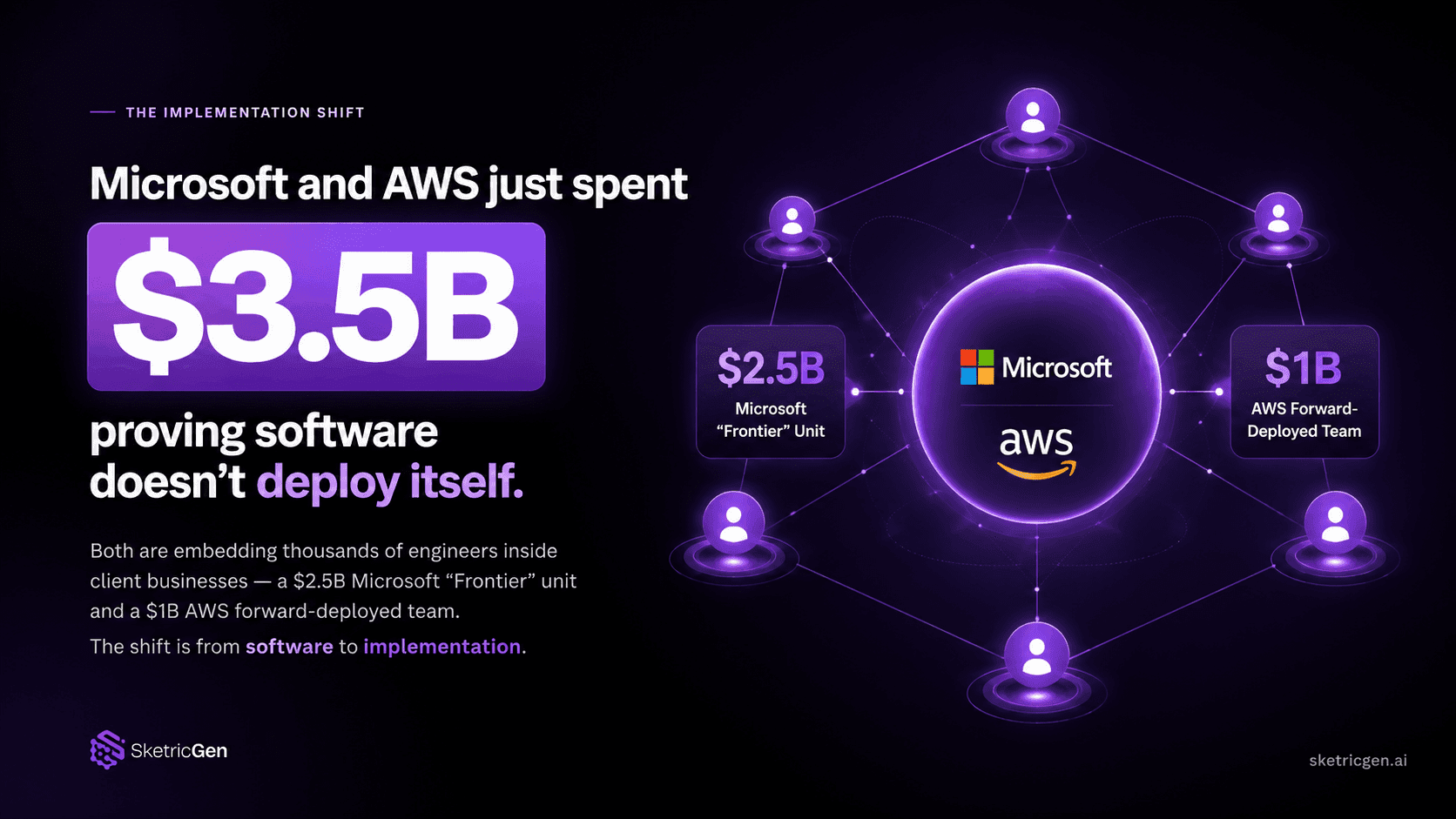
Microsoft and AWS Just Spent $3.5B Proving Software Doesn't Deploy Itself
ai agent news
Microsoft Scout: The AI Agent That Just Changed the Rules
ai agent news
n8n Just Ate Zapier's Lunch: 80% of Its New Mid-Market Customers Were Already Paying for Zapier
ai agent news