How to Build an AI Marketing Agent (End to End)
AI marketing agents get talked about a lot and shown rarely. This post fixes that.
An AI marketing agent is a workflow, not a chatbot: give it a goal, connect it to your marketing channels, and it works through the job on its own, drafting posts, replying to DMs, and following up with leads, while you supervise the parts that need judgment.
That's the definition. The rest of this post builds one, live, starting from nothing but a URL.
A Reddit thread asking whether marketing agents actually work put it plainly: "it feels like 80% hype, but I'm sure some people are figuring it out." Fair. This post is about the other 20%.
By the end, you'll have a working AI marketing agent connected to real channels instead of another definition to file away.
Key Points
- Ask any Founder, Building a product is easy now. Marketing it to the right audience is still the hardest part, especially for small businesses and startups without a dedicated marketer.
- An AI marketing agent is a goal-driven workflow, not a static chatbot or a marketing automation tool.
- Explore SketricGen's marketing agents, or start a build from a single URL. SketricGen reads the site and uses it as the agent's knowledge base.
- Agents connect to Instagram, WhatsApp, LinkedIn, and email, among other channels.
- Build time for a working agent is measured in hours, not months.
- The biggest mistake is treating the agent as fully autonomous instead of giving it one clear job first.
Why Small Businesses and Startups Need an AI Marketing Agent
With smartest AI agents and engineers that vibe code as easily as one breathes, building a product has never been easier. Marketing it to the right audience however, still hasn't been cracked. Or, maybe, it wasn't until now.
Most founders easily ship a working product in a weekend now, thanks to no-code tools and AI copilots. Getting that product in front of the right people, consistently, without a dedicated marketing agency or in-house team, is the actual bottleneck.
This is where a team of AI marketing agents come in, especially for SMBs & start-ups:
- No marketing hire needed to keep a consistent posting and outreach cadence.
- No agency retainer just to test messaging across channels.
- No missed leads while the founder is heads-down building the product.
For a two-person startup or a small business owner running their own marketing, this isn't a nice-to-have automation layer. It's the difference between being invisible and being found.
That's the honest reason to build one: not to replace marketing, but to make marketing possible at all when there's no dedicated marketer on staff.

What Is an AI Marketing Agent, Actually?
Most default definitions floating around, including what a lot of AI chat tools return by default, describe an "AI marketing agent" as an older machine learning pipeline: a model scoring leads or predicting churn quietly in the background.
That's not what the term means anymore.
An AI marketing agent today is an agentic workflow. It has a goal, such as "grow LinkedIn engagement" or "answer WhatsApp inquiries" or "follow up on new leads." It has access to your marketing channels. And it takes multi-step action toward that goal without a human clicking send on every message.
That shift, from your basic trigger-based static automation to agentic ai in marketing, is why build activity is accelerating faster than the term's older definition would suggest.
An AI marketing agent is not just a chatbot with a marketing skin, and it's not a lead-scoring model running quietly in the background. It's a goal-driven, planning oriented worker that plans, acts, and reports back. Set it up once and see the magic unravel.
AI Marketing Agent vs. Chatbot vs. Marketing Automation Tool

| What it does | Who runs it | How it starts | |
|---|---|---|---|
| AI marketing agent | Plans and executes multi-step marketing work: drafting, replying, following up, reporting | Runs mostly on its own toward a stated goal, with a human reviewing judgment calls | A URL, a goal, and a set of connected channels |
| Chatbot | Answers one question at a time, inside one conversation | Reactive, waits for a message | A script or a knowledge base |
| Marketing automation tool | Triggers pre-built sequences, such as email drips or ad rules | Runs a fixed workflow someone else designed | A rule: if this happens, do that |
How to Build an AI Marketing Agent, Step by Step

This is the part nobody ranking for "ai marketing agents" actually shows. Here's the build, in the order it happens.
Step 1: Start from a URL. Point SketricGen's no-code AI agent builder at your website. It reads the site, pulls your offer, tone, and key pages, and uses that as the agent's starting knowledge base. No developer and no data upload are required to begin.
Step 2: Give it one job. Pick a single, specific goal: reply to Instagram DMs about pricing, turn new leads into a first outreach message, or post three times a week on LinkedIn. One narrow job beats five vague ones. This mirrors a build pattern practitioners already describe: give the agent knowledge, write a clear instruction, then let it run before adding more.
Pro tip: build the narrowest version of the agent first. Add channels and jobs once the first one is working, not before.
Step 3: Connect the channel that job lives on. This is where the agent stops being a document and starts doing marketing work. Covered in full detail next.
Step 4: Test it, then publish. Run it against a handful of real messages or a real content brief before turning it loose. Watch what it drafts, correct the tone once or twice, and publish.
One marketer summed up the shift plainly in a post on no-code agent building for marketing teams: "Build time: hours, not months." That tracks with what a URL-first, no-code build actually looks like in practice.
Marketing Agents to Build today
You don't have to build a marketing agent from a blank page. SketricGen already has working templates for the jobs marketers ask about most, already built and waiting for a job.
| Template | What it does |
|---|---|
| LinkedIn Post Generator | Drafts and schedules on-brand LinkedIn posts, so your feed doesn't go quiet. |
| Instagram DM automation | Replies to DMs and comments, qualifies interest, and hands off real conversations to you. |
| WhatsApp AI agent | Answers inbound questions, sends follow-ups, and confirms bookings without you at the keyboard. |
| Web Lead Extractor | Pulls and enriches new leads straight from your website traffic. |
| Website Lead Capture | Turns anonymous visitors into a follow-up-ready list. |
| SEO Content Brief Generator | Researches and briefs blog topics before you write a word. |
| SEO-Optimized Blog Generator | Drafts full SEO-ready blog posts from that brief. |
Each one plugs into the agent you build in the steps above, or works as a standalone starting point if you'd rather launch one job first and expand later.
Which Marketing Channels an AI Agent Can Actually Connect To

An AI marketing agent is only as useful as the channels it's plugged into. Here's what's realistic today.
| Channel | What the agent can do there | Template to start from |
|---|---|---|
| Reply to DMs and comments, qualify interest, hand off to a human for pricing or complaints | Instagram DM automation | |
| Answer inbound questions, send follow-ups, confirm bookings | WhatsApp AI agent | |
| Draft and schedule posts, keep a content cadence without a writer on standby | LinkedIn Post Generator | |
| Email and leads | Capture a new lead, enrich what's known about them, send the first outreach message | Web Lead Extractor, Website Lead Capture |
Connect one channel per job. An agent handling Instagram DMs doesn't need LinkedIn access, and giving it access anyway just adds surface area for mistakes.
Common Mistakes That Stall an AI Marketing Agent Build
Mistake 1: Treating it as fully autonomous. One AI agent builder described talking a client out of an agent entirely and pointing them at a simpler no-code website builder instead, because their task was deterministic and repeatable, not the kind of unpredictable, judgment-heavy work an agent is worth the cost for. Agents earn their keep on ambiguous, multi-step work. For a fixed, repeatable task, a simpler tool is often the right call.
Mistake to avoid: don't hand the agent brand-risk decisions, such as pricing exceptions or complaint handling, on day one. Let it draft, and you approve, until it's earned trust on the easy calls.
Mistake 2: Skipping the single clear job. "Automate my marketing" is not a job. "Reply to WhatsApp pricing questions within five minutes" is a job. The narrower the first job, the faster the agent starts pulling its weight.
Mistake 3: Never testing before publishing. A few test messages catch tone problems before a real customer does.
What Practitioners Are Saying
Real outcomes are more convincing than vendor claims, so here's one.
A founder who replaced their marketing process with four coordinated AI agents reported roughly 2.6x website traffic and about a 40% lift in signups over 14 days, at $0 in additional ad spend, running agents across content, outbound, and community-response work.
That's not universal, and results vary by starting point and effort. But it lines up with the broader cost logic other builders point to: one Reddit post estimated that a five-person in-house marketing team runs $18,000 to $28,500 a month in salary alone. That's the number most "is this worth it" questions are really asking about.
Author's Take - Sam
Here's the thing that surprised me building these: the hard part was never the technology. It was picking one job narrow enough to trust the agent with on day one.
Every ranking page for this term stops at "here's what an AI marketing agent is." That's not wrong, it's just incomplete. The build is where the real questions live: which channel first, how much autonomy, what happens when it gets something wrong. Those are the questions this post tried to answer instead of skip.
If you're still deciding whether to build one, start with the smallest possible version. A single channel, a single job, a week of watching what it drafts. That's a more honest test than any comparison table.
Next Steps
You don't need a roadmap to start. You need a URL and one job.
Head to SketricGen's marketing agents to see the full lineup, or jump straight into the no-code AI agent builder and point it at your site.
If you want the fuller build walkthrough first, read our complete guide to building a no-code AI agent or our full breakdown of agentic AI. And if you're not sure an agent is even the right word for what you're picturing, what an AI workflow builder actually is is a good place to check first.
FAQs
A goal-driven workflow that plans and executes marketing tasks, such as replying to messages, drafting posts, and following up on leads, across your connected channels, instead of waiting for a single command like a chatbot does.
A chatbot answers one message at a time. A marketing automation tool runs a fixed, pre-built sequence. An AI marketing agent has a goal and takes multi-step action toward it, adjusting as it goes.
The best ones are scoped narrowly: one channel, one job, built from your own site's knowledge base. Broad, do-everything agents tend to underperform narrow ones with a clear goal.
With a no-code, URL-first builder, a working first version is realistically a matter of hours, not months, for a single-channel, single-job agent.
Instagram, WhatsApp, LinkedIn, and email are the most common, with lead-capture and enrichment tools feeding it new contacts to act on.
No. A no-code builder that starts from a URL and lets you set the agent's goal in plain language covers most marketing use cases without custom development.
Both are true at once. Skepticism is fair and common. Real, measurable outcomes exist too, but they come from narrow, well-scoped agents, not from "fully autonomous marketing" claims.
A five-person in-house marketing team commonly runs $18,000 to $28,500 a month in salary alone. An AI marketing agent handling a narrow slice of that work costs a fraction of that, though it's not a full replacement for strategy and judgment.
Related blogs
View more
SEO Automation: The No-Code Build, Start to Finish
tutorials
No-Code Automation Platforms for Marketing Teams: Grow Business without Employees
tutorials
AI LinkedIn Post Generator: How to Research, Write & Publish Posts on Autopilot (2026)
tutorials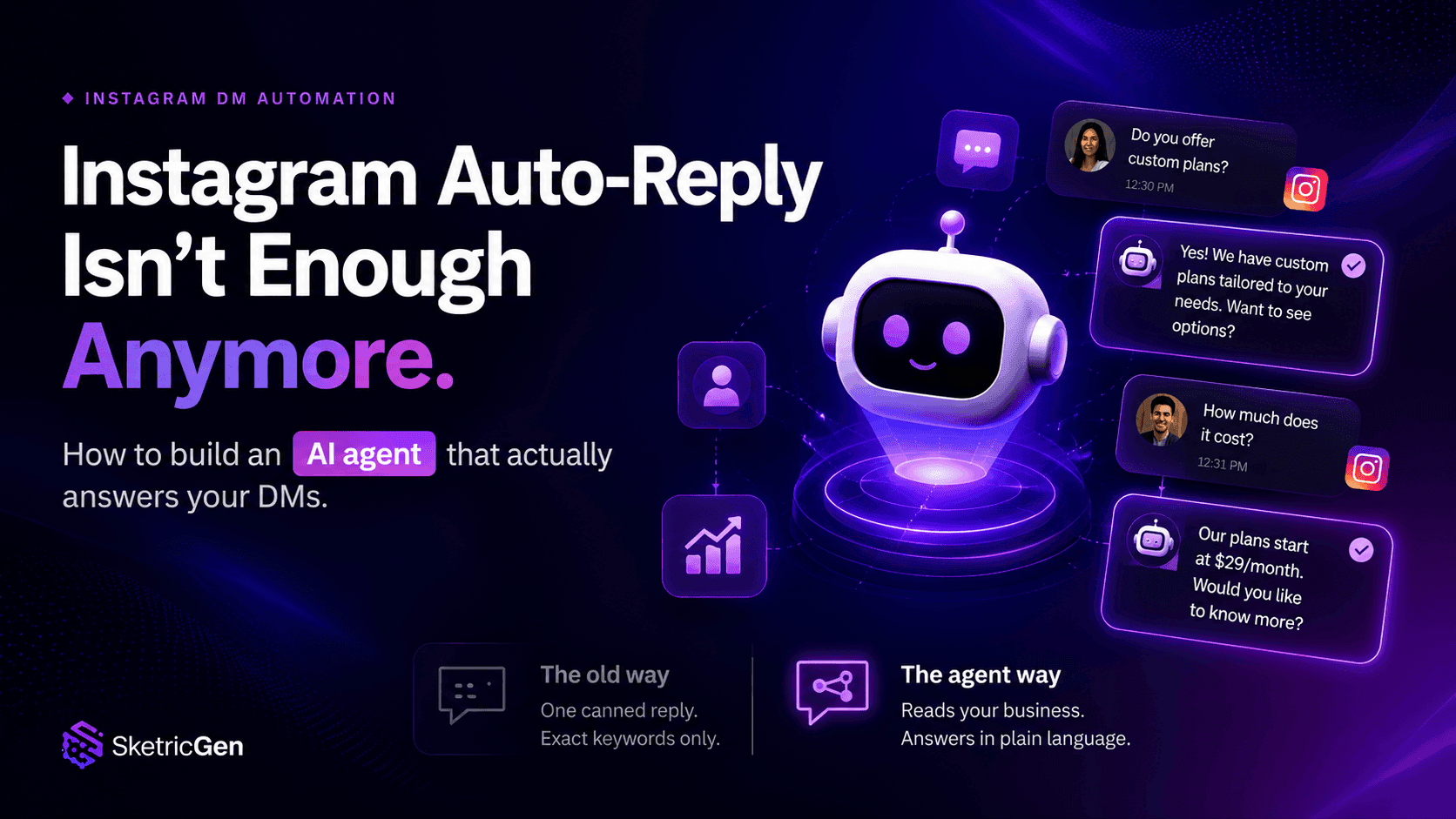
Instagram Auto-Reply: How to Build an AI Agent That Actually Answers Your DMs
tutorials