What Is an AI Workflow Builder? How to Choose the Right One in 2026
At SketricGen, we've built and stress-tested AI workflows across customer operations, lead generation, and content pipelines — here's what actually matters when you're choosing.
Who This Is For
- Founders and ops leads evaluating AI automation tools for the first time
- Teams who've outgrown basic Zapier setups and need more capability
- Anyone confused about the difference between workflow builders, chatbot platforms, and automation tools
Key Points
- An AI workflow builder automates multi-step business processes using AI logic — not just simple if-then triggers
- It's different from a chatbot builder (one conversation, one response) and from basic automation (no decision-making)
- The right choice depends on three things: your team's technical level, how many apps you need to connect, and whether you need AI agents that can make decisions
- Free tiers almost always cap out exactly where your real business workflows start getting interesting
- Most teams are either overbuilding on n8n or overpaying on Zapier — a middle path exists
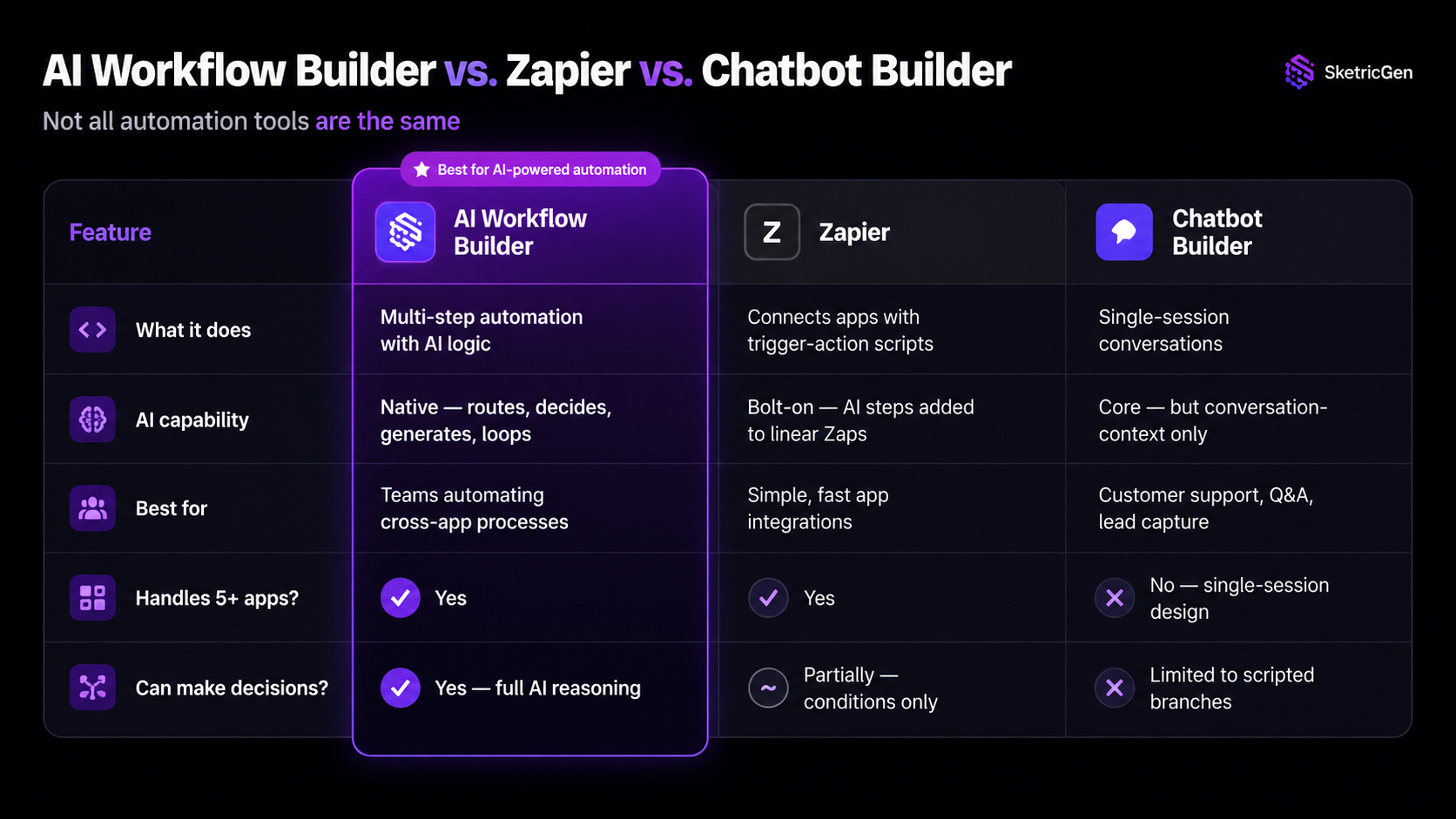
At a Glance: AI Workflow Builder vs. Zapier vs. Chatbot Builder
| AI Workflow Builder | Zapier | Chatbot Builder | |
|---|---|---|---|
| What it does | Automates multi-step processes across apps using AI logic | Connects apps with event-based triggers and fixed actions | Handles single-session conversations; one input, one output |
| AI capability | Native — routes, decides, generates, and loops | Bolt-on — AI steps added to linear zaps | Core — but limited to conversational context only |
| Best for | Cross-app workflows with decision logic | Fast, simple app integrations | Customer support, Q&A, lead capture chat |
| Technical bar | Low to medium (no-code options exist) | Low (no-code) | Low (templates available) |
| Handles 5+ apps? | Yes | Yes | No — single-session design |
| Can make decisions? | Yes | Partially (conditions, but no AI reasoning) | Limited to scripted branches |
What Is an AI Workflow Builder?
An AI workflow builder is a platform that lets you design, automate, and run multi-step business processes using artificial intelligence — without writing code. You describe what needs to happen across your tools, and the builder creates and executes the automation for you.
A standard trigger-action tool runs a fixed script: when X happens, do Y. An AI workflow builder goes further. It can evaluate conditions, make decisions, generate content, call APIs, and hand off tasks between tools — all in a single automated run.
According to a Harvard Business Review report cited by Slack, nearly two-thirds of organizations now consider AI adoption a key strategic priority, with workflow automation ranked among the top implementation areas.
The gap is real. Teams still running manual handoffs across their CRM, inbox, and project tools are a step behind teams that automated those handoffs a year ago.
How It's Different from Traditional Automation and Chatbot Builders
These three categories get mixed up constantly — and vendors make it worse. A chatbot platform adds "automation" features. An automation platform adds a chatbot node. The result is a market where everything claims to do everything and nothing is clearly labeled.
The practical difference is this:
- Traditional automation (early Zapier, IFTTT) follows a fixed script. When a form is submitted, send an email. No judgment required.
- AI workflow automation adds a model in the loop. The workflow reads the form submission, classifies the lead type, generates a personalized response, routes it to the right team member, and logs the outcome. One automated run.
- Chatbot builders (Intercom, Tidio, basic bot tools) create conversational interfaces for single sessions. They're great at answering questions and capturing contact details. They're not designed to orchestrate processes across six different apps.
"The real question isn't which tool has the most integrations. It's whether the tool can handle the logic your actual process requires." — community member in the r/nocode AI workflow builder recommendations thread
The confusion usually disappears as soon as you sketch out your actual workflow. Multiple apps, branching conditions, steps that require reading and interpreting content — that's an AI workflow builder. A single conversation window — that's a chatbot.
How AI Workflow Automation Works
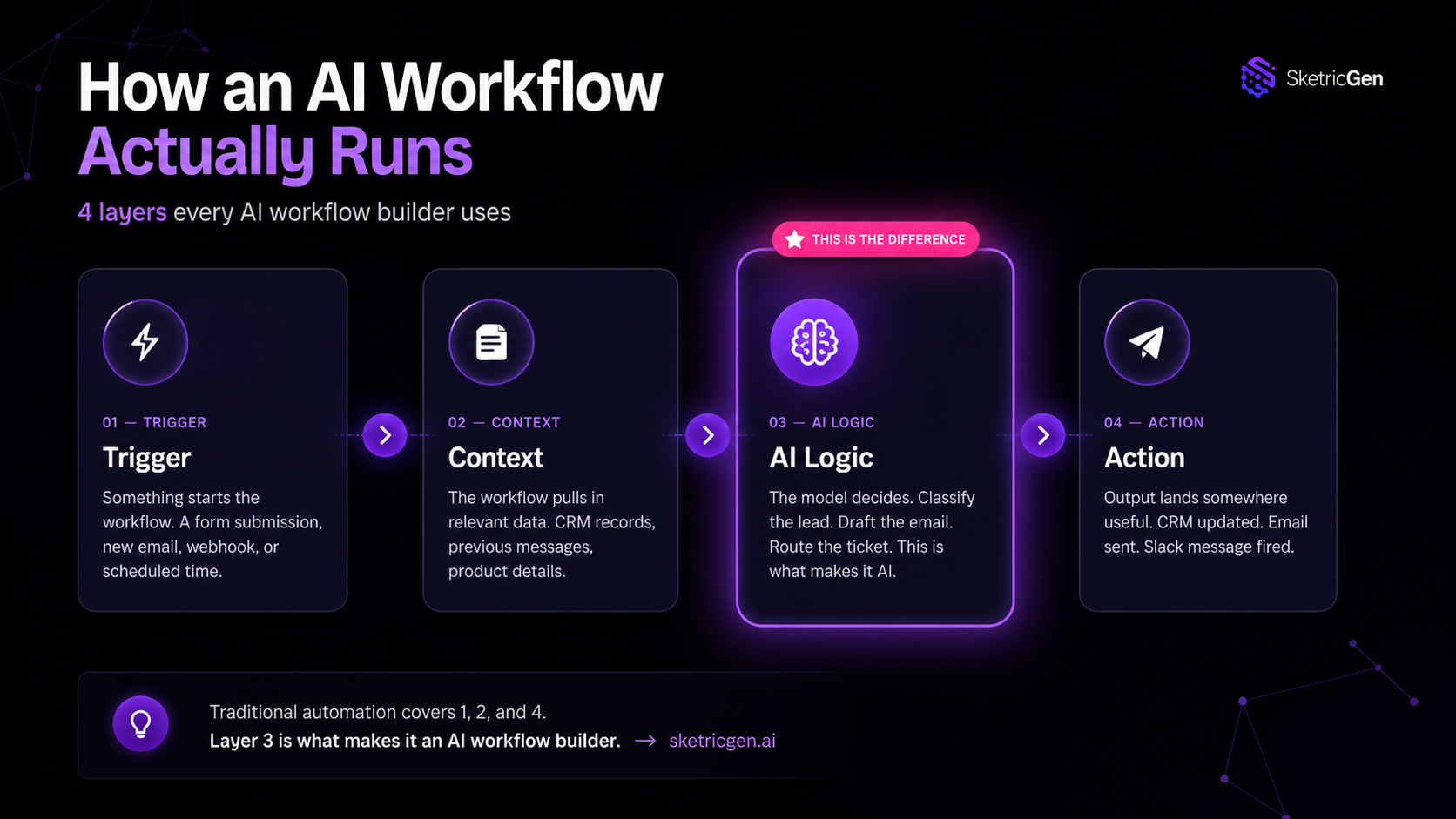
Every AI workflow runs on four layers. Get these right and tool selection becomes a lot more straightforward.
1. Trigger Something starts the workflow. A form submission, a new email, a scheduled time, a webhook from an external app, or a user action inside your product.
2. Context The workflow pulls in relevant data. Customer records from your CRM, previous messages, product inventory, or anything else the next step needs.
3. AI logic This is what separates AI workflow builders from traditional automation. An LLM or model makes a decision: classify this lead, generate this email draft, extract these fields from this document, route this ticket to the right team. Without this layer, you just have an app connector.
4. Action The output lands somewhere useful: a CRM is updated, a Slack message is sent, an email goes out, a row is logged in a spreadsheet, an API call fires.
Traditional automation handles layers 1, 2, and 4 just fine. Layer 3 is what makes something an AI workflow builder rather than a fancy app connector.
Decision rule: If you can describe every step of your workflow as "when X, then Y" with no judgment required — standard automation is fine. If any step requires reading, understanding, classifying, or deciding based on content — you need an AI workflow builder.
Key Features That Separate Good Tools from Great Ones
Not all AI workflow builders deliver equally once you get past the demo. When we built SketricGen, these seven capabilities drove every product decision — and they're the right criteria for evaluating any tool:
- Native LLM integration — Can the tool call a model (GPT-4o, Claude, Gemini, local) directly? Or do you need a third-party node and a workaround?
- Multi-step logic with conditions — Can the workflow branch? If the lead is high-value, route to sales. If it's low-value, route to a drip sequence.
- Error handling — What happens when one step fails? Does the workflow crash silently, retry, or alert you?
- App connectivity — Native integrations plus HTTP/API support for everything else. Check the specific apps you need before assuming.
- Looping and iteration — Can it process a list of 200 contacts in a single run, or does it only fire once per trigger?
- Human-in-the-loop checkpoints — Can the workflow pause, surface a decision to a team member, and resume after approval?
- Observability — Can you see exactly what ran, what data passed between steps, and where it failed? This is underrated until your first production incident.
Most platforms cover 3 or 4 of these in their free tier. The missing ones show up once you're processing real volume or connecting more than 4 apps — usually at the worst possible time.
How to Choose the Right AI Workflow Builder
Skip the comparison articles for a minute. Three questions will cut through the noise faster.
Question 1: How technical is your team?
Be honest here. "Technical" means someone who's comfortable reading JSON, debugging API calls, and understanding data mapping — not just someone who uses computers.
- Non-technical team → prioritize drag-and-drop UI, pre-built templates, and responsive support
- Technical team → you have access to n8n, Pipedream, and similar tools that give far more power per dollar but require real configuration
Question 2: How many apps do you need to connect?
| App count | Likely right tool |
|---|---|
| 2–5 apps, standard SaaS | Zapier or similar handles this cleanly |
| 6–15 apps with custom logic | Make or n8n |
| Internal tools + external APIs + AI models | Purpose-built AI workflow platform |
| Need to connect your own product/database | Look for HTTP/webhook support and custom code nodes |
Question 3: Do you need AI agents or just automation?
This is the defining question in 2026. Traditional automation follows a fixed path every time. AI agents can decide, reroute, and adapt based on what they encounter mid-run.
If your workflow requires judgment — reading a message and deciding how to respond, classifying a document, or selecting a next action based on content — you need agent capability, not just trigger-action logic.
Decision rule: Sketch your workflow as a flowchart. Every diamond (decision point) is a place where you'd normally ask a person to use judgment. Those are the spots that need AI logic. If your flowchart has no diamonds — basic automation is the right choice.
Zapier vs. Make vs. n8n vs. AI-Native Platforms
This is the question that comes up in almost every r/nocode thread. Here's the honest breakdown:
| Zapier | Make | n8n | AI-native (e.g. SketricGen) | |
|---|---|---|---|---|
| Best for | Non-technical teams, fast setup | Visual multi-step logic, SMBs | Developer control, self-hosting | Agentic automation for operators |
| Pricing model | Per task (pricing) | Per operation (pricing) | Per execution / free self-hosted (pricing) | See SketricGen pricing |
| AI capability | Bolt-on (AI steps in Zaps) | Bolt-on (AI modules) | Native (LangChain, 70+ AI nodes) | Native (agent-first) |
| Learning curve | Low | Medium | High | Low |
| Scales without breaking | Medium | Medium-High | High | High |
| Free tier | Yes (100 tasks/mo) | Yes (1,000 ops/mo) | Yes (self-hosted) | Yes |
Zapier is the fastest way to start. It's also the fastest way to run up a bill. Once you're processing real volume — leads, tickets, orders — the per-task pricing compounds quickly.
Make offers better value at volume and a more visual canvas, but the learning curve is real. Most small business owners who start with Make spend the first week confused by the module/scenario structure.
n8n is genuinely powerful. It supports LangChain natively, has 70+ AI-specific nodes since n8n 2.0, and is free to self-host. But the honest assessment from the n8n community itself: it's a developer tool. If your team doesn't have someone who thinks in API calls and data mapping, n8n's power stays locked behind a configuration wall.
For teams who want AI-native automation without engineering overhead, the alternatives to each of these are worth evaluating: the best Zapier alternatives for AI automation, the best Make alternatives for workflow automation, and the best n8n alternatives for no-code AI agent building.
Two Failure Modes Nobody Warns You About
Tool reviews don't cover these. They show up after teams have been running on a platform for a few weeks.
Failure mode 1: Starting with the wrong scope
Most teams try to automate everything at once. They pick a powerful platform, spend two weeks building an elaborate multi-step workflow, and end up with something that breaks every time the CRM adds a new field. The workflow is too brittle to maintain and too complex to debug.
The fix: start with one high-volume, low-risk process. A single repetitive task your team does 20+ times a week. Get that working reliably. Then expand.
Failure mode 2: Confusing "no-code" with "easy"
"No-code" means you don't write syntax. It does not mean zero learning curve. Every workflow builder requires you to understand triggers, conditions, data mapping, and loop logic — even if you never touch a terminal.
The better question isn't "is it no-code?" — it's "is the complexity proportional to what I'm trying to build?" A five-person team automating lead follow-up doesn't need to learn n8n's node architecture. They need a tool that surfaces the right options without requiring them to understand the plumbing.
What Practitioners Are Saying
The r/nocode AI workflow builder recommendations thread ran to 70 comments and kept surfacing the same point: the platform matters less than the process clarity you bring to it. Several practitioners said the same thing in different words — every workflow they built without a documented process first had to be rebuilt within a month.
That tracks with what we see at SketricGen. The teams that get the most from AI workflow automation aren't the ones who picked the most sophisticated tool — they're the ones who knew exactly what process they were automating before they opened the builder.
Teams aren't just layering automation on top of old processes anymore. The ones moving fastest are redesigning the process with AI built in from step one — here's why that shift is happening now.
Author Take - Sam
I've watched teams burn two months on the wrong platform. Usually because they chose based on what had the most YouTube tutorials. n8n has excellent content, so everyone starts there. But n8n is a developer tool. If your team doesn't have someone who thinks in JSON and API calls, you'll spend more time debugging the builder than building your business.
My actual advice: pick the simplest tool that handles your most complex workflow at your current scale. Not your imagined future scale — the scale you have right now. A working automation today beats a perfect architecture you never finish.
If you want AI-native automation that doesn't require an engineering hire, SketricGen's no-code AI agent builder is built specifically for operators. The agent handles the AI logic; you focus on the process.
Next Steps
The right AI workflow builder isn't the one with the most integrations or the best YouTube channel. It's the one your team actually ships something on.
A few things worth doing before you pick:
- Document the process first. Write out every step on paper. Mark every decision point. That document is your specification before you open any tool.
- Start with one workflow. Pick the most repetitive, high-volume process your team runs manually today. Automate that. Expand once it's stable.
- Test the free tier on your actual workflow — not the demo. If the free tier breaks on your real use case, you've learned something before spending money.
- Explore SketricGen's no-code AI agent builder if you want agent-capable automation without engineering overhead.
- Compare your current tools honestly:
FAQs
An AI workflow builder is a platform that automates multi-step business processes using AI logic. It works by connecting a trigger — an event that starts the run — to a series of steps, with AI handling any part that requires classification, content generation, routing, or decision-making. You configure it visually or by describing the process in plain language; the platform executes it automatically every time the trigger fires.
A chatbot builder creates a conversational interface for a single session: one input, one output. An AI workflow builder automates processes across multiple apps and steps. A chatbot answers a question. A workflow builder can read that question, look up the customer in your CRM, classify the issue type, draft a response, send it, update a ticket, and log the outcome — automatically, without human involvement. Both have value; they solve different problems.
Look for platforms built with operators in mind rather than developers. Key signals: drag-and-drop interface, pre-built templates for common workflows, clear error messages without requiring you to read logs, and built-in AI capabilities rather than requiring separate integrations. Zapier handles simple linear flows well. For anything involving AI decision-making or more than 5 apps, look for platforms that are AI-native from the ground up rather than platforms that bolted AI onto an existing trigger-action engine.
Zapier is a trigger-action platform: when X happens, do Y. It's fast, reliable, and excellent for simple flows with a low app count. An AI workflow builder adds a reasoning layer: the workflow can read, classify, and act differently based on what it encounters. Zapier has added AI steps to its platform, but it's designed as a linear tool. AI workflow builders support loops, conditional branching, and agentic behavior — where the automation can decide what to do next, not just execute a fixed sequence. For a detailed breakdown, see the Zapier alternatives for AI automation guide.
Yes — most platforms have usable free tiers. Zapier's covers 100 tasks per month; Make's covers 1,000 operations; n8n is free if you self-host. The catch is consistent: free tiers almost always cap out exactly where your actual business workflows start to get interesting. Build on the free tier to validate the workflow logic. Budget for a paid plan before you scale, and account for the operational cost of managing the tool, not just the subscription.
Traditional workflow automation follows a fixed script — if A happens, do B. AI workflow automation puts a model in the loop that can classify, generate, extract, and decide. In practice: a traditional workflow sends a templated email when a form is submitted. An AI workflow reads the form submission, determines the lead category, writes a personalized outreach based on the context, selects the right sender and sequence, and routes it — all from a single trigger. The output quality and the range of tasks it can handle are fundamentally different.
Mostly. "No-code" means you don't write programming syntax. It does not mean there's no logic to learn. Most no-code workflow tools still require you to understand triggers, conditions, data mapping, and how apps pass data between each other. The platforms that genuinely minimize that overhead are the ones built for operators from day one, not retrofitted from developer tools. When evaluating "no-code" claims, test the tool on your actual workflow — not a demo scenario — before committing.
Related blogs
View more
What Is an AI Marketing Agent? What It Automates, and What It Cannot
ai trends and research
AI-Proof Jobs in 2026: What the Data Actually Shows
ai trends and research
What Is AI Agent Orchestration? A Plain-English Guide (2026)
ai trends and research
87% of Small Businesses Use AI. Only 14% Have It Running Their Business.
ai trends and research